
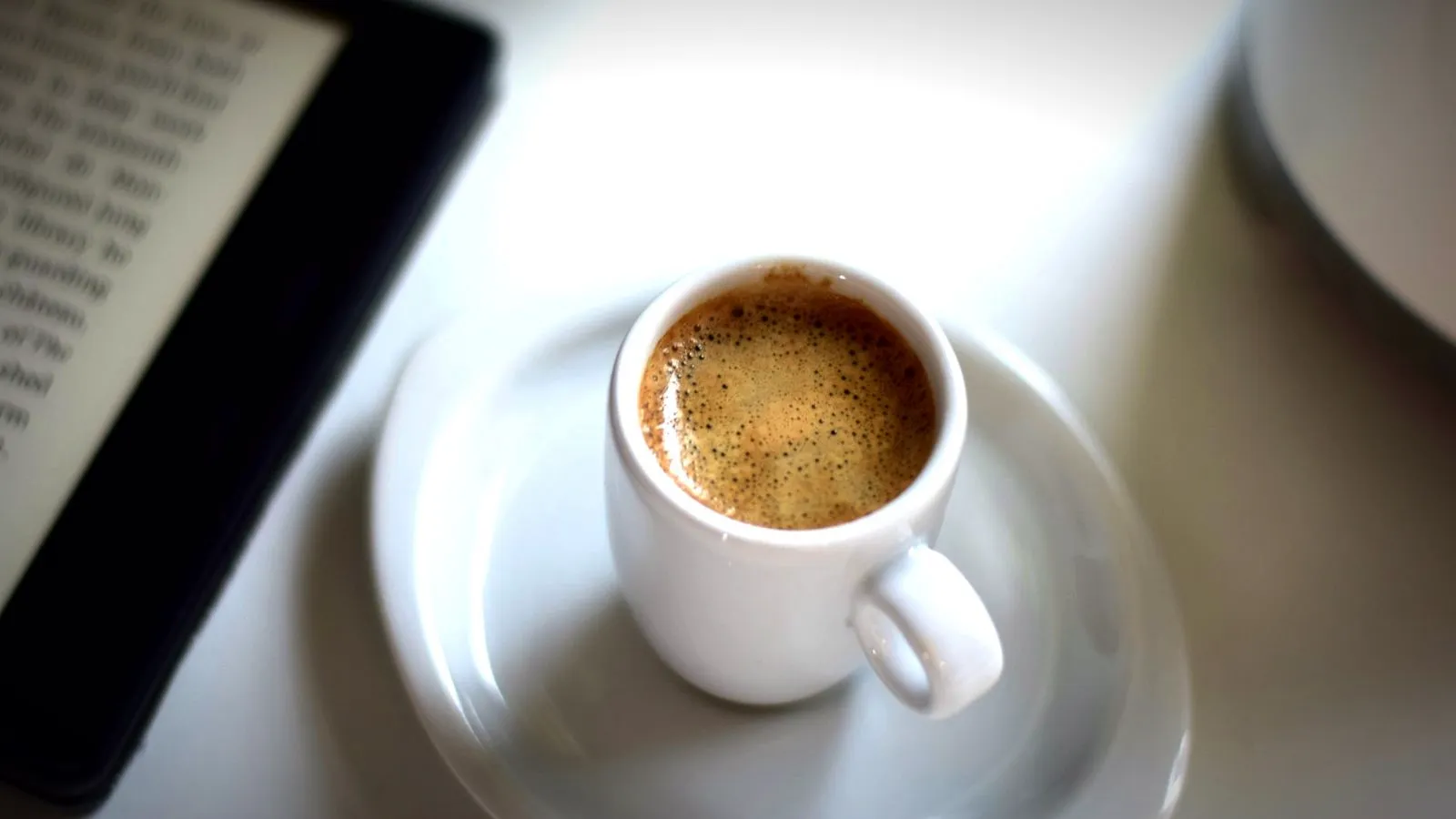
Espresso is a small, concentrated coffee made by forcing hot water through finely ground, tightly packed coffee at about 9 bar of pressure. A shot takes about 25–30 seconds and yields roughly 1 oz (30 ml) for a single or 2 oz (60 ml) for a double, topped with a golden-brown foam called crema.
Espresso is a brewing method, not a type of bean or roast, and it is the base of lattes, cappuccinos and Americanos. For step-by-step brewing, see how to make espresso; below are the definition, taste, caffeine, history and spelling.
The short answer
| Question | Answer |
|---|---|
| What is it? | Coffee brewed by forcing hot water through fine, packed grounds under pressure |
| Pressure | About 9 bar |
| Water temperature | About 90–96 °C (195–205 °F) |
| Time | About 25–30 seconds |
| Typical double | About 18 g of coffee in, 36 g of espresso out |
| Serving | About 1 oz single, 2 oz double |
| Caffeine | About 63 mg per single, 126 mg per double (USDA) |
| Origin | Italy; first machine patents in Turin (1884) and Milan (1901) |
| Spelling | Espresso, with an s, not “expresso” |
Espresso definition: the official standards
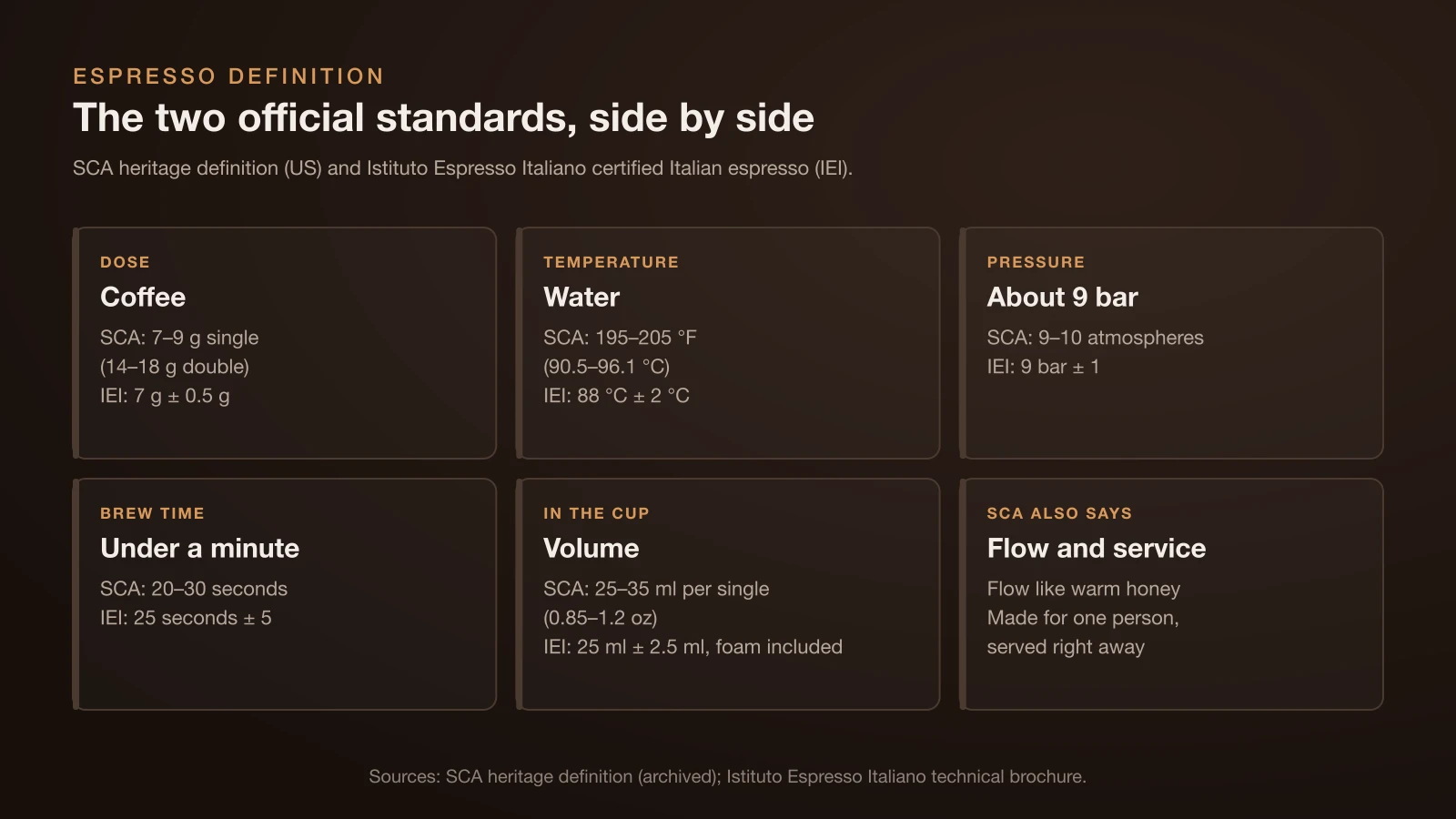
Espresso has two widely cited definitions, from the Specialty Coffee Association (SCA) in the US and the Istituto Espresso Italiano (IEI) in Italy. Both describe a short drink brewed under about 9 bar of pressure in well under a minute, and they differ mainly on dose and temperature.
| Parameter | SCA heritage definition | IEI certified Italian espresso |
|---|---|---|
| Coffee dose | 7–9 g single (14–18 g double) | 7 g ± 0.5 g |
| Water temperature | 195–205 °F (90.5–96.1 °C) | 88 °C ± 2 °C (about 187–194 °F) |
| Pressure | 9–10 atmospheres | 9 bar ± 1 |
| Brew time | 20–30 seconds | 25 seconds ± 5 |
| Volume in the cup | 25–35 ml (0.85–1.2 oz) per single | 25 ml ± 2.5 ml, foam included |
The SCA adds that the flow should look like warm honey and that the shot should be made for one person and served right away. Modern cafés lean toward larger doses: in an SCA-published survey of baristas, the average shot used 18–20 g of coffee, yielded about 36.5 g and ran 25–30 seconds at 9 bar. Our guide to espresso brew temperature explains why the two temperature standards differ.
How espresso is made
Espresso is made by locking finely ground, tamped coffee into a portafilter and pushing hot water through it at about 9 bar. Most home and café machines use an electric pump; manual lever machines, sometimes called espresso presses, use the force of a lever instead.
The grind is the main control. It has to be fine enough that the packed coffee resists the pressure and the shot takes about 25–30 seconds. A common starting recipe for a double is 18 g of coffee in and about 36 g of espresso out, a 1:2 ratio.
- Pump machines: from compact home models to multi-group café machines.
- Lever machines: a hand-pulled piston builds the pressure; see manual espresso machines.
- Capsule (pod) machines: pre-portioned coffee in a sealed capsule, brewed at the press of a button.
Moka pots and other stovetop “espresso makers” brew at far lower pressure, so they make strong coffee rather than espresso.
What does espresso taste like?
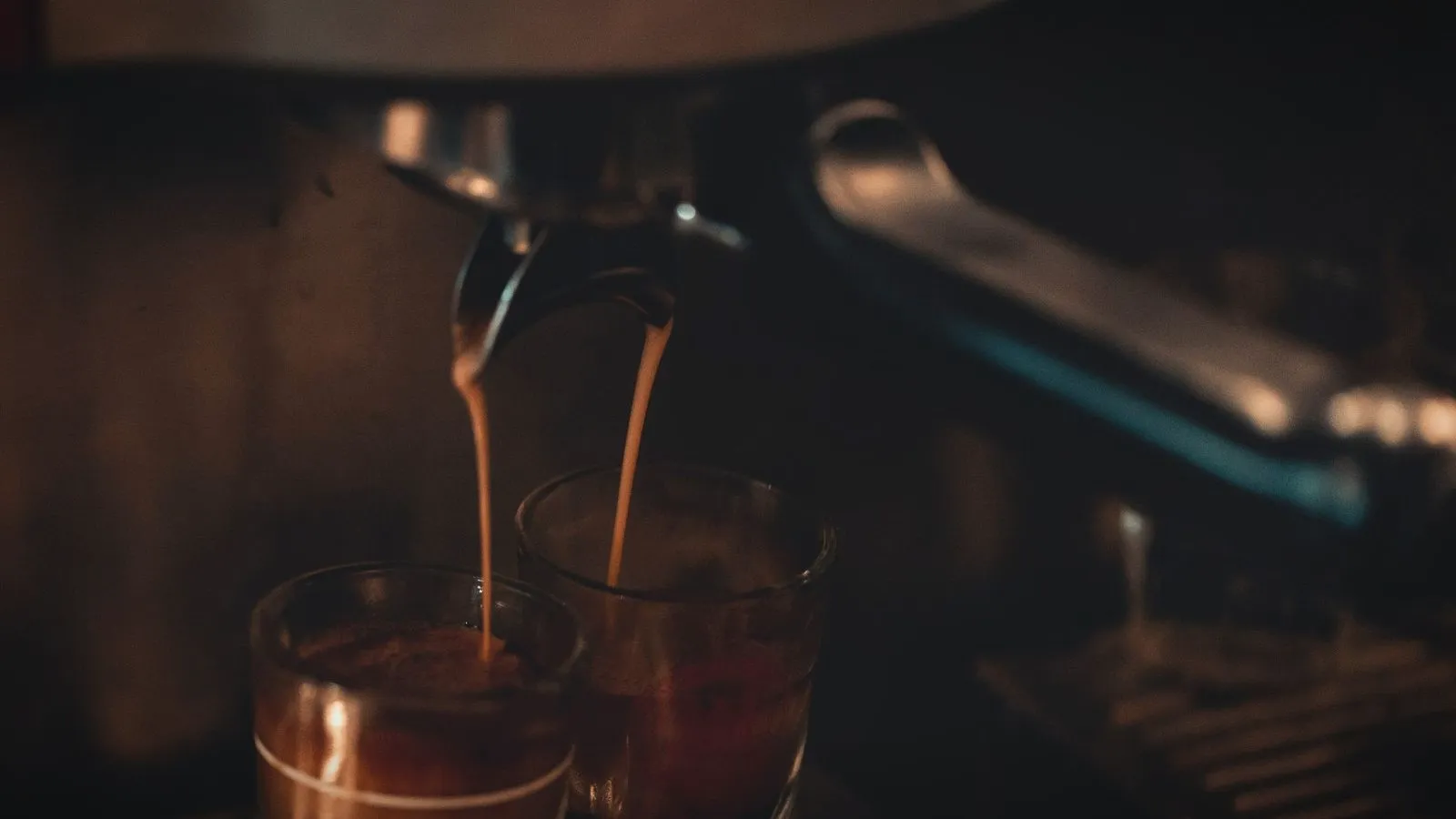
Espresso tastes intense, rich and slightly bittersweet, with a thick, almost syrupy body. The IEI describes a good certified espresso as round, substantial and velvety, with sour and bitter tastes in balance so that neither one takes over, and little or no astringency.
Its aroma is strong and long-lasting. The IEI lists notes of flowers, fruit, toasted bread and chocolate, and says the flavor can linger for seconds or even minutes after swallowing. The roast and beans shift the profile: darker roasts lean toward chocolate and smoke, lighter roasts toward fruit and acidity.
Crema at a glance
Crema is the layer of fine foam that sits on top of a fresh shot. The SCA heritage definition calls for a thick, dark golden crema, while the IEI describes a hazel-brown to dark brown foam with tawny reflections and a very fine texture, free of large bubbles.
Crema needs pressure. Gaggia traces the “crema naturale” now expected on espresso to Achille Gaggia’s 1938 patent, which replaced steam with hot water under pressure.
Espresso next to a cup of drip coffee
Espresso and regular coffee can come from the same beans; the difference is how they are brewed. Espresso uses pressure, a fine grind and very little water, while drip coffee lets water flow through medium grounds by gravity over several minutes.
| Espresso | Drip coffee | |
|---|---|---|
| Brewing | Pressure, about 9 bar | Gravity, no added pressure |
| Grind | Fine | Medium |
| Time | 25–30 seconds | Several minutes |
| Serving | 1–2 oz | 8 oz or more |
| Caffeine per serving | About 63 mg single | About 95 mg per 8 oz |
| Texture | Thick, with crema | Light and clean |
Ounce for ounce, espresso has roughly five times the caffeine of drip coffee, but a mug of drip usually holds more in total. Our full comparison of espresso vs coffee covers taste, ratios and health.
Is espresso a type of bean or roast?
No, espresso is not a type of bean or a roast. The National Coffee Association (NCA) puts it plainly: espresso is a coffee drink named after the method used to brew it, so any fresh coffee can be brewed as espresso.
Bags labeled “espresso” are blends and roasts that the roaster thinks taste best under pressure, often medium-dark. Our guides to espresso beans and espresso roast explain what those labels mean and how roast level changes a shot.
What’s in a shot: caffeine and calories
A single 1 oz shot of espresso has about 63 mg of caffeine and a 2 oz double about 126 mg, based on USDA FoodData Central, which lists espresso at 212 mg per 100 g. The IEI’s certified Italian espresso is capped at under 100 mg per cup.
Real shots vary with the dose, the beans and the cup size, and a robusta blend carries more than pure arabica. A plain shot is almost calorie-free: USDA’s 9 kcal per 100 g works out to about 3 kcal per ounce. Our guide on caffeine in a shot of espresso compares café and home shots.
How to drink espresso
Drink espresso fresh, soon after it is pulled, because the SCA definition treats it as a drink made to order. It says espresso should be prepared for and served immediately to the person drinking it, and the IEI sets the temperature of the drink in the cup at 67 °C ± 3 °C (about 147–158 °F).
The serving habits below are common practice rather than formal rules:
- Use a small, warm cup. The IEI’s ideal espresso cup is white china, 50–100 ml, with a plain inside.
- Stir before sipping. A quick stir mixes the crema into the liquid underneath, so every sip tastes the same.
- Add sugar if you like. Many drinkers sweeten a straight shot; it softens bitterness without hiding flavor.
- Sip it in a few mouthfuls. A single is small and cools fast, so it is best finished while still warm.
- Have water on the side. A glass of water before the shot clears the palate.
When and where was espresso invented?
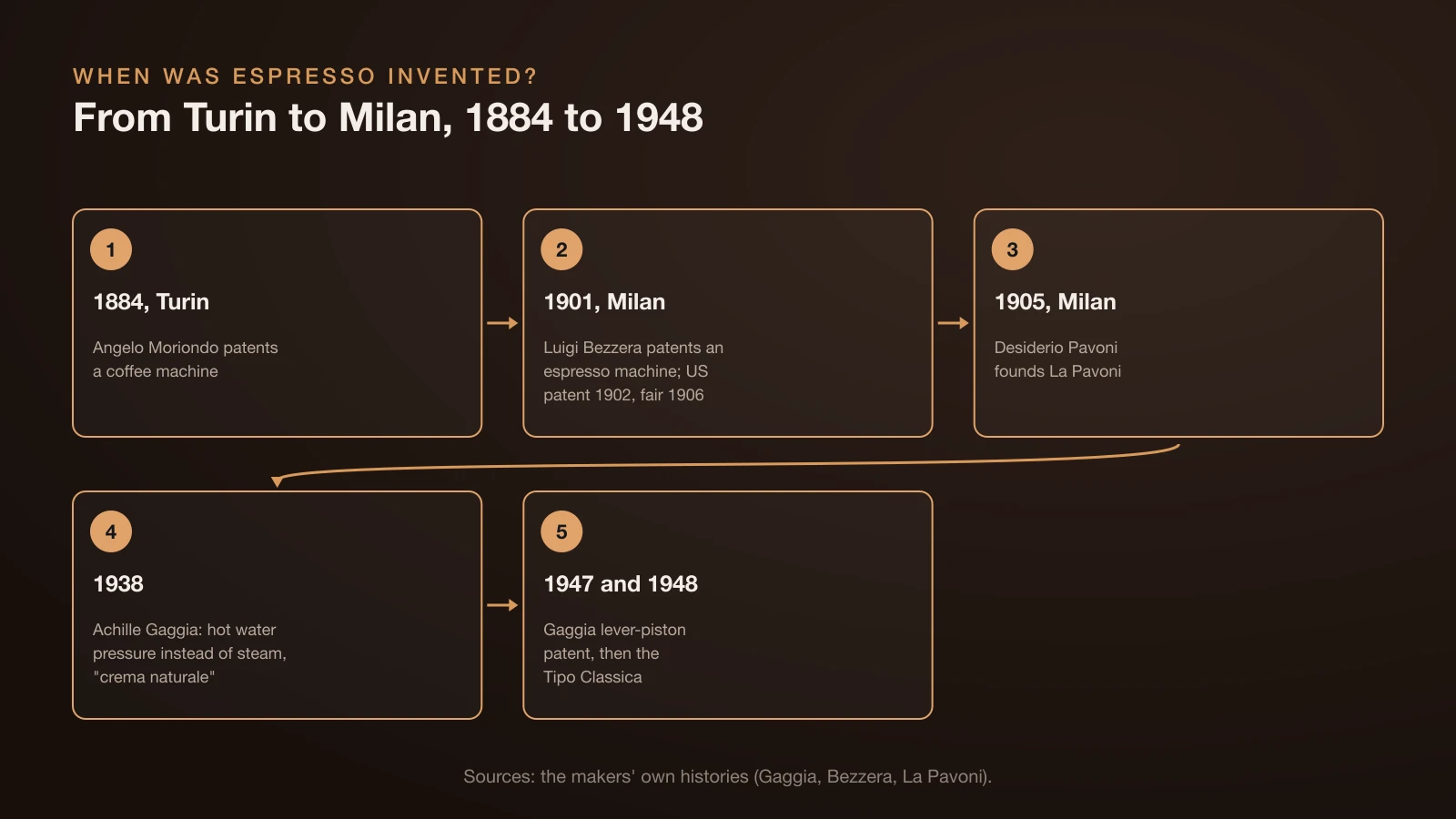
Espresso was invented in Italy between the 1880s and the 1940s, through a series of machine patents in Turin and Milan. The makers’ own histories date the key steps:
- 1884: Angelo Moriondo patents a coffee machine in Turin, which Gaggia’s history counts as the start of the espresso story.
- 1901: Luigi Bezzera of Milan patents an espresso machine; Bezzera cites the matching US patent 726,793 of 1902 and an exhibit at the 1906 Milan International Fair.
- 1905: Desiderio Pavoni founds La Pavoni in a Milan workshop; his filter holder leads to the Ideale machine.
- 1938: Achille Gaggia patents a system using hot water pressure instead of steam, producing what Gaggia calls “crema naturale.”
- 1947 and 1948: Gaggia patents a lever-piston mechanism and produces its first espresso machine, the Tipo Classica.
Early machines pushed water with steam. Gaggia’s switch to hot water under pressure, then to a lever-driven piston, is what produced crema and the shot most cafés still serve. Our guide to Italian espresso machines follows the makers that are still based in northern Italy.
How do you spell and pronounce espresso?
The correct spelling is espresso, with an s; “expresso” is a common misspelling. Oxford’s learner’s dictionaries list only espresso, with the plural espressos, and return no entry for “expresso.” The NCA also stresses that the second letter is s, not x.
In American English, Oxford gives the pronunciation as /ɛˈsprɛsoʊ/, close to eh-SPRESS-oh, with the stress on the middle syllable. The word comes from Italian caffè espresso, literally “pressed-out coffee,” which describes water pushed through the grounds. The link people make with “express” fits the speed of a shot, but it is not where the spelling comes from.
Drinks made with espresso
Most café coffee drinks start with one or two shots of espresso, changed by adding water, milk or foam. The main families:
- Straight: single, double, ristretto (shorter) and lungo (longer).
- With water: the Americano; see Americano vs espresso for how the two compare.
- With milk: macchiato, cortado, flat white, cappuccino and latte, from the least milk to the most.
- Sweet and iced: mocha, iced latte and espresso over ice.
For a quick espresso-style flavor without a machine, instant espresso works in many recipes; espresso powder vs instant coffee explains the difference. Our chart of types of espresso drinks lists the ratios for each.
The bottom line
Espresso is coffee brewed fast and under pressure: fine, packed grounds, water at about 90–96 °C and about 9 bar for 25–30 seconds, giving a 1–2 oz shot with crema. It is a method, not a bean, it was developed in Italy between 1884 and 1948, and it is spelled with an s.
Sources
- Specialty Coffee Association: Defining the ever-changing espresso (archived; heritage definition: 25–35 ml, 7–9 g, 195–205 °F, 9–10 atmospheres, 20–30 seconds, dark golden crema, served immediately; barista survey: 18–20 g, 36.5 g, 25–30 seconds, 9 bar)
- Istituto Espresso Italiano: Certified Italian Espresso (taste, aroma and crema description) and technical brochure (archived; 7 g, 88 °C, 9 bar, 25 seconds, 25 ml, 67 °C in the cup, under 100 mg caffeine, 50–100 ml cup)
- USDA FoodData Central: Coffee, brewed, espresso, restaurant-prepared (212 mg caffeine and 9 kcal per 100 g; 1 fl oz = 29.6 g) and Coffee, brewed (40 mg per 100 g; 8 fl oz = 237 g)
- Dictionaries and the NCA: Oxford Learner’s Dictionaries, espresso and word origin (pronunciation, plural, “pressed out”), and National Coffee Association, Espresso (a drink named for its brewing method; spelled with an s)
- Maker histories: Gaggia, history of coffee (Moriondo, 1884) and our history (1938, 1947, 1948, crema naturale); Bezzera (1901, US patent 726,793, 1906 fair); La Pavoni history (1905, Ideale)