The standard espresso brew temperature is 90–96 °C (195–205 °F), the range in the Specialty Coffee Association’s classic definition of espresso, and machines such as the Breville Dual Boiler default to 93 °C (200 °F). Go toward the top of the range for light roasts and toward the bottom for dark roasts, and keep the temperature stable from shot to shot.
Temperature is the third lever after grind and ratio: too cool and shots turn sour, too hot and they turn harsh. This guide compares the published standards, shows how temperature changes taste, explains how each type of machine controls heat and how to measure it. If a shot already tastes off, our guide to sour espresso covers under-extraction, and bitter espresso the opposite problem.
The short answer
| Question | Answer |
|---|---|
| Standard range | 90–96 °C (195–205 °F), SCA heritage definition |
| Common default | 93 °C (200 °F) |
| Italian standard (IEI) | 88 °C ± 2 °C water leaving the machine |
| Light roast | Toward the top of the range |
| Dark roast | Toward the bottom of the range |
| Too cool | Sour, thin, under-extracted |
| Too hot | Harsh, bitter, over-extracted |
| Most stable machines | Dual boiler with PID control |
What is the ideal espresso brew temperature?
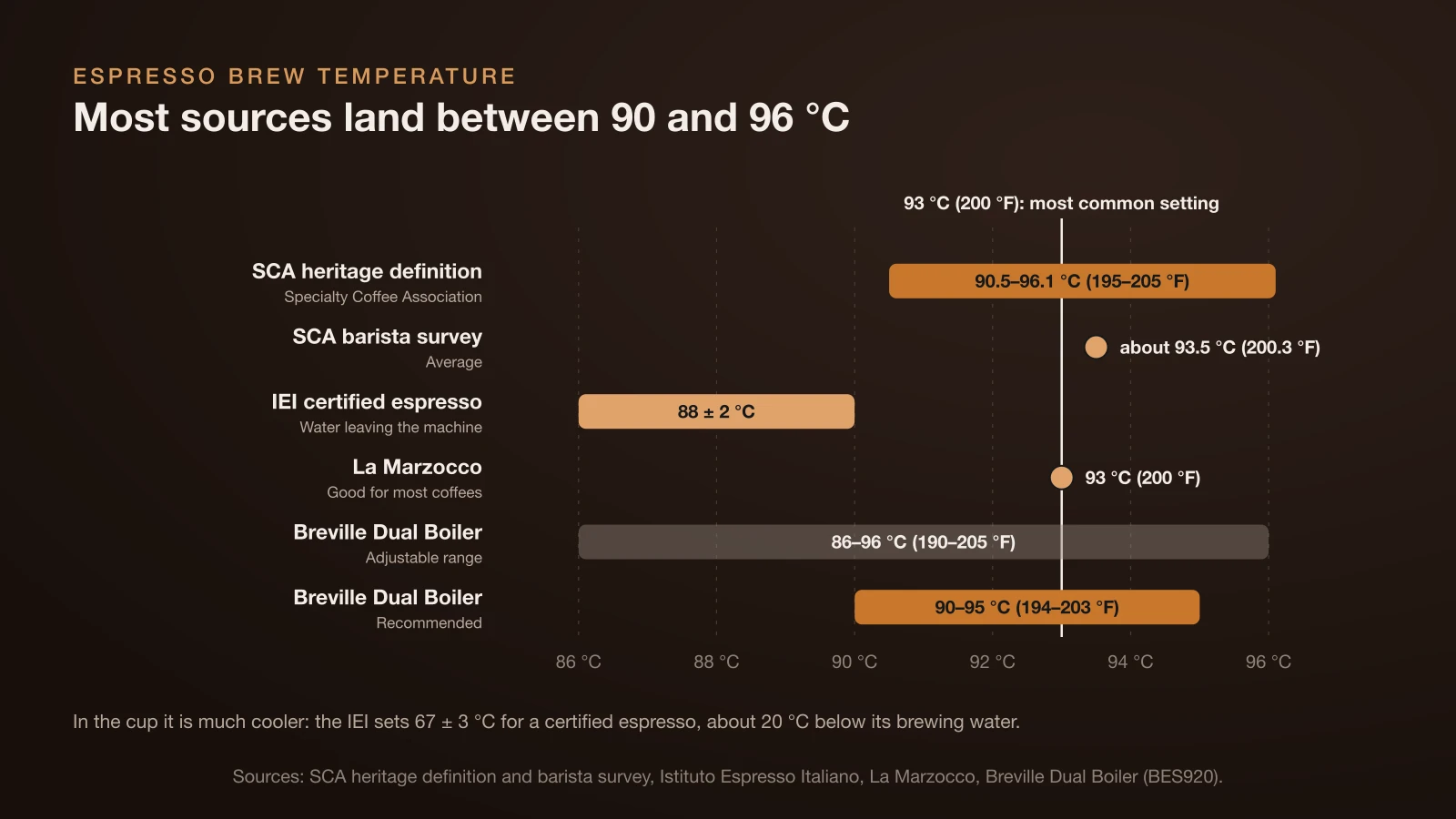
The ideal espresso brew temperature for most coffees falls between 90 and 96 °C (195–205 °F), with 93 °C (200 °F) the most common setting. The standards and manufacturers agree closely:
| Source | Brew temperature |
|---|---|
| SCA heritage definition of espresso | 195–205 °F (90.5–96.1 °C) |
| SCA barista survey | Average 200.3 °F (about 93.5 °C) |
| Istituto Espresso Italiano (IEI) certified espresso | 88 °C ± 2 °C (about 187–194 °F) water leaving the machine |
| La Marzocco | 93 °C (200 °F) gives good results for most coffees |
| Breville Dual Boiler | Default 93 °C (200 °F); adjustable 86–96 °C (190–205 °F); 90–95 °C (194–203 °F) recommended |
The Specialty Coffee Association (SCA) heritage range is the one most people quote, and the barista survey shows cafés sitting right in its middle. The IEI’s certified Italian espresso runs cooler, at 88 °C, alongside a 7 g single dose, 9 bar and a 25 second shot.
Brew temperature is not cup temperature
Brew temperature is the heat of the water hitting the coffee, not the heat of the drink. The IEI sets 67 °C ± 3 °C (about 147–158 °F) for a certified espresso in the cup, about 20 °C below its brewing water. A thermometer in a finished shot will always read far below the machine’s setting.
How espresso brew temperature changes the taste
Espresso brew temperature changes the taste by changing how much of the coffee dissolves: hotter water extracts more, cooler water extracts less. Breville explains that water under 195 °F leads to under-extraction that can taste sour or watery, while water over 205 °F can over-extract and pull out harsh-tasting compounds.
| Brew temperature | What happens | How it tastes |
|---|---|---|
| Below about 90 °C (195 °F) | Under-extraction | Sour, thin, watery |
| Lower part of the range | Less extraction | Brighter, lighter body |
| Middle, about 93 °C (200 °F) | Balanced starting point | Balanced for most coffees |
| Upper part of the range | More extraction | Fuller, heavier, more bitter |
| Above about 96 °C (205 °F) | Over-extraction | Harsh, bitter |
La Marzocco suggests getting the ratio and the shot time right first, then using temperature to fine-tune flavor on a machine that holds it steady. A single step on a home machine is small: the Breville Barista Express adjusts in 2 °F (about 1 °C) steps. Change it one step at a time and taste; our guide to dialing in espresso covers the order of adjustments.
Light vs dark roast: which temperature?
Light roasts usually need a hotter brew temperature and dark roasts a cooler one. La Marzocco says light roasts and larger brew ratios normally require higher temperatures, and darker roasts and smaller ratios lower ones. Breville adds that darker roasts extract flavor more easily and may need slightly lower brewing temperatures.
| Roast | Where to start | Why |
|---|---|---|
| Light | Upper part of 90–96 °C | Harder to extract; prone to sour shots |
| Medium | About 93 °C (200 °F) | The usual default |
| Dark | Lower part of the range | Extracts easily; prone to harsh, bitter shots |
These are directions, not fixed numbers. Breville’s Dual Boiler manual says the best temperature depends on the coffee’s origin, freshness and degree of roast.
How espresso machines control brew temperature
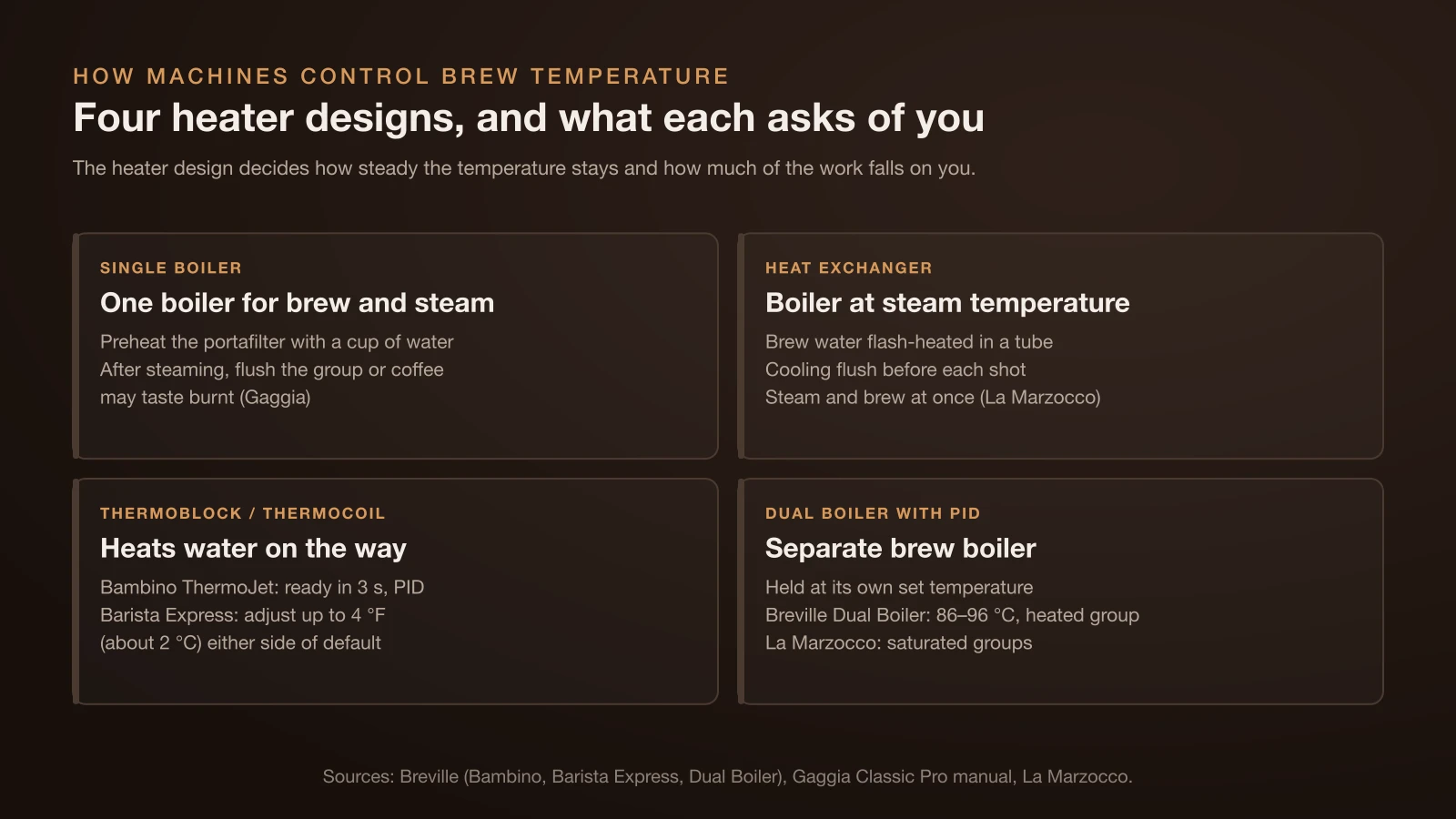
Espresso machines control brew temperature in four main ways, and the design decides how stable the temperature stays and how much of the work falls on you.
Thermoblock and thermocoil machines
A thermoblock or thermocoil heats water on its way to the group instead of storing it in a boiler. Breville’s ThermoJet in the Bambino is ready in 3 seconds with PID temperature control; a PID (proportional-integral-derivative) controller keeps adjusting the heater to hold a set temperature. The Barista Express uses a Thermocoil with PID control and lets you adjust the brew temperature by up to 4 °F (about 2 °C) either side of its default.
Single boiler machines
A single boiler machine uses one boiler for both brewing and steaming, so it has to change temperature between the two. Gaggia’s Classic Pro manual says to preheat the portafilter by running a cup of water through it, then wait a few minutes with it locked in before the first coffee. After steaming, it says to run water through the brew group to lower the boiler temperature, otherwise the coffee may taste burnt.
Timing a flush to catch the boiler at the right point in its heating cycle is known as temperature surfing. It helps, but it depends on your routine, so shot-to-shot temperature varies more than on a PID machine.
Heat exchanger machines
A heat exchanger machine keeps one large boiler at steam temperature and heats brew water in a tube running through it. La Marzocco explains that the brew water is flash-heated, so its temperature depends on boiler pressure and needs a cooling flush to stabilize before each shot. You can steam and brew at the same time, which suits milk drinks.
Dual boiler machines with PID
A dual boiler machine has a separate brew boiler held at its own set temperature, usually by a PID controller. La Marzocco calls independent thermal stability the main advantage, and its saturated groups circulate boiler water around the group to keep the temperature even. The Breville Dual Boiler adds a heated group head and lets you set the brew temperature anywhere from 86 to 96 °C. These features are a large part of what separates high end espresso machines from entry models.
How to measure espresso brew temperature
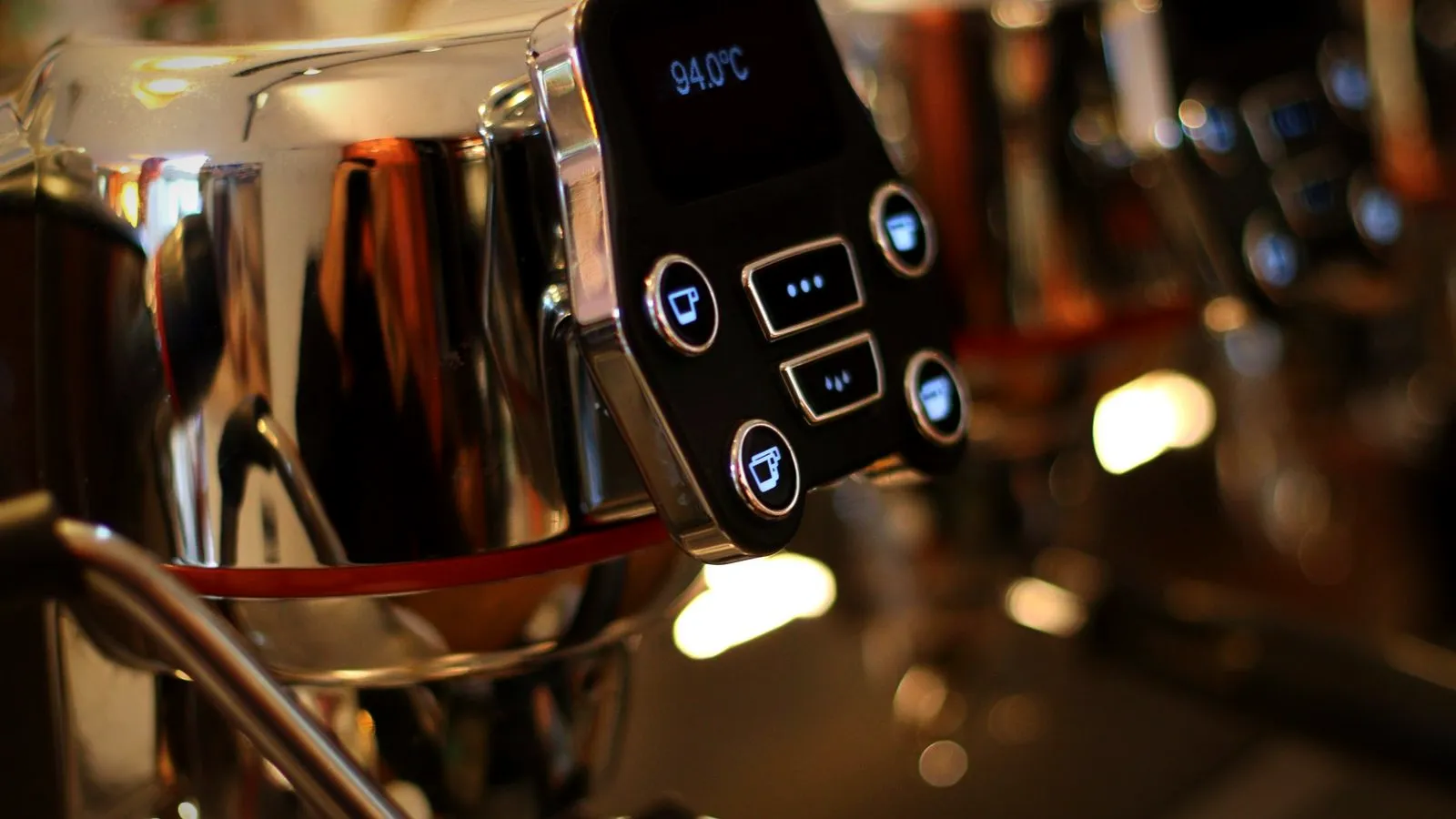
The practical way to measure espresso brew temperature at home is to read your machine’s display and confirm it by taste, because a thermometer in the cup measures the drink instead. Breville’s Dual Boiler, for example, shows the selected extraction temperature on its screen.
- Machine display or PID readout. It shows the set or boiler temperature, not the water at the puck, but it is consistent and easy to repeat.
- Thermometer in the cup. It reads the finished drink, which the IEI puts about 20 °C below the brewing water, so it cannot confirm the brew setting.
- Thermofilter. Technicians use a special portafilter basket with a temperature probe sitting where the coffee would be, which measures the water at the puck during a shot.
- Taste. If a well-timed shot tastes sour, the water may be too cool; if it tastes harsh, too hot.
A thermofilter is the only one of these that reads the water at the puck, and it is a tool for tuning and repairs rather than daily use.
How to keep the brew temperature stable at home
Keeping the brew temperature stable at home comes down to a full warm-up, preheated parts and a clean, descaled machine. Breville’s Barista Express manual warns that a cold portafilter and basket can reduce the extraction temperature enough to significantly affect the espresso.
- Let the machine heat fully. Wait for the ready light; Gaggia’s manual adds a few minutes with the portafilter locked in.
- Flush the group before each shot. Breville says a short flush stabilizes the temperature; on a heat exchanger this is the cooling flush La Marzocco describes.
- Preheat the portafilter and cup with hot water, then dry the basket.
- Leave the portafilter locked in the group between shots so it stays hot.
- Wait or flush after steaming on a single boiler machine.
- Descale on schedule. Breville lists scale as a reason for coffee that is not hot enough, so follow the descaling interval in your machine’s manual. Our guide on how to descale an espresso machine walks through the process.
Once the temperature is stable, compare shots by time as well as taste; our guide to espresso shot time explains what the clock can tell you.
The bottom line
Espresso brews best at about 90–96 °C (195–205 °F), and 93 °C (200 °F) is a sound default for most coffees. Go a step hotter for light roasts and a step cooler for dark ones, but only after the grind, dose and yield are right. Stability matters as much as the number, so warm up fully, preheat the portafilter and cup, flush when your machine needs it and keep it descaled.
Sources
- Specialty Coffee Association: Defining the ever-changing espresso (archived; heritage definition of 195–205 °F (90.5–96.1 °C); survey average 200.3 °F)
- Istituto Espresso Italiano: Certified Italian Espresso and its archived technical brochure (88 °C ± 2 °C water, 67 °C ± 3 °C in the cup, 7 g, 9 bar, 25 seconds)
- Breville: A guide to coffee brewing temperature (under 195 °F sour or watery, over 205 °F harsh, darker roasts lower), Dual Boiler BES920 instruction book (93 °C default, 86–96 °C range, 90–95 °C recommended, heated group, origin, freshness and roast), Barista Express BES870 instruction book (Thermocoil and PID, ±4 °F in 2 °F steps, cold portafilter, purge to stabilize, coffee not hot enough) and Bambino BES450 (ThermoJet ready in 3 seconds, PID)
- La Marzocco: Basic espresso theory (200 °F / 93 °C, light and dark roasts, temperature after ratio and time) and Dual boiler espresso machines (heat exchanger cooling flush, dual boiler stability, saturated groups)
- Gaggia: Classic Pro RI9380 operating instructions (warm-up and preheating, lowering boiler temperature after steaming)