A high end espresso machine is a home machine built with café-grade parts: two boilers or a heat exchanger, digital PID temperature control, a heavy 58 mm group, and often a rotary pump and plumb-in option. You pay for stable temperature, strong steam, back-to-back capacity and serviceable parts, not for better coffee by default.
This guide explains each feature, what to check before buying and what these machines cost to run. It sits between the home machines on this site and the café machines in our guide to commercial espresso machines. Prices appear only where a manufacturer lists them in its own US store, marked “as of September 2026”.
The short answer
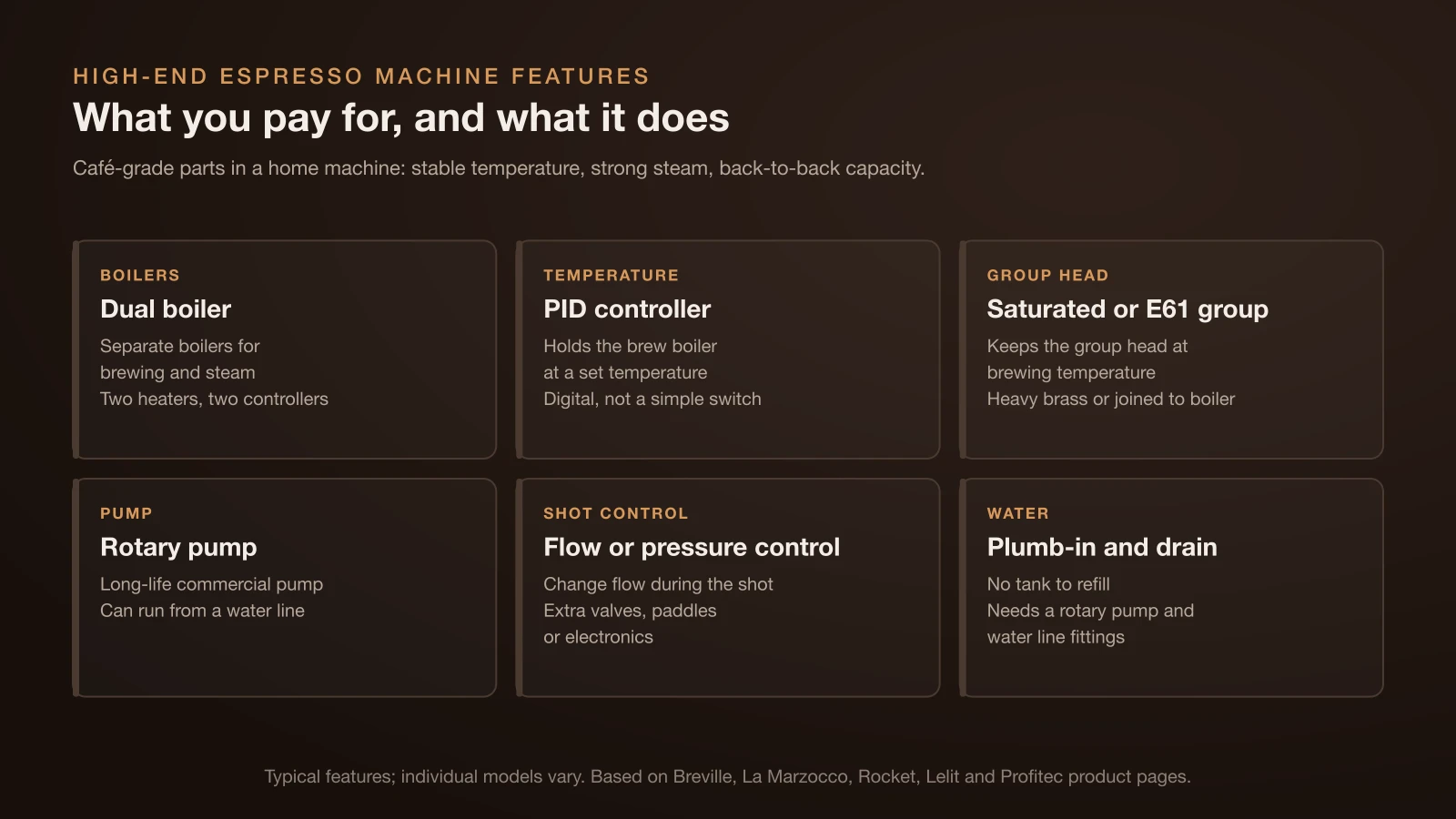
| Feature | What it does | Why it costs more |
|---|---|---|
| Dual boiler | Separate boilers for brewing and steam | Two heaters, two controllers, more plumbing |
| PID controller | Holds the brew boiler at a set temperature | Digital control instead of a simple switch |
| Saturated or E61 group | Keeps the group head at brewing temperature | Heavy brass or a group joined to the boiler |
| Rotary pump | Long-life pump that can run from a water line | Commercial part; enables plumb-in |
| Flow or pressure control | Lets you change flow during the shot | Extra valves, paddles or electronics |
| Plumb-in and drain | No tank to refill | Rotary pump and water line fittings |
If you mostly drink milk drinks and make several at a time, the boiler system matters most. If you drink straight espresso across different roasts, temperature control matters most.
What makes an espresso machine high end?
A high-end espresso machine is defined by its parts and its duty, not by a price threshold. These are home machines, often called prosumer machines, that borrow commercial hardware such as E61 or saturated groups, rotary pumps and dual boilers, but keep one group, a water tank and a standard 115–120 V plug.
The payoff is consistency under load. A small thermoblock machine such as Breville’s Bambino heats in about 3 seconds, as our Bambino vs Bambino Plus comparison shows, but it is built for a few drinks at a time. A high-end machine keeps liters of water hot, so the tenth drink behaves like the first. Many are built in Italy; our guide to Italian-made espresso machines covers who makes what.
What to check before buying a high-end espresso machine
Before buying a high-end espresso machine, check your counter space, electrical circuit, water, warm-up time and local service, because these limits decide which machines will work in your kitchen.
- Counter space and weight. La Marzocco lists the Linea Micra at 11.5 × 18 in (W × D) and 42 lb, and the GS3 at 16 × 21 in and 76.1 lb. Measure the height under your wall cabinets too, and plan for someone to help lift it.
- Power. In the US these machines run on 115–120 V but draw heavily: La Marzocco rates the Linea Mini at 14 A and the Linea Micra’s plate shows 120 V, 15 A. Breville recommends a grounded, dedicated circuit for its Dual Boiler, and La Marzocco advises against adapters and extension cords.
- Water. La Marzocco’s warranty excludes problems relating to poor water quality and scaling, and the Micra manual asks for 70–100 ppm total hardness. Test your water before the machine arrives.
- Tank or plumbed. Only some models can run from a water line; Rocket’s FAST models, for example, can be plumbed only in their rotary pump version.
- Warm-up time. Rocket quotes a first brew in as little as 12 minutes for its FAST models and brew temperature in around 8 to 10 minutes for the Bicocca. Look for auto-on scheduling if you want coffee right after waking.
- Service and warranty. La Marzocco lists 12 months for the Linea Micra and 24 months for the Linea Mini. Rocket’s warranty sits with the authorized dealer, so ask who repairs the machine locally.
- A grinder. Most high-end machines do not grind coffee, so budget for a capable espresso grinder at the same time.
Boiler types: single, heat exchanger and dual boiler
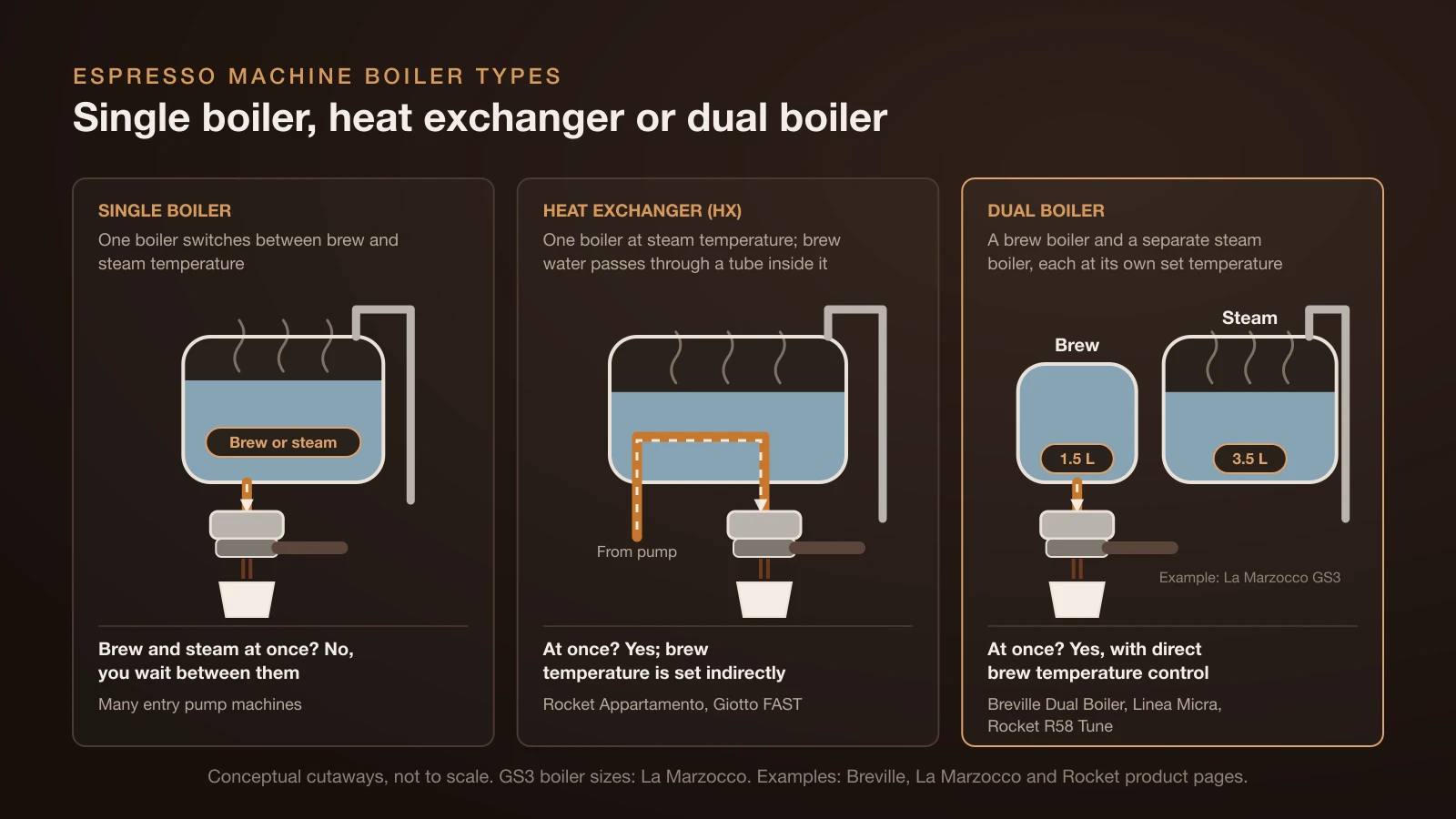
The boiler system is the biggest single difference between an entry machine and a high-end espresso machine, because it decides whether you can brew and steam at the same time and how directly you set brew temperature.
| Boiler system | How it works | Brew and steam at once? | Examples |
|---|---|---|---|
| Single boiler | One boiler switches between brew and steam temperature | No, you wait between them | Many entry pump machines |
| Heat exchanger (HX) | One boiler at steam temperature; brew water passes through a tube inside it | Yes; brew temperature is set indirectly | Rocket Appartamento, Giotto FAST |
| Dual boiler | A brew boiler and a separate steam boiler, each at its own set temperature | Yes, with direct brew temperature control | Breville Dual Boiler, La Marzocco Linea Micra, Rocket R58 Tune |
La Marzocco explains why the second boiler matters: a standalone brew boiler never reaches a boil, so it does not overheat the coffee during brewing. Boiler size also sets milk capacity. La Marzocco’s GS3 pairs a 1.5-liter coffee boiler with a 3.5-liter steam boiler, and the Linea Mini lists a 3-liter steam boiler. Our Rocket espresso machines guide shows the heat exchanger and dual boiler trade-off within one range.
Temperature control: PID and the group head
A PID (proportional-integral-derivative) controller holds a boiler at the temperature you set, and the group design decides how well that temperature reaches the coffee. Both matter more if you switch between light and dark roasts, as our guide to espresso brew temperature explains.
High-end machines use one of three group designs:
- E61 group. Introduced by Faema in 1961, it circulates hot water from the heat exchanger through a solid brass group of 4–5 kg (about 9–11 lb), according to Profitec, and includes a pre-infusion chamber.
- Saturated group. La Marzocco’s GS of 1970 welded the group directly onto the boiler so hot water flows around it at all times. The GS3 and Rocket’s R Nine One use saturated groups.
- Electrically heated group. Breville’s Dual Boiler has a heated group head, and Rocket’s Bicocca uses an electrically heated group with PID control.
Pumps, pre-infusion and flow control
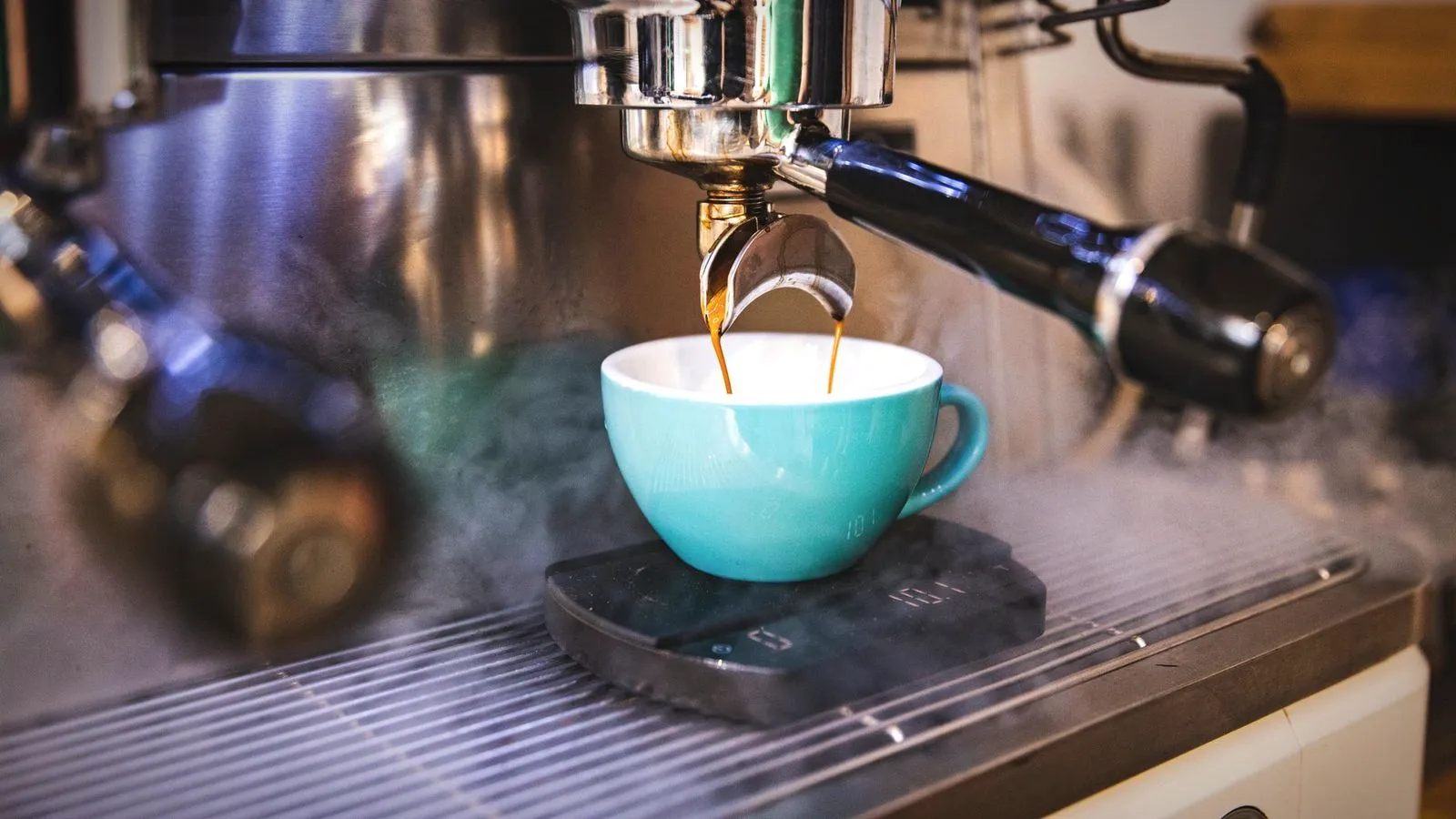
A rotary pump offers a longer service life and allows optional water line plumbing, according to Rocket Espresso USA, while vibratory pump machines usually run from the tank. Rocket sells its Giotto and Mozzafiato FAST in both versions: the R with a rotary pump for tank or water line, and the V with a vibration pump for the tank only.
Pre-infusion wets the coffee at low pressure before full pressure arrives. Breville’s Dual Boiler uses low-pressure pre-infusion followed by 9 bar extraction, and Rocket’s R58 Tune lets you time a pre-infusion stage at a fixed 3 bar.
Flow and pressure control go further by letting you change the shot while it runs:
- Lelit Bianca: a paddle changes the water flow onto the coffee as it rotates, until full pressure is reached.
- La Marzocco GS3 MP: a manual paddle moves brewing pressure from 0 to 9 bar and back.
- Rocket R Nine One: five preset pressure programs or a paddle.
- Decent: controls temperature and pressure with technology instead of a large metal boiler, all run from a touch tablet.
Our guide to the espresso machine pressure gauge explains how to read the needle during these shots. For pressure control without a pump, see lever espresso machines.
High-end espresso machine examples and maker prices
The machines below illustrate the features above; they are examples, not a ranking. Prices come from each manufacturer’s own US store as of September 2026, and “Not listed” means the maker does not publish one.
| Machine | Boilers and group | Notable features | US maker price |
|---|---|---|---|
| Breville Dual Boiler | Dual boiler, PID, heated group | 58 mm portafilter, pre-infusion, pressure gauge | $1,599.95 |
| Breville Oracle Dual Boiler | Dual boiler plus heated group, PID | Grinds, doses and tamps automatically; automatic milk texturing | $2,999.95 |
| La Marzocco Linea Micra | Dual boiler, PID | Compact, 42 lb | $4,500 |
| La Marzocco Linea Mini | Dual boiler, integrated group, PID | 3 L steam boiler | $6,600 |
| La Marzocco GS3 | Dual boiler, saturated group, PID | Auto volumetric (AV) or manual paddle (MP); plumb-in kit included | From $8,400 |
| Rocket R Nine One, Bicocca, R58 Tune | Dual boiler | Pressure profiling (R Nine One), touchscreen and heated group (Bicocca) | Not listed; sold through dealers |
| Lelit Bianca | Dual boiler, L58E group | Flow paddle, water supply and direct drain option | Not listed on the maker’s page |
The Oracle stands apart: it automates grinding, dosing and tamping, so it overlaps with super-automatic espresso machines while keeping a portafilter.
What a high-end espresso machine costs to run
A high-end espresso machine costs more to run than a small one mainly through water care, power draw and servicing, and the manufacturers publish the figures that matter.
- Water. Filters and testing are part of ownership. Breville’s Dual Boiler filter lasts 90 days or 10.6 gal (40 L) at hardness level 4, and La Marzocco includes a water test kit with its machines.
- Descaling. Hard water shortens the life of big boilers, and some makers prefer prevention to home descaling; our guide on how to descale an espresso machine lists what each maker allows.
- Power. Rated power runs from 1,620 W (Linea Mini, store spec) to 1,700 W (Breville Dual Boiler) and 1,800 W on the Linea Micra’s US rating plate. La Marzocco suggests switching the machine off if you will not use it for 36 hours.
- Boiler care. La Marzocco recommends draining the steam boiler every two months.
- Service. Gaskets and shower screens wear, and La Marzocco publishes a preventive maintenance checklist for the Linea Micra.
Who needs a high-end espresso machine, and who doesn’t
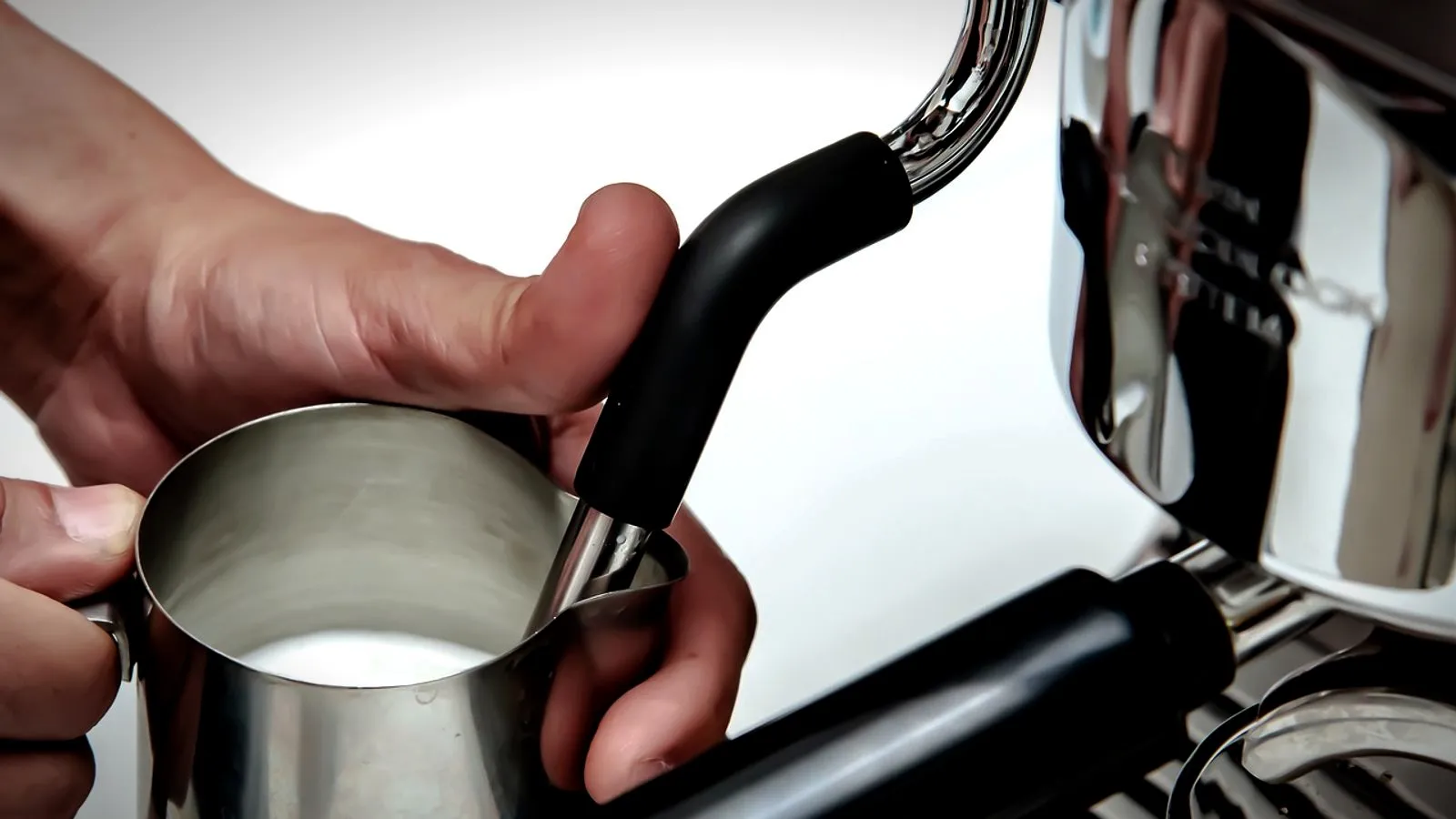
A high-end espresso machine makes sense when you make several drinks a day, steam a lot of milk or want to control brewing precisely.
It suits you if you:
- make milk drinks back to back for a household or guests;
- drink straight espresso across different roasts and want to set brew temperature;
- want to plumb the machine into a water line;
- plan to keep a machine for many years and service it rather than replace it.
It is probably more than you need if you:
- make one or two drinks a day and want them within a minute of switching on;
- have not yet budgeted for a good grinder, which affects the shot as much as the machine;
- have no space for a machine of 40 lb or more, or no local service;
- would rather press one button, in which case a super-automatic fits better.
The bottom line
A high-end espresso machine buys temperature stability, steam power and control through dual boilers, PID, heavy groups, rotary pumps and flow or pressure control. Check your counter, circuit, water and local service before comparing models, and compare prices only on each maker’s own US store. If you make just one or two drinks a day, spend on the grinder first.
Sources
- La Marzocco: Linea Micra, Linea Mini and GS3 US store pages, Linea Micra manual, warranty, water for home espresso machines, history of the GS, GS3 MP guide and Micra maintenance checklist (prices, sizes, weights, boilers, 115 V 14 A 1,620 W, 120 V 15 A 1,800 W plate, warranty terms, 70–100 ppm, 36 hours, two-month drain, 1970 saturated group, 0 to 9 bar paddle)
- Breville: Dual Boiler BES920 and Oracle Dual Boiler BES995 product pages and Dual Boiler instruction book (prices, PID, heated group, pre-infusion and 9 bar, automatic grinding, dedicated circuit, 1,700 W, 90-day or 40 L filter)
- Rocket Espresso: domestic models, Bicocca, R58 Tune, warranty statement and Rocket Espresso USA’s R Cinquantotto page (FAST R and V pumps, 12-minute first brew, Bicocca 8 to 10 minute heat-up, 3 bar pre-infusion, heated group, dealer warranty, rotary pump service life and plumbing, auto-on)
- Other makers: Lelit Bianca, Decent overview, Faema’s E61 brochure and Profitec: About us (flow paddle, L58E group, plumb-in, electronic control, E61 in 1961, 4–5 kg brass group)