A lever espresso machine brews espresso with a piston instead of an electric pump. You either push the piston through the coffee yourself (a direct or manual lever) or cock a spring that pushes it for you. Both styles build pre-infusion into every shot and let pressure change through the shot instead of holding it flat.
Levers are one branch of the wider family in our guide to manual espresso machines, which also covers hand presses and portable pumps. This guide goes deeper on the lever itself: the group, heating, pulling a shot and caring for the seals.
The short answer
| Spring lever | Direct (manual) lever | Boilerless lever press | |
|---|---|---|---|
| Who drives the piston | A spring you compress with the lever | Your arm, for the whole shot | Your arm |
| Pressure through the shot | Highest early, then eases as the spring extends | Whatever you apply | Whatever you apply |
| Pre-infusion | Built in: water fills the chamber first | Built in: lift and hold the lever | Press gently until the first drops |
| Water heating | Electric boiler | Electric boiler | Kettle water (some add a heated brew head) |
| Steam wand | Usually | Usually | No |
| Examples | Bezzera Strega, Profitec Pro 800 | La Pavoni Europiccola, Olympia Express Cremina | Flair 58 Plus 2, Cafelat Robot |
How does a lever espresso machine work?
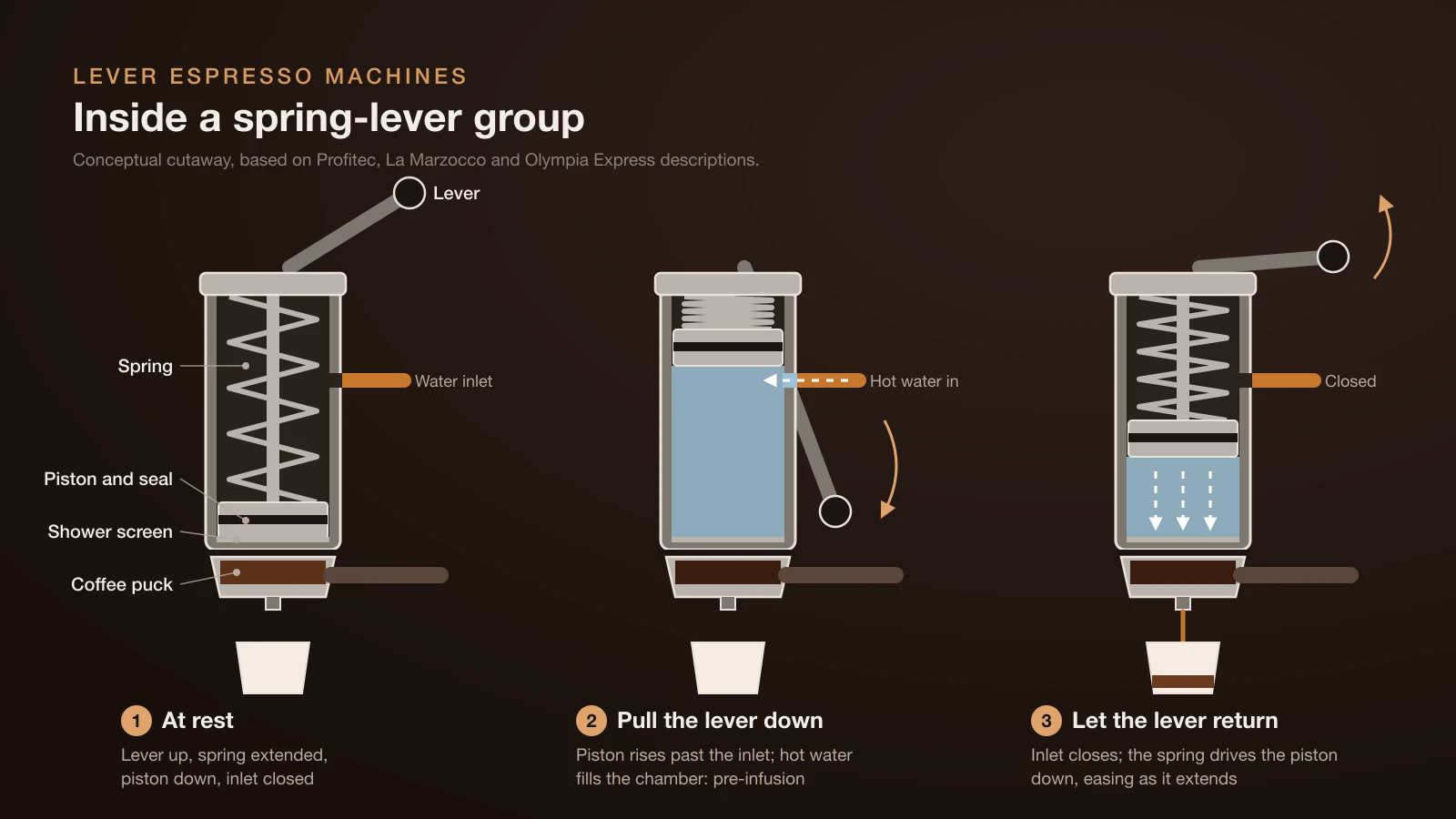
Every lever group has the same core: a piston in a cylinder above the portafilter. Raising the piston lets hot water fill the chamber over the coffee; lowering it forces that water through the coffee and into the cup.
That first soak, before full pressure, is pre-infusion. Olympia Express describes it for its Cremina: lifting the lever draws water into the piston chamber and lets the grounds swell, and lowering it forces the water through.
Spring lever machines
On a spring lever, pulling the handle down raises the piston and compresses a heavy spring. Profitec explains the sequence: pulling the lever starts pre-infusion, and when the lever returns, the water inlet closes and the spring presses water through the coffee.
La Marzocco’s operating manual for its Leva adds a useful detail: the longer the lever stroke, the more water is loaded and the higher the delivery pressure. Bezzera’s Strega is a hybrid. A vibration pump fills the lever group for pre-infusion, then the pump stops and two springs develop the brewing pressure.
Direct (manual) lever machines
A direct lever has no spring, so your arm drives the piston from start to finish. La Pavoni’s manual says to lift the lever, hold it for a few seconds, then lower it as far as it goes, with pressure that matches the resistance you feel.
That is the appeal and the challenge: you can press softly, hold, then build force or taper off. Olympia Express leaves finding the right pressure on the Cremina to the barista’s feel.
Why the pressure falls during a lever shot
A spring pushes hardest when most compressed, so on a spring lever the pressure peaks early and eases off as the spring extends. Faema, which launched the pump-driven E61 in 1961, describes its pump as keeping pressure constant through the whole extraction, unlike lever machines.
Makers publish different targets. Flair describes its Classic press as brewing at 6–9 bar. Cafelat recommends 6–7 bar on its Robot, and its manual notes that traditional lever machines rarely extract above 7 bar. La Marzocco advises not exceeding 12 bar on the Leva.
A short history of the lever espresso machine
The lever espresso machine goes back to Milan in the 1940s. Early espresso machines pushed water with steam. In 1938 Achille Gaggia of Milan patented a system that used hot water under pressure instead, producing what Gaggia calls “crema naturale.” In 1947 he patented the lever-piston mechanism: a lever loads a spring that pushes the piston through the filter.
His first commercial machine, the Tipo Classica, followed in 1948, and La Marzocco calls the 1950s the decade of spring-piston lever machines. In 1961 La Pavoni launched its first electric home machine; its Europiccola lever is still in the range.
That same year, Faema’s pump-driven E61 set the direction for later machines, but levers never disappeared. Many classic names are still based in northern Italy, as our guide to Italian-made espresso machines explains.
Lever espresso machine vs pump machine
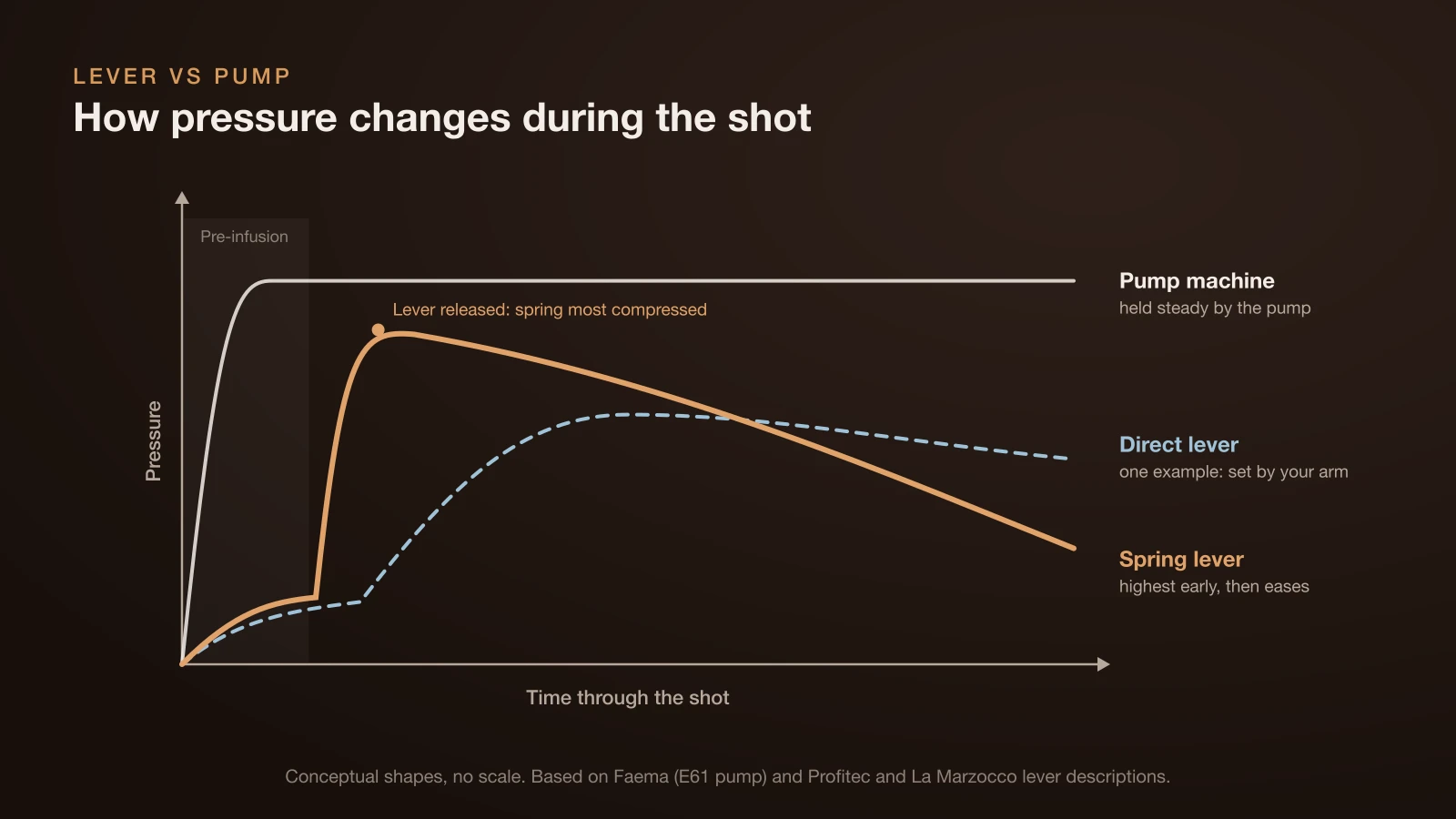
A lever machine drives the piston with your arm or a spring, so pressure changes through the shot, while a pump machine uses an electric pump that holds pressure steady.
| Lever machine | Pump machine | |
|---|---|---|
| Pressure source | Your arm or a spring | Electric pump |
| Pressure through the shot | Changes: eases off on a spring lever, set by you on a direct lever | Held steady (per Faema’s description of the E61) |
| Pre-infusion | Part of every lever stroke | Depends on the machine |
| Noise | Near silent while brewing | Pump hum |
| Back-to-back shots | Limited on small boiler levers | Easy |
Are lever espresso machines better?
They are different, not better. The advantages:
- Pre-infusion and a natural pressure curve on every shot, without extra hardware.
- Quiet brewing, since most levers have no pump running during the shot.
- Simple mechanics. The Cafelat Robot has no heating element at all.
The trade-offs:
- Skill. Consistent shots take practice, especially on a direct lever.
- Heat management. La Pavoni advises waiting a few minutes after three or four consecutive coffees so the group can return to the right temperature.
- Milk. Kettle-fed levers have no steam wand.
How lever espresso machines heat water
Lever espresso machines heat water in one of three ways: a boiler that also heats the group, a boiler plus a separately heated group, or a kettle.
Boiler levers with the group on the boiler. Classic direct levers such as La Pavoni’s heat a boiler that also feeds the group. La Pavoni’s Europiccola holds 27 oz (0.8 L), which its manual equates to about 8 espressos per fill, and the Professional holds 54 oz (1.6 L), about 16. The manual allows about 5 minutes for the boiler to reach pressure on first start.
Levers with a separately heated group. Bezzera’s Strega pairs a 68 oz (2 L) boiler with a heating element on the group for thermal stability. Profitec’s Pro 800 uses a 118 oz (3.5 L) copper boiler with PID temperature control.
Kettle-fed lever presses. The Cafelat Robot and Flair presses have no boiler: you pour in water just off the boil. Cafelat says that water drops by around 4 °C (about 7 °F) as it meets the basket, landing near 95 °C (203 °F). Flair’s 58 Plus 2 adds an electric preheat controller for the brew head, with three settings for dark, medium and light roasts.
Commercial levers work the same way at café scale; our guide to commercial espresso machines covers the power, plumbing and water side.
Lever espresso machine examples
Lever espresso machines range from direct levers by La Pavoni and Olympia Express to spring levers by Bezzera and Profitec and kettle-fed presses by Flair and Cafelat. Details are from each maker’s own page or manual; check the voltage for your country.
| Machine | Maker based in | Lever type | Heating | Maker-stated details |
|---|---|---|---|---|
| La Pavoni Europiccola | San Giuliano Milanese, Italy | Direct | Electric boiler, 0.8 L | About 8 cups per fill, 52 mm filter holder, steam wand |
| Olympia Express Cremina | Schwanden, Switzerland | Direct | Electric boiler | Brass group, steam wand, 120 V version rated 850 W |
| Bezzera Strega | Rosate (Milan), Italy | Spring (two springs) | 2 L boiler plus heated group | Pump pre-infusion, 135 oz (4 L) water tank |
| Profitec Pro 800 | Bammental, Germany | Spring | 3.5 L copper boiler with PID | US version 115 V, 1,500 W |
| Flair 58 Plus 2 | Flair Espresso, California (design) | Direct press | Kettle water plus heated brew head | 58 mm portafilter, 16–20 g dose |
| Cafelat Robot | Cafelat, Hong Kong | Direct, twin arms | Kettle water, no heating element | 58 mm basket, 10–21 g dose, no steam |
Portable lever makers, such as the Flair 2GO, also exist.
How to pull a shot on a lever espresso machine
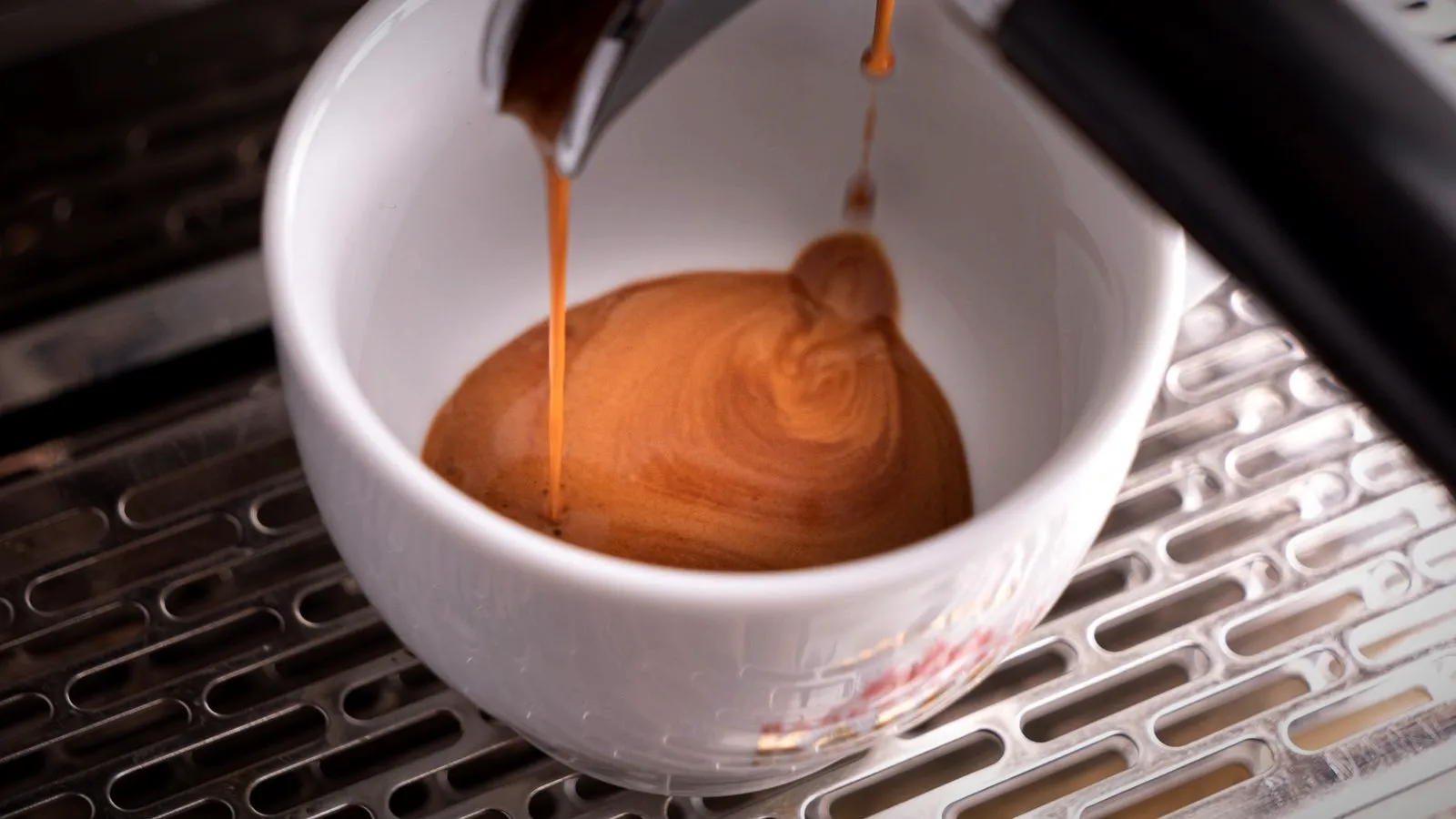
To pull a shot on a lever espresso machine, preheat the group, pre-infuse by lifting the lever, then lower it smoothly and adjust the grind by taste. The routine below follows the makers’ manuals; adjust it to your own machine.
- Heat up. Wait for a boiler lever’s light or gauge to show it is ready, or bring the kettle to the boil.
- Preheat the group. La Pavoni suggests lifting the lever fully to run a cup of hot water through first; Cafelat suggests a dummy shot or a 10–20 second hot-water soak for the basket and portafilter.
- Dose and tamp. Use a fine espresso grind. Cafelat suggests starting at 14 g in the Robot’s basket; La Pavoni uses one scoop per cup.
- Lock in the portafilter.
- Pre-infuse. Lift and hold the lever for a few seconds (La Pavoni), or press gently until the first drops appear, about 5–10 seconds on the Robot.
- Extract. Lower the lever smoothly, or guide a spring lever back up, without stop-start movements. Cafelat looks for at least 15 seconds of flow.
- Wait before unlocking. La Pavoni advises waiting a few seconds so residual pressure between the coffee and the shower screen can release.
- Taste and adjust the grind. If coffee gushes, grind finer or use more coffee; if it only drips, grind coarser or use less.
Grind does most of the work: too coarse, and the piston has nothing to push against. Our guide to espresso grind size shows how to dial it in.
Lever safety: habits worth building
Lever machines store energy in a loaded spring or a pressurized boiler, so a few habits from the makers’ manuals matter.
- Keep hold of a loaded spring lever. La Marzocco warns never to let go of it by accident and to keep its path clear of your face.
- Never fire a spring lever empty. La Marzocco says not to release the lever without a properly installed portafilter holding coffee.
- Expect a lever that moves on its own. La Pavoni notes that a cooling boiler can form a vacuum that lifts the lever by itself.
- Depressurize before refilling. La Pavoni says to switch off, release the steam and lift the lever to vent the boiler through the group before opening the cap.
Lever espresso machine maintenance: gaskets and seals
A lever’s main wear parts are the piston seal and the group gasket that seals the portafilter.
- Watch for leaks. La Pavoni lists coffee leaking between the group and the filter holder as a sign of a worn group gasket and sends that job to a service center. Cafelat links leaks on the Robot to overfilling or a seal that is poorly seated or needs lubricant.
- Lubricate only where the maker says. Cafelat recommends a silicone-based grease such as Dow 111 on the Robot’s silicone piston seal, just enough to give it a sheen. It treats the seal as a consumable part.
- Clean without backflushing unless allowed. La Pavoni says to clean the filter holder, basket and shower screen with warm water and a neutral detergent, and not to use a blind filter on the group.
For routines by machine type, see how to clean an espresso machine.
Who should buy a lever espresso machine?
A lever espresso machine suits people who mostly drink straight espresso and enjoy technique more than speed.
- Straight espresso drinkers who want to shape the shot.
- Hobbyists who enjoy technique and simple home maintenance.
- Quiet or small kitchens, where a silent lever or compact kettle press fits better than a big pump machine.
If your household wants several milk drinks in a hurry, a pump machine will be faster.
The bottom line
A lever espresso machine replaces the pump with a piston, driven either by your arm or by a spring, so every shot gets pre-infusion and a pressure curve that eases off. Choose a spring lever for repeatability, a direct lever for control and a kettle-fed press for simplicity. Expect a learning curve, grind finely and keep an eye on the seals.
Sources
- Gaggia: 85 years of heritage, 1938–1947 and Gaggia North America: Our history
- Faema: E61 Legend and Jubilé brochure (1961, pump vs lever pressure)
- La Pavoni: History, Europiccola Lusso and instruction manual
- Cafelat and Flair: Robot user manual, Flair espresso makers and Flair 58 Plus 2
- Spring and direct lever makers: Bezzera Strega, Profitec: About us and Pro 800, Olympia Express Cremina, La Marzocco Leva operating manual and La Marzocco heritage