A Rocket espresso machine is a semi-automatic, pump-driven home or café machine built by Rocket Milano, a company based just outside Milan, Italy. The domestic lineup runs from the compact heat exchanger Appartamento to dual boiler models such as the R58 Tune and Bicocca. All use large commercial-style groups and need a separate grinder.
This guide covers the current models, what each boiler type means in practice, and the specifications Rocket itself publishes. Every Rocket is an electric pump machine, not a hand-powered lever like the ones in our guide to manual espresso machines, and none of them grinds or tamps for you like a super-automatic does.
Numbers below come from Rocket’s product pages, brochures and cleaning guide, and from Rocket Espresso USA, the brand’s US distributor. Where Rocket’s own documents disagree, we left the figure out.
The short answer
| Model | Boiler system | Pump | Water feed | Listed by Rocket Espresso USA |
|---|---|---|---|---|
| Appartamento | Heat exchanger, 1.8 L | Not stated | Tank only | Yes |
| Appartamento TCA | Heat exchanger, 1.8 L, adjustable pressure | Vibration | Tank only | Yes |
| Giotto FAST / Mozzafiato FAST (V) | Heat exchanger, 1.8 L | Vibration | Tank | Yes |
| Giotto FAST / Mozzafiato FAST (R) | Heat exchanger, 1.8 L | Rotary | Tank or plumbed | Yes |
| R58 Tune | Dual boiler, PID | Not stated | Tank or plumbed | Yes |
| Bicocca | Dual boiler, heated group | Rotary | Tank or plumbed | Yes |
| R Nine One | Dual boiler, saturated group, pressure profiling | Not stated | Tank or plumbed | Yes |
| Epica | Dual boiler, saturated group, lever-controlled pressure | Not stated | Tank or plumbed | No |
| Porta Via | Two small boilers, portable | Not stated | Tank only | No |
If you mostly drink milk drinks and want the simplest machine, the heat exchanger models are the core of the range. If you want to set brew temperature directly, look at the dual boiler models.
Who makes Rocket espresso machines?
Rocket Espresso is the brand of Rocket Milano S.r.l., whose registered address is in Liscate, in the province of Milan. The company says its story dates back to 2007 and that its first model was the Giotto, recognizable by its angled side panels. It is guided by two Italian partners. Rocket is one of many espresso machine makers based in Italy; our guide to Italian-made espresso machines explains what the “made in Italy” label really covers.
Rocket describes its production as “fatto a mano”, made by hand, by a small team of craftsmen. It builds both domestic and commercial machines, plus its own grinders. In the United States, the brand is represented by Rocket Espresso USA in Lynnwood, Washington.
The Rocket espresso machine lineup
Rocket’s home lineup runs from the compact Appartamento models through the Giotto and Mozzafiato FAST to the dual boiler R58 Tune, Bicocca, R Nine One and Epica, plus the portable Porta Via. Model names change between generations, so check the exact version when you compare listings.
Appartamento and Appartamento TCA
The Appartamento is Rocket’s compact machine. It uses a 1.8-liter heat exchanger boiler and, according to Rocket Espresso USA, an E61 group. The latest version has a deeper drip tray, RGB LED indicators and a water tank sensor that lets you finish a shot when water is low. It has no PID and no shot timer, and it runs from its tank only.
The Appartamento TCA adds Temperature Control Adjustment. Rocket’s brochure describes a PID-driven system with four presets that set boiler pressure between 0.9 and 1.2 bar, which moves the brew temperature up or down. It uses a vibration pump and a 1.9-liter tank, and the US version is rated 115 V, 1,200 W.
Giotto FAST and Mozzafiato FAST
These two share the same internals and differ mainly in their case. The Giotto has the angled panels of Rocket’s original design, and the Mozzafiato has slimmer, flat sides. Both use a 1.8-liter heat exchanger boiler, an OLED display and dual pressure gauges. Rocket lists a tank reserve sensor on both R versions and on the Mozzafiato V, but not on the Giotto V.
Each comes in two versions. The R version has a rotary pump and can run from its tank or a water line. The V version has a vibration pump and runs from the tank. Rocket quotes a first brew in as little as 12 minutes on average from startup, depending on water temperature and conditions.
R58 Tune and R Cinquantotto
The R58 Tune is the current version of Rocket’s long-running dual boiler platform. It has two PID-controlled boilers (0.58 L for coffee, 1.8 L for steam), a color display, a shot timer and push-turn knobs. Its Tune Technology lets you time both the pre-infusion and the final stage of the shot at a fixed 3 bar.
Rocket Espresso USA still lists the earlier R Cinquantotto. It has separate brew and steam boilers, a 58 mm E61 group, a rotary pump that can be plumbed in, a detachable touchscreen PID, auto-on scheduling and a shot timer.
Bicocca
Rocket calls the Bicocca the flagship of its domestic range. It has two stainless steel boilers (0.5 L coffee, 1.5 L steam), an electrically heated group with PID control and a rotary pump. A 3.5-inch touchscreen above the group lets you program two volumetric recipes with pre-infusion and extraction time, and set a calendar for auto on and off.
R Nine One and Epica
Rocket says the R Nine One brings its commercial development work into a machine for a home or small café, and the Epica shares its boiler layout. Both have a fully saturated group, a 1.9-liter coffee boiler and a 3.6-liter steam boiler. The R Nine One profiles pressure through five preset programs or a paddle. The Epica uses a manual lever to ramp pump pressure up and down.
Porta Via
The Porta Via is a portable machine that ships in a case, with a 0.47-liter coffee boiler and a 0.73-liter steam boiler. Rocket lists it only in a 220–240 V version, and Rocket Espresso USA does not list it or the Epica.
Heat exchanger vs dual boiler: which Rocket fits your drinks?
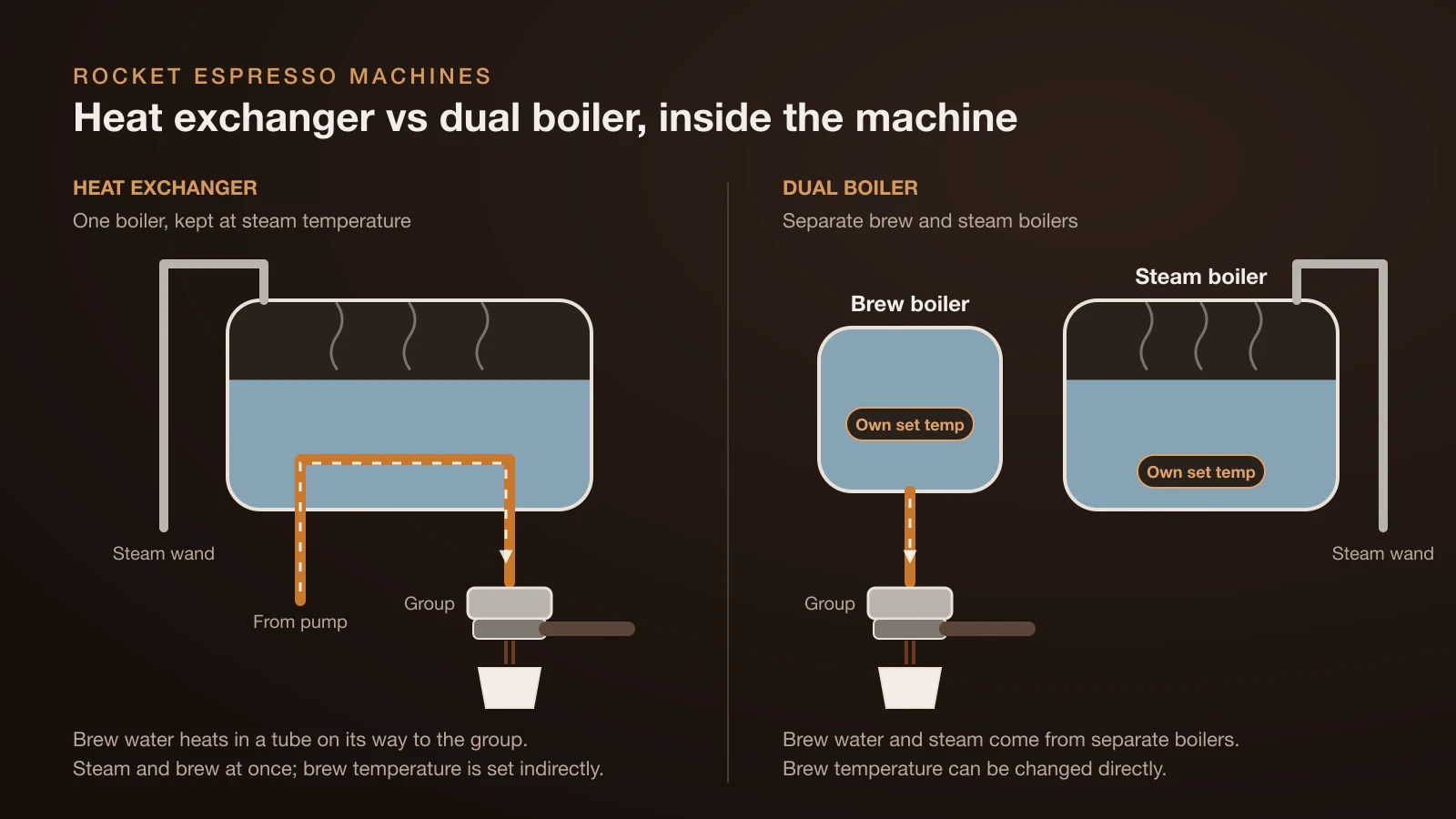
A heat exchanger Rocket suits households that mostly make milk drinks, while a dual boiler Rocket suits you if you want to set brew temperature directly.
A heat exchanger machine keeps one boiler at steam temperature. Brew water runs through a tube inside that boiler and is heated on the way to the group. You can steam milk and pull a shot at the same time, but brew temperature is set indirectly. On the Appartamento TCA, you adjust it by changing boiler pressure.
A dual boiler machine has one boiler for brewing and a separate one for steam, each held at its own set temperature. That makes it easier to change brew temperature for different roasts, which matters more if you drink straight espresso or switch between light and dark coffees.
| If you… | Look at |
|---|---|
| Mostly make lattes and cappuccinos and want a smaller machine | Appartamento, Appartamento TCA |
| Want a heat exchanger with a rotary pump and plumbing option | Giotto FAST R, Mozzafiato FAST R |
| Want to set brew temperature directly | R58 Tune, Bicocca |
| Want pressure profiling | R Nine One, Epica |
| Need a machine to travel with | Porta Via (not sold by the US distributor) |
Rocket espresso machine specs compared

Dimensions are width × depth × height as Rocket lists them, converted to inches. Weights are rounded.
| Model | Boilers | Size (in) | Weight | US power rating |
|---|---|---|---|---|
| Appartamento | 1.8 L HX | 10.8 × 17.3 × 14.2 | 44 lb | Not listed on Rocket’s page |
| Appartamento TCA | 1.8 L HX | 10.6 × 17.6 × 14.1 | 48.5 lb | 115 V, 1,200 W |
| Giotto FAST | 1.8 L HX | 13.4 × 18.0 × 15.9 | 66 lb (R), 59.5 lb (V) | 1,550 W installed |
| Mozzafiato FAST | 1.8 L HX | 12.4 × 18.0 × 16.1 | 66 lb (R), 59.5 lb (V) | 1,550 W installed |
| R58 Tune | 0.58 L + 1.8 L | 13.2 (16.1 with display) × 19.0 × 16.8 | 64 lb | 115 V, 1,600 W |
| Bicocca | 0.5 L + 1.5 L | 16.1 × 18.3 × 15.7 | 77 lb | 115 V, 1,600 W |
| R Nine One | 1.9 L + 3.6 L | 16.1 × 19.9 × 16.9 | 104.5 lb | 115 V, 1,400 W |
| Epica | 1.9 L + 3.6 L | 16.5 × 19.9 × 25.4 | 93.5 lb | 115 V, 1,400 W |
The weights are worth noticing. Even the compact Appartamento weighs about as much as a full suitcase, so plan where it will live before it arrives.
What to check before buying a Rocket espresso machine
Before buying a Rocket espresso machine, check that it is the 115 V US version, whether it can be plumbed in, which pump it uses, where it will fit, which portafilter size it takes, which grinder you will pair with it and who handles the warranty.
- The US version. Confirm the listing is rated 115 V, 60 Hz. Rocket’s international pages also list 220–240 V versions.
- Tank or plumbed. Only some models offer a direct water connection: the FAST R versions, R58 Tune, Bicocca, R Nine One and Epica. The Appartamento models and FAST V versions run from the tank.
- Rotary or vibration pump. Rocket Espresso USA notes that a rotary pump runs more quietly and supports plumbing from a water line.
- Counter space. Measure the counter and the height under your wall cabinets against the sizes in the specs table above, and plan for the weight: even the Appartamento is about 44 lb.
- Portafilter size. The Appartamento models and the R Cinquantotto use E61 groups, which take 58 mm portafilters, so tampers and baskets must match. A bottomless portafilter is a common add-on for checking extraction.
- A grinder. No Rocket machine grinds coffee, so budget for a capable espresso grinder and fresh espresso beans.
- Warranty. Rocket’s warranty statement says the warranty resides with the authorized dealer you buy from, and lists one year for domestic machines in the USA. Rocket Espresso USA advertises three years of parts and labor, so ask the dealer which terms apply.
Maintenance: backflushing, water and descaling
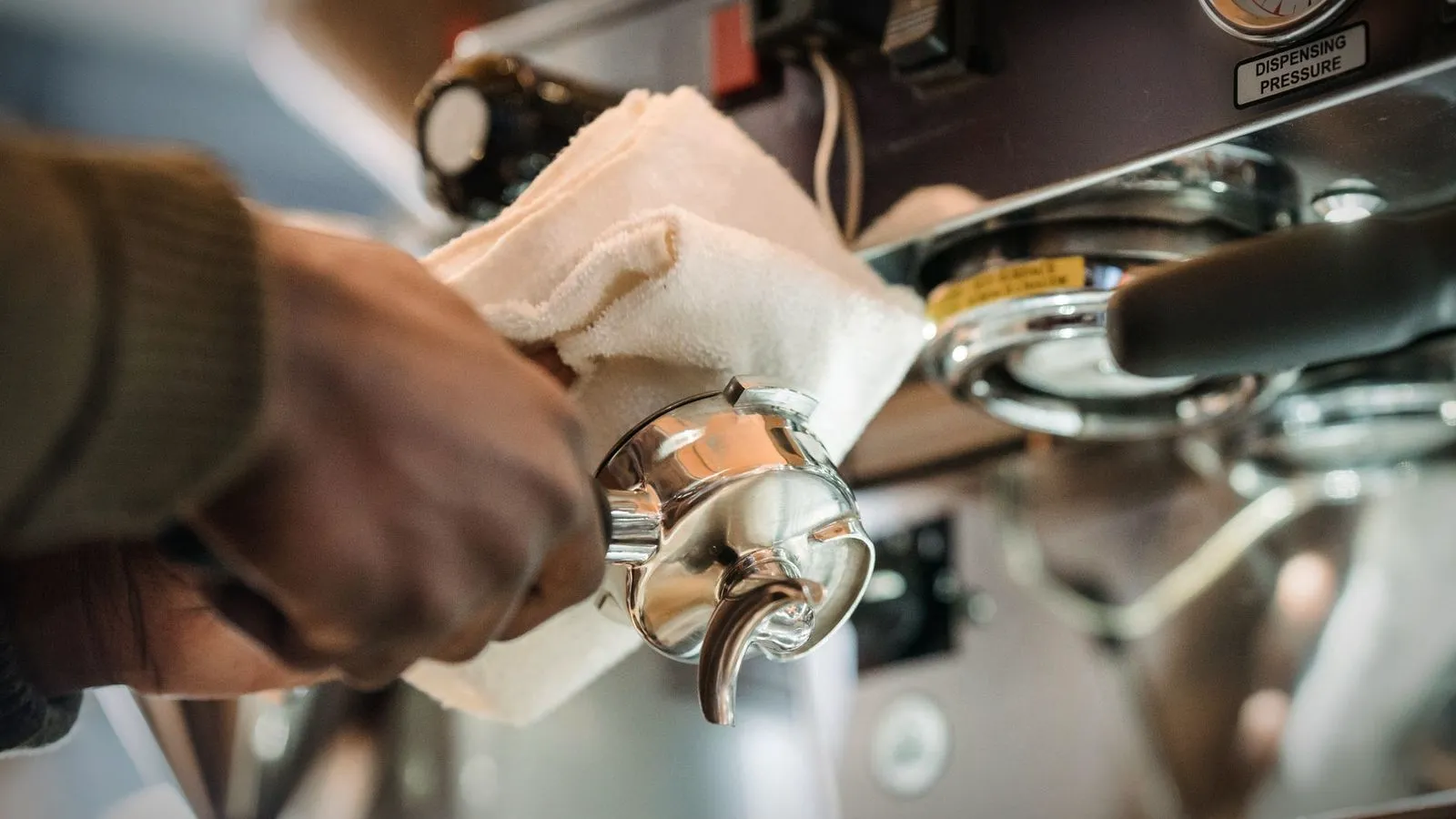
A Rocket needs a daily backflush, a weekly backflush with detergent and regular scrubbing of the group and portafilter. Rocket’s own cleaning guide for its E61-group Giotto and Cellini models sets out the routine:
- Every day: backflush with water. Fit the blind filter, run the pump for about 15 seconds, then stop and empty the filter. Repeat until the water comes out clean.
- Every week: add a small amount of espresso machine cleaning detergent to the blind filter and repeat the same cycles until it runs clean, then backflush again with plain water to rinse out the residue.
- Regularly: scrub the inside of the group with a small, stiff brush and clean the basket and portafilter. If coffee oils have built up, soak the portafilter in hot water with a capful of detergent for about 30 minutes, then rinse.
- After each use: wipe the steam wand and check that the tip holes are not blocked.
Water matters as much as any cleaning step, because scale builds up inside the boiler where you cannot see it. Rocket sells an anti-limescale filter pack for the water tank, and its website does not publish a home descaling routine.
Ask the authorized dealer who handles your warranty which water and filter they recommend for your area, and how they handle descaling if scale does build up. Prevention is far easier than removing scale from a large boiler.
Rocket compared with other home machines
Rocket machines sit in the prosumer class: home machines built with commercial-style parts. Our guide to high end espresso machines compares them with other machines at this level. Compared with compact thermoblock machines, the difference is scale. A Breville Bambino uses a 54 mm portafilter, a ThermoJet heater that Breville says is ready in 3 seconds, and weighs about 10.4 lb. See our Breville Bambino vs Bambino Plus comparison for those numbers.
A Rocket takes minutes, not seconds, to heat up, but it has much larger boilers and a commercial-style group. If you would rather press one button and skip grinding, dosing and tamping, a super-automatic espresso machine is the other end of the spectrum.
Rocket also builds a commercial range, including the R 9, R 9V, RE Doppia and Boxer models. Our guide to commercial espresso machines explains what changes when a machine has to serve a café.
Once your machine is set up, our step-by-step guide on how to use an espresso machine covers dosing, tamping and timing a shot.
The bottom line
A Rocket espresso machine is a hand-assembled Italian prosumer machine, and the main choice is the boiler system. The Appartamento, TCA and FAST models use a heat exchanger and suit milk-drink households. The R58 Tune, Bicocca, R Nine One and Epica add a second boiler for direct temperature control. Whichever you pick, budget for a grinder and soft water, and buy the 115 V version from an authorized dealer.
Sources
- Rocket Espresso: domestic models and model pages for Appartamento TCA, R58 Tune and Bicocca (boiler type and capacity, pump, water feed, dimensions, weight, wattage, heat-up time)
- Rocket Espresso: About (2007 origin, Giotto, Milan, “fatto a mano”), commercial models, warranty statement (warranty held by the authorized dealer; 1 year for domestic machines in the USA) and water reservoir filter (anti-limescale pack)
- Rocket Espresso USA: Appartamento and R Cinquantotto (E61 group, 58 mm, rotary pump, US warranty)
- Rocket Espresso: How to clean your Giotto or Cellini (archived copy of Rocket’s cleaning guide: daily backflush of about 15 seconds, weekly detergent backflush and rinse, group scrub, 30-minute portafilter soak, steam wand care)