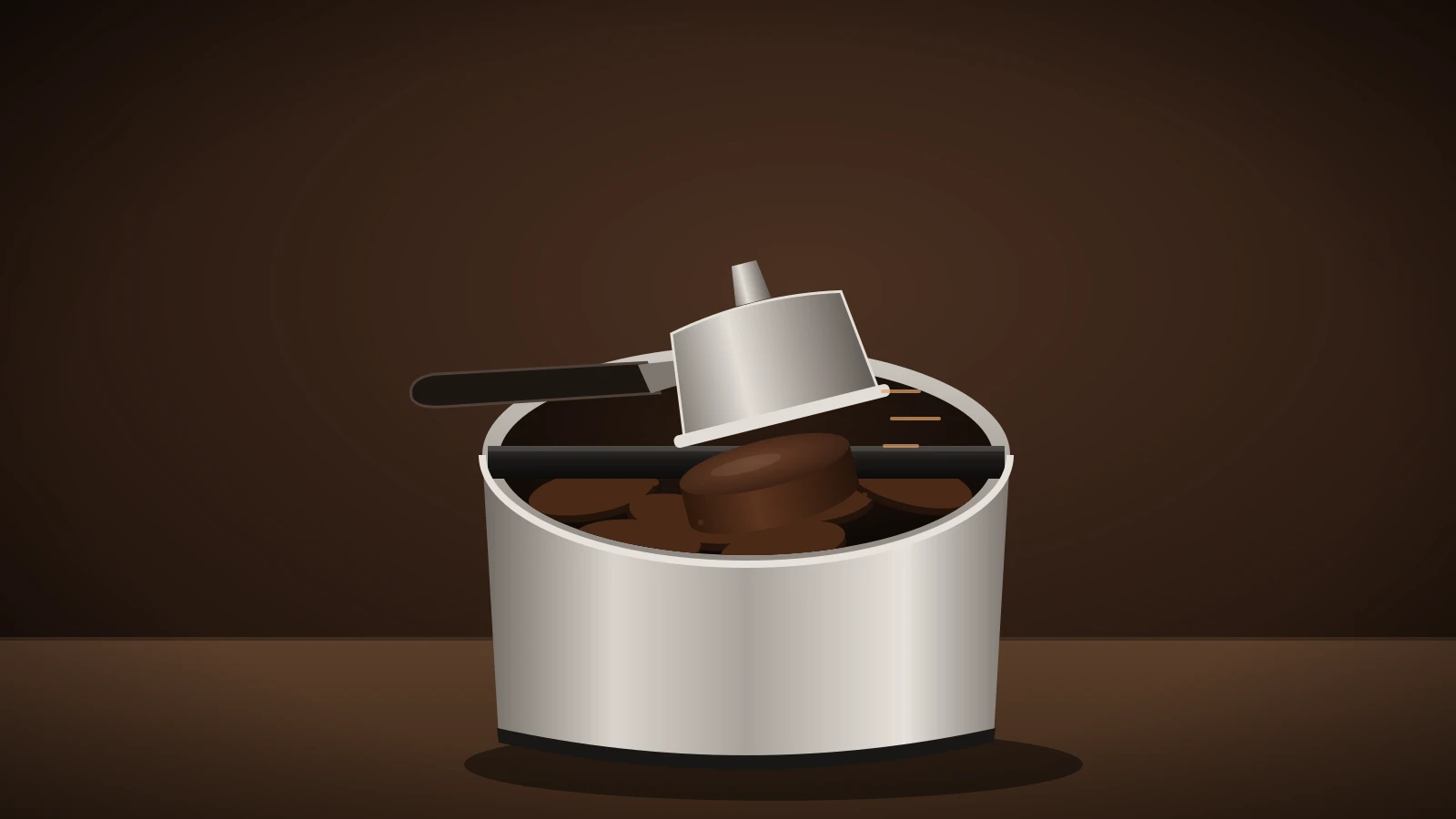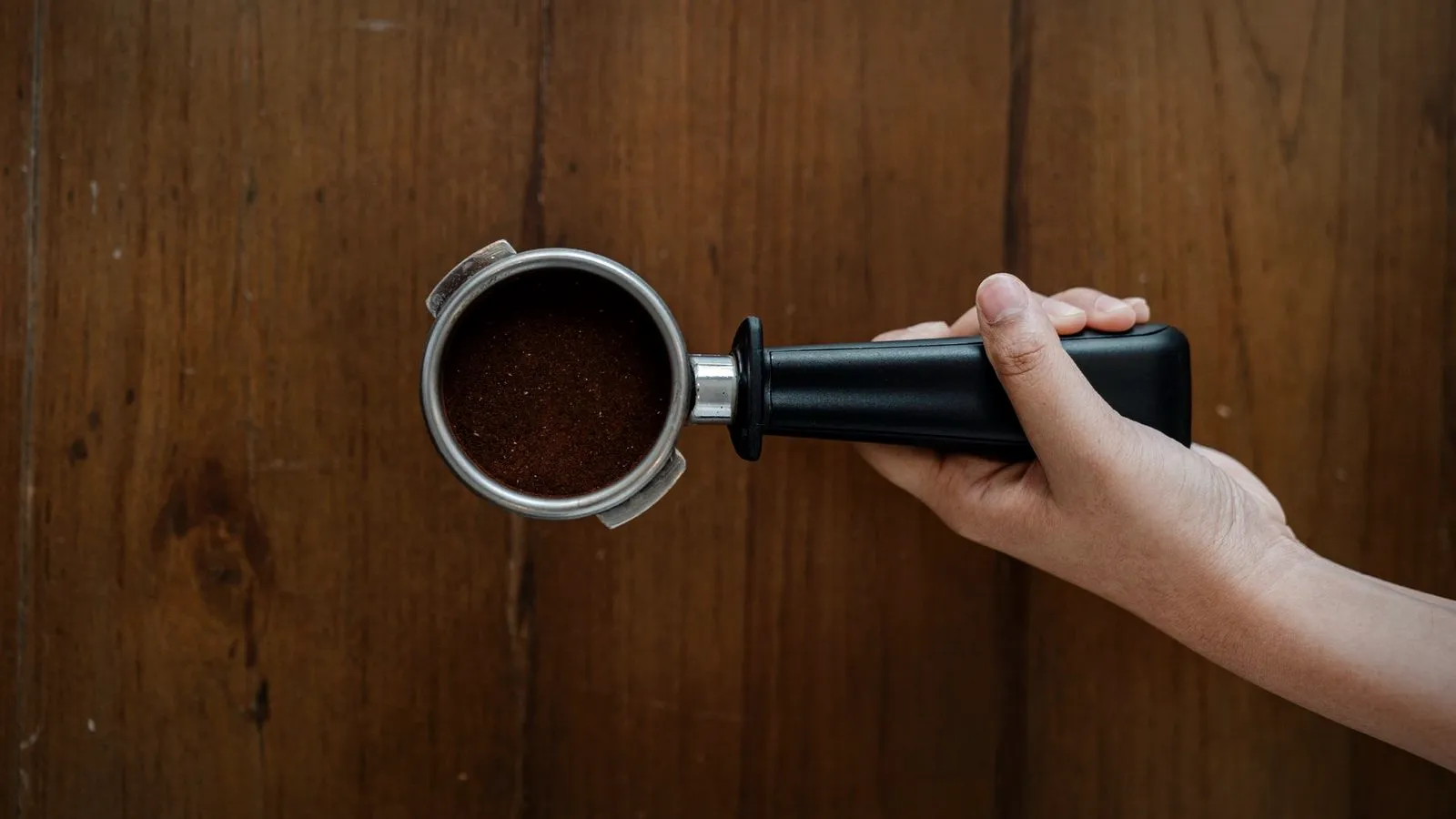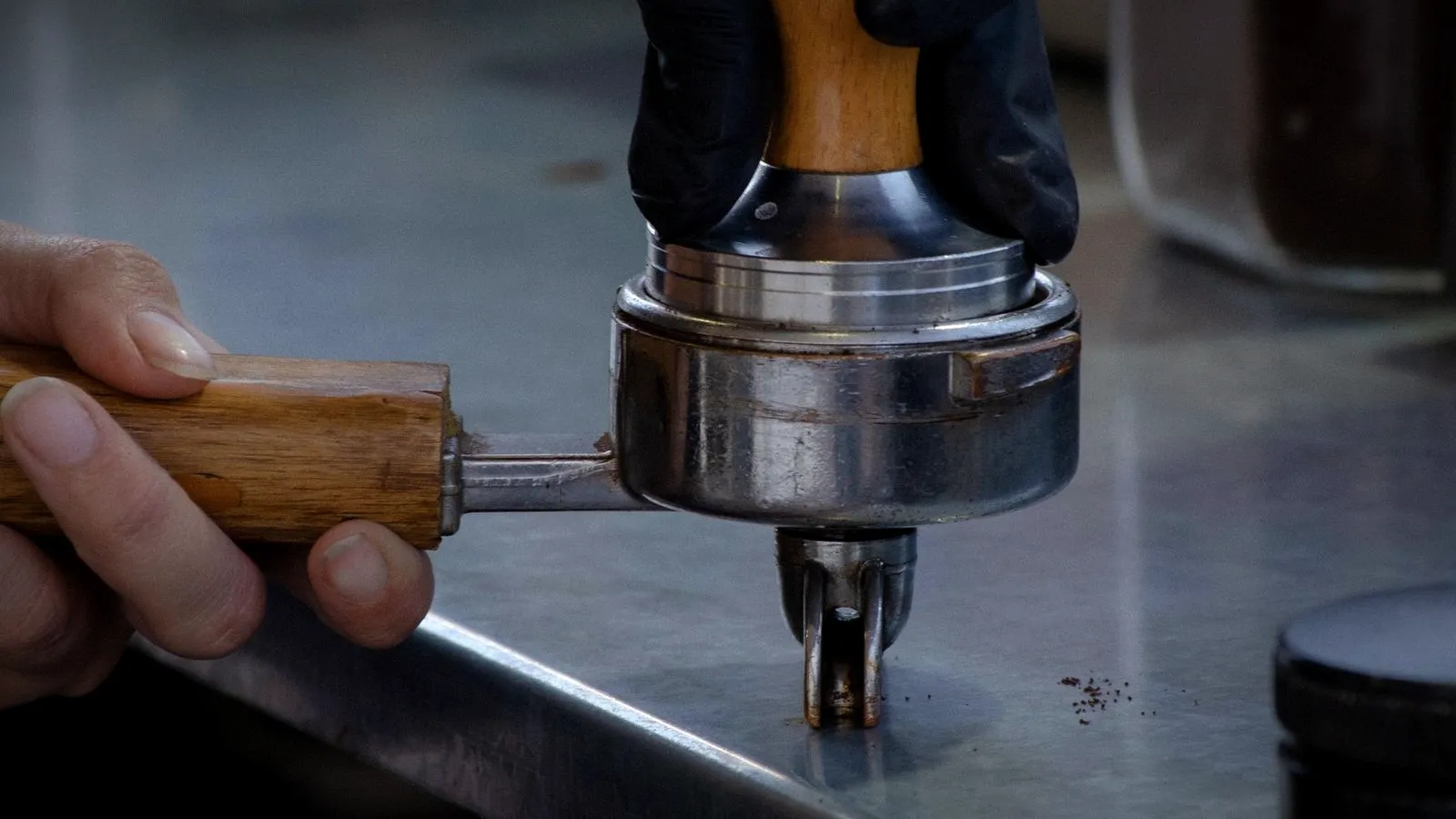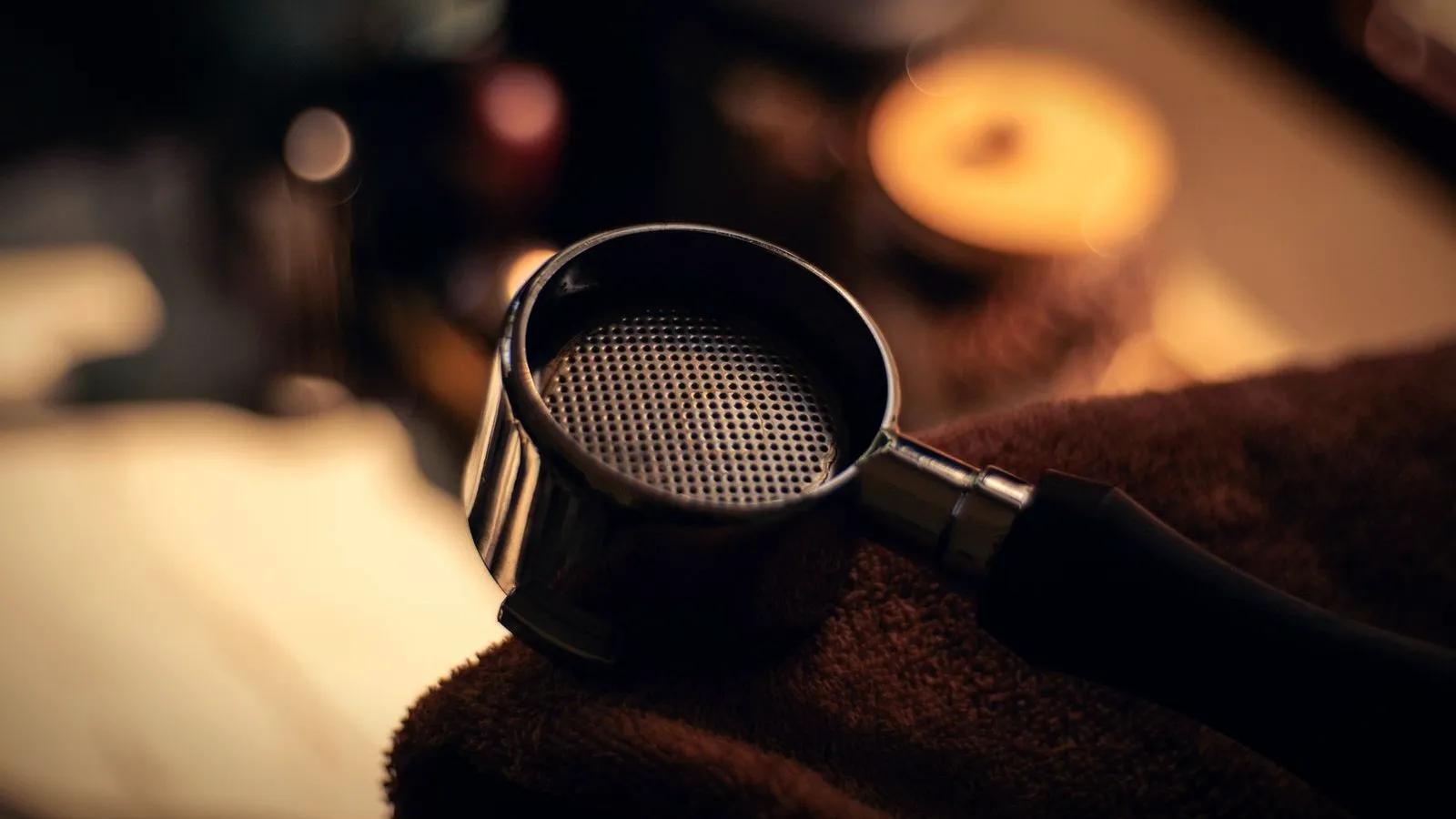
A bottomless portafilter (also called a naked portafilter) is a portafilter with the spouts and the bottom of the metal cup cut away, so the underside of the filter basket is exposed. You can watch espresso form on the basket floor, which makes channeling, uneven tamping and grind problems visible while the shot runs.
It doesn’t brew coffee any differently. What it changes is feedback: instead of guessing why a shot tastes sour or harsh, you can see where the water went. This guide covers what a bottomless portafilter shows, the trade-offs, how to match the size to your machine and how to read a shot. If you’re still learning the basic routine, start with our step-by-step guide on how to use an espresso machine.
The short answer
| Question | Answer |
|---|---|
| What it is | A portafilter with no spouts and an open bottom, so the basket underside is visible |
| What it shows | Channeling, uneven distribution, uneven tamping, grind that is far too fine or coarse |
| Main benefits | Instant visual feedback, easy cleaning, extra cup clearance |
| Main downsides | Spray and mess when a shot channels; can’t split a double into two cups |
| Common sizes | 51 mm, 54 mm, 58 mm, matched to your machine’s group head |
| Basket to use | Single-wall (non-pressurized), not a dual-wall pressurized basket |
| Worth it? | Yes if you grind fresh and want to improve; little use with pre-ground coffee and pressurized baskets |
What is a bottomless portafilter?
A standard portafilter is a metal cup with a handle that holds the filter basket and locks into the group head. Under the basket, a closed cup gathers the espresso and sends it out through one or two spouts. A bottomless portafilter removes that cup, leaving only a ring that holds the basket by its rim.
With nothing under the basket, the espresso drips straight from the basket’s holes into your cup. That is why it is also called a naked portafilter: nothing is hidden. Everything else, including the basket, the dose and the tamp, stays the same.
What a bottomless portafilter shows you
A bottomless portafilter shows how water is moving through the coffee puck, so channeling, uneven distribution and grind problems become visible during the shot. Water always takes the easiest path through the puck. If the puck has a weak spot, such as a loose area, a crack or a gap along the basket wall, more water rushes through it. Breville’s espresso machine manual calls this channeling: water bypassing the ground coffee during extraction.
A channel over-extracts the coffee around it and under-extracts the rest, so the cup can taste bitter and sour at once. With spouts, all of that mixes together before it reaches the cup, and you only taste the result. A bottomless portafilter shows the channel as a spurt, a spray or a pale stream, so you can connect the flavor to a cause.
It is also a good grind check. A shot that gushes pale almost immediately is running far too fast, and one that barely drips from a few holes is choking.
Bottomless portafilter pros and cons
A bottomless portafilter’s main advantage is instant visual feedback on channeling and puck preparation, and its main drawback is the spray a channeling shot throws onto the cup, drip tray and machine.
| Pros | Cons |
|---|---|
| Shows channeling and uneven extraction as it happens | Channeling sprays coffee onto the drip tray, cup and machine |
| Useful training tool for distribution and tamping | Can’t split a double shot into two cups without spouts |
| Fewer metal surfaces for coffee to touch; nothing to scrub inside spouts | Less forgiving to watch; flaws you used to ignore become obvious |
| More vertical space under the basket for a cup and scale | Needs a basket and grinder that give you real control |
| Lets you see the whole basket floor, not just a spout | Adds nothing if you use pressurized baskets |
The mess is the main complaint, and it is also the point. Spray tells you something went wrong; the fix is better puck preparation, not a different portafilter.
Bottomless portafilter sizes: match your machine
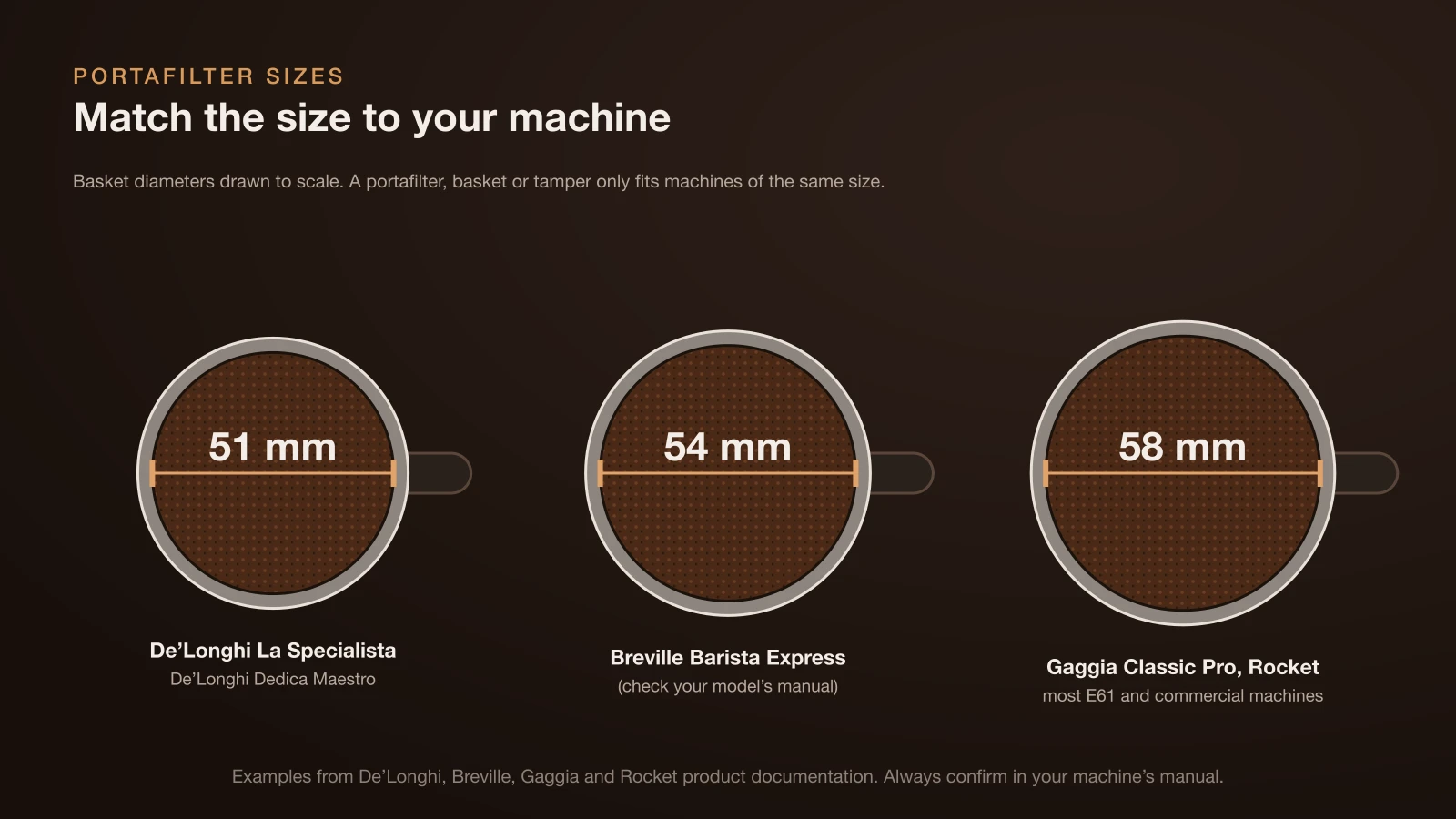
A bottomless portafilter has to match your machine’s group head in diameter and in the lug (ear) design that locks it in place. The common home portafilter sizes are 51 mm, 54 mm and 58 mm, shown here with examples taken from the manufacturers’ own specifications:
| Size | Example machines (manufacturer spec) | Notes |
|---|---|---|
| 51 mm | De’Longhi La Specialista and Dedica Maestro | De’Longhi sells its own 51 mm bottomless portafilter for these models |
| 54 mm | Breville Barista Express (BES870) | Breville lists a “54mm stainless steel portafilter” in the manual |
| 58 mm | Gaggia Classic Pro, Rocket machines, most E61-style and commercial machines | The widest range of aftermarket baskets and tools |
Diameter alone is not enough. De’Longhi, for example, lists its 51 mm bottomless portafilter as compatible with La Specialista and Dedica Maestro models, not every 51 mm De’Longhi machine. Always check the portafilter maker’s compatibility list for your exact model number.
If you’re choosing a machine and want the most basket options, 58 mm is the size to look for. Our guide to Rocket espresso machines covers one 58 mm family, and our Breville Bambino vs Bambino Plus comparison looks at two compact Breville models.
Which basket to use in a bottomless portafilter
Use a single-wall (non-pressurized) basket in a bottomless portafilter, because a pressurized dual-wall basket hides what the portafilter is meant to show. There are two broad types.
Pressurized (dual-wall) baskets
A pressurized basket has a second wall with a single small exit hole. Breville says its Dual Wall baskets “regulate the pressure” to help extraction “regardless of the grind, dose, tamp pressure or freshness,” and recommends them for pre-ground coffee. That is useful for convenience, but it hides exactly what a bottomless portafilter is meant to show, because you only see one jet.
If you mostly use pre-ground coffee, our guide to espresso grounds explains why pressurized baskets suit it better.
Single-wall (non-pressurized) baskets
A single-wall basket has one perforated floor, and the puck alone creates resistance. Breville recommends its Single Wall baskets when you grind fresh beans, because they let you adjust grind, dose and tamp. This is the basket to use with a bottomless portafilter.
For reference, Breville rates its 54 mm baskets at about 8–11 g for the single and 16–19 g for the double.
Precision baskets
“Precision” baskets are made to tighter hole tolerances than typical stock baskets. VST, one well-known maker, says its baskets are matched to a total open area within ±5% and that every hole is measured. VST baskets fit most 58 mm portafilters, not 54 mm ones, and come in sizes from a 7 g single to a 25 g triple.
VST also notes that its larger baskets (20 g and up) may need a bottomless portafilter on some machines, because a deep basket can hit the bottom of a spouted one. A precision basket does not fix poor puck preparation, but it removes one variable.
How to use a bottomless portafilter
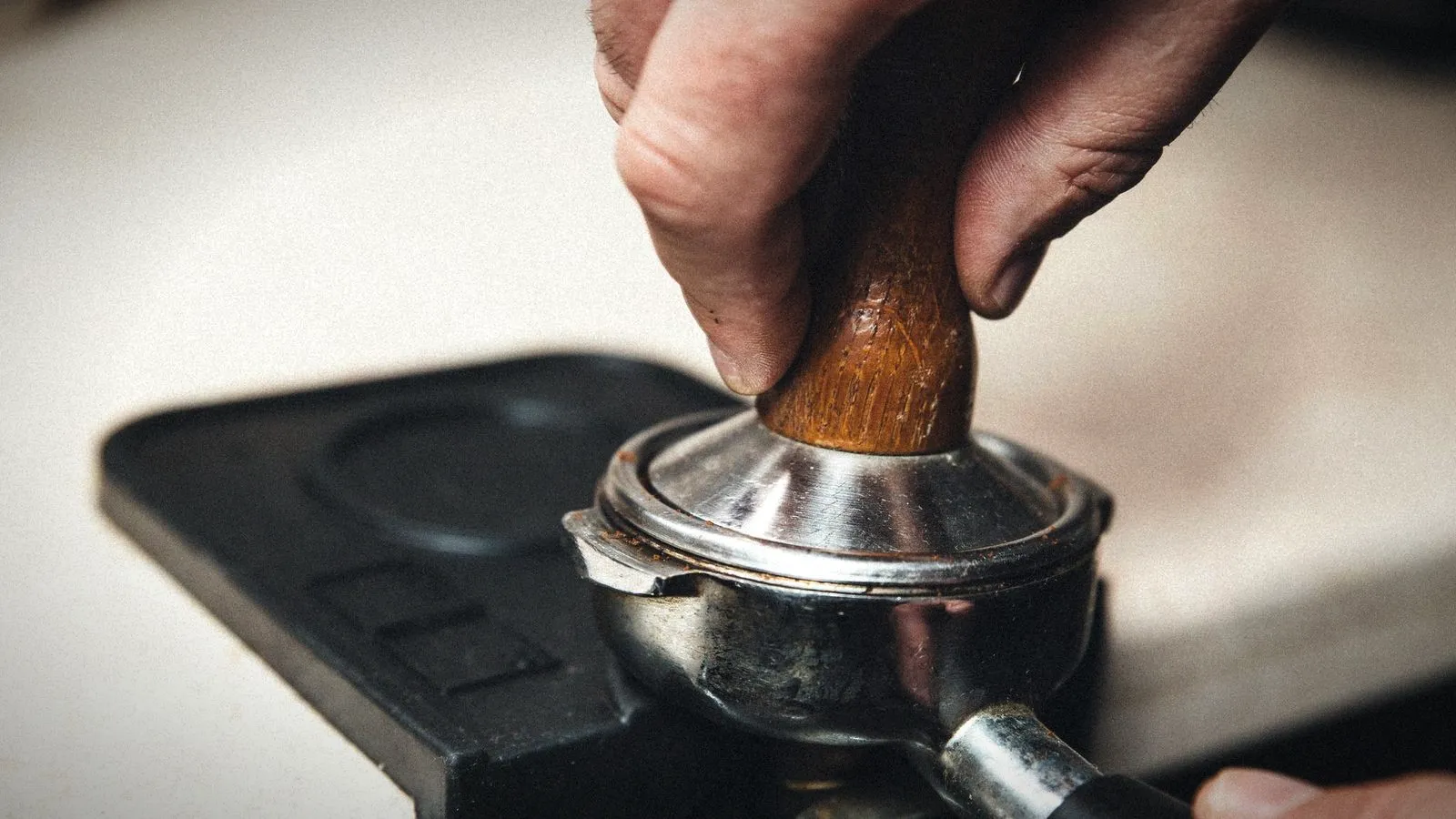
You use a bottomless portafilter exactly like a spouted one; the extra care goes into puck preparation, because it will show every mistake.
- Preheat and dry. Lock the empty portafilter into the group head to warm it, then wipe the basket dry. Breville notes that moisture can encourage channeling.
- Dose by weight. Use the dose your basket is designed for. Too little coffee leaves headspace that lets the puck shift; too much can press against the shower screen.
- Break up clumps and distribute. Stir the grounds with a fine-needle tool (often called WDT) or tap the portafilter so the bed is even from edge to edge. Our espresso distributor guide compares needle and leveling tools.
- Tamp level. Press straight down with a tamper that matches the basket size. A tilted tamp leaves one side thinner, and water will favor it. See how to tamp espresso for the full technique.
- Place the cup close. Put the cup, or a cup on a scale, as close under the basket as it fits. A short drop means less splashing.
- Brew and watch. Start the shot and watch the basket floor for the first few seconds, then keep an eye on the stream color.
- Clean up. Knock out the puck, rinse the basket and wipe any spray off the machine and drip tray.
For choosing the coffee itself, see our guide to espresso beans. Fresher, evenly ground coffee channels less.
How to read a shot from a bottomless portafilter
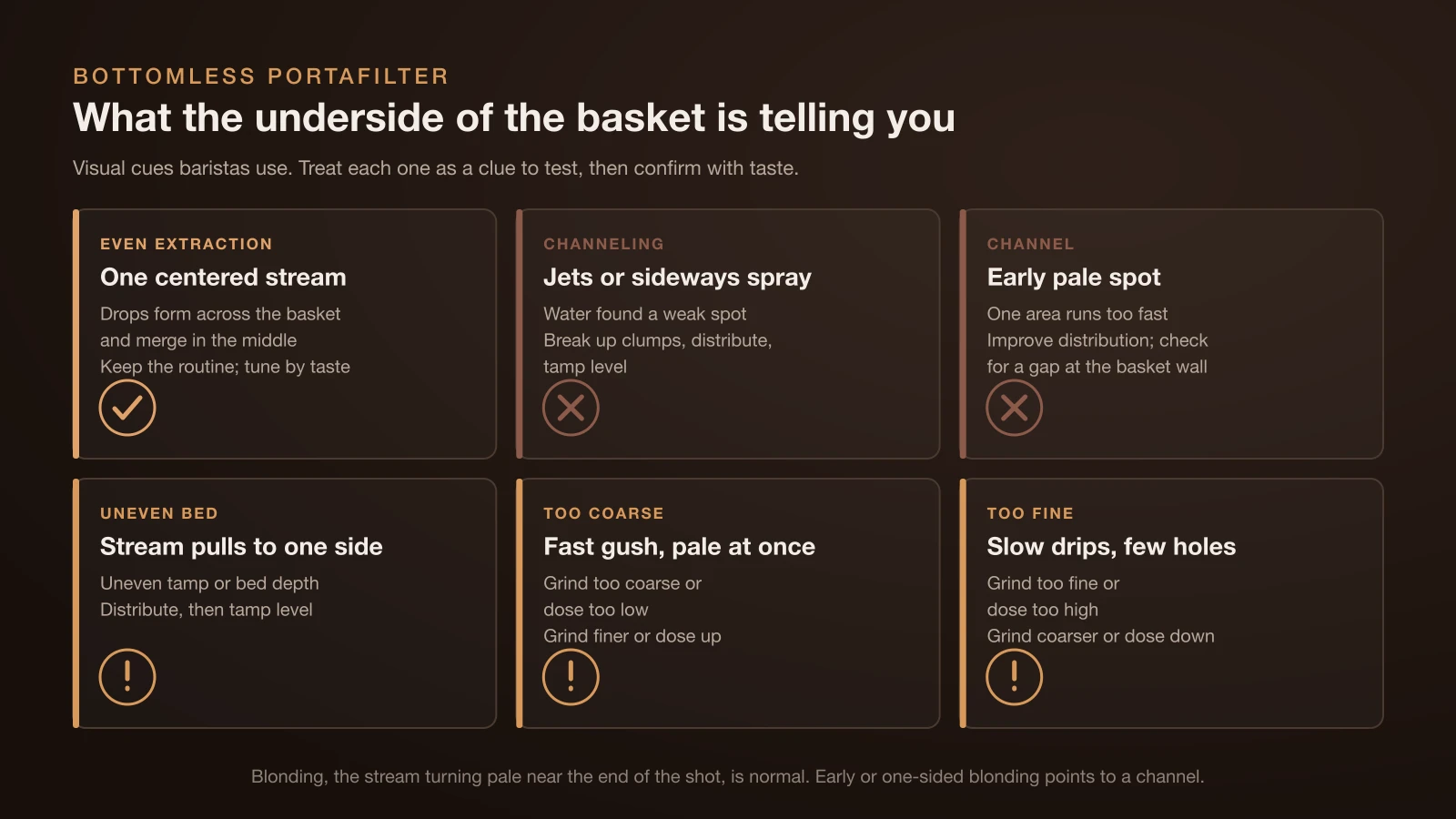
A good shot starts as drops across the basket floor that merge into one centered stream, while sideways spray, early pale spots or a leaning stream point to a problem. Baristas widely use these patterns as visual cues, so treat them as clues to test, then confirm with taste.
| What you see | What it usually means | What to try |
|---|---|---|
| Drops appear across the basket, merge into one centered stream | Even extraction | Keep your routine; adjust grind for taste |
| Tiny jets or spray shooting sideways | Channeling through a weak spot in the puck | Break up clumps, distribute more evenly, tamp level |
| A pale or white spot early in the shot | A channel in that area running water through too fast | Improve distribution; check for a gap at the basket wall |
| Stream pulls to one side | Uneven tamp or uneven bed depth | Tamp level; distribute before tamping |
| Coffee appears first only at the edges | Water running down the basket wall | Check dose and tamp; make sure the edge of the bed is packed |
| Gushes fast and turns pale right away | Grind too coarse or dose too low | Grind finer or increase the dose |
| Slow drips from only a few holes, long before a stream forms | Grind too fine or dose too high | Grind coarser or reduce the dose |
What is blonding?
Toward the end of every shot, the stream turns lighter, from dark brown to pale yellow. This is called blonding, and it is normal. It is only a warning sign when it happens early or in one spot, which points to a channel. Many people stop the shot around the point the whole stream blonds, or at their target weight, whichever comes first.
Is a bottomless portafilter worth it?
It is worth it if you grind your own beans with a capable grinder, use single-wall baskets and want to get better at puck preparation. For the price of an accessory, it gives you faster feedback than taste alone. It also suits people who find cleaning spouts a chore.
It is less useful if you use pre-ground coffee with pressurized baskets, often split a double into two cups, or simply want a quick morning shot without adjusting anything. If you’re deciding between hands-on and push-button brewing, our comparison of manual espresso machines is a good place to see where this kind of tinkering fits.
The bottom line
A bottomless portafilter doesn’t make espresso on its own; it shows you how your espresso is being made. Match it to your machine’s diameter and lugs, pair it with a single-wall basket, and use what you see, such as spray, pale spots or a leaning stream, to fix distribution, tamping and grind. Expect some mess at first; that mess is the feedback.
Sources
- Breville: Barista Express BES870 instruction book (54 mm portafilter, Single Wall vs Dual Wall baskets, 8–11 g and 16–19 g basket doses, channeling note)
- De’Longhi: Rosewood Bottomless Portafilter DLSC085 (51 mm, compatible with La Specialista and Dedica Maestro)
- Gaggia North America: Gaggia Classic Pro (58 mm stainless steel portafilter)
- Rocket Espresso: Tamper (58 mm diameter suits all Rocket Espresso machines)
- VST: Precision Filter Baskets (±5% open area, sizes, fit 58 mm only, larger baskets may need a bottomless portafilter)