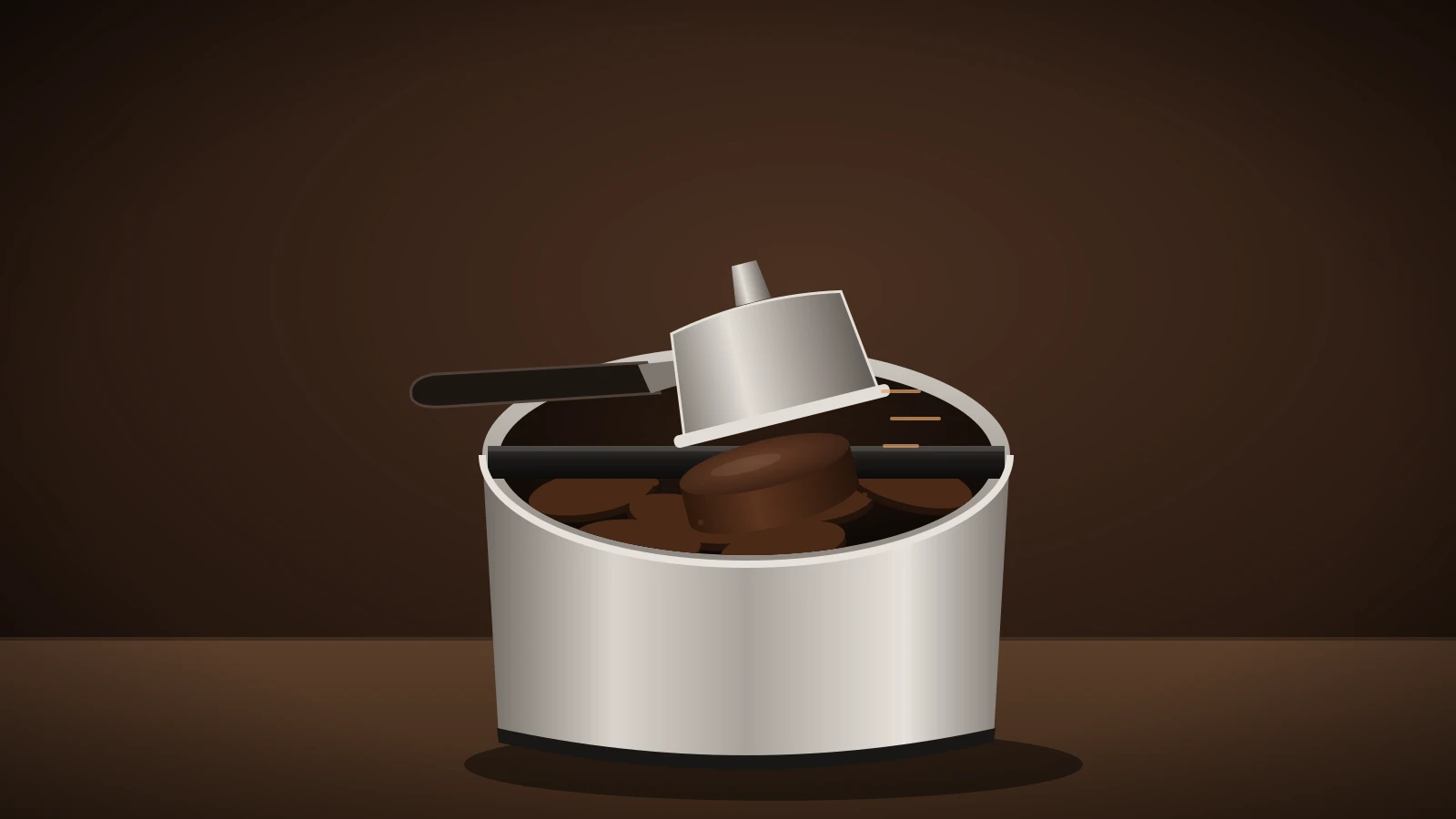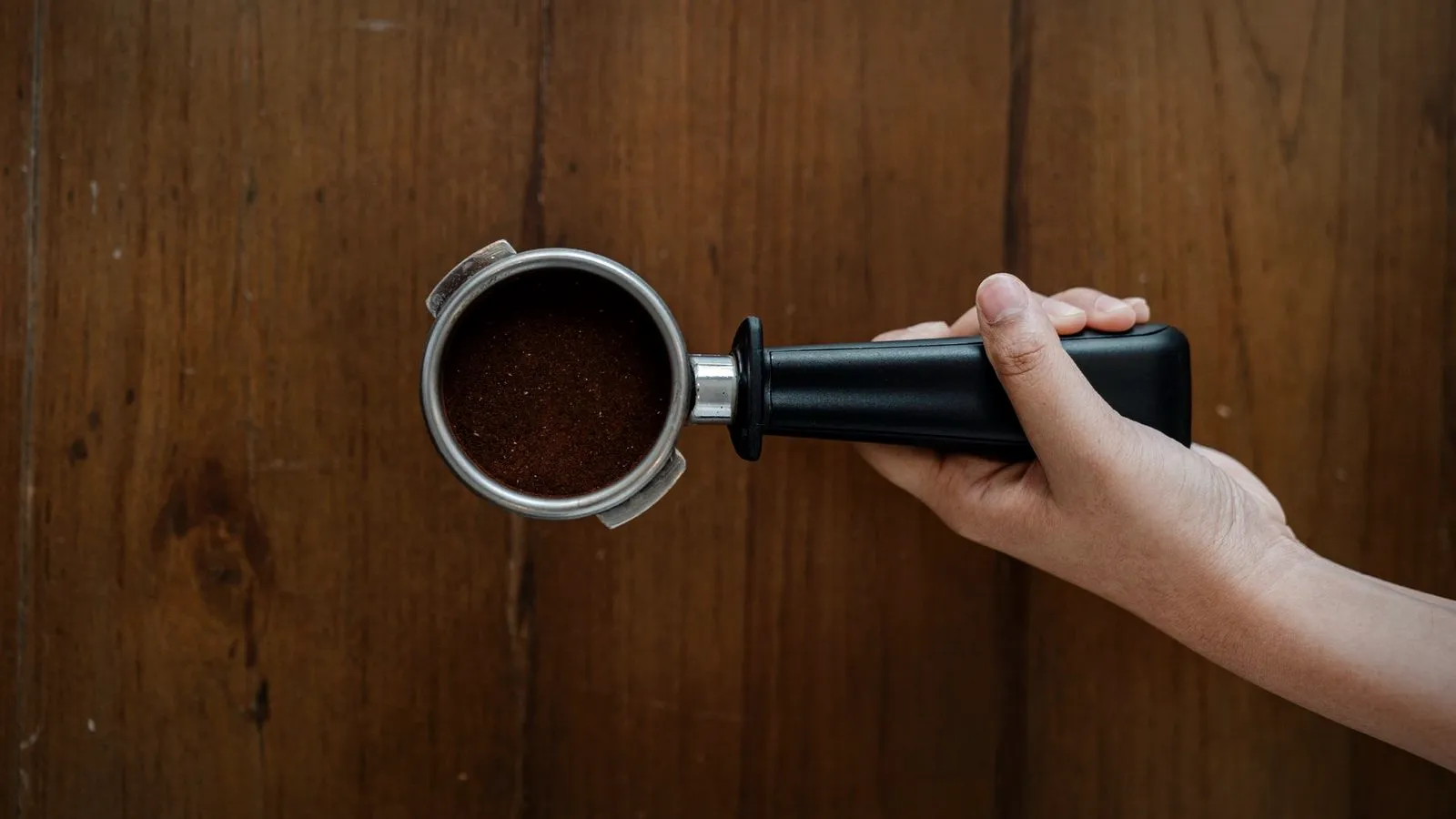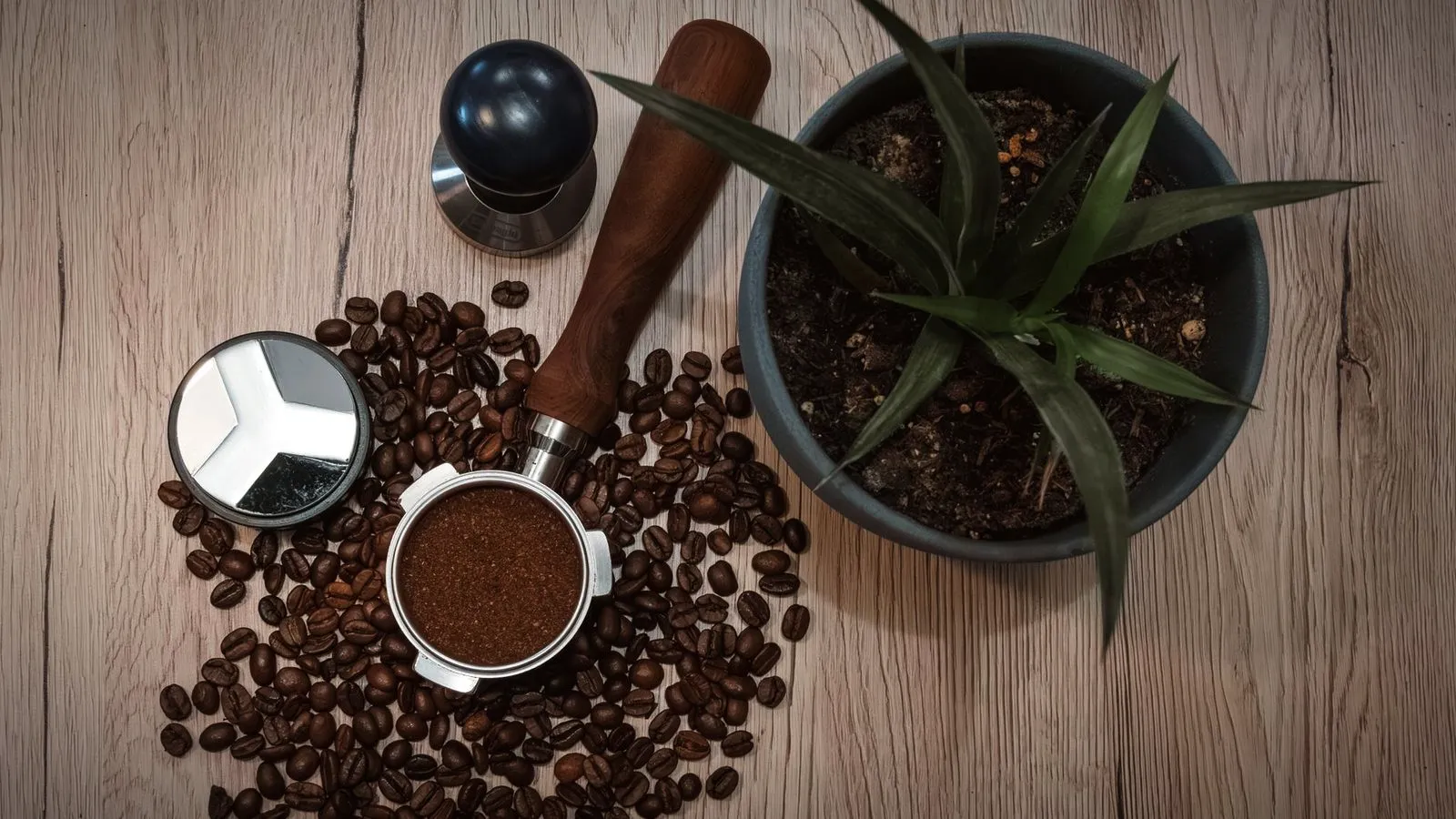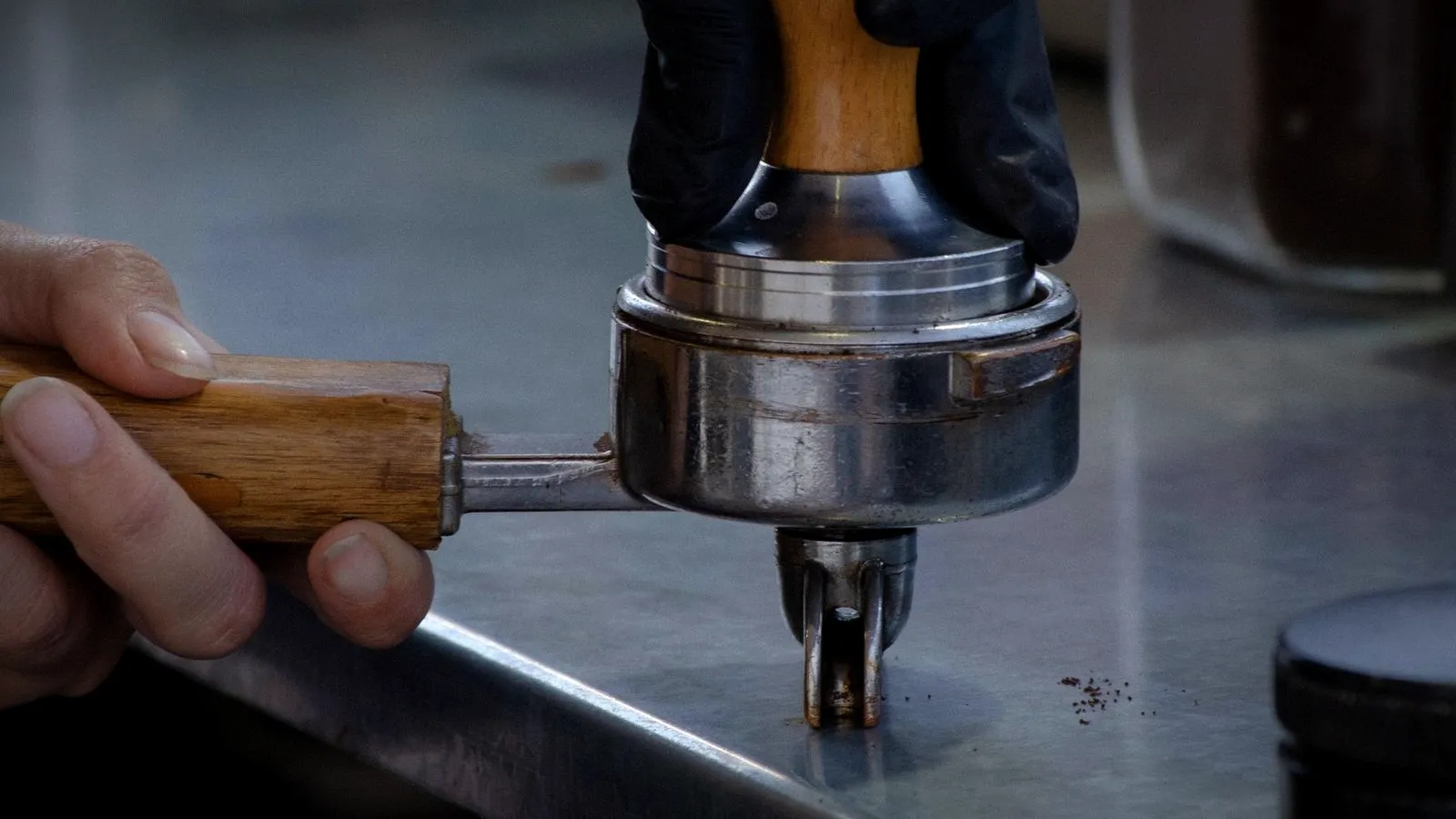
An espresso distributor (also called a leveler) is a disc with angled blades that you rest on the portafilter basket and turn, so the grounds spread into a flat, even bed before tamping. It does not compress the coffee. A WDT needle tool breaks up clumps first, and a tamper does the compressing afterward.
These tools exist because water takes the easiest path through the coffee puck, and an uneven bed gives it one. This guide covers what each tool does, what to check before you buy, how to set the depth and where each step fits before you tamp espresso.
The short answer
| Tool | What it does | When you use it | Needed? |
|---|---|---|---|
| WDT (needle) tool | Breaks up clumps through the whole bed | Right after grinding | Helpful if your grinder clumps |
| Espresso distributor (leveler) | Sweeps the top layer flat to a set depth | After WDT, before tamping | Optional; tapping also works |
| Tamper | Compresses the bed into a firm puck | After distributing | Yes |
| Puck screen | Sits on the tamped puck under the shower screen | After tamping | Optional |
| Dosing funnel | Keeps grounds from spilling while you grind and stir | While grinding, removed before brewing | Optional |
What does an espresso distributor do?
An espresso distributor evens out the height of the coffee bed so the tamper compresses the same amount of coffee everywhere. You set it on the basket, where it rests on the rim, and turn it a few times. Its angled blades or facets push grounds from high spots into low spots and leave a flat surface.
Breville’s Distribution Duo uses a face with three angled blades to leave a level top surface for tamping. La Marzocco says its faceted Primo tool emulates the Stockfleth’s method, a finger distribution technique used by professional baristas.
A distributor only reaches as deep as its blades, so it cannot break up clumps lower in the bed. It levels coffee; it does not replace a tamper or fix a grind or dose that is wrong.
What to check before you buy an espresso distributor
Before you buy an espresso distributor, check its size, depth adjustment and fit on your basket; these matter more than the brand.
- Diameter that matches your basket. Tools are sold for 51 mm, 54 mm and 58 mm portafilters. The base rarely matches that number exactly: one maker sells 53.3 mm tools for Breville’s 54 mm machines but 58.5 mm tools for standard 58 mm baskets. Too small leaves a ring of loose coffee at the wall. Our portafilter size guide shows which basket each machine family uses.
- Adjustable, lockable depth. The depth should change in small steps and stay put. One maker’s range runs from 4 to 12 mm.
- A rim that sits on your basket. Some tools do not seat on baskets with flat, 90° shoulders, so check the lip shape your basket has.
- Fine needles on a WDT tool. Makers list needles of about 0.2–0.3 mm (200–300 microns). La Marzocco advises looking for fine stainless steel prongs.
- Needle length and count. Needles should reach the basket floor. Some tools use removable needles you can trim or swap for deeper or shallower baskets.
- Puck screen size and thickness. A screen must match the basket diameter, and in a very full basket its thickness can crowd the shower screen.
- Cleaning. Some tools are hand wash only, so check before you put one in the dishwasher.
For tamper sizes, base shapes and types, see our guide to choosing an espresso tamper.
WDT: the needle distribution method
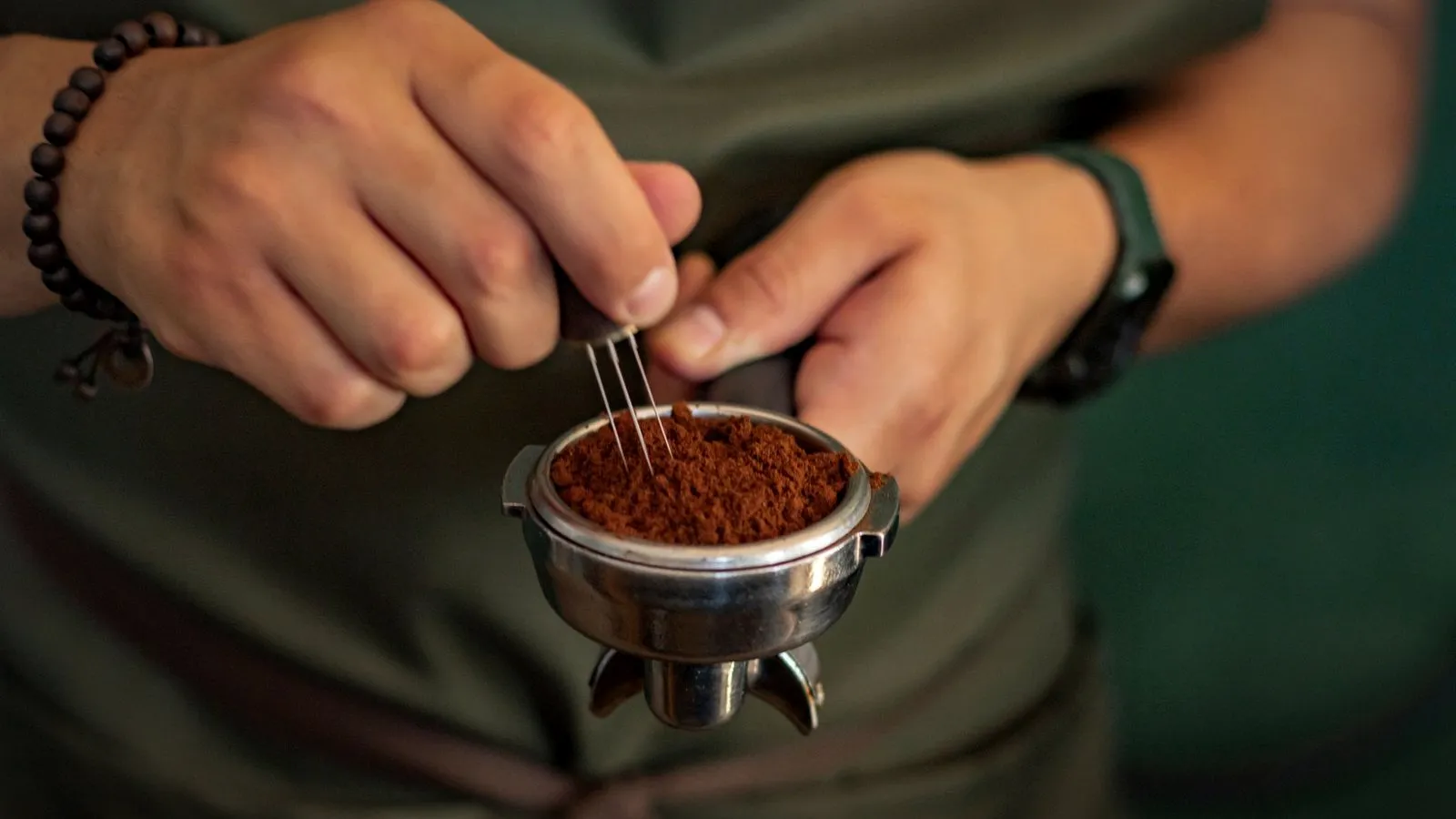
WDT, short for Weiss Distribution Technique, means stirring the grounds with very fine needles to break up clumps and spread coffee evenly before tamping. Breville’s Distribution Duo has 8 removable pins that can be set straight or angled, and Weber Workshops’ Moonraker moves its needles in a spirograph-like pattern at two heights; Weber says 2 or more turns are enough.
Researchers use the method too. In a 2026 study in Physics of Fluids, the team shook each 18.5 g dose in a blind shaker, evened out the upper layer of the bed in a 58 mm basket with a 3D-printed WDT tool fitted with acupuncture needles, then tamped it with an automatic tamper set to 20 kg.
How to use a WDT tool
- Grind into the basket, ideally with a dosing funnel in place to catch stray grounds.
- Push the needles to the bottom of the bed near the wall.
- Stir in small circles while slowly working around the basket and across the middle, until no clumps are left.
- Finish near the surface with a few light passes so the top is loose and roughly even.
- Give the portafilter one gentle tap on the counter to settle the bed before leveling or tamping.
Espresso distributor vs WDT tool vs tamper
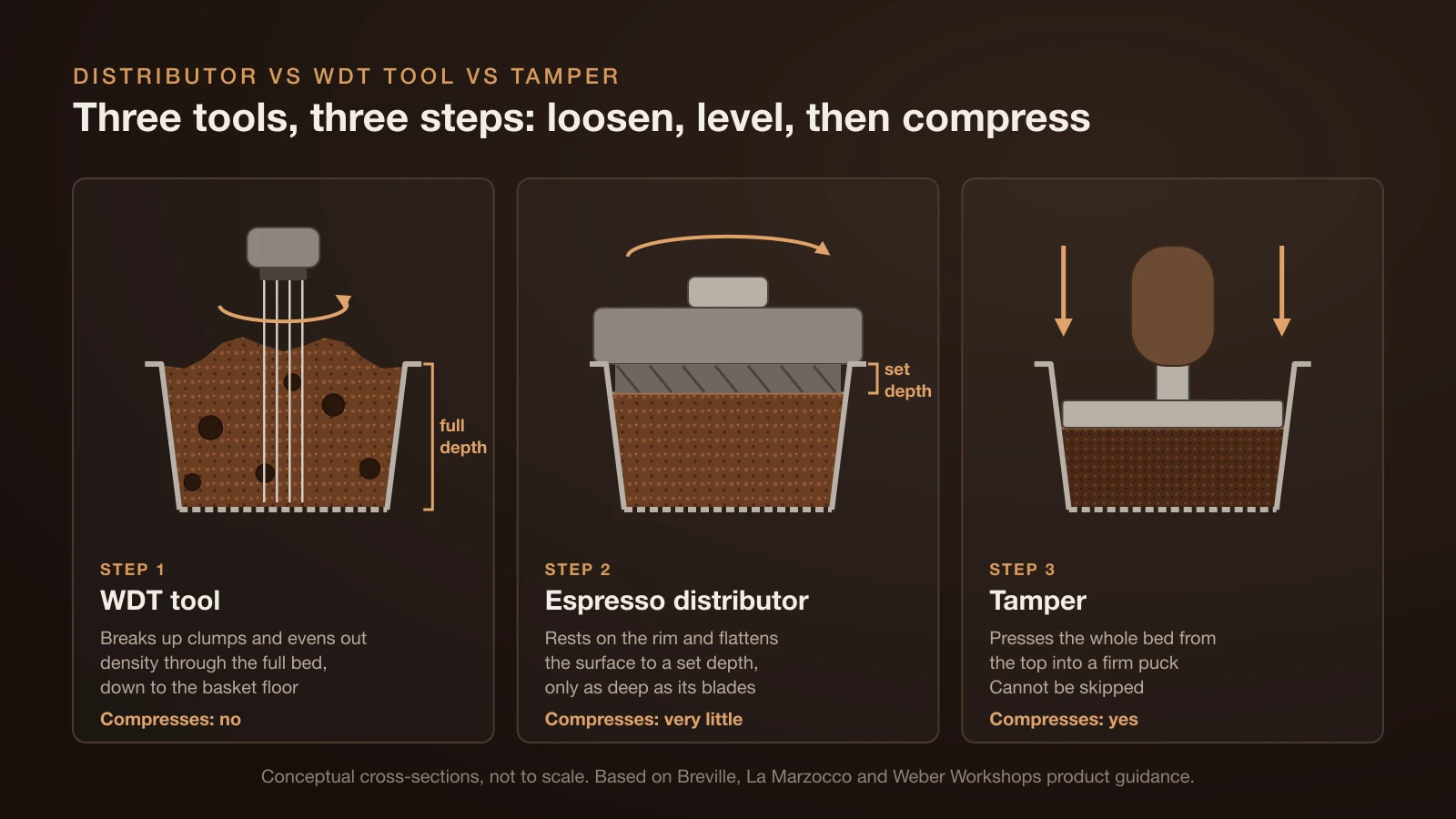
An espresso distributor levels the surface, a WDT tool loosens the whole bed, and a tamper compacts it; they are three different steps, not three versions of one tool.
| WDT tool | Espresso distributor | Tamper | |
|---|---|---|---|
| Main job | Break up clumps, even out density | Flatten the surface to a set depth | Compress the bed into a puck |
| Depth it works at | Full bed, down to the basket floor | Only as deep as its blades | Whole bed, from the top |
| Compresses coffee? | No | Very little | Yes |
| Step in the routine | First | Second | Third |
| Can you skip it? | Yes, if your grounds do not clump | Yes; tapping or finger sweeping also works | No |
Combined tools, such as a needle-and-blade distributor or a palm-style leveling tamper, save time, but the order stays the same: loosen, level, then compress.
How to set distributor depth
Set the distributor so its blades just sweep the whole surface without packing the coffee down. Breville’s instructions say to adjust the height to match the desired depth of grounds in relation to the shower screen, which may vary with the size of the filter basket. One maker lets you adjust the blade depth from 4 to 12 mm by loosening the middle rim.
- Start shallow. Set the blades high enough that they barely touch the grounds.
- Turn it on a dosed basket and look at the surface. If some areas were not touched, lower the blades a little.
- Stop before it compresses. If the blades leave a shiny, packed surface or you feel resistance, raise them.
- Reset when the dose changes. A heavier dose or a different basket needs a new depth.
Puck screens: what they do
A puck screen is a thin, perforated metal disc that sits on top of the tamped puck, between the coffee and the machine’s shower screen. Normcore, which makes them, says a screen disperses water more evenly across the puck, reduces channeling and keeps grounds from sticking to the shower screen. Treat those as the maker’s claims; a cleaner shower screen is the one you can check for yourself.
Normcore’s standard screen is 1.7 mm thick and, for very full baskets, it suggests reducing the dose by 0.5–1 g to keep clearance between the puck and the shower screen. La Marzocco’s check still applies: if the imprint of the shower screen screw shows on the puck before any water has run through it, there may be too much coffee in the basket, or the grind may not be fine enough.
Puck prep step by step: grind, WDT, level, tamp
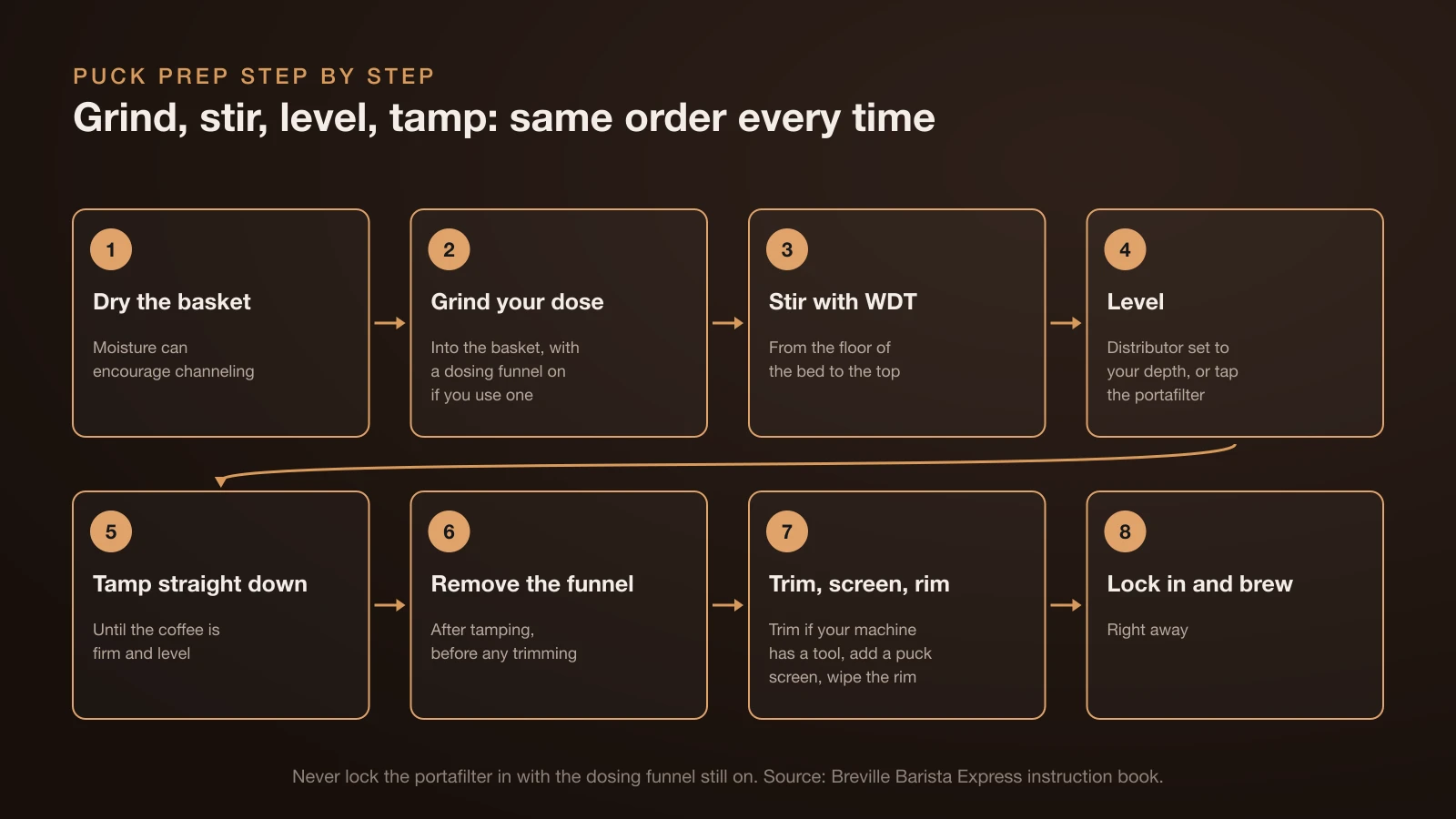
A full puck-prep routine is grind, stir, level, tamp and brew, in the same order every time. Breville’s Barista Express manual adds one warning: never lock the portafilter into the group head with the dosing funnel still on.
- Dry the basket. Breville notes that moisture can encourage channeling.
- Grind your dose into the basket, with a funnel in place if you use one.
- Stir with the WDT tool from the floor of the bed to the top.
- Level with the distributor set to your depth, or tap the portafilter a few times.
- Tamp straight down until the coffee is firm and level. Our guide on how to tamp espresso covers pressure and common mistakes.
- Remove the funnel, then trim if your machine has a trimming tool. Breville takes the funnel off after tamping; its Razor then rests on the basket rim and trims the tamped puck to the right level.
- Add a puck screen if you use one and wipe the rim.
- Lock in and brew right away.
Does an espresso distributor fix channeling?
An espresso distributor can reduce channeling that comes from an uneven bed, but it cannot fix channeling caused by grind, dose or a tilted tamp. La Marzocco explains that uneven distribution creates air pockets, and water then follows those paths of least resistance. A 2020 study in the journal Matter linked uneven flow through the puck to shots that are under- and over-extracted at the same time.
A bottomless portafilter shows where the water went: spurts, sideways spray and a stream that leans to one side point to the puck, while an even but fast or slow stream points to the grinder.
| What you see or taste | Likely cause | What to change |
|---|---|---|
| Spurts or tiny sideways jets | Clumps or uneven density | Stir with WDT, then level |
| Stream pulls to one side | Uneven surface or tilted tamp | Level, then tamp straight |
| Pale spot early in the shot | A channel in that area | Distribute more evenly; check the edge of the bed |
| Even stream, fast and sour espresso | Grind too coarse or dose too light | Adjust grind and dose, not distribution |
| Even stream, very slow | Grind too fine or dose too heavy | Grind coarser or reduce the dose |
Once shots flow evenly, use our method for dialing in espresso to adjust grind, dose and yield for taste.
Do you need an espresso distributor?
You do not need an espresso distributor to make good espresso, but it makes an even bed easier to repeat. Breville’s manual relies on tapping the portafilter to collapse and spread the grounds, and La Marzocco names finger distribution as an alternative to a tool.
Both tools earn their place when you grind fresh into a single-wall basket and your grinder produces clumps. They matter much less with pressurized (dual-wall) baskets, which Breville says help the extraction regardless of grind, dose, tamp pressure or freshness.
The bottom line
An espresso distributor levels the grounds to a set depth, a WDT tool breaks up clumps through the whole bed, and a tamper compresses the result. Choose one that matches your basket and has a depth you can lock. If shots still spurt, check the puck; if they run evenly but taste off, change the grind.
Sources
- Breville: Barista Express BES870 instruction book (tapping to collapse and distribute, dosing funnel use, Razor trimming, dry basket, dual-wall baskets) and the Distribution Duo 54 mm (8 removable pins, three angled blades, depth relative to the shower screen)
- La Marzocco: What should my espresso puck look like? (air pockets and channeling, finger distribution, screw imprint check), Primo coffee distribution tool (Stockfleth’s method, 58.3 mm) and Espresso accessories for every home barista (fine stainless steel prongs)
- Weber Workshops: Moonraker (WDT, 300 and 200 micron needles, 2+ turns, fit on 58 mm baskets with rolled lips, not flat 90° shoulders)
- Normcore: Coffee distributor, V blade base (51, 53.3 and 58.5 mm sizes, 4–12 mm depth, hand wash), 0.25 mm WDT tool and Espresso puck screen (placement, claims, 1.7 mm, reduce dose 0.5–1 g)
- Research: Cameron et al., Matter (2020) (uneven flow and mixed extraction) and Waszkiewicz et al., Physics of Fluids (2026) (blind shaker, then WDT tool with acupuncture needles on the upper layer, 18.5 g dose, 58 mm basket, 20 kg tamp)