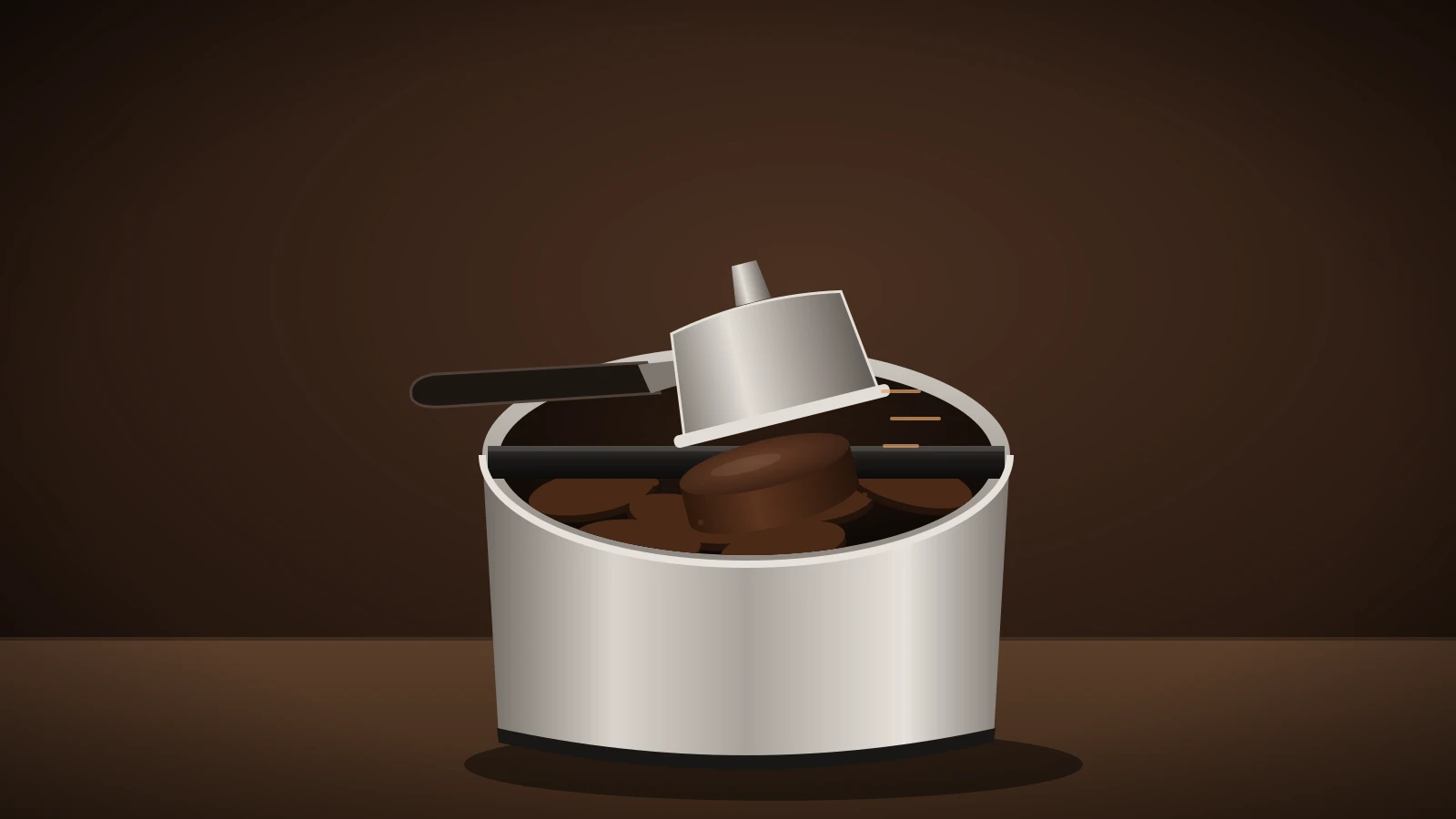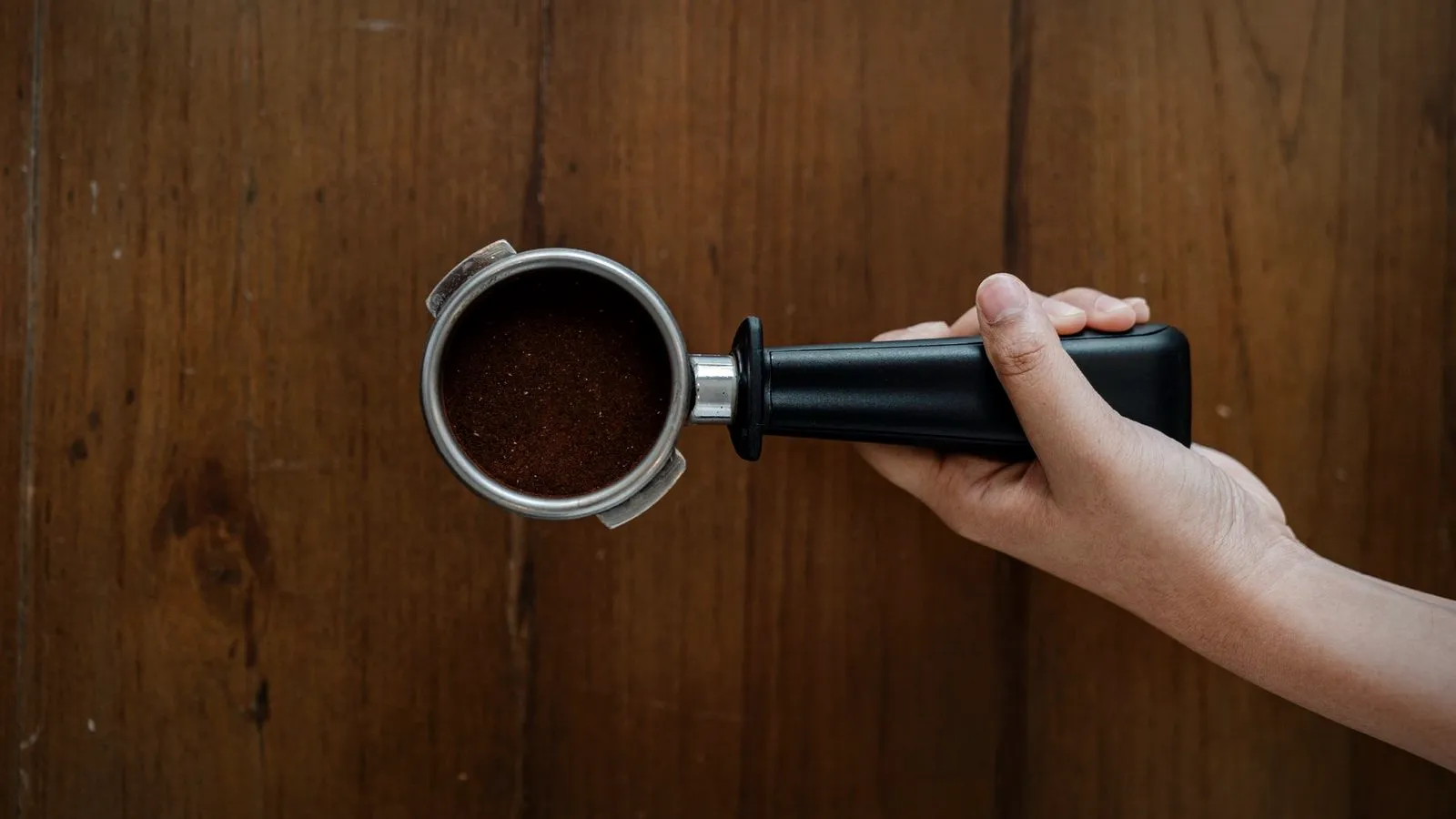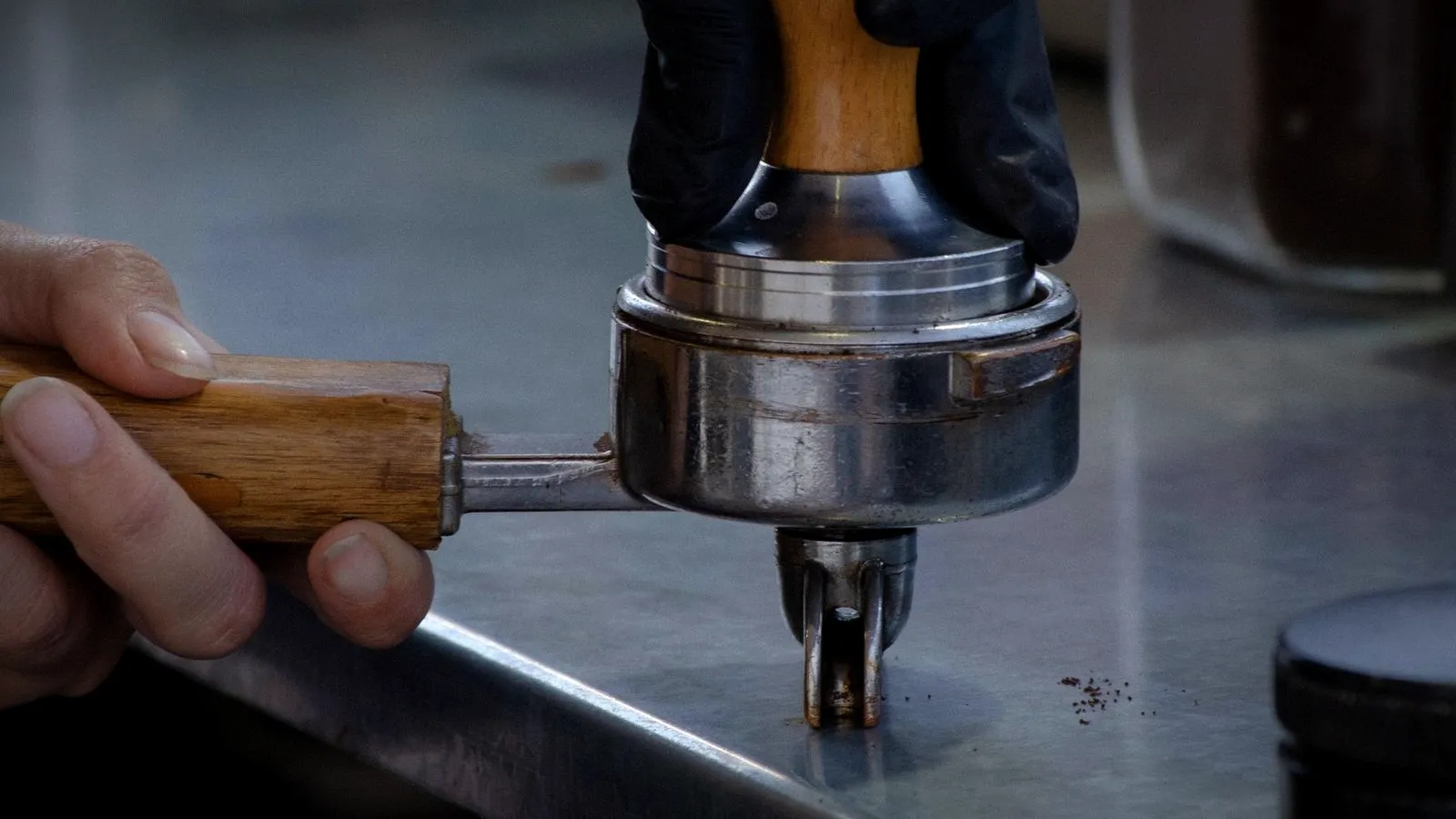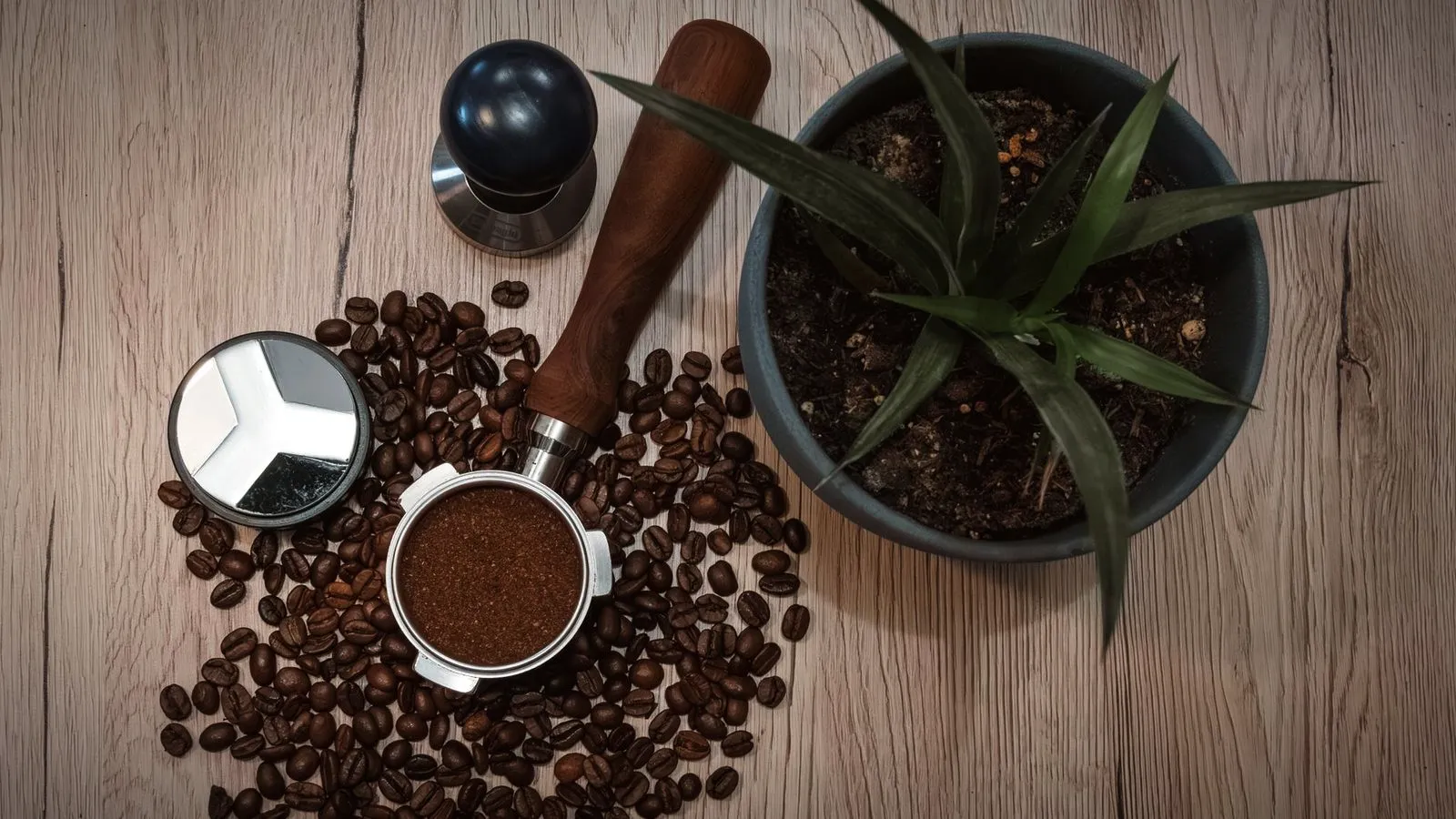
An espresso tamper is a handheld press with a metal base that packs ground coffee into a firm, level puck. The right espresso tamper matches your basket’s diameter: 51 mm for many De’Longhi pump machines, 54 mm for Breville’s Barista and Bambino machines, and 58 mm for machines such as the Gaggia Classic Pro and La Marzocco’s Linea Micra.
This guide covers sizes and how to measure your basket, base shapes, tamper types, weight and tamping mats. For the pressing itself, see our step-by-step guide on how to tamp espresso; for the steps before it, see our guide to the espresso distributor and WDT tools.
The short answer
| Question | Answer |
|---|---|
| What it does | Compresses loose grounds into an even puck that resists the water |
| Which size | The size your machine’s manual lists: commonly 51, 54 or 58 mm |
| Precision baskets | Some 58 mm baskets take 58.35–58.55 mm tampers for a closer fit |
| Base shape | Flat is the safe default; convex and ripple are alternatives |
| Types | Standard handled, calibrated or spring-loaded, palm (leveling) |
| Material | Stainless steel base; wood, aluminum or steel handle |
| Replace the stock one? | Worth it if it is a light scoop-tamper or fits loosely |
What an espresso tamper does
An espresso tamper turns a loose pile of grounds into a dense, flat puck, so water has to pass through all of the coffee instead of the easiest gap. Breville notes that untamped coffee takes up about three times the volume of tamped coffee. A 2020 study in the journal Matter described the purpose simply: coffee is tamped to level the bed.
Technique matters as much as the tool. In short, rest the portafilter on a flat surface, press straight down until the coffee feels firm and wipe the rim. Our guide on how to tamp espresso covers pressure, common mistakes and how to tell a tamping problem from a grind problem.
Espresso tamper sizes: match your basket
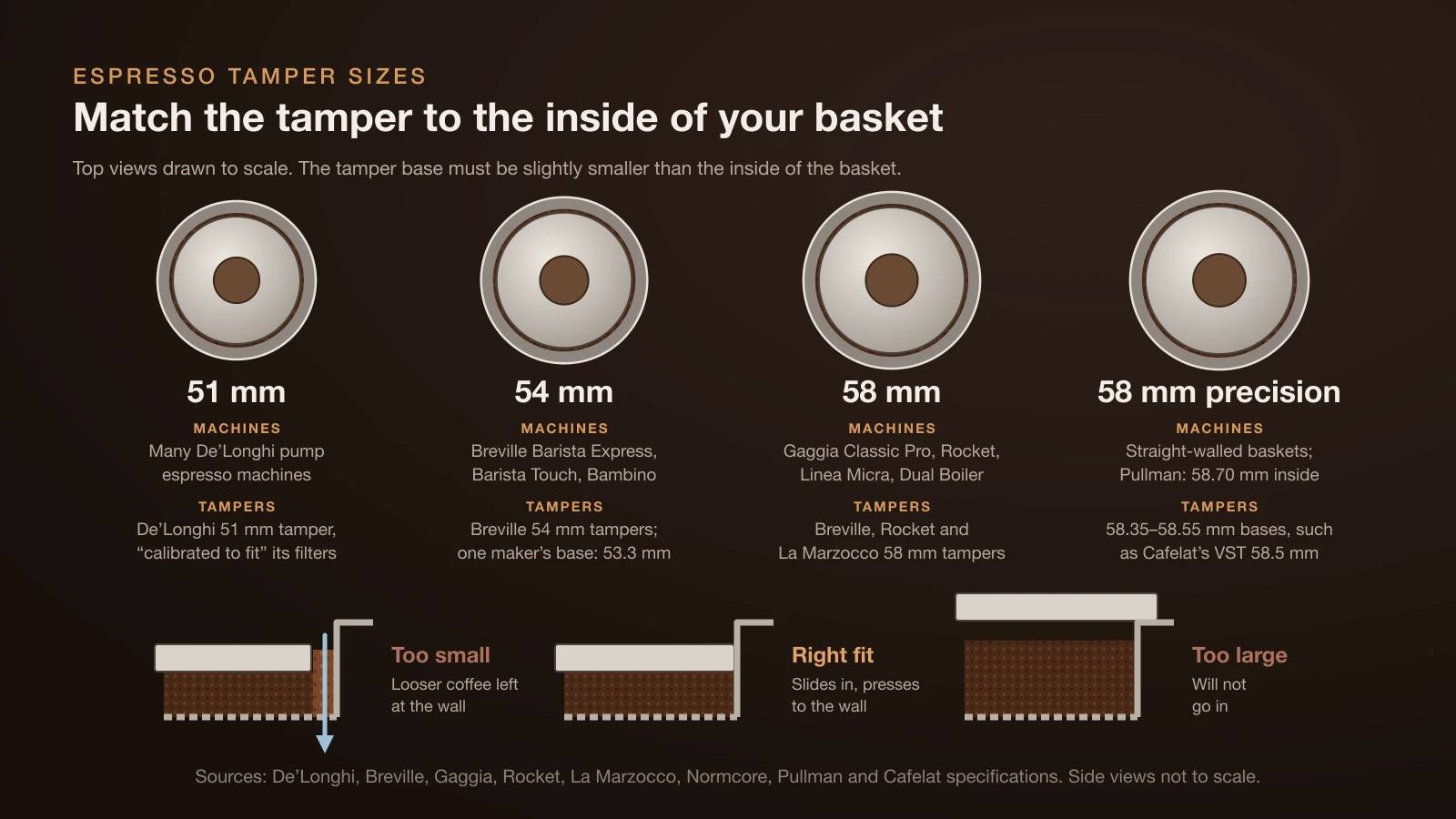
An espresso tamper has to match the inside diameter of your filter basket, so it presses the coffee all the way to the wall. Too small, and a ring of looser coffee stays at the edge, where water can run down the basket wall. Too large, and it will not go in.
| Nominal size | Machine examples (manufacturer specs) | Tamper examples from makers |
|---|---|---|
| 51 mm | Many De’Longhi pump espresso machines | De’Longhi 51 mm stainless tamper, “calibrated to fit” its filters |
| 54 mm | Breville Barista Express, Barista Touch, Bambino | Breville 54 mm tampers; one accessory maker sizes its base at 53.3 mm for the same machines |
| 58 mm | Gaggia Classic Pro, Rocket machines, La Marzocco Linea Micra, Breville Dual Boiler | Breville, Rocket and La Marzocco 58 mm tampers |
| 58 mm precision | Straight-walled precision baskets | 58.35–58.55 mm bases, such as Cafelat’s “VST 58.5 mm” |
The number on the box is a nominal size, not a promise of the exact base diameter. Breville sells its own tamper for these machines as 54 mm, while Normcore sizes its tamper for the same Breville models at 53.3 mm. Check the tamper maker’s compatibility list for your exact model number.
How to measure your basket
Measure the basket, not the portafilter or the group head. Use calipers across the inside of the basket at two or three angles and take the smallest reading; many baskets narrow toward the bottom, so measure near the height where the tamped coffee sits. Then compare it with the base diameter the tamper maker lists: you want a base slightly smaller than the basket, so it slides in without scraping.
Why 58.5 mm tampers exist
Precision baskets such as Pullman’s are ridgeless and wider inside than their nominal 58 mm, so a slightly wider tamper covers more of the coffee. Pullman, which makes both baskets and tampers, measures its 58 mm baskets at 58.70 mm inside. It says they suit tampers from 58 to 58.4 mm, and that its 58.55 mm BigStep base gives the most coverage. Cafelat sells a 58.5 mm flat base labeled for VST baskets.
A wide base only works if every basket you use is equally wide. A tamper that fits a precision basket snugly can bind in a narrower stock basket, so measure each one.
What to check before you buy an espresso tamper
Before you buy an espresso tamper, check the base diameter and shape, any leveling or pressure feature, and how the handle fits your hand; none of these depends on the brand.
- Base diameter in millimeters, matched to your basket, with a compatibility list that names your machine.
- Base shape. Flat unless you have a reason to choose another shape.
- Leveling feature. A plate that rests on the basket rim keeps the press level; a plain handle relies on your wrist.
- Pressure feedback. A spring or a click tells you when you have pressed enough; the rating should be stated in pounds or kilograms.
- Handle fit. Hold it the way you tamp; a handle that is too short or too thin makes a straight press harder.
- Weight and material. A stainless steel base does the work; the handle material is mostly about grip and looks.
- Replaceable parts. Some tampers use interchangeable bases or springs, useful if you change baskets later.
Base shapes: flat, convex and ripple
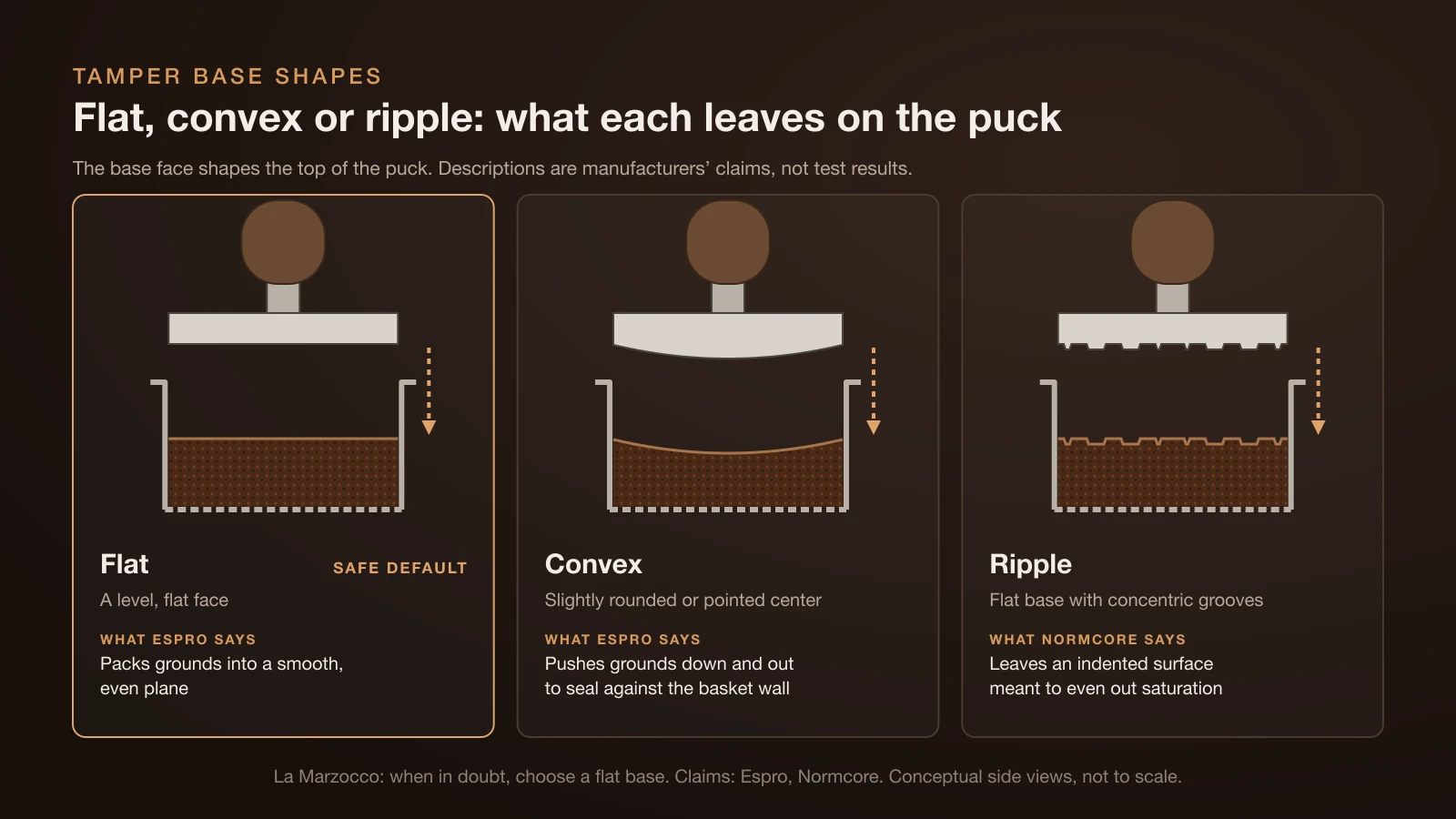
A flat base is the standard and the safest choice for most people, while convex and ripple bases change the surface of the puck on purpose. La Marzocco’s advice is simple: when in doubt, choose a tamper with a flat base.
| Base shape | What it looks like | What makers say it does |
|---|---|---|
| Flat | A level, flat face | Packs grounds into a smooth, even plane (Espro) |
| Convex | Slightly rounded or pointed center | Pushes grounds down and out to seal against the basket wall (Espro) |
| Ripple | Flat base with concentric grooves | Leaves an indented surface meant to even out saturation (Normcore) |
The descriptions above are manufacturers’ claims, not test results. A flat base leaves a flat surface to judge by eye and works with any distribution tool, which is why it is the common default. Cafelat, for example, offers 8 base options, and all but one are flat.
Types of espresso tampers
Espresso tampers differ mainly in how they help you press level and consistently, from a plain handle to springs and leveling plates.
| Type | How it works | Good to know |
|---|---|---|
| Standard (handled) | A base on a handle; you control force and angle | Simplest; relies on technique |
| Calibrated | Clicks when you reach a set force | Espro’s version clicked at 30 lb |
| Spring-loaded | A spring gives way at a set force; often has a leveling plate | Breville’s Force Gauge Tamper applies 15.4–22 lb |
| Palm (leveling) | A short body pressed with the palm; a plate stops on the basket rim | Sets depth rather than force |
| Built-in | The machine tamps for you | Breville’s Barista Express Impress tamps at 22 lb |
Calibrated and spring-loaded tampers
Calibrated and spring-loaded tampers give the same force on every press, so the only thing left to control is level. Breville’s Force Gauge Tamper uses a spring that delivers 15.4–22 lb and a leveling plate that keeps the grounds from being compacted more on one side. Normcore’s spring-loaded tamper ships with 15, 25 and 30 lb springs you can swap. Breville’s spring range sits below the 22–33 lb its manual gives for hand tamping, which fits the manual’s point that consistent pressure matters more than the exact figure.
Palm and leveling tampers
A palm tamper is pressed with the flat of your hand, and a plate around the base stops on the basket rim, so every puck ends at the same depth. Normcore describes the leveling plate on its tampers the same way: it rests on the basket rim as you press, so the tamp lands level. Some palm tools combine a leveler and a tamper, which overlaps with the tools in our espresso distributor guide.
Weight and materials
Most espresso tampers pair a stainless steel base with a handle of wood, aluminum or steel. Cafelat lists its 58 mm tampers at about 290 g (10.2 oz) with bamboo, walnut or zebra wood handles and 408 g (14.4 oz) with an aluminum handle. Espro listed its calibrated tampers at 14.7 oz (417 g) to 1 lb (454 g) depending on size.
A heavier tamper feels steadier in the hand, but its weight is small next to the force of a tamp. Breville’s hand-tamping range of 22–33 lb (10–15 kg) is far more than any tamper weighs, so choose weight for comfort. Ounce and gram conversions in this section are ours.
Tamping mats and stations
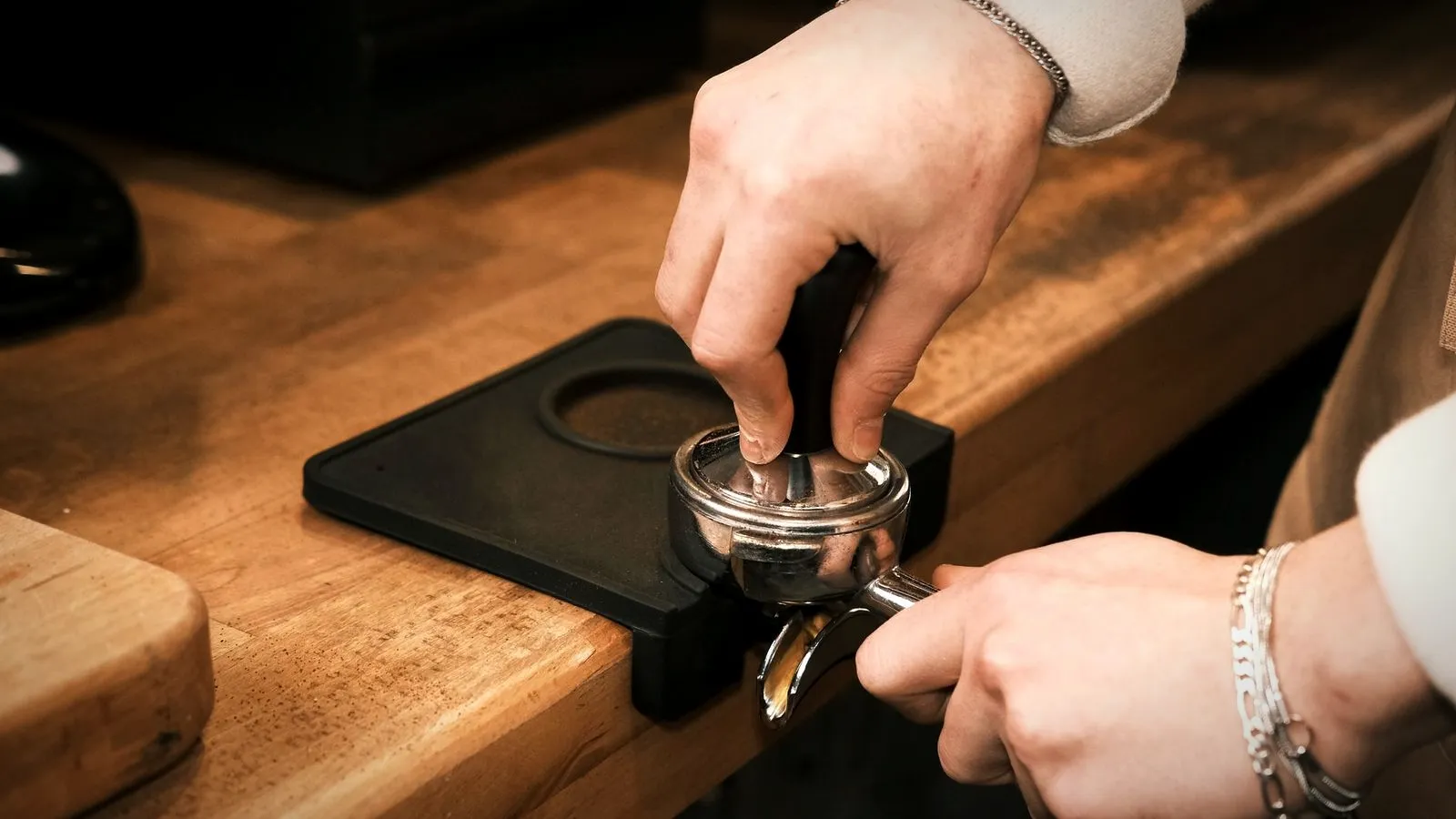
A tamping mat or station gives the portafilter a flat, stable place to rest while you press, which makes a level tamp easier. A rubber mat protects the counter and the portafilter, and some are shaped so the spouts hang over the edge. A station adds a cradle for the portafilter and a place for your tools.
Neither is essential: any flat, stable counter works if the portafilter sits level. Avoid a drip tray edge or a folded towel, which let it tilt under pressure.
Why people replace the stock espresso tamper
People replace the stock espresso tamper when it is a light combined scoop, fits the basket loosely or makes a level press difficult. De’Longhi lists a combined spoon and tamper among the accessories of its Dedica EC685, and sells a separate 51 mm stainless tamper with a wood handle calibrated to fit its filters.
Breville machines ship with a proper tamper. The Barista Express has an integrated, removable 54 mm tamper, and the Bambino and Bambino Plus both include one; see our Breville Bambino vs Bambino Plus comparison. The Barista Express, Pro, Touch and Impress models share the same 54 mm portafilter, as our Breville Barista Pro vs Express guide shows, so one 54 mm tamper fits all of them.
An upgrade does not change the coffee by itself. If shots already run evenly, a bottomless portafilter will confirm it, and the grinder is the next place to look.
The bottom line
Buy an espresso tamper by size first: match the inside diameter of your basket, using your machine’s manual and the tamper maker’s compatibility list. A flat stainless steel base is the safe default, and a spring or leveling plate helps if you struggle to press level and consistently. The tool matters less than the technique, so pair it with a steady, straight press.
Sources
- Breville: Barista Express BES870 instruction book (integrated removable 54 mm tamper, 54 mm portafilter, 22–33 lb or 10–15 kg, three times the volume), Force Gauge Tamper 54 mm (15.4–22 lb spring, leveling plate, compatible models), Tamper Blend 58 mm (Dual Boiler) and Barista Express Impress (22 lb assisted tamp)
- De’Longhi: Professional Style Tamper FAQ (51 mm, stainless steel, calibrated to fit De’Longhi filters, wood handle) and Dedica EC685.M (spoon/tamper accessory)
- 58 mm machine makers: La Marzocco Setting up your Linea Micra (58 mm tamper) and Espresso accessories for every home barista (flat base when in doubt), Gaggia Classic Pro (58 mm portafilter), Rocket Espresso Tamper (58 mm)
- Tamper and basket makers: Cafelat espresso tampers (base sizes and shapes, VST 58.5 mm, weights), Pullman filtration basket specifications (58.70 mm inside, 58–58.4 mm tampers, 58.55 mm BigStep), Espro Calibrated Espresso Tamper (archived; 30 lb click, 58.35 mm, flat and convex, 14.7 oz to 1 lb) and Normcore Spring Loaded Tamper V4 with ripple base (15, 25 and 30 lb springs, ripple claim, 53.3 mm for Breville, leveling plate)
- Research: Cameron et al., Systematically improving espresso, Matter (2020) (coffee is tamped to level the bed)