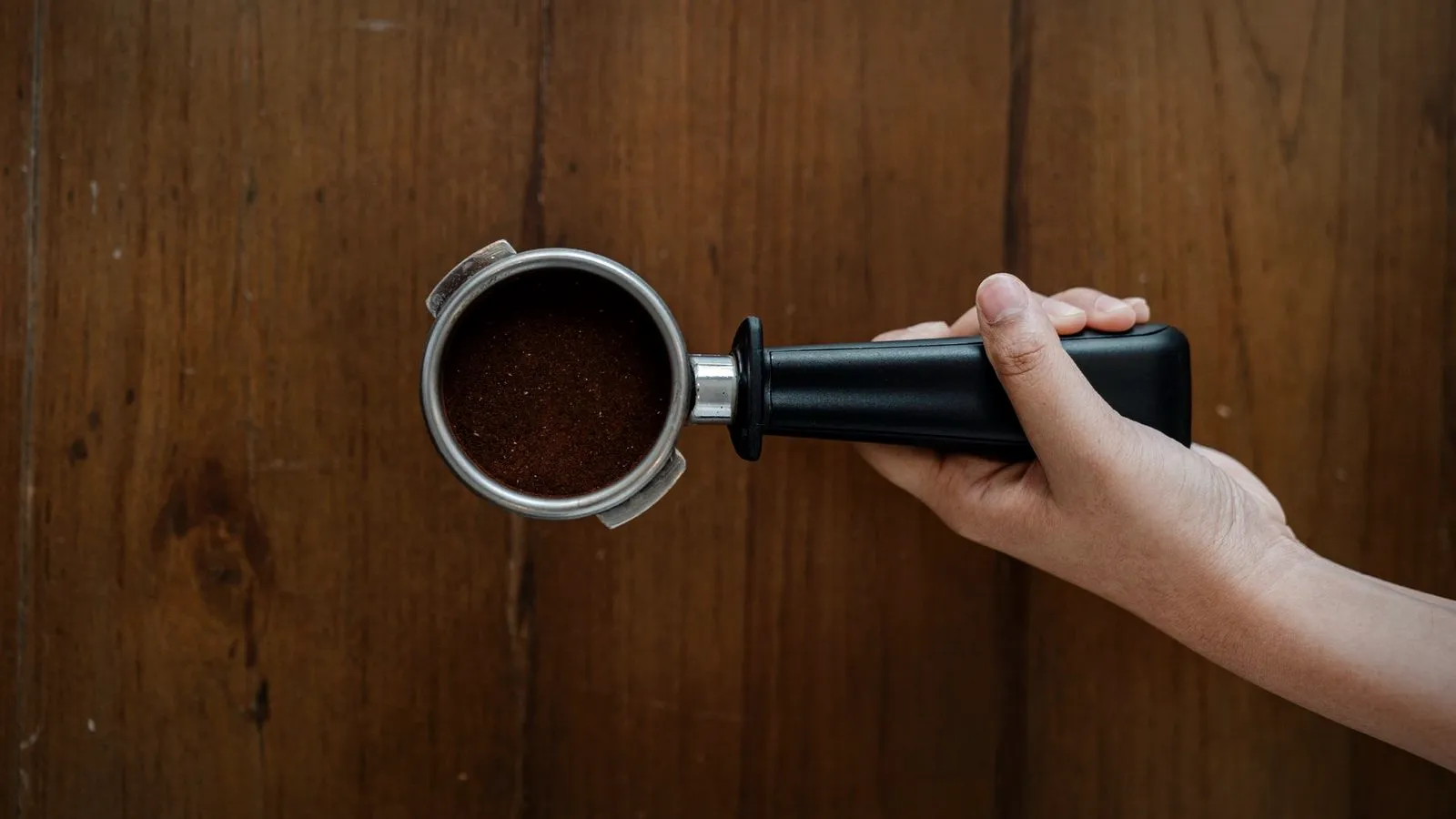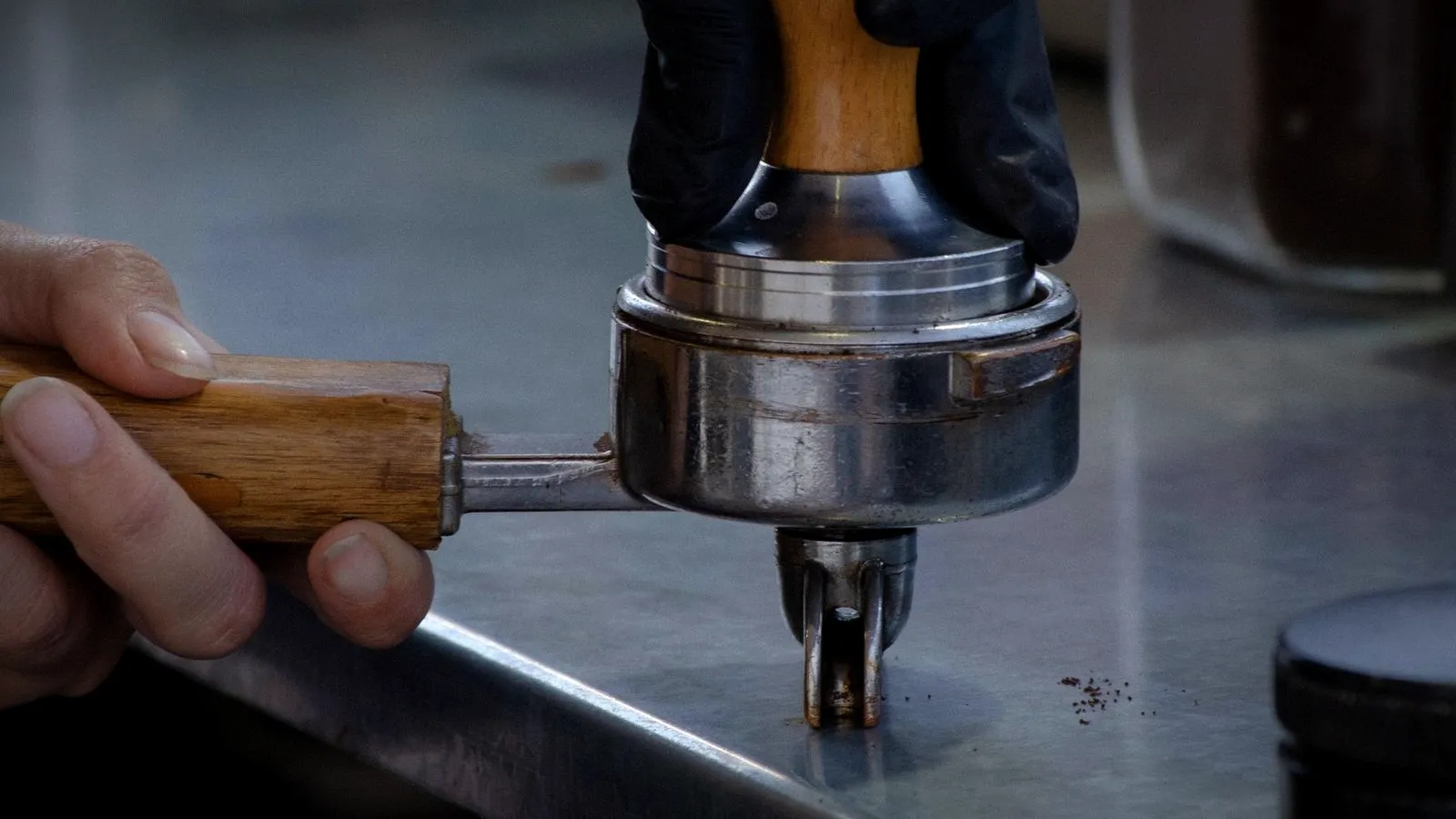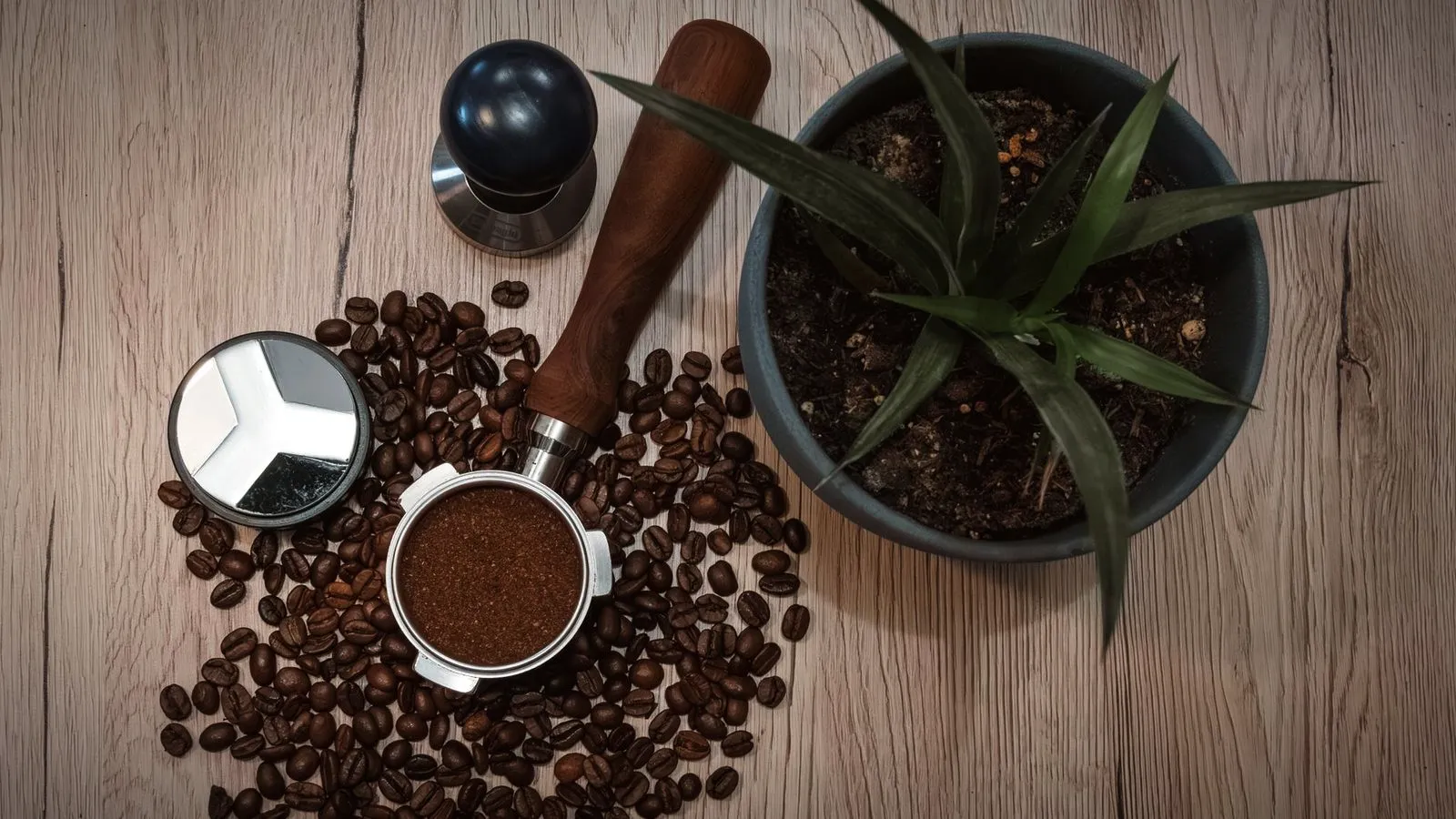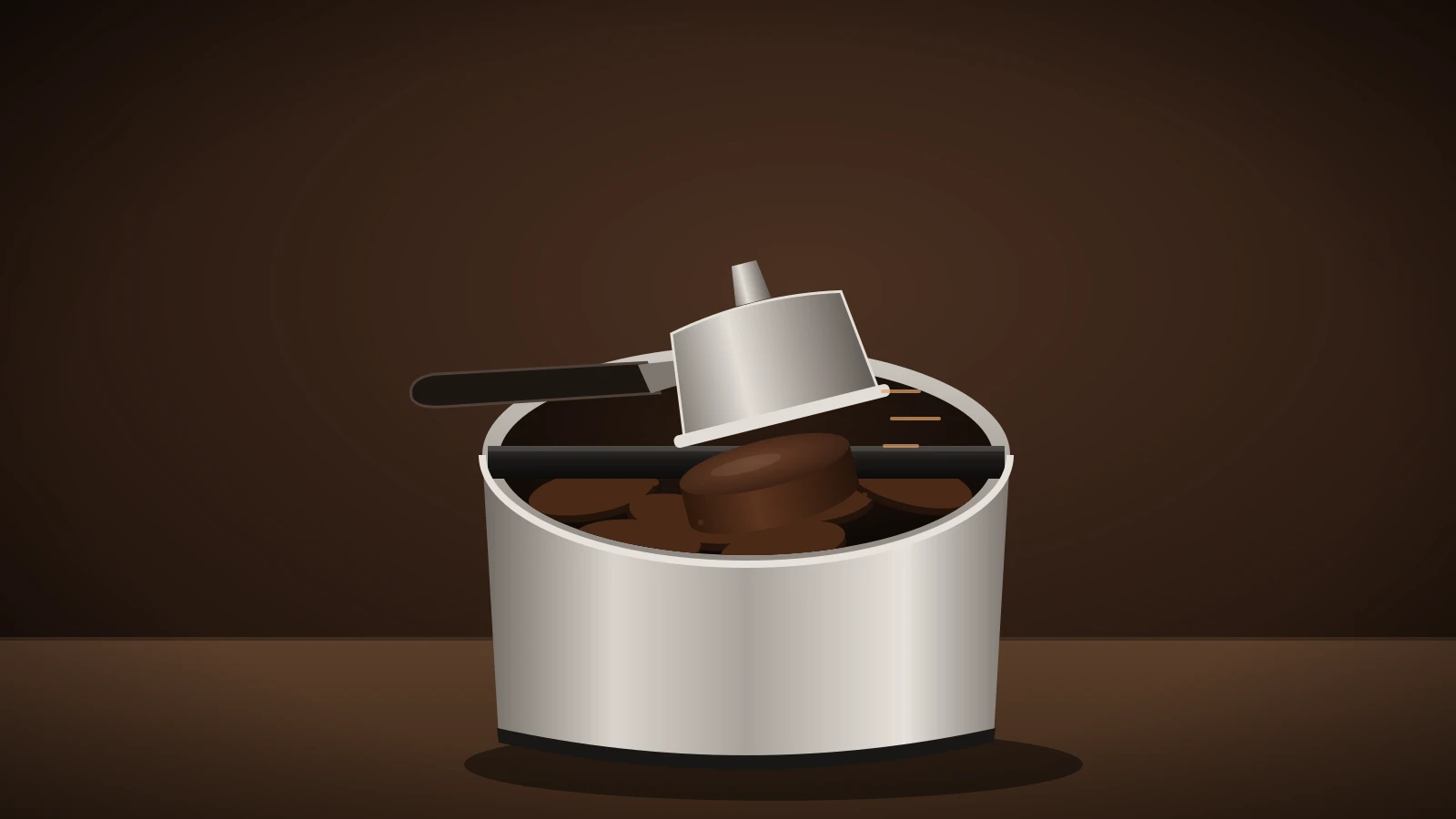
A knock box is a small container with a padded bar across the top that catches used espresso pucks. After a shot, you tap the portafilter rim against the bar and the spent coffee drops into the bin, so the basket is empty and ready to rinse. It protects your portafilter from hard edges and keeps damp grounds in one place.
A knock box is one of the few espresso accessories that changes nothing about the taste and a lot about the cleanup. If you are still matching baskets and tampers to your machine, start with our guide to portafilter sizes.
The short answer
- What it is: a bin with a padded knock bar for emptying spent pucks from the portafilter.
- Why use one: it protects the portafilter and basket from hard edges and keeps grounds off the counter and out of the sink.
- Size: makers rate home boxes by pucks; Breville sells 10-puck and 20-puck versions.
- What to check: capacity, a non-slip base, a padded removable bar and an easy-to-wash bowl.
- The grounds: trash or compost; the EPA lists coffee grounds and paper filters as compost greens.
What is a knock box?
A knock box is a bin with a bar laid across its opening, built for one job: getting a used espresso puck out of the portafilter quickly. Breville describes its version as a basket with a bar across the top; you strike the portafilter against the bar and the grounds fall into the bowl. Machine manuals treat it as standard kit: Breville’s Barista Express manual has you trim excess coffee over a knock box, and Rancilio’s Silvia manual starts its cleaning steps with “knock out” the coffee.
The bar is the important part. It is usually wrapped in rubber or a polymer sleeve so the metal rim of the portafilter hits something that gives a little.
Why use a knock box?
A knock box gives the portafilter a padded surface to hit, so you can empty it hard and fast without damaging the portafilter, the basket or the edge you knock against. Without one, people tap the portafilter on a trash can rim, a sink or the counter. Metal against metal or stone is loud and can scratch or dent the portafilter rim or the surface over time; Ninja describes its padded bar as protecting the portafilter from damage.
It also contains the mess. Spent pucks are wet, and a box beside the machine means you are not carrying a dripping portafilter across the kitchen or washing grounds into the sink. The cleaner basket you get from a single clean knock is also easier to rinse, which matters for the next shot.
How to use a knock box
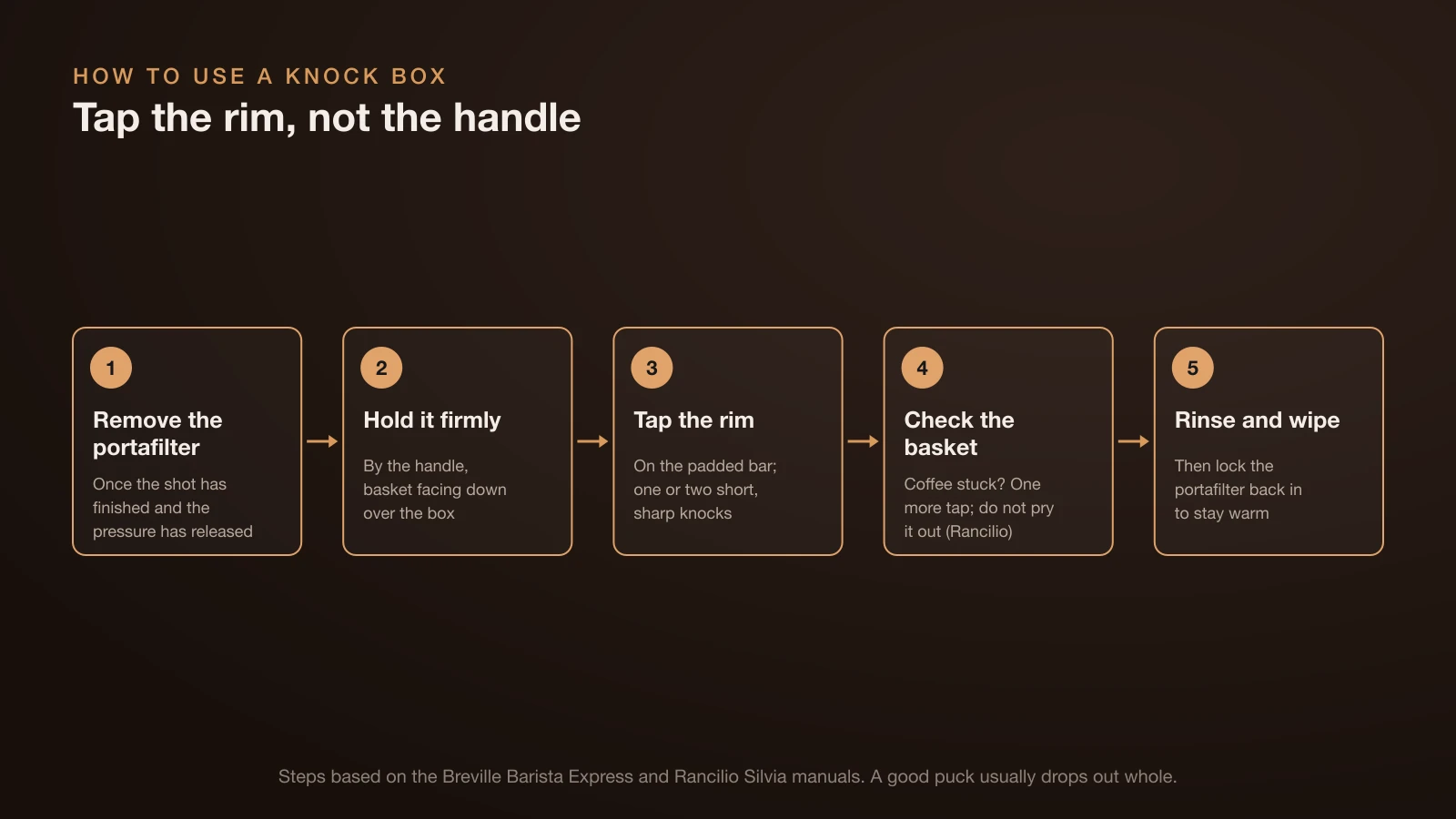
To use a knock box, remove the portafilter after the shot, hold it firmly by the handle and tap its rim once or twice against the bar so the puck drops out whole. A good puck usually comes out in one piece.
- Remove the portafilter from the group head once the shot has finished and the pressure has released.
- Hold the handle firmly with the basket facing down over the box.
- Tap the rim, not the handle, against the bar with a short, sharp motion. One or two knocks are usually enough.
- Check the basket. If some coffee sticks, give one more tap rather than prying it out; Rancilio’s manual warns not to damage the filter.
- Rinse and wipe the basket and portafilter, then lock the portafilter back into the group head to stay warm.
Then dry the basket before the next dose. A dry basket is the first step of good puck preparation, followed by distribution with an espresso distributor and tamping. For the full routine from grinding to cleanup, see our guide on how to use an espresso machine.
Types of knock boxes
Knock boxes come in four main forms: a countertop bin, a drawer under the grinder or machine, a tube with a bin below, and a chute built into a counter. Home kitchens mostly use the first two.
| Type | How it works | Best for |
|---|---|---|
| Countertop bin | A freestanding box with a bar across the top | Most home setups; easy to move and empty |
| Drawer | A pull-out drawer with a bar that sits under the grinder or machine | Saving counter space in a fixed setup |
| Tube | A tall tube with a bar on top, over a bin or bag | Higher volume; takes floor or cabinet space |
| Built-in chute | A hole in the counter with a bar, emptying into a bin below | Cafés and custom coffee bars |
Rocket Espresso, for example, sells both a stainless steel countertop knock box and a knock drawer designed to sit under its grinders. La Marzocco’s home knock box uses a stainless steel insert inside a wood or aluminum surround.
What size knock box do you need?
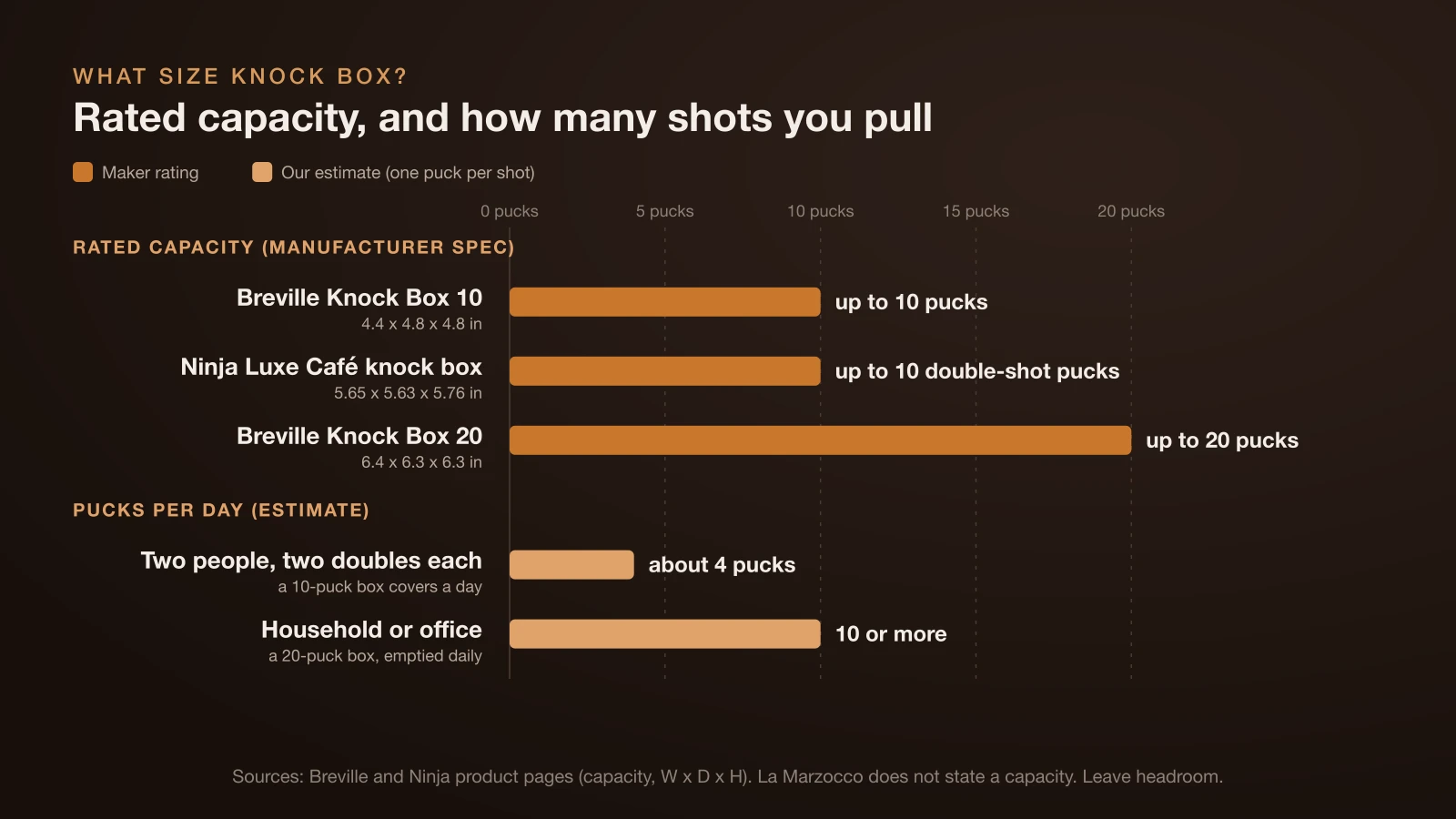
The right knock box size depends on how many shots you pull between emptying it, and makers rate their boxes by the number of pucks they hold.
| Model (manufacturer spec) | Rated capacity | Size (W x D x H, in) |
|---|---|---|
| Breville Knock Box 10 | Up to 10 pucks | 4.4 x 4.8 x 4.8 |
| Ninja Luxe Café knock box | Up to 10 double-shot pucks | 5.65 x 5.63 x 5.76 |
| Breville Knock Box 20 | Up to 20 pucks | 6.4 x 6.3 x 6.3 |
| La Marzocco Counter Knockbox | Not stated | 6.84 x 7.34 x 4.68 |
Estimate, not a maker figure: count one puck per shot and multiply by the days between emptying. Two people drinking two doubles a day each make about 4 pucks a day, so a 10-puck box covers a day with room to spare. A household or office pulling 10 or more shots a day is better served by a 20-puck box, emptied daily. Leave headroom, because a box packed to the bar is hard to knock into cleanly.
What to look for in a knock box
When choosing a knock box, check capacity, stability, the bar and how easy it is to clean, since none of these depends on the brand.
- Capacity. Matched to your shots between emptying, as above.
- Non-slip base. Breville and Rocket use rubber grip bases and Ninja lists a non-slip base, so the box does not slide when you knock.
- Padded, sturdy bar. It should take a hard knock without bending; La Marzocco uses a large bar with a stainless steel core.
- Removable bar. Breville and Ninja bars lift out so you can rinse the whole bowl.
- Washable bowl. Stainless steel and plastic are easy to clean; Breville’s blog says its Knock Box bowl is removable and dishwasher safe.
- Weight and footprint. A heavier box moves less; make sure it fits beside the machine without blocking the drip tray.
- Material and finish. Stainless steel, plastic, wood and aluminum surrounds all work; choose for cleaning and looks.
How to clean a knock box
Clean a knock box by emptying it, lifting out the knock bar and washing the bowl and bar in warm, soapy water. Breville and Ninja both design their bars to lift out for exactly this.
Empty it at least daily, even if it is not full. Wet grounds left for days start to smell and can turn moldy, and oils build up on the bowl.
Check the maker’s instructions before putting any part in the dishwasher, since not every model is rated for it. Wipe the bar sleeve too, because coffee oils collect where the portafilter hits. For the rest of the machine, from the group head to the drip tray, see our guide on how to clean an espresso machine.
What to do with used coffee grounds
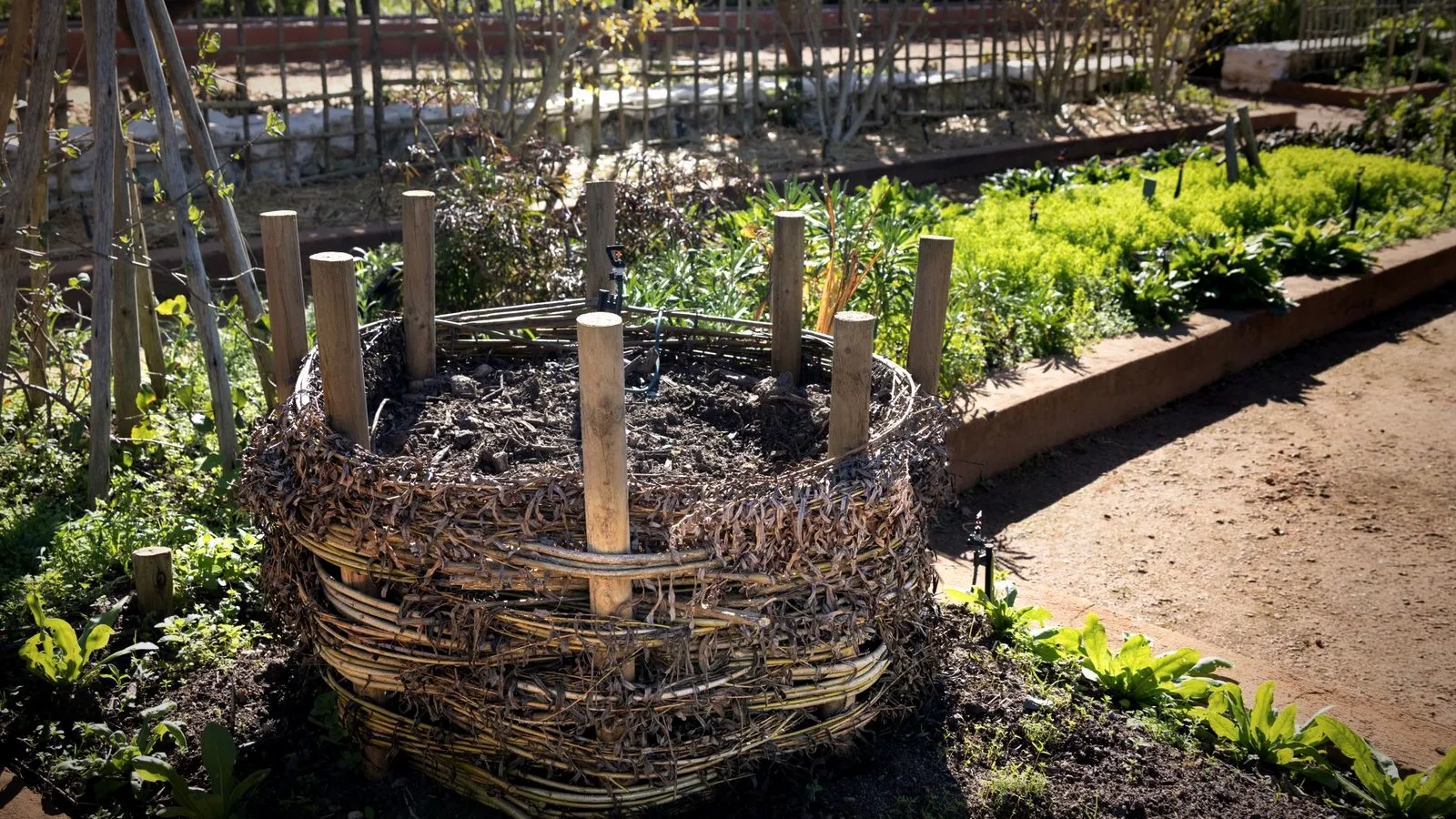
Used espresso grounds can go in the trash or the compost bin. The EPA lists coffee grounds and paper filters as nitrogen-rich “greens” for home composting and also as suitable food for worm bins.
Composting coffee grounds
Balance the grounds with dry “browns”: the EPA advises at least two to three times the volume of browns, such as dry leaves, to the volume of greens. Washington State University Extension recommends that coffee grounds make up no more than 20 percent of a compost pile by volume. Keep the mix about as damp as a wrung-out sponge, per the EPA.
Grounds in the garden
Do not spread fresh pucks straight onto beds. WSU Extension notes that fresh grounds can be harmful to a range of plants and does not recommend them as a mulch or soil amendment. Composted grounds can be applied as a thin layer of no more than half an inch when a soil test shows low nutrients.
Spent pucks are not the same as the fresh espresso grounds you buy to brew: their flavor has gone into the cup, so they are a cleanup job, not a second shot.
The bottom line
A knock box is a bin with a padded bar that lets you empty the portafilter quickly without damaging it or the counter. Pick one rated for the shots you pull between emptying, with a non-slip base and a bar that lifts out for cleaning. Empty it daily, and send the grounds to the trash or the compost pile, mixed with plenty of dry browns.
Sources
- Breville: the Knock Box 10 and the Knock Box 20 (10 and 20 pucks, dimensions, stainless steel and plastic, removable bar, anti-slip base), Must-have espresso accessories (bar across a basket, removable dishwasher-safe bowl) and Barista Express BES870 instruction book (trimming over a knock box)
- Other makers: Ninja Luxe Café knock box (10 double-shot pucks, padded bar, non-slip base, lift-out bar, dimensions), La Marzocco Counter Knockbox (stainless insert, steel-core bar, surrounds, dimensions), Rocket Espresso knock box and coffee drawer (rubber base, drawer under grinder)
- Rancilio: Silvia user manual (knock out the coffee, do not damage the filter)
- U.S. Environmental Protection Agency: Composting at home (coffee grounds and filters as greens, two to three times browns, wrung-out sponge, vermicomposting)
- Washington State University Extension: Using coffee grounds in gardens and landscapes (FS207E) (no more than 20 percent of compost volume, fresh grounds not recommended as mulch, half-inch layer)