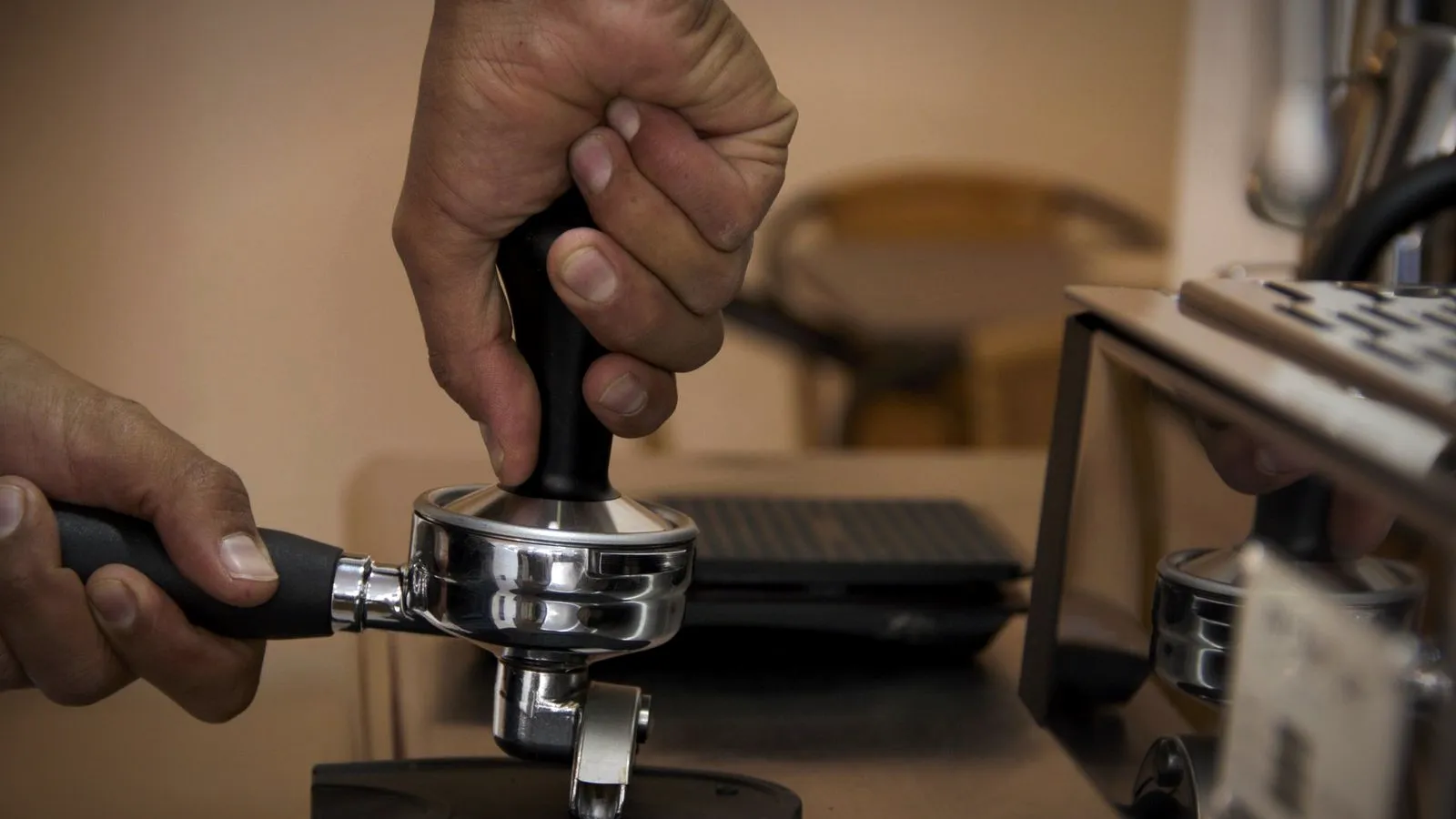
To tamp espresso, spread the grounds evenly in the basket, rest the portafilter on a flat surface and press straight down with a tamper that fits the basket until the coffee feels firm and level. Then wipe the rim clean. That is how to tamp espresso: a level, consistent tamp matters more than raw force.
Tamping turns loose grounds into a flat, even puck, so water has to pass through all of the coffee instead of the easiest gap. This guide covers the steps, how hard to press, tamper sizes, common mistakes and how to tell a tamping problem from a grind problem. If you are new to the whole routine, start with our guide on how to use an espresso machine.
The short answer
| Step | What to do |
|---|---|
| 1. Dry | Wipe the basket dry; moisture encourages channeling |
| 2. Dose | Weigh the coffee for your basket, about 18 g in a double |
| 3. Distribute | Tap or stir so the bed is even from edge to edge |
| 4. Set down | Rest the portafilter on a flat, stable surface |
| 5. Tamp | Press straight down until the coffee feels firm |
| 6. Check | Look at the puck from the side: it should be level |
| 7. Clean | Wipe loose grounds off the basket rim |
| Pressure | Firm and repeatable; Breville suggests about 22–33 lb (10–15 kg) |
Why tamping espresso matters
Tamping matters because water always takes the easiest path through the coffee, and a loose or uneven puck gives it one. Breville’s manual calls this channeling: water bypassing the ground coffee during extraction. The coffee along a channel over-extracts while the rest under-extracts, so one shot can taste bitter and sour at once.
Loose grounds also take up far more room than a tamped puck. Breville notes that untamped coffee is about three times the volume of tamped coffee, which is why a freshly dosed basket looks overfilled. The researchers behind a 2020 espresso study in the journal Matter put the purpose simply: coffee must be tamped to level the bed.
How to tamp espresso, step by step
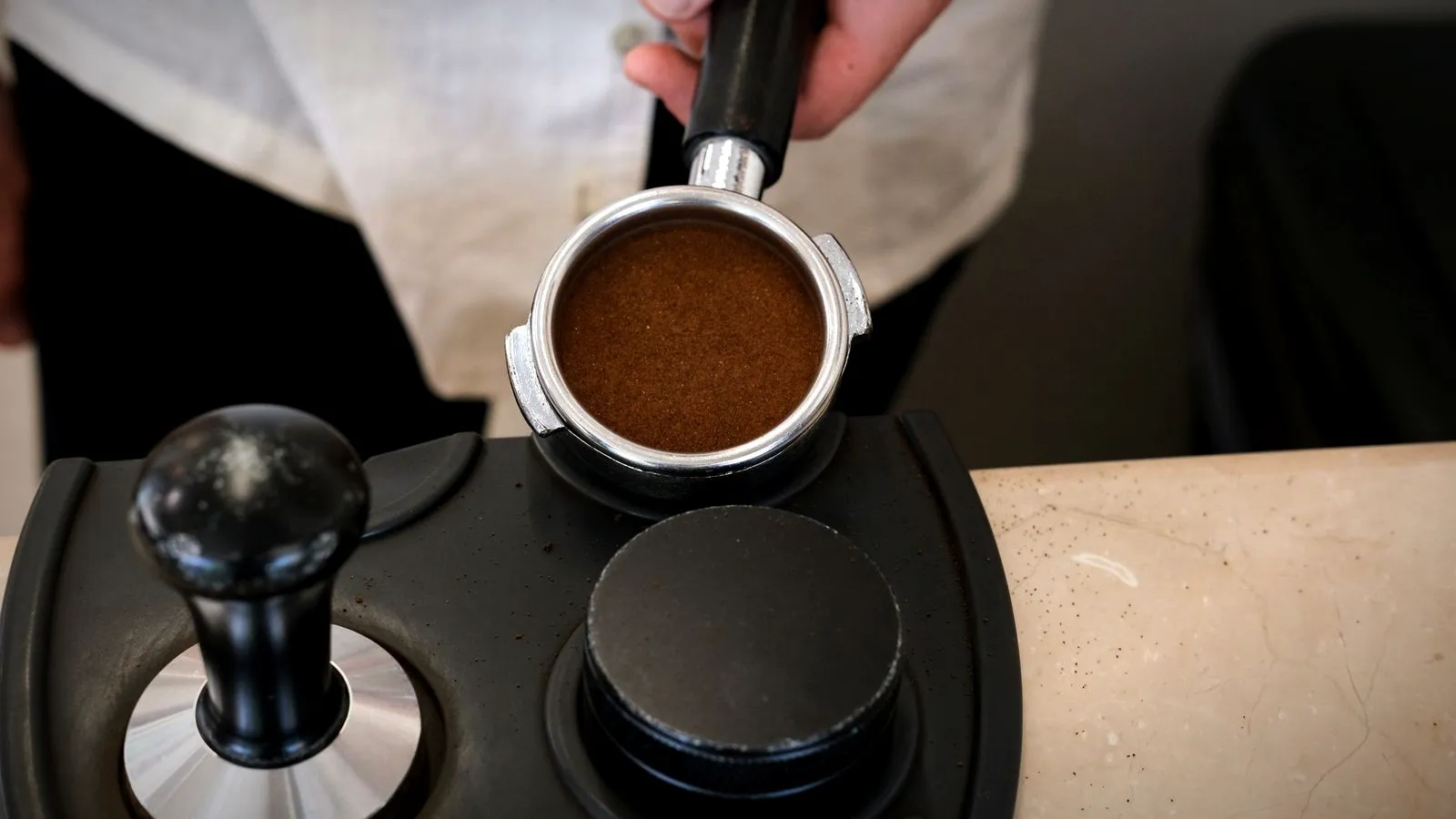
Tamping espresso is a short routine you repeat for every shot: dry, dose, distribute, press, check and clean.
- Dry the basket. Wipe the basket and portafilter dry before dosing. Breville warns that moisture can encourage channeling.
- Dose by weight. Use the amount your basket is made for. Breville rates its double basket at about 16–19 g, and 18 g is a common starting point.
- Distribute the grounds. Breville’s instructions say to tap the portafilter several times to collapse the coffee and spread it evenly. Break up clumps so the bed is the same depth everywhere; distribution tools exist, but a few taps are enough to start.
- Rest the portafilter on a flat, stable surface. A counter or a tamping mat keeps it level, unlike the edge of a drip tray.
- Hold the tamper straight. Grip the handle with your wrist directly above it and the base flat on the coffee.
- Press straight down. De’Longhi describes the goal as a firm, even tamp at a right angle to the filter, without unnecessary force. La Marzocco’s advice is to push until you feel the puck push back.
- Check that it is level. Look at the puck at eye level. On the Barista Express, Breville’s dose check is that the top of the tamper’s metal cap sits level with the basket rim after tamping.
- Lift cleanly and wipe the rim. A light twist as you finish can polish the surface. Then wipe loose grounds off the rim, which Breville says ensures a proper seal in the group head.
- Brew promptly. Lock the portafilter in and start the shot.
Tap the portafilter before you tamp, never after. Breville puts the settling taps before the tamp, and a knock on a tamped puck can shift it and open a gap at the basket wall.
Use a tamper that fits the basket
A tamper that fits the basket presses the coffee right to the wall, while one that is too small leaves a looser ring at the edge where water can run down. The tamper that came with your machine is sized for its baskets, such as De’Longhi’s 51 mm tamper for its pump machines, 54 mm on the Barista Express and 58 mm on the Linea Micra. If you replace it, match the size your manufacturer lists.
La Marzocco suggests a simple dose check after tamping: lock the portafilter in, take it out before brewing and look for an imprint of the shower screen screw. If you see one, there is too much coffee for the basket, so tamp a little more or switch to a larger basket.
How hard to tamp espresso
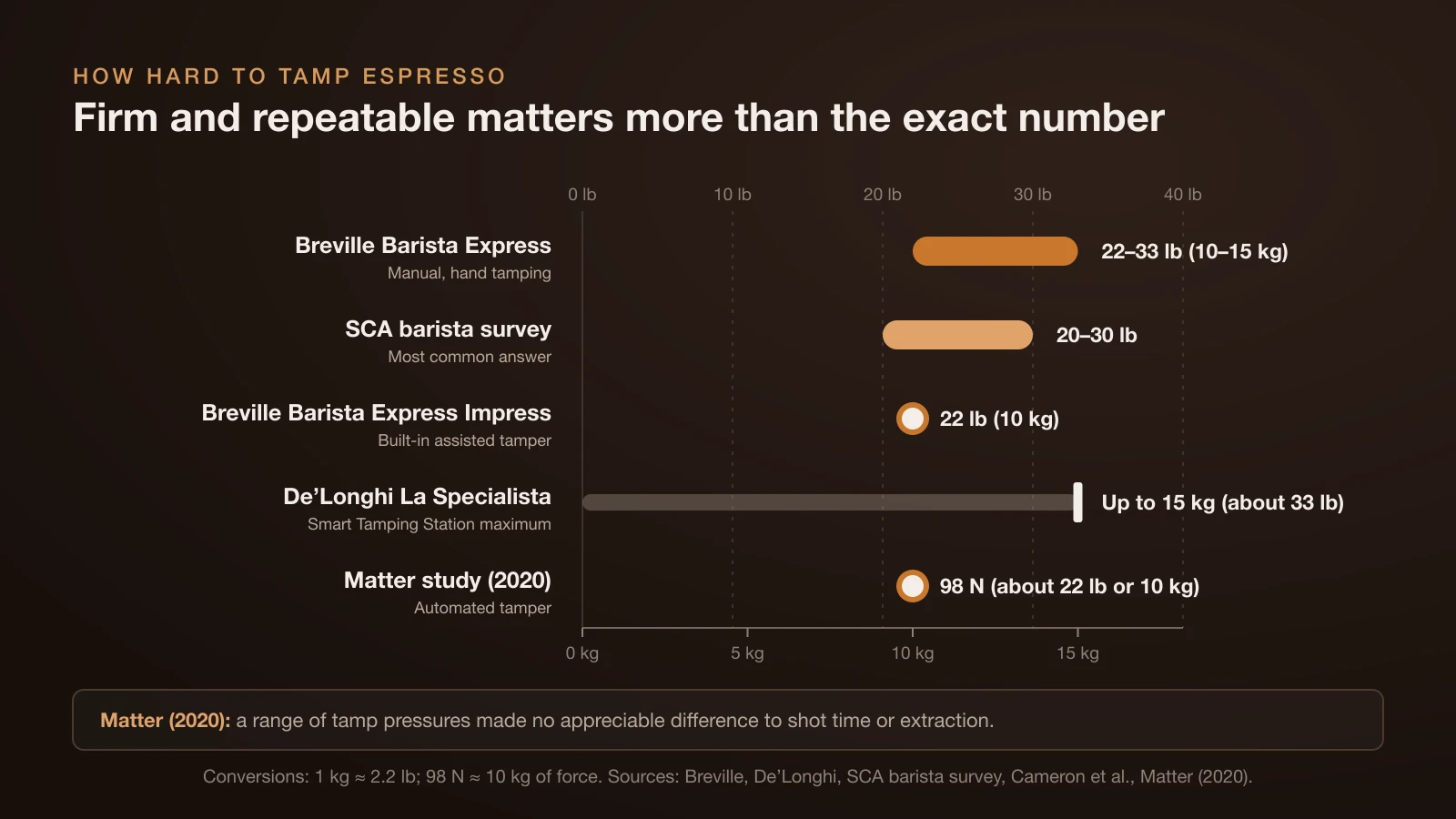
Tamp espresso firmly and the same way every time; the exact force matters less than consistency and a level puck. Breville’s Barista Express manual suggests about 22–33 lb (10–15 kg) and says the amount of pressure is not as important as consistent pressure every time.
Here is what manufacturers and research report about espresso tamping pressure:
| Source | Tamping pressure | Context |
|---|---|---|
| Breville Barista Express manual | 22–33 lb (10–15 kg) | Hand tamping; consistency matters more than the exact force |
| Breville Barista Express Impress | 22 lb (10 kg) | Built-in assisted tamper, finished with a 7° twist |
| De’Longhi La Specialista | Up to 15 kg (about 33 lb) | Maximum of the built-in Smart Tamping Station |
| SCA barista survey | 20–30 lb, the most common answer | 22% said “other”: never measured, used a machine, or tamped until the puck felt evenly dense |
| Cameron et al., Matter (2020) | 98 N (about 22 lb or 10 kg) | Automated tamper; a range of tamp pressures made no appreciable difference to shot time or extraction |
Conversions in parentheses are ours (1 kg ≈ 2.2 lb; 98 newtons ≈ 10 kg of force). SCA is the Specialty Coffee Association, which published the barista survey.
The research result is the most useful one for home baristas. When the Matter researchers tried a range of tamp pressures, shot time and extraction yield barely changed, so they fixed the tamp with a machine and adjusted the grind instead. If a shot runs too fast or too slow, change the grind rather than pressing harder or softer.
To learn what firm feels like, press your tamper on a bathroom scale once or twice. The goal is to know roughly where your normal press sits, not to hit a number every morning.
Can you tamp espresso too hard?
Yes, at the extremes. Breville’s troubleshooting lists coffee tamped too firmly as one cause of espresso that only drips or does not flow, and coffee tamped too lightly as a cause of espresso that runs too quickly or has no crema. Its fix in both cases is the same 22–33 lb range. Between those extremes, a steady, level press is what counts.
Common tamping mistakes
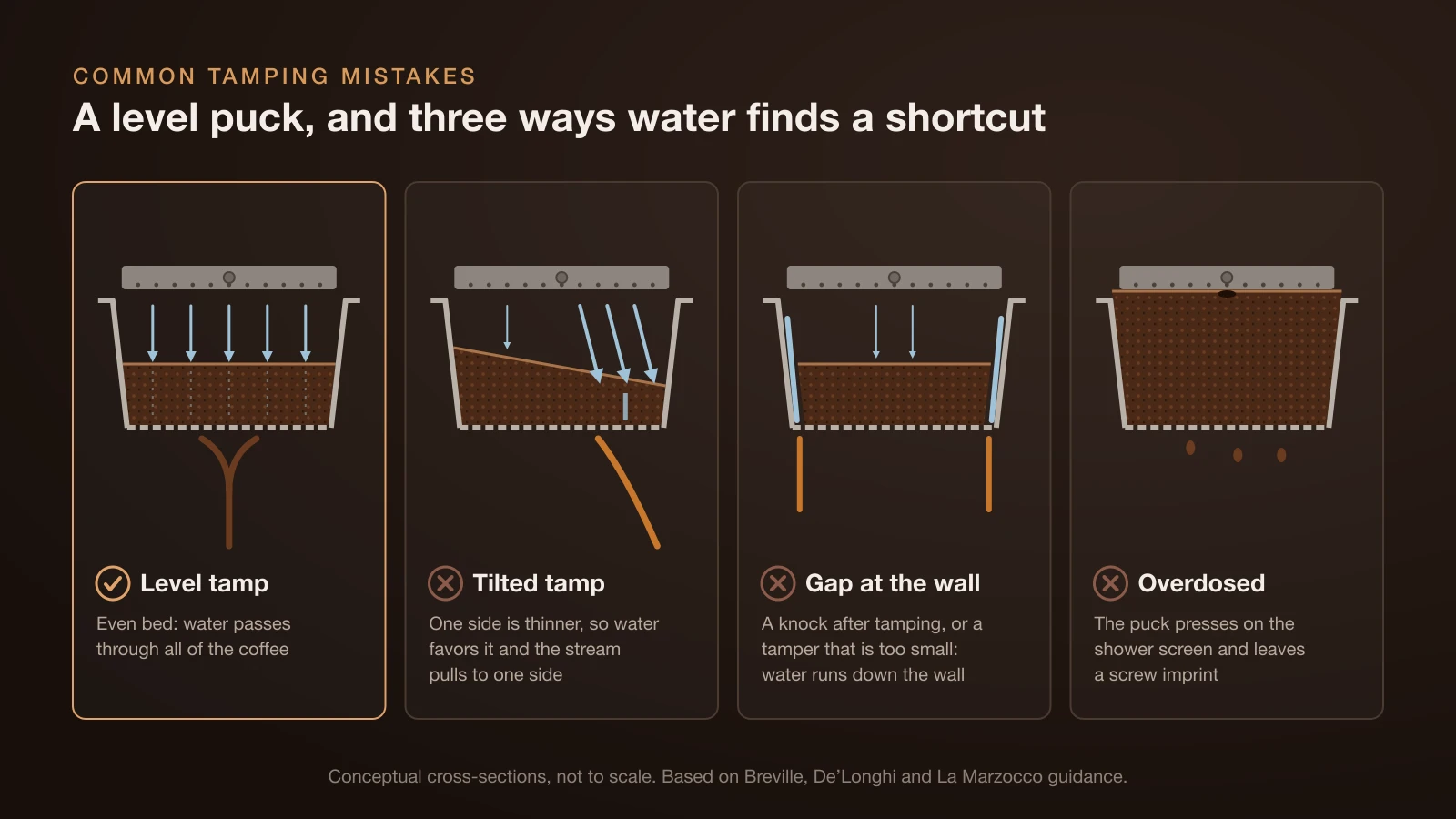
Most tamping mistakes leave the puck uneven, loose at the edge or packed against the shower screen, and each has a simple fix.
| Mistake | What happens | Fix |
|---|---|---|
| Tilted tamp | One side of the puck is thinner, so water favors it and the stream pulls to one side | Tamp on a flat surface with your wrist above the tamper |
| Tapping the side after tamping | The puck can shift and open a gap at the basket wall | Tap to settle the grounds before tamping, never after |
| A second press at a new angle | A stepped, uneven surface | Press straight down on the same puck |
| Overdosing | The puck presses on the shower screen; the shot drips, or espresso leaks around the portafilter | Lower the dose; check for a screen imprint |
| Underdosing | Extra space above the puck and a fast, thin shot | Raise the dose to suit the basket |
| Grounds on the rim | The portafilter does not seal; espresso runs out around the edge | Wipe the rim before locking in |
| Wet basket | Moisture encourages channeling | Wipe the basket dry before dosing |
Tamping twice is not a mistake in itself. Breville’s Barista Express Impress manual recommends pushing its tamping lever twice for a very polished puck; the problem is a second press that goes in at a different angle.
Is it your tamp or your grind?
If every shot runs evenly but too fast or too slow, the grind is the likely cause; if shots spurt, lean or vary from one to the next, look at distribution and tamping. Breville’s extraction guide lists tamp pressure alongside grind size and dose, but Breville’s dial-in guide calls grind size the first place to make a change.
| What you see | More likely cause | What to change |
|---|---|---|
| Every shot fast and sour, even stream | Grind too coarse | Grind finer |
| Every shot slow and bitter, even stream | Grind too fine | Grind coarser |
| Spurts, sprays or pale spots | Channeling from uneven distribution or tamping | Distribute evenly, tamp level |
| Stream pulls to one side | Tilted tamp or uneven bed | Tamp level on a flat surface |
| Times swing with the same settings | Inconsistent dose or tamp | Weigh every dose; repeat the same press |
A bottomless portafilter makes this easy to see, because the whole basket floor is visible. Once the puck is even, move to the grinder: our guides to espresso grind size, dialing in espresso and the espresso ratio take it from there. If your machine has a gauge, our espresso machine pressure gauge guide explains what its reading can tell you.
Does tamping matter with a pressurized basket?
Tamping matters much less with a pressurized (dual-wall) basket, because the basket itself creates the resistance. Breville says its dual-wall baskets regulate the pressure and help optimize the extraction regardless of the grind, dose, tamp pressure or freshness, and recommends them for pre-ground coffee. A light, level press is enough there.
Single-wall baskets are different. Breville recommends them for freshly ground beans because they let you experiment with grind, dose and tamp, and there the puck alone slows the water, so careful tamping pays off.
The bottom line
To tamp espresso, dry the basket, dose by weight, distribute evenly, press straight down until the coffee is firm and level, and wipe the rim. Breville’s 22–33 lb (10–15 kg) is a sensible target, but consistency and a level puck matter more than the exact number. If shots still run too fast or too slow, change the grind, not the tamp.
Sources
- Breville: Barista Express BES870 instruction book (tapping, 22–33 lb or 10–15 kg, consistency, three times the volume, tamper cap check, rim, dry basket, troubleshooting, 16–19 g, basket types), Barista Express Impress and its instruction book (22 lb, 7° twist, 54 mm, tamping twice) and How to dial in espresso (grind first)
- De’Longhi: Professional Style Tamper FAQ (51 mm, short twist), Smart Tamping Station FAQ (maximum 15 kg) and How to tamp the perfect espresso (firm, even, perpendicular)
- Specialty Coffee Association: Defining the ever-changing espresso (archived; survey: 18–20 g dose, 20–30 lb, 22% “other”)
- Cameron et al., Matter (2020): Systematically improving espresso: insights from mathematical modeling and experiment (tamping to level the bed, tamp pressure vs shot time and extraction, 98 N)
- La Marzocco: Setting up your Linea Micra (58 mm tamper, puck pushes back, imprint check)