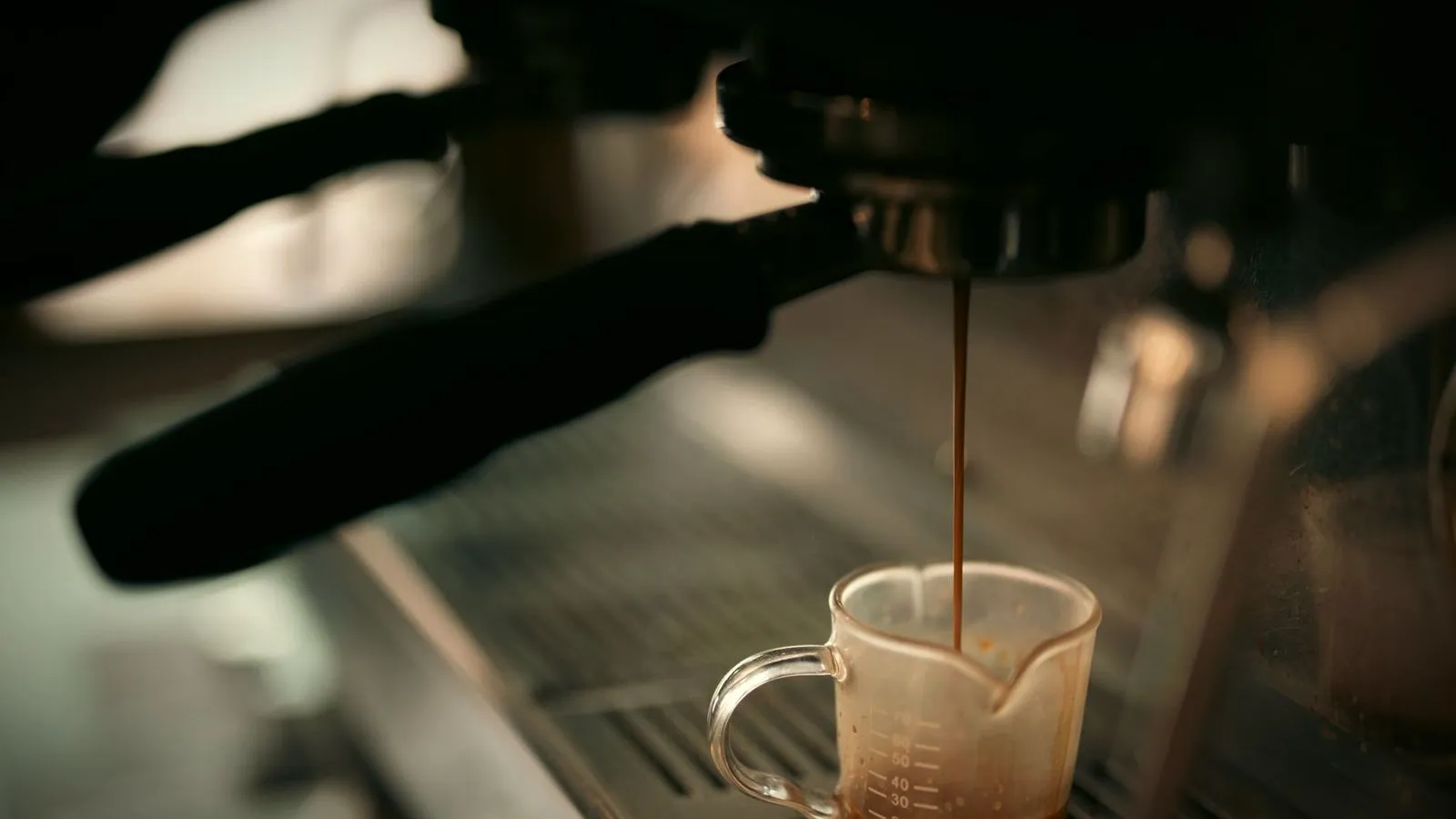
The espresso ratio is the weight of ground coffee in the basket compared with the weight of espresso that ends up in the cup. The standard starting point is 1:2: about 18 g of coffee in and 36 g of espresso out, in 25–30 seconds. Shorter ratios taste stronger and thicker; longer ones taste lighter.
This guide explains why the ratio is measured in grams, gives an espresso ratio chart from ristretto to lungo, and shows how to adjust it together with your espresso grind size.
The short answer
- What it is: dose in to yield out, both weighed in grams (18 g in, 36 g out is 1:2).
- Standard: 1:2 in about 25–30 seconds, the average in an SCA survey of baristas and Breville’s “golden standard.”
- Shorter (ristretto): about 1:1 to 1:1.5. Stronger and thicker.
- Longer (lungo): about 1:3, up to 1:4 by La Marzocco’s definition. Lighter and more diluted.
- How to adjust: fix the dose and target yield, grind to hit the time, then nudge the yield by taste.
What is an espresso ratio?
An espresso ratio, or brew ratio, compares the dry coffee dose with the liquid espresso it produces, both measured by weight. La Marzocco defines it as “the weight of coffee grounds to the weight of liquid espresso in the cup.” To find yours, divide the shot weight by the dose: 36 g from 18 g is 36 ÷ 18 = 2, or 1:2.
You will also see it called the espresso coffee ratio or espresso water ratio. The second name can mislead, because the ratio counts the espresso in the cup, not the water in the tank. The wet puck holds back part of the water, so more water goes in than comes out.
For comparison, La Marzocco puts a cup of drip coffee at around 1:15, which is why espresso tastes so concentrated. Our espresso vs coffee guide covers the rest of that difference. A French press steeps coffee without pump pressure, so there is no true French press espresso ratio; a very strong press brew is still French press coffee.
Why espresso ratio is measured in grams, not ml
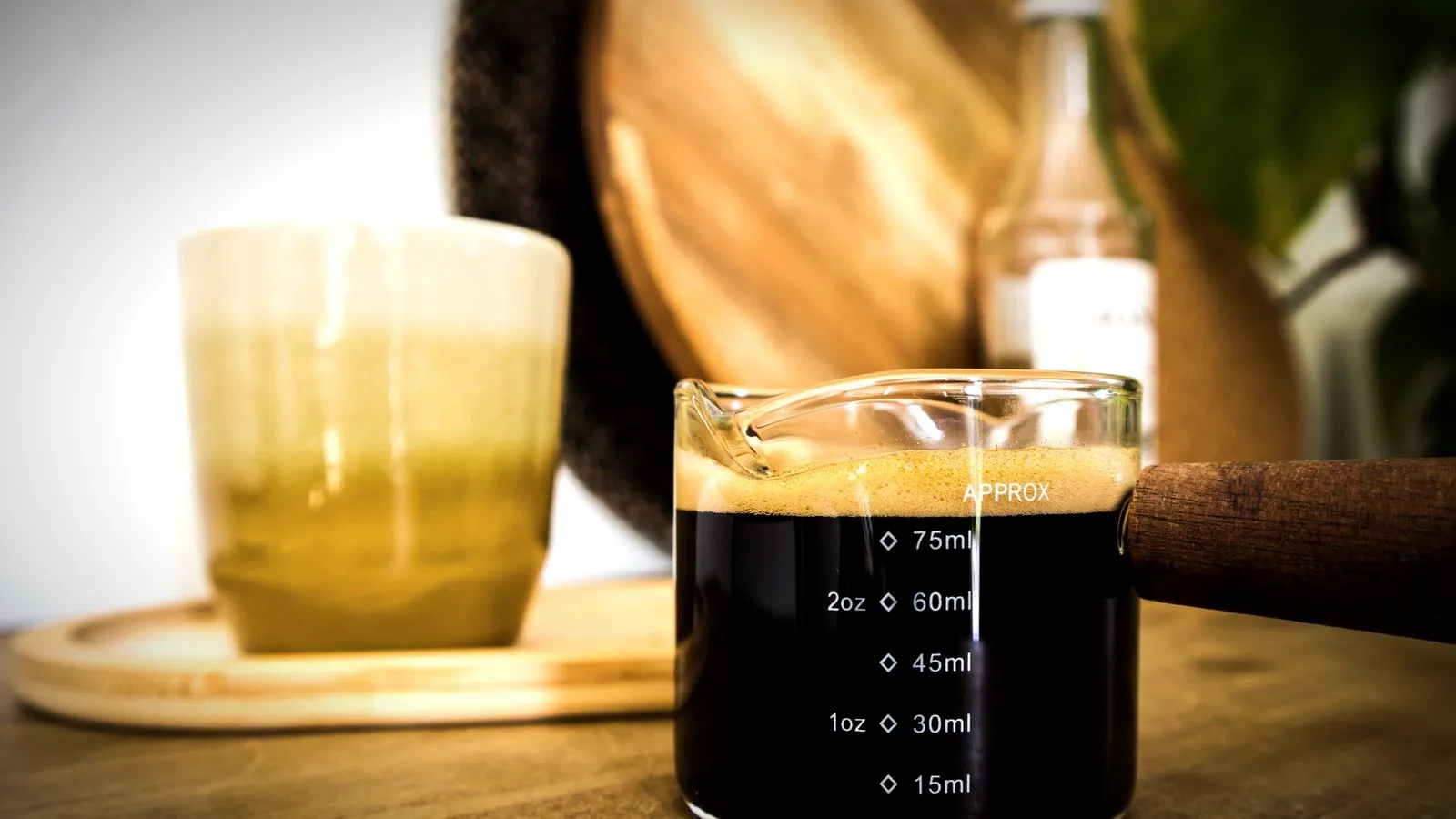
Espresso ratios use grams because crema, the foam on top of a fresh shot, makes volume unreliable. Flair points out that espresso was once measured by volume, about 30 ml for a single and 60 ml for a double. But coffee brewed two days after roasting carries significantly more crema in those 60 ml than the same coffee two or three weeks later.
Volume also ignores the dose. Flair notes that 60 ml tastes “wildly different” from 18 g of coffee than from 24 g. A ratio by weight fixes both problems, because a gram of espresso is a gram whether it is liquid or foam.
Professionals have mostly switched. In the Specialty Coffee Association (SCA) survey of baristas, 82% measured their yield by weight, with an average of 36.5 g. Those who still measured volume reported 1.8 oz (74.2 ml) on average. The two groups were different baristas, so this is not a lab comparison, but it shows why a volume reading and a weight target rarely match.
Machine buttons measure volume too. Breville’s Barista Express presets pour about 1 oz (30 ml) for one cup and 2 oz (60 ml) for two, and the manual notes that the amount in the cup “will vary depending on your grind size and grind amount settings.”
The standard espresso ratio: 1:2
The standard espresso ratio is 1:2, meaning the finished shot weighs twice as much as the dry coffee. In the SCA survey, the average response was 1:2 and all answers fell between 1:1.5 and 1:2.5. The typical shot started with 18–20 g of coffee, weighed 36.5 g and took 25–30 seconds.
Manufacturers teach the same recipe. Breville’s dialing-in guide calls 1:2 “the golden standard,” with an ideal time of 25–30 seconds. La Marzocco’s example puts 18 g in a 17 g basket and pulls 36 g of espresso in 25–35 seconds. Our guide to espresso shot time explains why the clock matters and how to correct it.
Our reference double is 18 g in and about 36 g out in 25–30 seconds. Breville’s manual gives 16–19 g for its two cup basket and 8–11 g for the one cup basket, so check what your basket is made for. In the same SCA survey, 93% of baristas said the espresso they pull is a double.
Espresso ratio chart
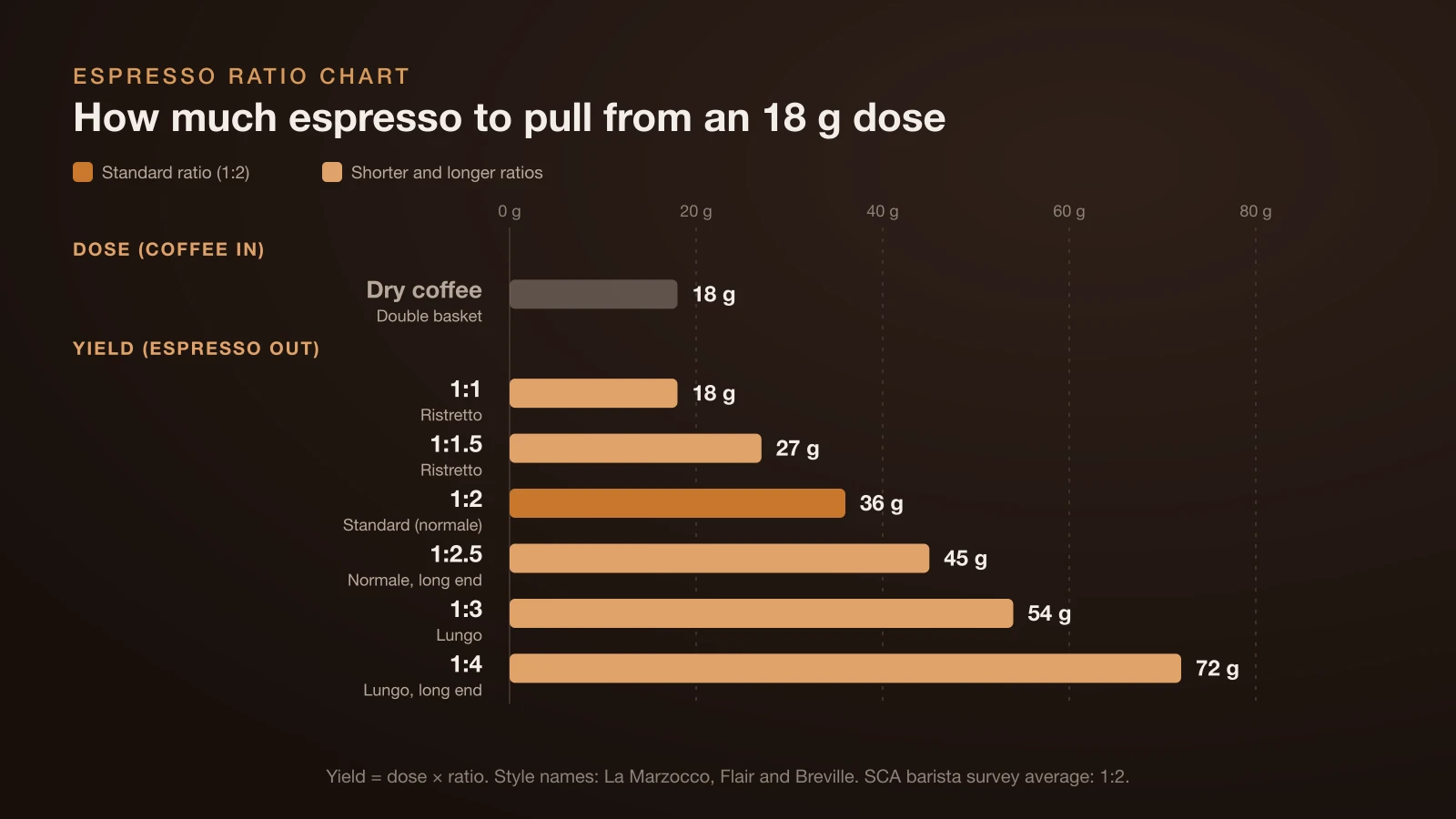
An espresso ratio chart shows how much espresso to aim for from a given dose, and the names attached to each ratio vary by source. Three espresso machine makers publish these ranges:
| Style | La Marzocco | Flair | Breville |
|---|---|---|---|
| Ristretto | 1:1 to 1:2 | 1:1 to 1:1.5 | 1:1 |
| Normale (standard) | 1:2 to 1:3 | 1:2 to 1:2.5 | 1:2 |
| Lungo | 1:3 to 1:4 | About 1:3 | 1:3 |
The overlaps are real: a 1:2 shot sits on La Marzocco’s border between ristretto and normale, but it is the standard shot for Flair and Breville. Flair calls its ratios “guidelines” rather than hard rules. Use the table below to turn any ratio into a target weight (yield = dose × ratio):
| Ratio | 16 g dose | 18 g dose | 20 g dose | Usually called |
|---|---|---|---|---|
| 1:1 | 16 g | 18 g | 20 g | Ristretto |
| 1:1.5 | 24 g | 27 g | 30 g | Ristretto |
| 1:2 | 32 g | 36 g | 40 g | Standard (normale) |
| 1:2.5 | 40 g | 45 g | 50 g | Normale, long end |
| 1:3 | 48 g | 54 g | 60 g | Lungo |
| 1:4 | 64 g | 72 g | 80 g | Lungo, long end |
How the ratio changes strength and taste
A shorter ratio makes espresso stronger and thicker, while a longer ratio pulls more out of the coffee but dilutes it. Flair explains that as you push more water through the grounds, extraction rises but the drink’s relative strength falls. La Marzocco adds that smaller ratios give thicker, more viscous shots and larger ratios thinner ones.
| Ratio | Strength and body | Extraction |
|---|---|---|
| Shorter (1:1 to 1:1.5) | Strongest, thickest | Lowest |
| Standard (1:2) | Balanced starting point | Medium |
| Longer (1:2.5 to 1:3 and up) | Lighter, thinner | Highest |
Roast matters too. La Marzocco says darker roasts perform well with a smaller ratio and lighter roasts with a larger one. Breville’s extraction guide links under-extraction with sour, underdeveloped shots and over-extraction with bitter, astringent ones, so a longer ratio can fix sourness and a shorter one can tame harshness. Our guide to bitter espresso shows when to stop a shot early.
In milk drinks, the espresso ratio sets the strength of the shot, and the latte milk ratio sets how far it is diluted.
How to adjust your espresso ratio
Adjust espresso in a fixed order: set the dose, set the yield from your ratio, use the grind to hit the time, and only then change the ratio for taste. Fixing dose and yield first keeps the concentration steady, so each grind change shows its effect clearly.
- Weigh the dose. Use the same dose every time, for example 18 g for a double basket.
- Pick a target yield. Start at 1:2, so 36 g from 18 g.
- Grind to hit the time. Aim for 25–30 seconds. Breville’s Barista Express manual links shots under 20 seconds with sour, under-extracted espresso (grind finer) and shots over 35 seconds with bitter, over-extracted espresso (grind coarser).
- Taste, then move the yield. If the time is right but the shot tastes harsh, stop a few grams earlier, toward 1:1.5. If it tastes thin or sharp, let it run a few grams longer, toward 1:2.5.
- Change one thing at a time. Note each dose, yield, time and taste so you can repeat what works.
Breville also uses the dose as a lever: if a shot runs fast, “try choosing a finer grind or upping dose,” and if it runs slow, grind coarser or cut the dose slightly. A new dose changes the ratio, so recalculate the yield. Our step-by-step guide to dialing in espresso walks through the whole process, including what to change when a shot tastes sour.
What you need to weigh espresso
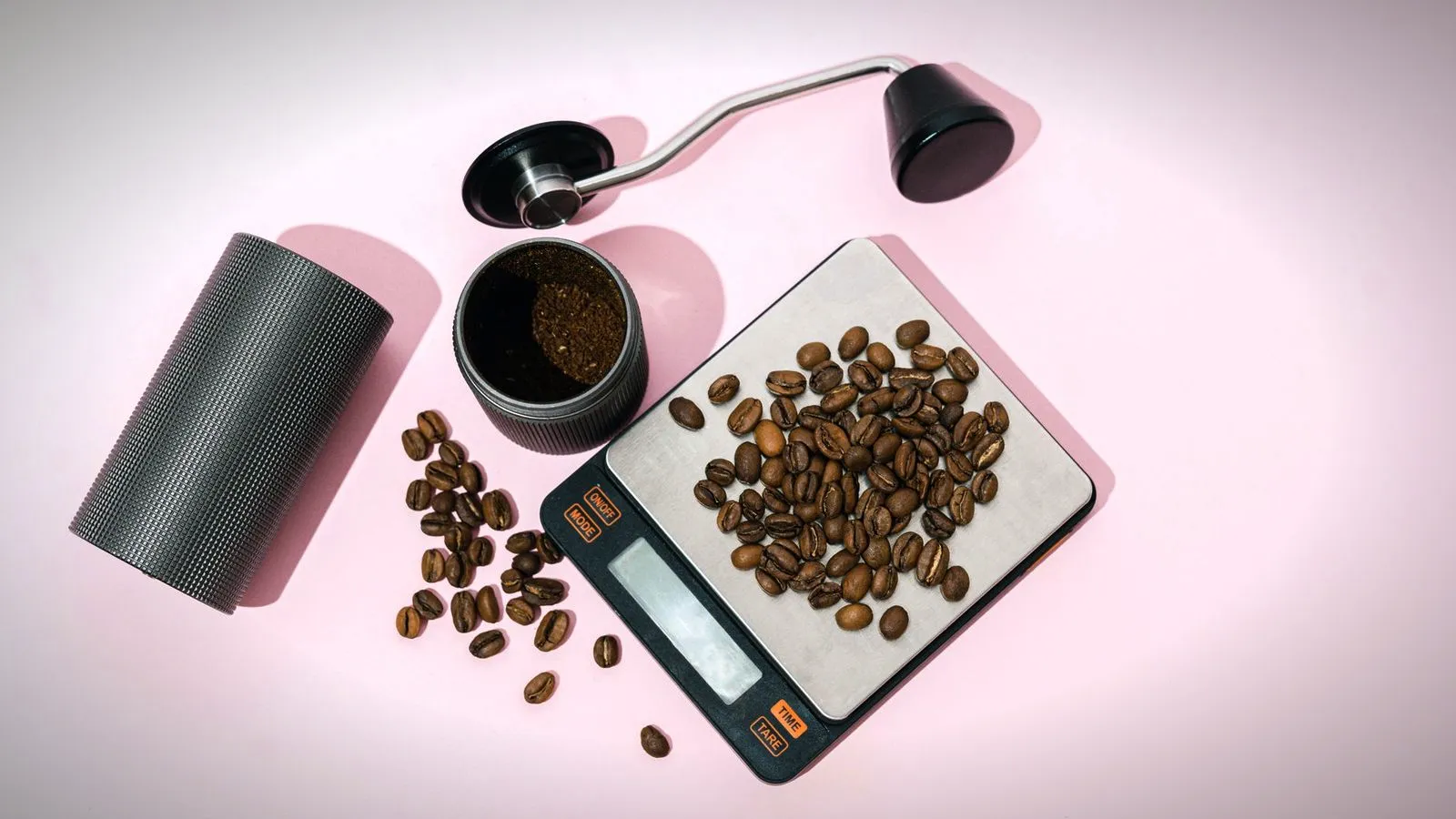
To weigh espresso, you need a digital scale that reads fractions of a gram and fits under the cup on your drip tray. Breville’s guide says you need a scale to weigh both the dry grounds and the output, and La Marzocco recommends one for consistent, repeatable shots.
- Weigh the dose. Put the portafilter or a dosing cup on the scale, zero it, grind and weigh.
- Weigh the shot. Set the cup on the scale under the spouts and zero it.
- Start the shot and a timer together. Many scales have a built-in timer.
- Stop just before the target. A few drops keep falling after the pump stops.
Once a recipe works, you can reprogram your machine’s shot button so it stops close to your target weight, then recheck it when you change beans. If your machine has a gauge, it gives a second check on the grind; see what an espresso machine pressure gauge shows.
The bottom line
The espresso ratio compares grams of coffee in with grams of espresso out, and 1:2, such as 18 g in and 36 g out in 25–30 seconds, is the standard place to start. Go shorter for a stronger, thicker shot and longer for a lighter one, with the names ristretto and lungo covering roughly 1:1 to 1:1.5 and 1:3 and up. Weigh both ends on a scale, fix the ratio before you touch the grinder, and let taste make the last adjustment.
Sources
- Specialty Coffee Association: Defining the ever-changing espresso (archived; heritage definition of 25–35 ml per single; barista survey: 1:2 average ratio, 1:1.5 to 1:2.5 range, 18–20 g doses, 36.5 g average yield, 1.8 oz or 74.2 ml by volume, 82% weighing, 93% pulling doubles, 25–30 seconds)
- La Marzocco: Using espresso brew ratios (definition; ristretto 1:1 to 1:2, normale 1:2 to 1:3, lungo 1:3 to 1:4; drip about 1:15; 18 g in a 17 g basket to 36 g in 25–35 seconds; thicker and thinner shots; darker and lighter roasts; scale)
- Flair Espresso: Brew ratios and espresso (30 ml and 60 ml by volume, crema and bean age, 18 g vs 24 g, ristretto 1:1 to 1:1.5, traditional 1:2 to 1:2.5, lungo about 1:3, extraction vs strength)
- Breville: How to dial in espresso (1:2 golden standard, 1:1 ristretto, 1:3 lungo, single 1 oz and double 2 oz, 25–30 seconds, scale, grind and dose adjustments) and Barista Express BES870 instruction book (8–11 g and 16–19 g doses, 1 oz (30 ml) and 2 oz (60 ml) presets, under 20 seconds sour and over 35 seconds bitter)