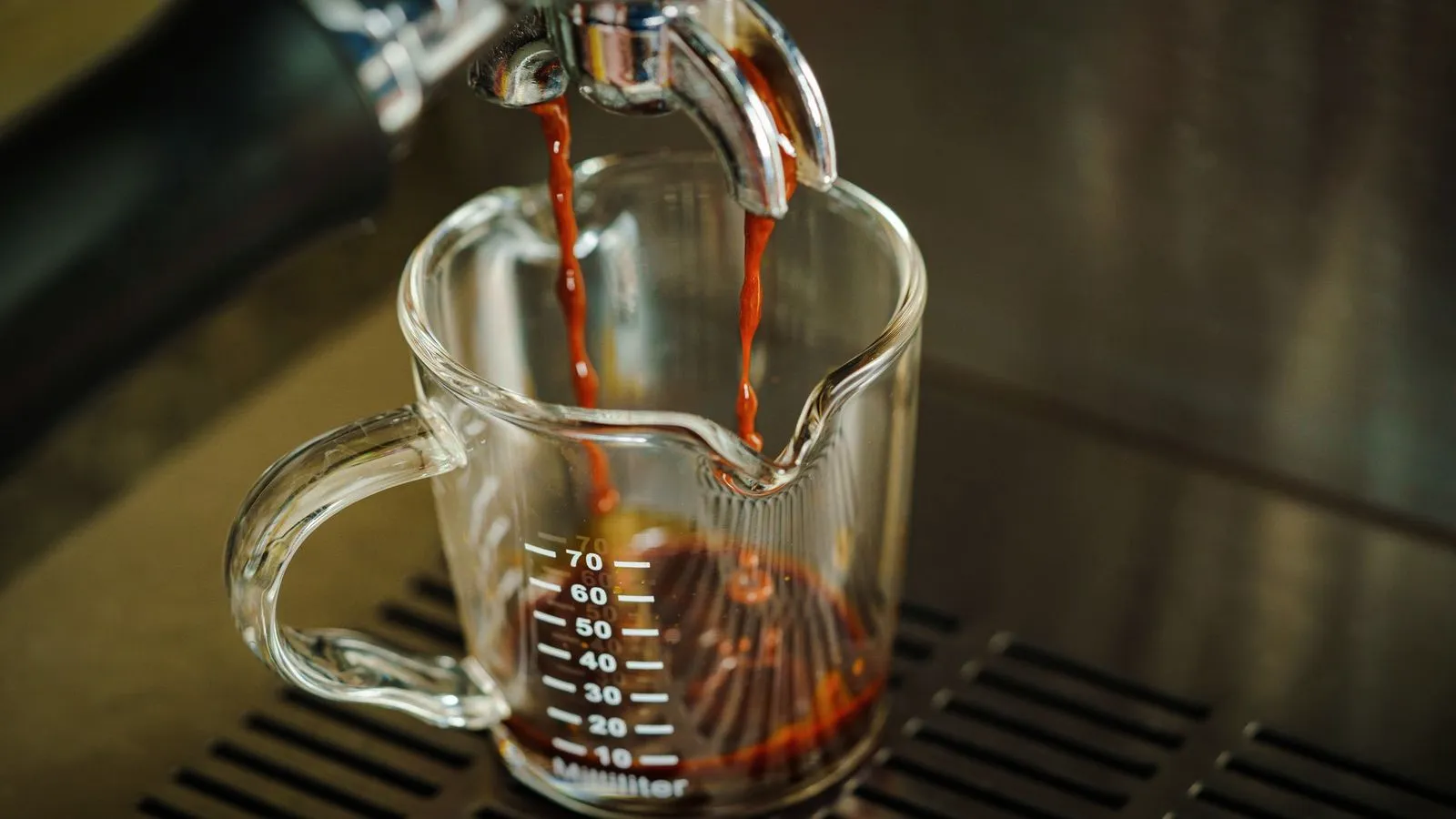
Espresso shot time is the time from pressing the brew button to stopping the shot, and for a double it usually lands between 25 and 30 seconds. That window is a guide: stop the shot when it reaches your target weight, such as 36 g from 18 g of coffee, then use the time to adjust the grind.
The number comes from standards and manuals rather than from the coffee itself, so this guide shows where 25–30 seconds comes from, when to start the clock, and how to read a fast or slow shot. It pairs with our guide to the espresso ratio, because the ratio decides when you stop and the clock only reports how long that took.
The short answer
| Question | Answer |
|---|---|
| How long should a shot take? | About 25–30 seconds for a double |
| When does the clock start? | When you press the button, pre-infusion included |
| When do I stop the shot? | At your target weight, such as 36 g from 18 g |
| Faster than 20 seconds? | Usually under-extracted and sour: grind finer |
| Slower than 35 seconds? | Usually over-extracted and bitter: grind coarser |
| Single vs double? | About the same time; only dose and yield change |
| How long does a pulled shot last? | Drink it right away; it changes as it cools |
How long should an espresso shot take?
An espresso shot should take about 25–30 seconds for a double, counted from the moment you start the pump. That target shows up again and again in standards, manuals and surveys:
| Source | Shot time | Notes |
|---|---|---|
| SCA heritage definition of espresso | 20–30 s | 7–9 g single, 14–18 g double, grind set to hit the time |
| SCA barista survey (Barista Guild of America) | 25–30 s | 51% of baristas’ average shot time |
| Istituto Espresso Italiano (IEI) certified espresso | 25 s ± 5 s | 7 g single, about 0.85 oz (25 ml) in the cup |
| Breville extraction guide | 25–30 s | Balanced; under 20 s under-extracted, over 35 s over-extracted |
| Breville dial-in guide | 20–40 s | Range of great-tasting shots |
The Specialty Coffee Association (SCA) defined espresso through its effect: a grind fine enough that brewing takes 20–30 seconds. Modern doses are larger, with most baristas in the same survey using 18–20 g, yet the typical time barely moved.
When does the espresso shot time start?
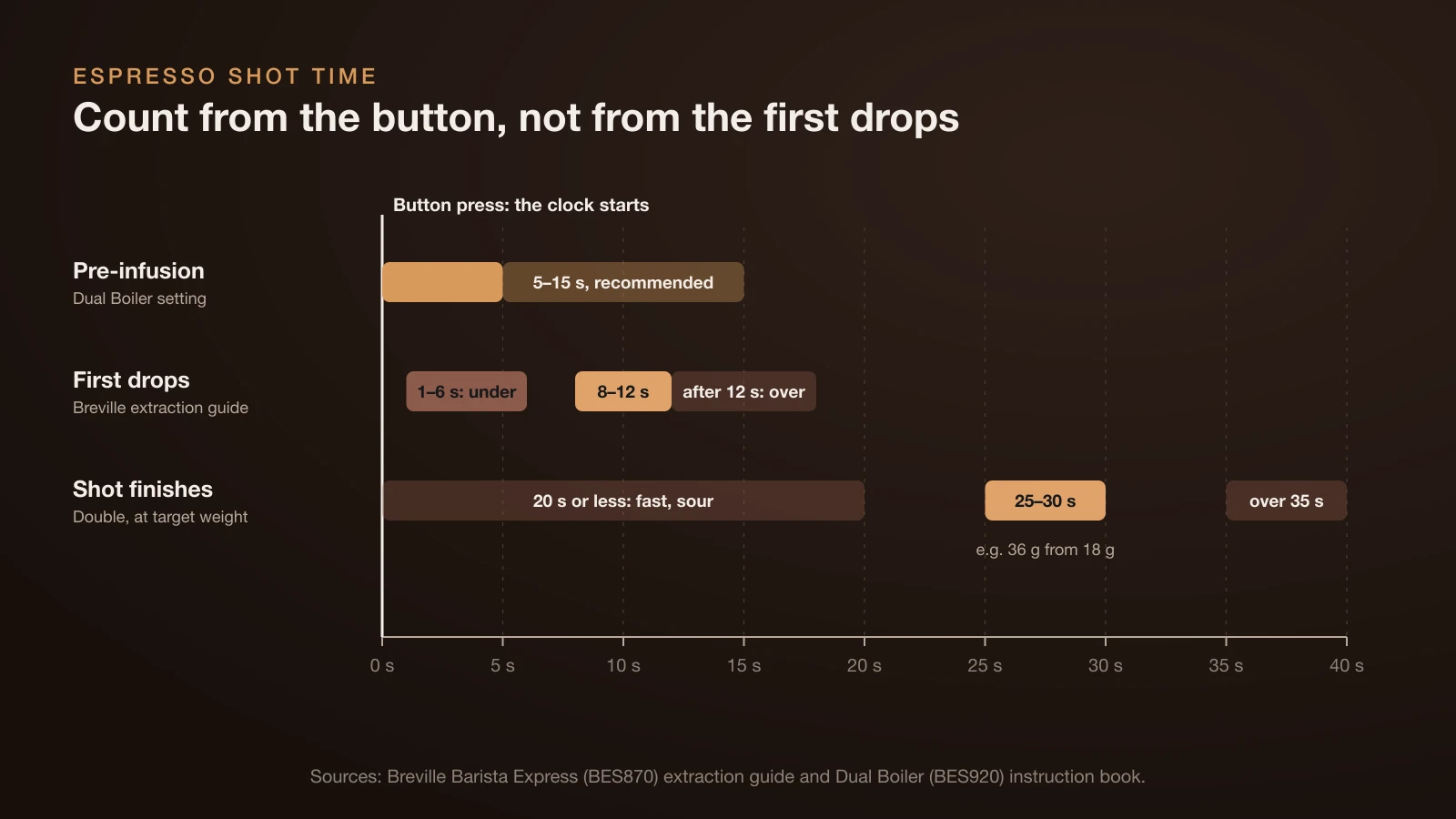
The espresso shot time starts when you press the brew button, not when the first drops appear. Breville says the ideal extraction time begins as soon as you activate the brew cycle, and the shot clocks on its machines count up from that moment.
Button press vs first drops
Coffee does not appear right away, because the puck first fills with water. In Breville’s extraction guide for the Barista Express, a balanced double starts to flow after about 8–12 seconds. The first drops after only 1–6 seconds point to an under-extracted shot, and none until after 12 seconds points to an over-extracted one.
Some baristas start their timer at the first drip instead. That works if you stay consistent, but it cuts several seconds off every number, so a first-drip time of 20 seconds can be a normal 28-second shot on the button clock.
How pre-infusion changes the number
Pre-infusion is a low-pressure phase at the start of a shot that wets and swells the coffee before full pressure. Breville’s Barista Express applies it automatically, and holding the button extends it. On the Breville Dual Boiler you can program it, with 5–15 seconds recommended.
A long pre-infusion adds seconds to the clock before full pressure starts, so a longer total does not by itself mean an over-extracted shot. If your machine pre-infuses for longer, expect total times toward the upper end of the range, and compare your shots only with shots from the same machine and settings.
How long to pull an espresso shot, step by step
Pull an espresso shot until it reaches your target weight, which for a standard double takes about 25–30 seconds. Stopping by weight keeps the recipe fixed, so the time tells you what the grind is doing.
- Weigh the dose. About 18 g in a double basket; Breville’s double basket takes 16–19 g.
- Pick the yield. Start at 36 g, a 1:2 ratio.
- Purge the group and lock in the portafilter.
- Start the shot and the timer together.
- Stop at the target weight, a gram or two early, since a few drops keep falling.
- Read the time. Under about 20 seconds means grind finer; over about 35 seconds means grind coarser.
- Taste before you change anything. A shot at 24 or 32 seconds that tastes good is a good shot.
Our guide to dialing in espresso turns these steps into a repeatable loop with a log template.
Espresso shot time vs ratio vs taste: time is a signal
Espresso shot time is a signal about flow, while the ratio sets the recipe and taste gives the verdict. Time depends on grind, dose, yield, pre-infusion and puck preparation, so the same 28 seconds can come from very different shots.
In a 2020 study in the journal Matter, shot time rose in a straight line as the grind got finer, with dose, yield and pressure held constant. That is why the grinder is the main control for time; our guide to espresso grind size shows how to adjust it.
The same study also shows why time cannot be the target by itself. The researchers made shots with the same extraction yield from different grind settings and found that their flavor still differed, so the barista has to taste. Breville’s range of 20–40 seconds for great-tasting shots makes the same point.
What fast and slow shots mean
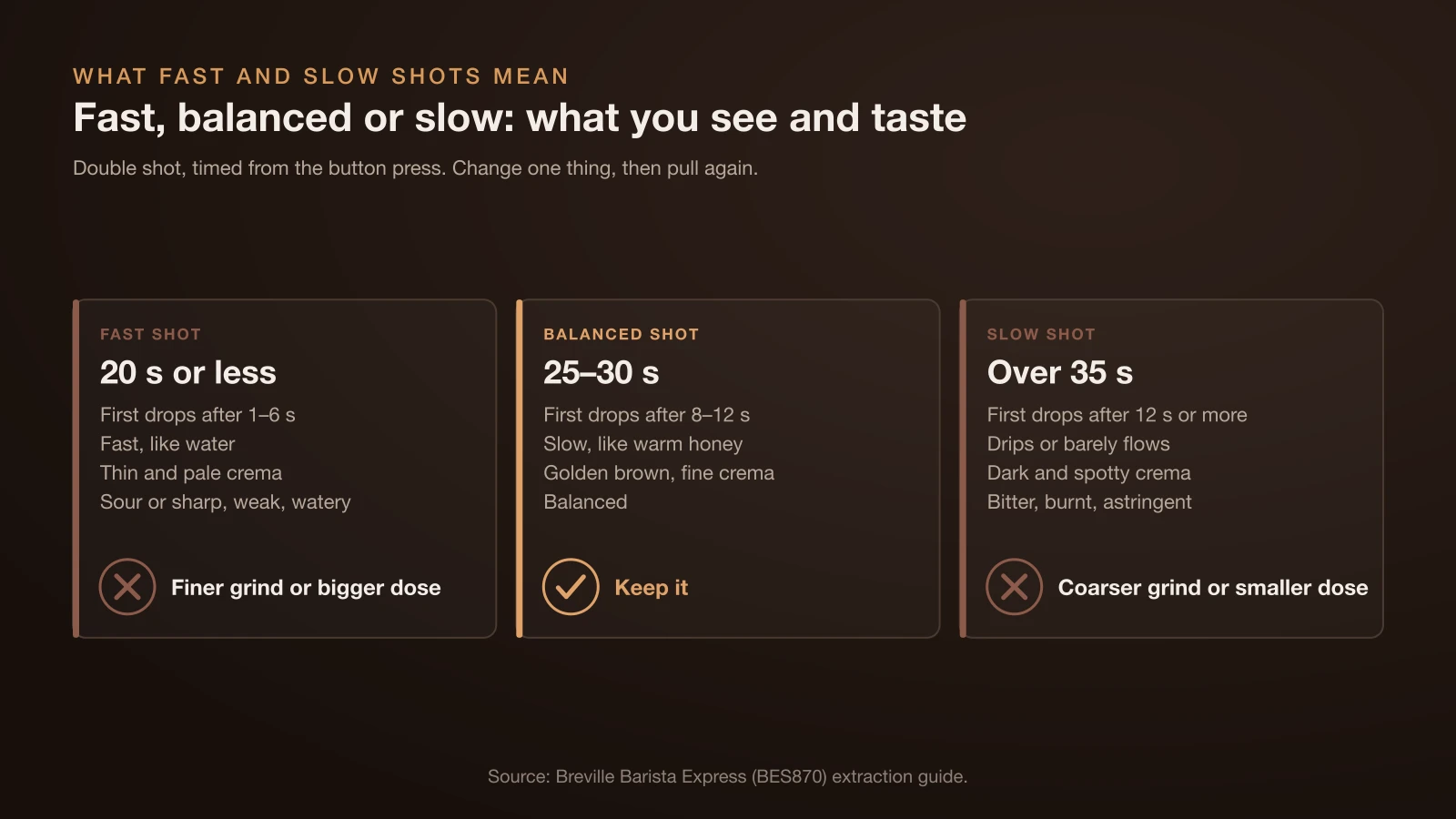
A fast shot usually means under-extraction and a slow shot usually means over-extraction, and Breville’s extraction guide ties each to what you see and taste.
| Fast shot | Balanced shot | Slow shot | |
|---|---|---|---|
| Total time (double) | 20 s or less | 25–30 s | Over 35 s |
| First drops | After 1–6 s | After 8–12 s | After 12 s or more |
| Flow | Fast, like water | Slow, like warm honey | Drips or barely flows |
| Crema | Thin and pale | Golden brown, fine texture | Dark and spotty |
| Taste | Sour or sharp, weak, watery | Balanced | Bitter, burnt, astringent |
| Fix | Finer grind or a slightly bigger dose | Keep it | Coarser grind or a slightly smaller dose |
A fast shot that tastes sharp is the classic under-extracted shot; our guide to sour espresso lists eight causes and a fix order. A slow shot that tastes harsh points the other way. If the time is right and the taste is still off, look at the ratio, the beans or the brew temperature rather than the clock.
Single vs double shot time
A single and a double take about the same time, because the dose and yield both double while the flow stays similar. Breville’s extraction guide uses the same 25–30 second window for its single basket (8–11 g) and double basket (16–19 g).
The Breville Dual Boiler’s presets stay close together: 25 seconds for the 1 cup button and 30 seconds for the 2 cup button. The SCA heritage definition also gives one time range, 20–30 seconds, for singles and doubles alike.
Turbo shots: can a fast shot taste good?
A fast shot can taste good when it is designed to be fast, with a coarser grind and less coffee. Researchers publishing in Matter showed that 15 g of coffee, ground much coarser and pulled to 40 g, can reach the same extraction yield as a 20 g recipe with better reproducibility. They note such shots may run in under 15 seconds.
The trade-off is a weaker, lower-concentration shot with a different flavor profile, which the authors say plainly. A café in Eugene, Oregon, that used the method routinely pulled shots in 14 seconds while saving coffee. A fast shot from an accidentally coarse grind at a normal 18 g dose is a different thing: that is the sour, under-extracted shot from the table above.
How long does a shot of espresso last?
A pulled shot of espresso is best drunk right away, while caffeine from it lasts for hours. The two questions have different answers.
In the cup
Espresso has no official “shelf life,” but the standards are clear about timing. The SCA’s heritage definition says espresso should be prepared for and immediately served to the person drinking it. The IEI puts the ideal temperature in the cup at 67 °C ± 3 °C (about 147–158 °F).
As the shot cools, its flavor shifts. The Matter authors note that a mix of bitter and acidic flavors is particularly detectable as coffee cools, so a flawed shot tastes worse after a few minutes. If you need to wait, add the shot to milk or water right away.
In your body
Caffeine from an espresso peaks in the blood within one hour, and its effects can last four to six hours, according to MedlinePlus from the National Library of Medicine. How much caffeine a shot holds depends on its size; see caffeine in an espresso shot for single and double amounts.
The bottom line
A double espresso usually takes about 25–30 seconds from the button press, with pre-infusion counted in the time. Stop the shot by weight, such as 36 g from 18 g, and use the time as a signal: grind finer when shots run fast and sour, coarser when they run slow and bitter. If the time is right but the taste is not, check the espresso brew temperature and the ratio next.
Sources
- Breville: Barista Express BES870 instruction book (extraction guide: flow start, under 20, 25–30 and over 35 seconds, flow and crema; 8–11 g and 16–19 g baskets; pre-infusion button), Dual Boiler BES920 instruction book (25 and 30 second presets, 5–15 second pre-infusion, shot clock) and How to dial in espresso (timing from the brew cycle start, 20–40 seconds, 1 oz and 2 oz)
- Specialty Coffee Association: Defining the ever-changing espresso (archived; heritage definition with 7–9 g, 14–18 g, 20–30 seconds and immediate serving; survey: 51% at 25–30 seconds, 18–20 g doses)
- Istituto Espresso Italiano: Certified Italian Espresso and its archived technical brochure (7 g, 25 seconds ± 5, 25 ml, 67 °C ± 3 in the cup)
- Cameron et al., Matter (2020): Systematically improving espresso: insights from mathematical modeling and experiment (shot time vs grind, same yield with different flavor, 15 g in and 40 g out under 15 seconds, 14 second café shots, flavors as coffee cools)
- National Library of Medicine: MedlinePlus, Caffeine (peak within one hour, effects for four to six hours)