Dialing in espresso means adjusting your grinder, dose and yield until a shot tastes balanced instead of sour or bitter. Fix the dose, for example 18 g in a double basket, aim for about 36 g of espresso in 25–30 seconds, then taste. Change one thing at a time, starting with the grind, and pull again.
Every new bag needs this, because beans differ in origin, roast and age, so no single setting suits them all. This guide gives you a repeatable method, a dial-in chart, a plain explanation of extraction and a log template. Keep our guide to espresso grind size nearby, since most changes happen at the grinder.
The short answer
| Step | What to do | Starting target |
|---|---|---|
| 1. Fix the dose | Weigh the coffee and keep it the same | 18 g in a double basket |
| 2. Set the yield | Decide where you will stop the shot | 36 g (a 1:2 ratio) |
| 3. Pull and time | Start the timer with the pump; stop at the yield | 25–30 seconds |
| 4. Taste | Sour, bitter or balanced? | Sweet and balanced |
| 5. Adjust | Change the grind by one step | One variable per shot |
| 6. Fine-tune | Adjust the yield for taste | Between 1:1.5 and 1:2.5 |
| 7. Record | Write down the settings that worked | One entry per shot |
What does dialing in espresso mean?
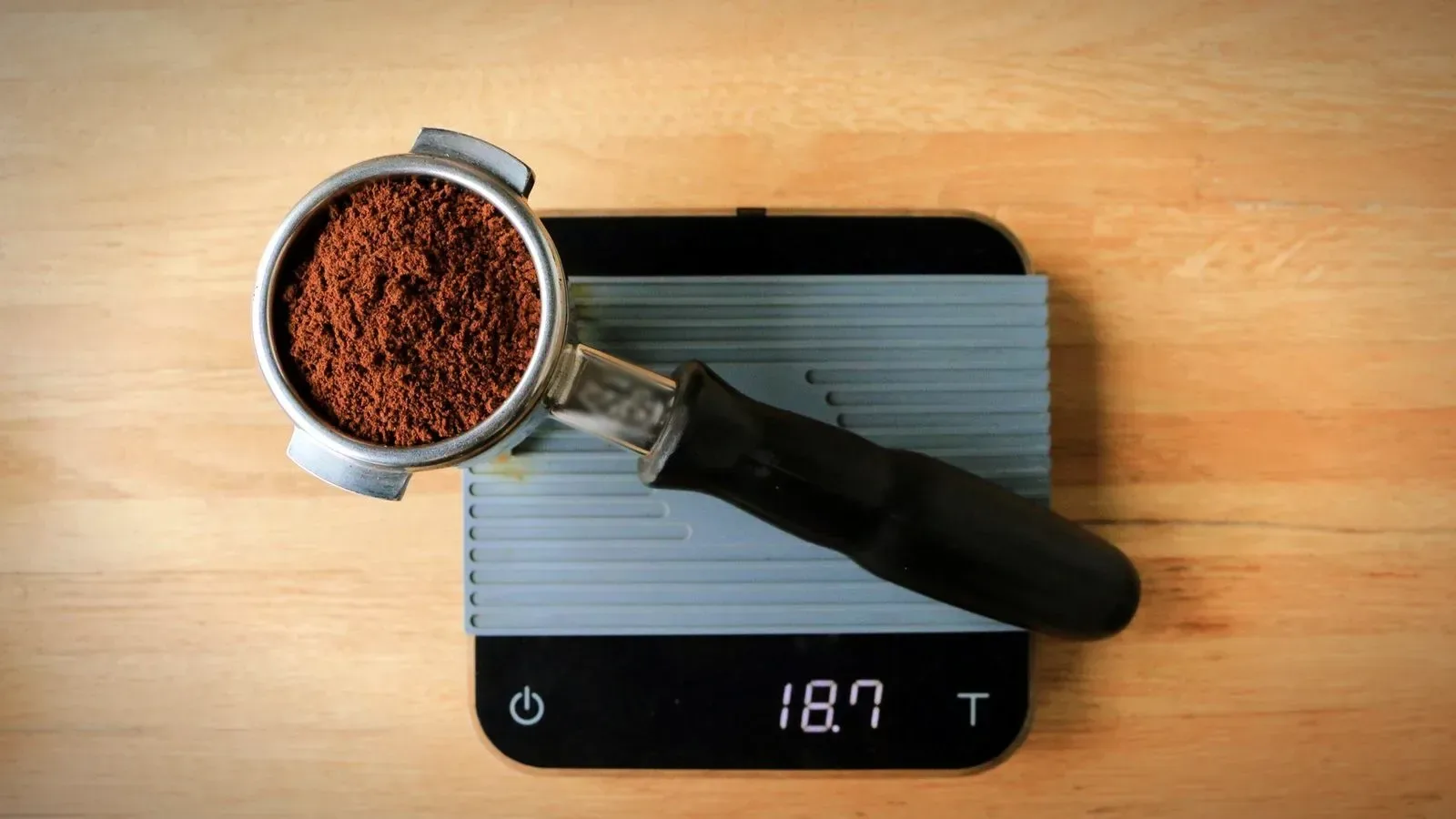
Dialing in espresso means fine-tuning your brewing variables until one particular coffee tastes balanced on your machine. Breville describes it as adjusting dose, yield, brew ratio, extraction time and grind size, and points out that there is no one-size-fits-all setting because beans differ in origin, roast and other factors.
- Dose: the dry coffee in the basket, weighed in grams.
- Yield: the espresso in the cup. In the Specialty Coffee Association’s (SCA) barista survey, 82% of professionals weighed it.
- Ratio: yield compared with dose. 18 g in and 36 g out is 1:2; see our guide to the espresso ratio.
- Time: from starting the pump to stopping the shot.
- Grind size: the main control over how fast water flows.
How to dial in espresso, step by step
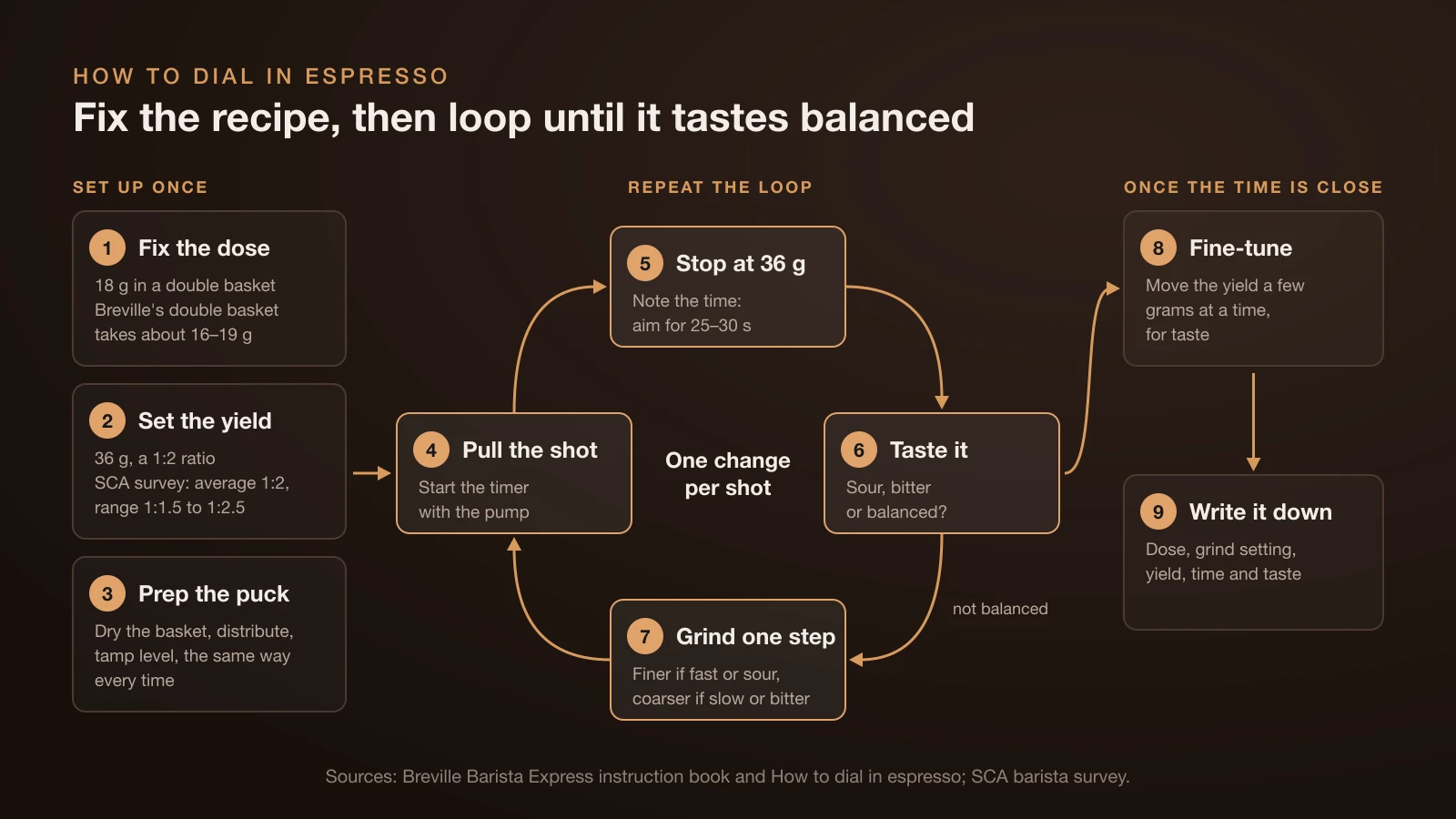
To dial in espresso, fix the dose and yield, pull a shot, time it, taste it and then change the grind in small steps until the shot tastes balanced.
- Fix the dose. Use the double basket and weigh about 18 g of coffee. Breville rates its 54 mm double basket at about 16–19 g, while La Marzocco suggests 17 g or 21 g baskets for a modern espresso, so match the dose to your basket.
- Set a target yield. Start at 36 g, a 1:2 ratio. In the SCA’s barista survey the average ratio was 1:2, and answers ranged from 1:1.5 to 1:2.5.
- Prepare the puck the same way every time. Dry the basket, distribute evenly and tamp level; our guide on how to tamp espresso covers the technique.
- Purge, lock in and start the timer with the pump. Breville counts extraction time from the moment you start the brew cycle, pre-infusion included.
- Stop at the target weight and note the time. Breville’s balanced zone is 25–30 seconds; La Marzocco suggests 25–35 seconds on its Linea Micra.
- Taste it. Sour, thin and sharp points to under-extraction; bitter, harsh and drying points to over-extraction.
- Change the grind by one step. Finer if the shot was fast or sour, coarser if it was slow or bitter. Change nothing else.
- Fine-tune the yield. Once the time is close, move the yield a few grams at a time for taste.
- Write it down. Record dose, grind setting, yield, time and taste.
Breville’s manual says it is normal for the grind size and grind amount to need a few adjustments before the extraction is right.
Why change the grind first?
Grind comes first because it controls the flow without changing your recipe. Breville’s dial-in guide calls grind size the first place to make a change. In a 2020 study in the journal Matter, shot time rose in a straight line as the grind got finer, while the dose, yield and pressure stayed the same.
Changing the dose also changes the flow, but it changes the ratio and basket fill too. Breville lists adding a gram or two for fast shots, or trimming the dose for slow ones, as a second option.
Espresso dial-in chart: taste, cause and fix
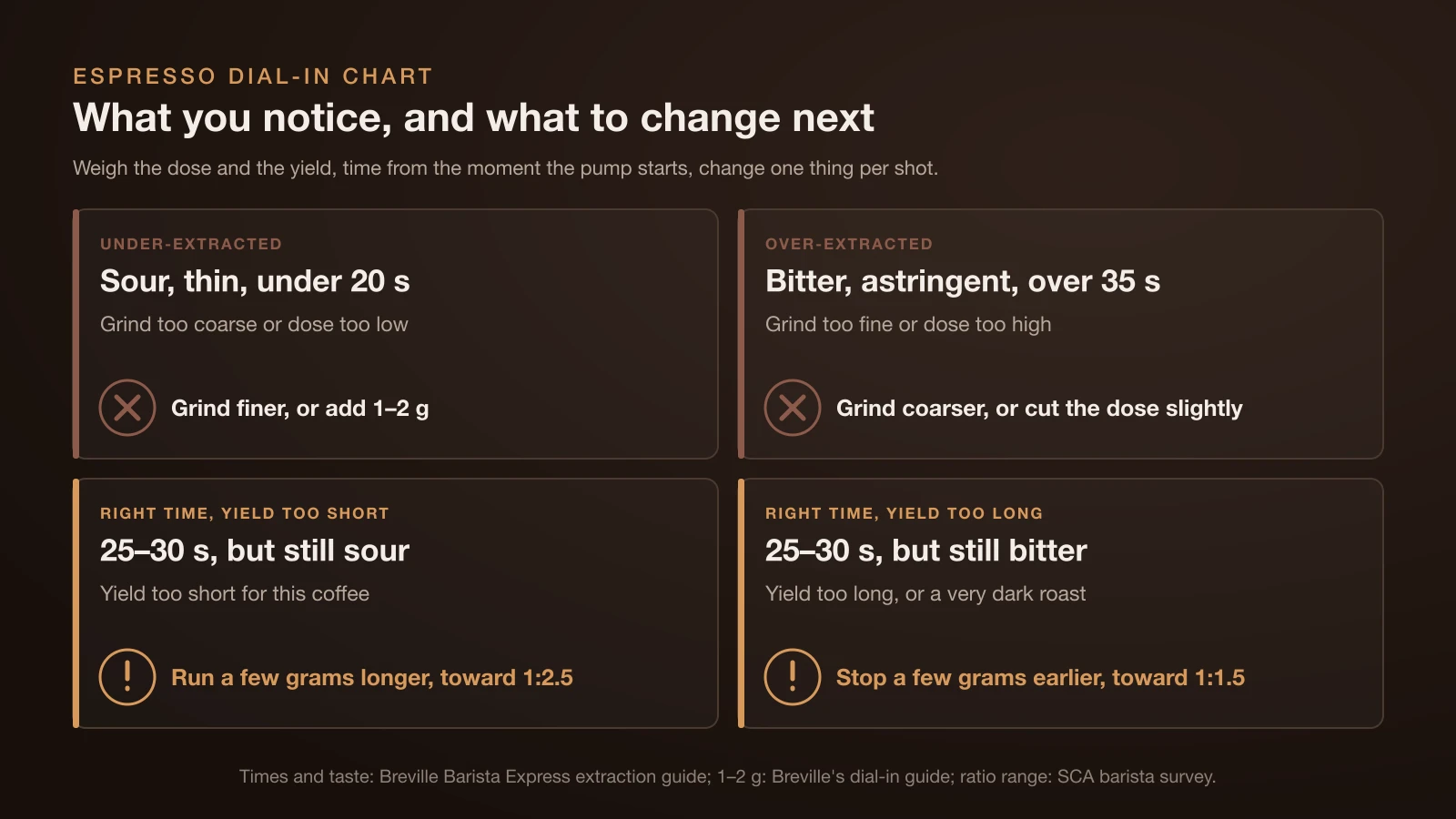
Use this dial-in chart to turn what you see and taste into one specific change for the next shot. The time marks come from Breville’s extraction guide.
| What you notice | Likely cause | Change for the next shot |
|---|---|---|
| Sour, thin, done in under 20 s | Under-extracted: grind too coarse or dose too low | Grind finer, or add 1–2 g |
| Bitter, astringent, over 35 s | Over-extracted: grind too fine or dose too high | Grind coarser, or cut the dose slightly |
| 25–30 s, but still sour | Yield too short for this coffee | Run a few grams longer, toward 1:2.5 |
| 25–30 s, but still bitter | Yield too long, or a very dark roast | Stop a few grams earlier, toward 1:1.5 |
| Sour and bitter at once, spurting | Channeling through an uneven puck | Dry the basket, distribute evenly, tamp level |
| Balanced but weak and watery | Ratio too long for your taste | Shorter ratio or a slightly bigger dose |
| Flat taste, little crema | Stale beans, or coffee tamped too lightly | Fresher beans; check the tamp |
| Espresso leaks around the portafilter | Grounds on the rim, or too much coffee | Wipe the rim; lower the dose |
If a shot stays harsh at the right time, our guide to bitter espresso covers roast, temperature and cleaning causes, and sour espresso covers the opposite problem. If shots spurt or taste sour and bitter together, a bottomless portafilter shows where the water breaks through.
Look at the shot, not only the clock
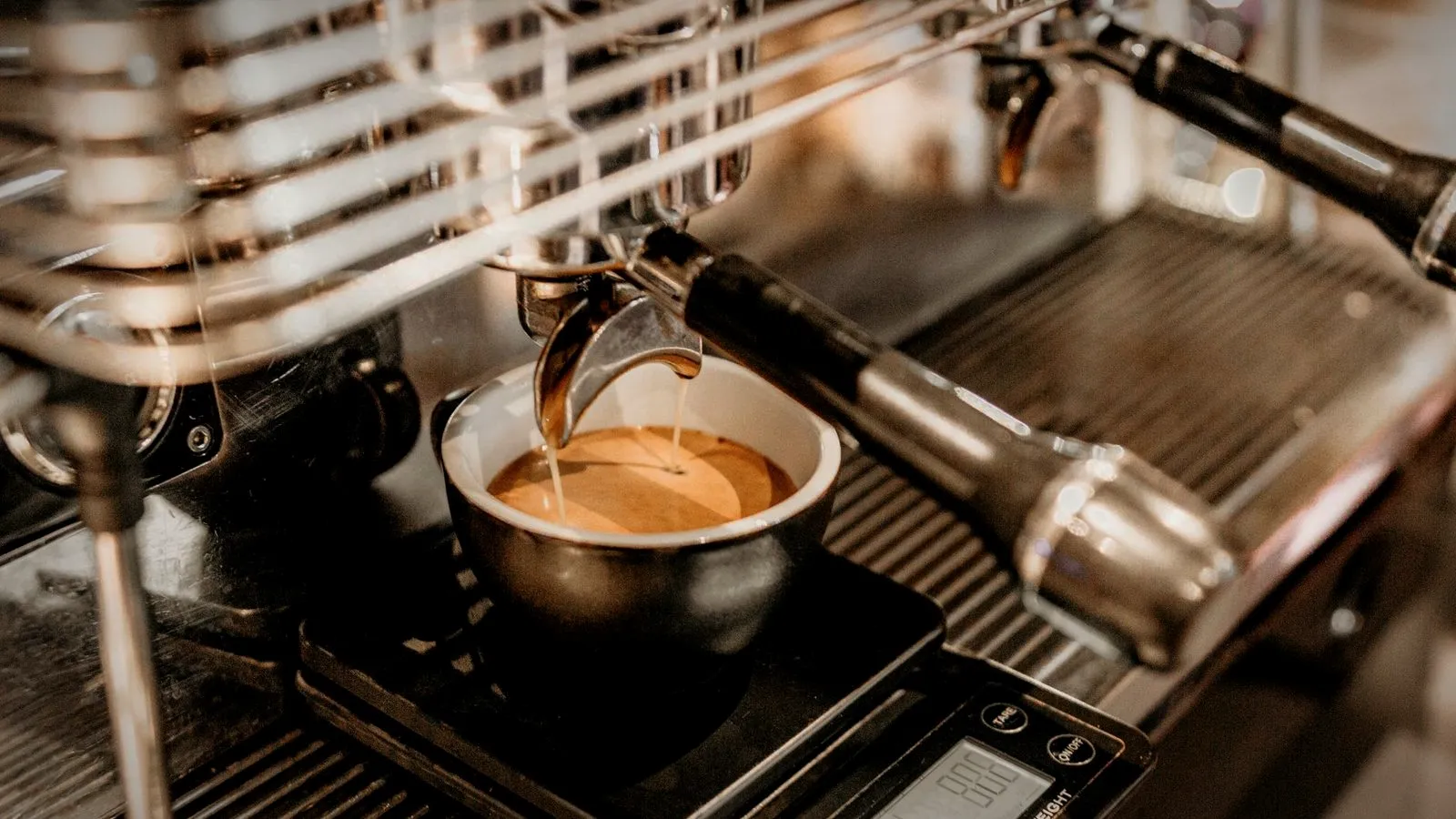
The flow and crema give you clues before you taste. Breville’s extraction guide describes a balanced double as flowing like warm honey with golden-brown crema, an under-extracted one as fast like water with thin, pale crema, and an over-extracted one as dripping, with dark, spotty crema.
On the Barista Express, the same guide pairs a balanced shot with the gauge needle inside its espresso range. Our guide to the espresso machine pressure gauge explains how to read one.
What espresso extraction means
Espresso extraction is hot water dissolving flavor compounds out of the ground coffee and carrying them into the cup. The coffee industry measures it as extraction yield: the mass of coffee that dissolved, as a share of the dry coffee used. It is calculated from a refractive index reading, so measuring it at home takes a refractometer.
Breville’s extraction guide describes under-extracted espresso as sour and underdeveloped, and over-extracted espresso as bitter and astringent. Dialing in moves the shot between those ends until it lands in the middle.
Espresso extraction time is simply the length of the shot, timed from the start of the brew cycle. It guides the grind, but Breville notes that a great-tasting espresso can take anywhere from 20 to 40 seconds, so time is a check, not the goal.
Why an extraction number is not the goal
A finer grind raises extraction only up to a point. In the Matter study, extraction peaked and then fell at the finest settings, because the bed partly clogged and water took uneven paths.
The researchers also produced two shots with the same 22% extraction yield from two different grind settings at the same ratio. The shots could not be chemically identical, they noted, so the barista still needs to taste the coffee rather than rely on the number.
When to dial in espresso again
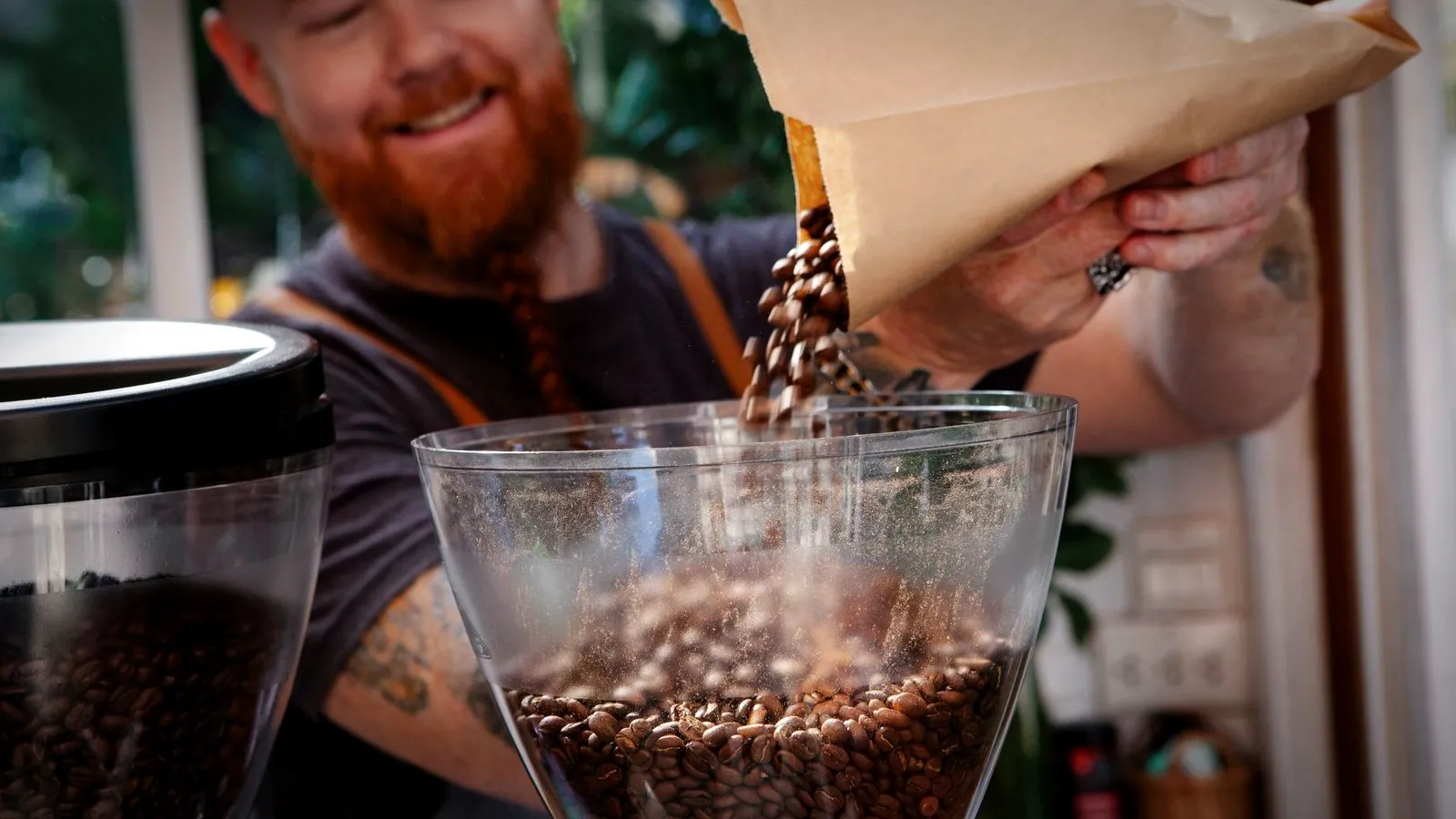
Dial in again whenever something changes the way the coffee extracts: a new bag, aging beans, a different roast or a different basket. Breville’s Barista Express Impress manual lists four reasons its dose reading drifts: fresh beans added to the hopper, beans getting older, a different type of coffee and a change in grind size.
- A new bag or a different coffee. Start from your last settings and pull a test shot.
- Beans getting older. Breville suggests using beans 5–20 days after the roast date and grinding just before brewing. Expect small grind corrections as a bag ages.
- A different roast level. Light and dark roasts extract differently; our guide to espresso roast gives a starting point for each.
- Switching baskets. Breville says the grind amount and grind size need adjusting when you move between the single and double basket.
- A big grinder change. Breville suggests occasionally purging old grounds by running a small amount through the grinder.
Dialing in pressurized baskets and super-automatic machines
Pressurized baskets and super-automatic machines leave you fewer variables to adjust, so dialing in is simpler and more limited. Breville says its dual-wall baskets regulate the pressure and help the extraction regardless of grind, dose, tamp pressure or freshness, which is why it recommends them for pre-ground coffee. With one, focus on fresh coffee, a steady dose and the yield.
Super-automatic machines grind, dose and tamp for you, as our guide to super-automatic espresso machines explains. If you own a De’Longhi Magnifica, follow the grinder instructions in the manual for your model; De’Longhi’s grinder FAQ says to move the dial one notch at a time, only while the grinder is running.
A simple dial-in log template
A dial-in log records what you changed, so you never repeat a failed shot or lose a good recipe. Breville recommends noting the measurements, timing and settings once you pull an especially tasty shot.
Copy this layout into a notebook or phone note:
| Shot | Coffee and roast date | Dose (g) | Grind setting | Yield (g) | Time (s) | Taste | Next change |
|---|---|---|---|---|---|---|---|
| 1 |
A filled-in log might look like this. The values are made up to show the method on a grinder like the Barista Express, where a lower number is finer and Breville suggests starting at 5:
| Shot | Dose | Grind | Yield | Time | Taste | Next change |
|---|---|---|---|---|---|---|
| 1 | 18 g | 5 | 36 g | 18 s | Sour, thin | One step finer |
| 2 | 18 g | 4 | 36 g | 24 s | Slightly sharp | One step finer |
| 3 | 18 g | 3 | 36 g | 28 s | Balanced | Keep; try 38 g next time |
The bottom line
Dialing in espresso is a loop: fix the dose, set the yield, pull, time, taste and change one thing. Start at about 18 g in and 36 g out in 25–30 seconds, adjust the grind first, then fine-tune the yield for taste. Write down what worked, and repeat the check for every new bag.
Sources
- Breville: Barista Express BES870 instruction book (16–19 g basket, grind setting 5, extraction guide times, flow, crema and gauge, switching baskets, 5–20 days after roasting), Barista Express Impress BES876 instruction book (why dose readings drift) and How to dial in espresso (variables, grind first, a gram or two, 20–40 seconds, 1 oz and 2 oz, notes)
- Specialty Coffee Association: Defining the ever-changing espresso (archived; barista survey: 18–20 g dose, 1:2 average, 1:1.5 to 1:2.5 range, 82% weigh yield)
- Cameron et al., Matter (2020): Systematically improving espresso: insights from mathematical modeling and experiment (extraction yield, refractive index, shot time vs grind, extraction peak, two 22% shots)
- La Marzocco: Setting up your Linea Micra (17 g and 21 g baskets, 25–35 seconds)
- De’Longhi: How do I adjust the coffee grinder? (one notch at a time, only while grinding)