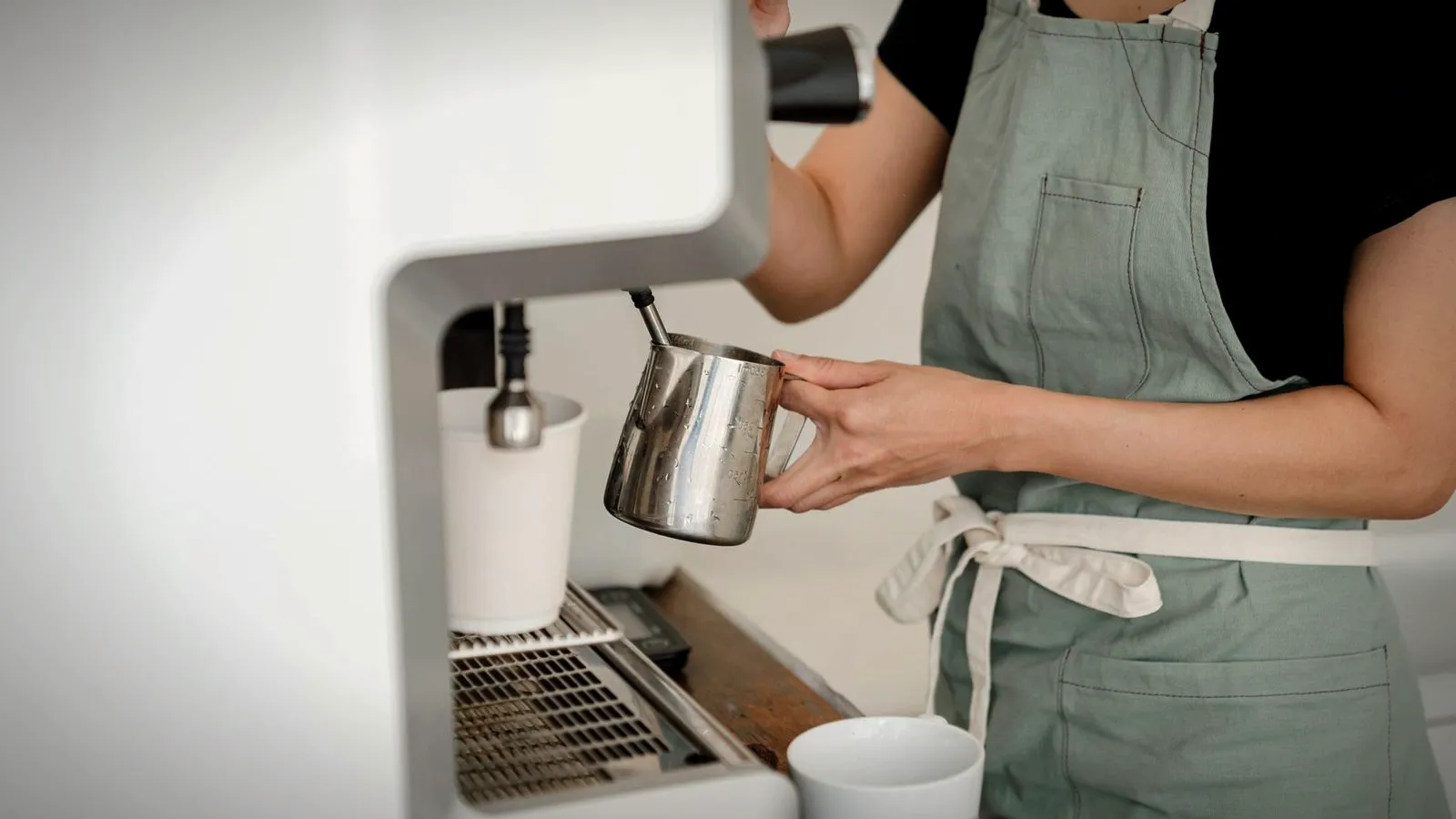
How to steam milk comes down to two phases. Pour cold milk into a pitcher about halfway, purge the steam wand, then hold the tip just under the surface for 5–10 seconds to add air. Lower it slightly so the milk spins in a whirlpool, and stop at 60–65 °C (140–150 °F). Tap, swirl and pour right away.
That routine is the skill behind every café drink, from a cappuccino to a latte made at home. Every number here comes from the machine makers’ own manuals and guides.
The short answer
| Step | What to do | Target |
|---|---|---|
| Milk | Start with fresh, cold milk | Straight from the fridge |
| Pitcher | Fill to just below the spout, about half full | 12 oz pitcher for small drinks, 20 oz for lattes |
| Purge | Blast steam over the drip tray for a second | Clears condensed water |
| Stretch | Tip just under the surface, soft tearing sound | About 5–10 seconds |
| Texture | Sink the tip slightly, keep a whirlpool | Until the pitcher is hot to touch |
| Stop | Turn the steam off before lifting the wand out | 60–65 °C (140–150 °F) |
| Finish | Wipe and purge the wand, tap and swirl the pitcher | Glossy, like wet paint |
Steamed milk vs frothed milk
Steamed milk is milk heated by pressurized steam that also folds in a little air, while frothed milk is whipped full of air without that steam. Breville describes the difference this way: frothing makes an airier milk with unevenly sized bubbles, and steaming makes a smoother, finer foam with very small, uniform bubbles.
| Steamed milk | Frothed milk | |
|---|---|---|
| How it is made | Steam wand on an espresso machine | Handheld or electric frother, whisk, jar or French press |
| Texture | Dense, glossy microfoam | Light, airy, bigger bubbles |
| Best for | Lattes, flat whites, cappuccinos, latte art | Cold foam, quick home drinks |
Milk proteins wrap around the bubbles and hold the foam together, which is why lower-protein plant milks such as almond need more stretching, and why makers sell barista versions made to foam.
What you need: milk frothing pitcher and milk
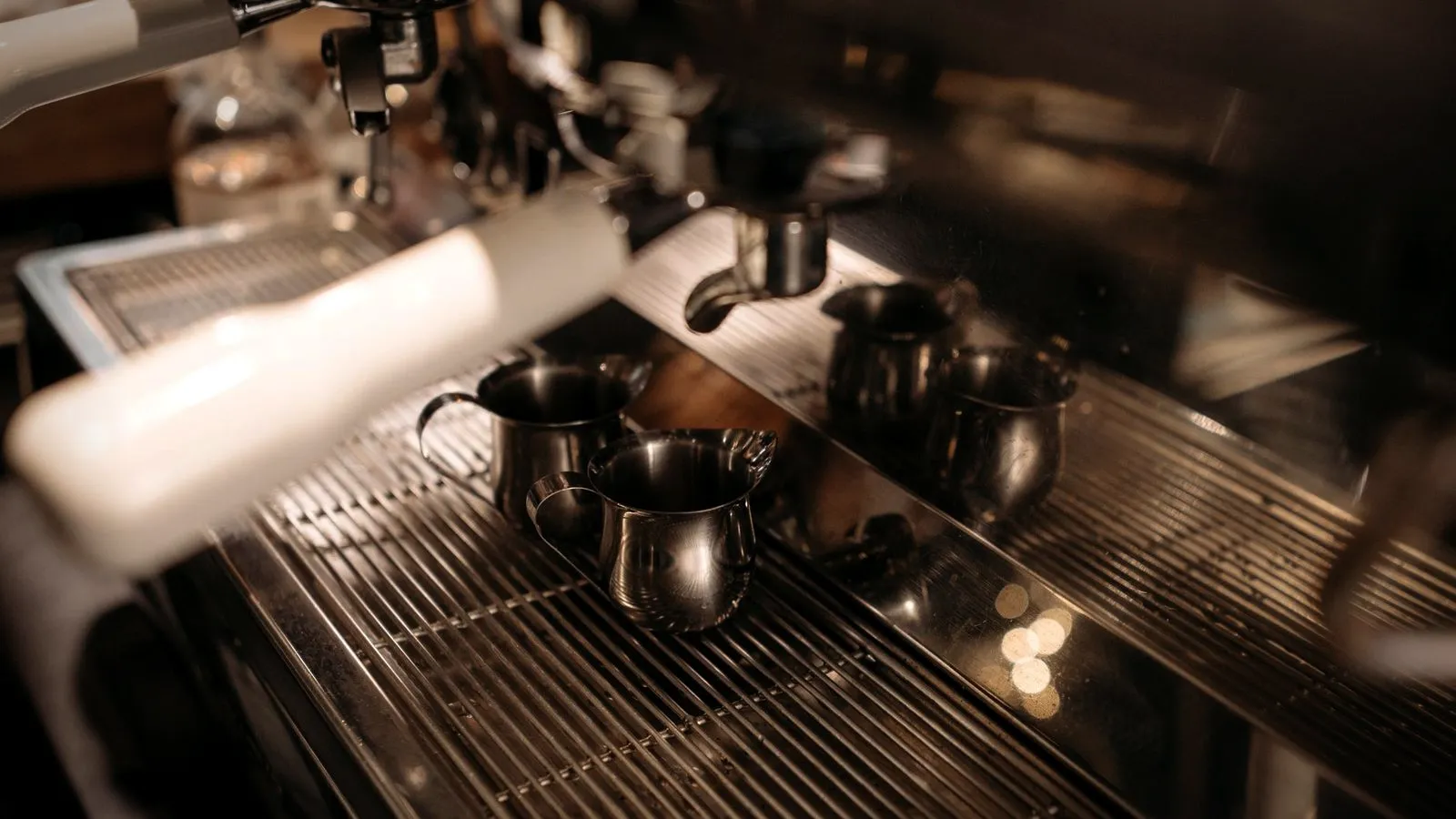
A milk frothing pitcher for steaming should be stainless steel, sized to your drink, and filled only about halfway. La Marzocco’s home steaming guide suggests filling to within a finger-width of where the spout starts, while Breville’s manual says to fill just below the “V” at the bottom of the spout.
| Pitcher size | Best for | Source |
|---|---|---|
| 12 oz (about 350 ml) | Drinks under 8 oz: cortado, cappuccino, flat white | La Marzocco |
| 16 oz (480 ml) | The jug Breville packs with its Barista Pro | Breville |
| 20 oz (about 590 ml) | Lattes of 8–12 oz, or two drinks at once | La Marzocco |
Breville’s steaming guide suggests a minimum of about half a cup (4 oz) and warns that an overfilled pitcher spills as the milk grows; La Marzocco adds that an underfilled one is harder to control and heats too quickly. A thermometer or a jug with a temperature strip helps while you learn.
For the milk, start cold. Whole milk is the most forgiving, and our latte milk ratio guide shows how much to pour for each cup size.
How to steam milk with an espresso machine steam wand
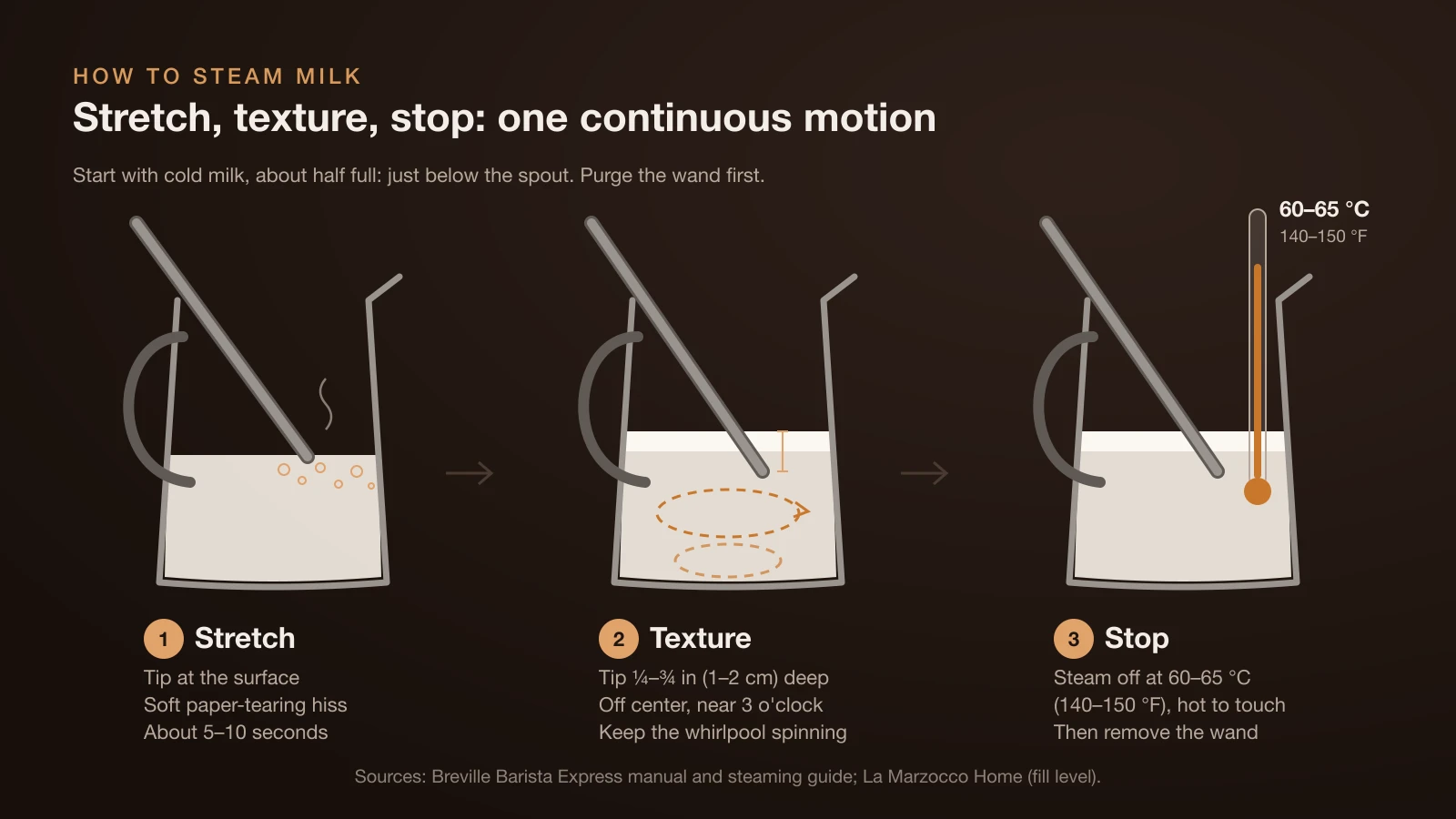
To steam milk with a steam wand, you stretch it first by letting air in at the surface, then texture it by spinning it below the surface until it is hot. Breville’s manual says the two phases should blend into one. These steps follow its instructions.
- Pour cold milk into the pitcher, about halfway.
- Purge the wand. Point it over the drip tray and open the steam for a second or two to clear condensed water.
- Place the tip and open the steam. Lower the wand about ¼–¾ in (1–2 cm) into the milk, slightly off center near the 3 o’clock position, then open the steam fully so the milk spins.
- Stretch. Lower the pitcher until the tip sits at the surface and you hear a soft, steady paper-tearing hiss. Breville’s guide puts this at about 5 to 10 seconds. The volume grows as air goes in.
- Texture. Raise the pitcher so the tip sinks just below the surface and keep the whirlpool going. This breaks big bubbles into microfoam.
- Stop at temperature. Turn the steam off at 60–65 °C (140–150 °F), when the pitcher feels hot to touch, then remove the wand.
- Clean the wand. Wipe it with a damp cloth and purge it again straight away.
- Tap and swirl. Knock the pitcher on the counter to pop any large bubbles, then swirl until the surface looks glossy.
- Pour quickly. Breville notes the milk starts to separate if it waits.
How the sound tells you what is happening
The sound is your best guide while steaming. La Marzocco describes it as controlled and fairly quiet, like paper ripping. A harsh sputter means the tip is too high; a high-pitched screech means it is too deep and adds no air.
How hot to steam milk
Steam milk to about 60–65 °C (140–150 °F), the range Breville’s espresso machine manual gives. Hot enough to drink right away, it still tastes sweet. Some makers aim a little lower: La Marzocco calls 55–60 °C (130–140 °F) the ready-to-drink range, and Breville’s steaming guide suggests 140–145 °F (60–63 °C) for dairy.
- Too cool: the drink goes lukewarm quickly once it meets the cup.
- Too hot: in a study of steam-heated milk, steaming beyond 65 °C reduced some vitamins, and above about 80 °C (176 °F) most whey proteins break down, which gives milk its cooked taste.
- No thermometer: stop when you can touch the side of the pitcher for only a moment.
Milk steamer options for home
A milk steamer at home is almost always the steam wand on an espresso machine, but stovetop and standalone steamers also exist. Breville points out that true steamers are built into espresso machines and need a separate pitcher, while frothers are standalone appliances.
| Type | How it works | Good to know |
|---|---|---|
| Manual steam wand | Machine boiler or thermoblock makes steam; you control texture | Most control, needed for latte art |
| Automatic steam wand | A sensor under the pitcher reads the milk temperature and the wand stops by itself | Breville’s Bambino Plus lets you pick Warm, Ideal or Hot and Low, Medium or High foam |
| Stovetop milk steamer | Small boiler heated on the stove feeds a real wand | Flair’s Wizard has a 700 ml capacity and works on gas, coil, glass and most induction cooktops |
| Electric frother | Whisks milk in a heated jug | Froths rather than steams; also makes cold foam |
If you are weighing an automatic wand, our Bambino vs Bambino Plus comparison shows how a manual and an automatic wand differ on the same small machine.
How to steam milk at home without a steamer
You cannot truly steam milk at home without steam, but you can heat it and froth it close enough for a latte-style drink. Starbucks at Home publishes three methods; the foam is lighter and bubblier than wand microfoam.
| Method | Starbucks at Home steps | Result |
|---|---|---|
| French press (coffee press) | Heat milk to 60 °C (140 °F), pour into the press leaving room to double, plunge for about 30 seconds | Fine, fluffy foam |
| Whisk | Heat 8 fl oz (236 ml) to 60 °C in a tall mug, whisk in circles 15–20 seconds, then lift the whisk just under the foam | Light foam, more effort |
| Jar and microwave | Fill a jar halfway with 5 fl oz (150 ml), shake 20–30 seconds, then microwave uncovered 30–45 seconds | Quick, bubbly foam |
Heat the milk on the stove or in the microwave, and never let it boil. Let frothed milk rest for a few seconds so large bubbles rise, then tap and swirl it before pouring. For a sweet version of the same drink, these methods also work for a homemade vanilla latte.
How to steam oat milk and other plant milks
Plant milks steam best when you buy a barista version and adjust the stretch and heat to the milk: oat and almond need a slightly longer stretch, almond a lower temperature, and soy steams faster. Oatly says its Barista Edition is fully foamable and has 3% fat, and Califia Farms says its Oat Barista Blend froths, foams and steams for espresso drinks.
| Milk | Breville guidance |
|---|---|
| Dairy | 140–145 °F (60–63 °C) |
| Oat | Tolerates more heat than almond; stretch a few seconds longer |
| Soy | Up to 150 °F (65 °C); steams about twice as fast, so shorten the time |
| Almond | About 131 °F (55 °C); more stretching, less heat |
Shake the carton before pouring and start with it cold, just as with dairy. Our oat milk latte guide covers how oat milk tastes and behaves in a finished drink.
Steaming milk for a latte vs a cappuccino
The steaming technique stays the same for every drink; only the amount of air changes. A latte or flat white needs a short stretch and a thin layer of glossy microfoam, while a cappuccino needs a longer stretch, until the volume clearly grows. La Marzocco keeps the tip just below the surface for microfoam and just above it for dense foam.
Our guide to the wet vs dry cappuccino explains how much foam each style uses.
Common milk steaming mistakes and fixes
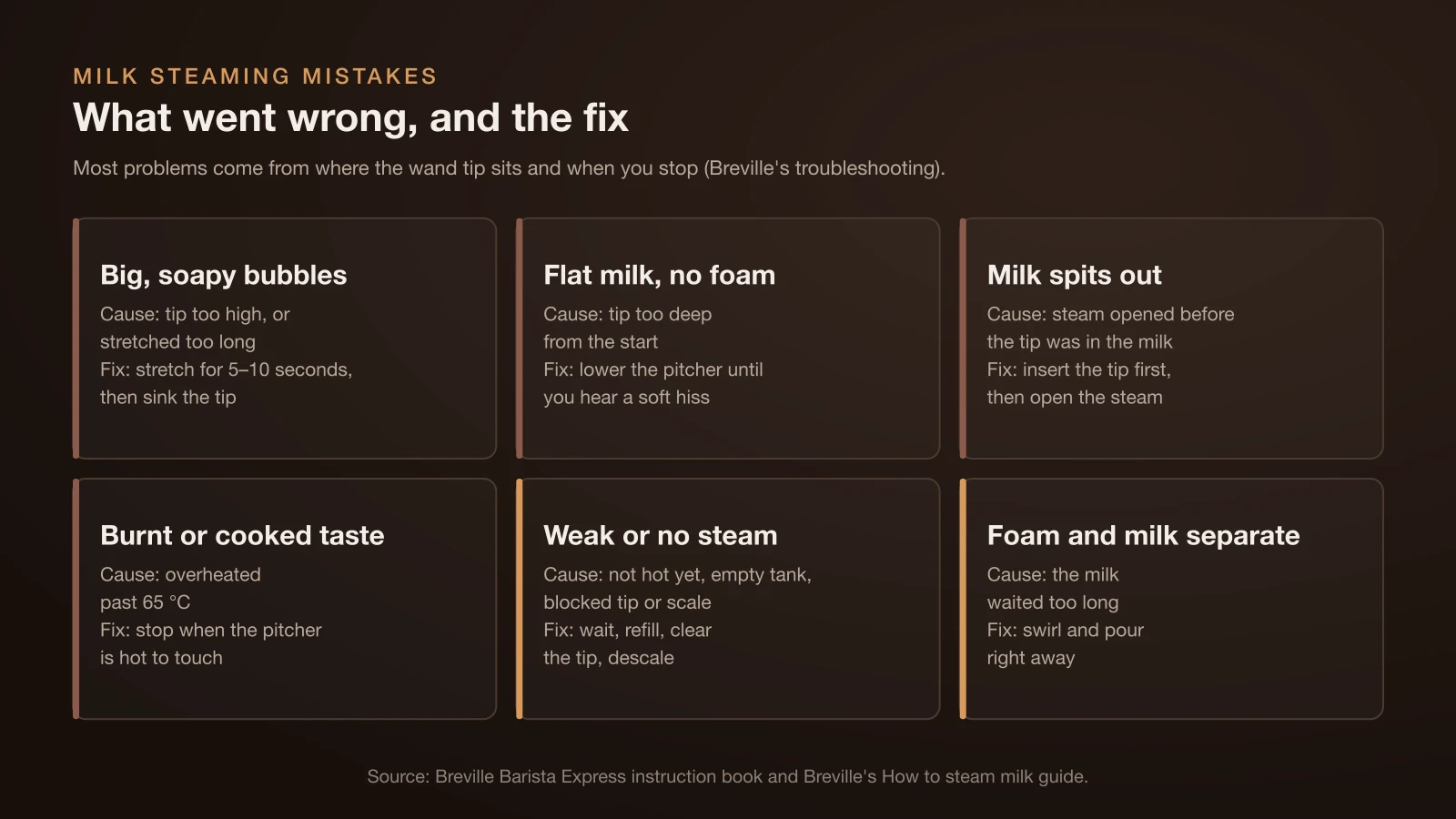
Most steaming problems come from where the wand tip sits and when you stop. This table follows the troubleshooting in Breville’s manual and steaming guide.
| Problem | Likely cause | Fix |
|---|---|---|
| Big, soapy bubbles | Tip too high or stretched too long | Stretch for 5–10 seconds, then sink the tip |
| Flat milk, no foam | Tip too deep from the start | Lower the pitcher until the tip reaches the surface and you hear a soft hiss |
| Milk spits out of the pitcher | Steam opened before the tip was in the milk | Insert the tip first, then open the steam |
| Burnt or cooked taste | Overheated past 65 °C | Stop when the pitcher is hot to touch |
| Weak or no steam | Machine not hot yet, empty tank, blocked tip or scale | Wait, refill, clear the tip, descale |
| Foam and milk separate in the cup | Milk waited too long | Swirl and pour right away |
How to clean the steam wand
Clean the steam wand every single time you steam milk, because milk dries inside the tip and can block its holes. Breville’s manual says to wipe the wand with a damp cloth and then open the steam briefly over the drip tray to clear milk from inside.
If a hole in the tip blocks, switch the machine off, let it cool and clear it with the pin on the cleaning tool. If that fails, unscrew the tip and soak it in hot water first. For weekly soaks with milk system cleaner, see our full guide on how to clean an espresso machine.
The bottom line
To steam milk, start cold, purge the wand, stretch for about 5–10 seconds with a soft hiss, then spin the milk until it reaches 60–65 °C (140–150 °F). Choose the pitcher size for your drink and fill it about halfway. Without a steam wand, a French press, whisk or jar gives a lighter foam that still works for a homemade latte.
Sources
- Breville: Barista Express BES870 instruction book (stretching and swirling, fill below the spout, tip 1–2 cm deep, 60–65 °C, wand cleaning and troubleshooting), How to steam milk (4 oz minimum, 5–10 second stretch, 140–145 °F, soy, almond and oat), Milk frother vs. steamer, Barista Pro (480 ml jug) and Bambino Plus manual (automatic texturing to a selected temperature and foam level)
- La Marzocco Home: How to steam milk (12 and 20 oz pitchers, fill level, underfilled pitchers heat too quickly, sound, 55–60 °C, dense foam vs microfoam)
- Starbucks at Home: Froth milk with a coffee press, with a whisk and in a Mason jar (60 °C, amounts and times)
- Equipment and milk makers: Flair Wizard stovetop milk steamer (700 ml, cooktop compatibility), Oatly Barista Edition (3% fat, foamable) and Califia Farms Oat Barista Blend
- Peer-reviewed studies: Food Chemistry (2023), steam-heated milk for coffee drinks (60–65 °C, vitamin losses when hotter; pasteurized milk foams better than UHT); Zhang et al., Foods (2025), whey protein changes in heated milk (denaturation mainly above 80 °C)