
A dry cappuccino has more milk foam and less liquid steamed milk than a standard cappuccino, so it tastes bolder and feels lighter. A wet cappuccino goes the other way: more steamed milk, less foam, and a creamier, milder cup. A bone dry cappuccino is espresso with foam only. In every version, the espresso stays exactly the same.
None of these terms has an official standard. Cafés use them as ordering shorthand, so this guide starts from a certified reference cappuccino and describes the rest as café conventions. If you are also weighing a cappuccino against its silkier cousin, see flat white vs cappuccino.
The short answer
| Bone dry | Dry | Traditional | Wet | |
|---|---|---|---|---|
| Espresso | Same | Same | Same | Same |
| Liquid steamed milk | None or almost none | Less | About equal to the foam | More |
| Foam | Fills the cup | Thick, stiff cap | Thick layer | Thin, silky layer |
| Taste | Espresso-forward, airy | Bold, light | Balanced | Mild, creamy, sweeter |
| Closest relative | Espresso macchiato, with more foam | Bone dry cappuccino | The reference point | Flat white or small latte |
| Caffeine | Same as the shots | Same as the shots | Same as the shots | Same as the shots |
“Traditional” here means the classic picture of equal parts espresso, steamed milk and foam. Read every column as a café convention, not a rule.
What is a dry cappuccino?
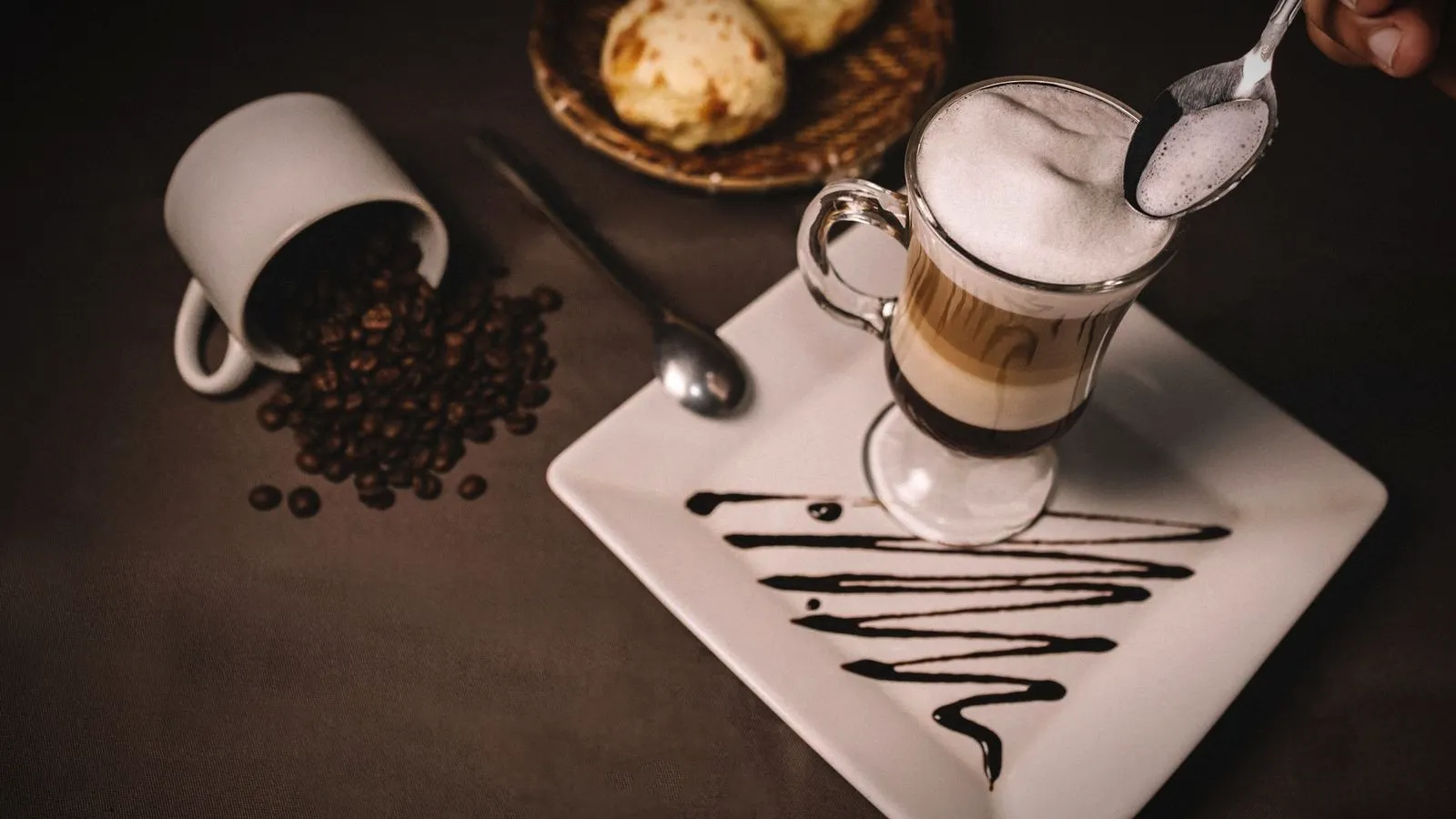
A dry cappuccino is a cappuccino ordered with more foam and less liquid milk. Foam counts as “dry” because it is mostly air, compared with the “wet” liquid milk under it. Nescafé describes the result as a thick, dense foam floating on the espresso, with a punchier coffee flavor.
Breville, which makes espresso machines, describes the same drink from the texture side. In its explanation, the thicker foam of a dry cappuccino stays separate from the steamed milk and espresso, gives the drink more structure and lets the espresso taste stronger.
In short, a dry cappuccino still contains milk; more of it has simply been turned into foam.
Bone dry cappuccino
A bone dry cappuccino takes the idea to its limit: espresso topped with foam only, and no liquid steamed milk poured in. Nescafé defines it as all foam and no milk. It drinks almost like an espresso under a cloud, and it is the lightest cappuccino in both texture and milk content.
Extra dry cappuccino
“Extra dry” sits between dry and bone dry: mostly foam, with only a splash of liquid milk. Like the other terms, it has no fixed ratio, so two cafés may pour it differently. If the exact result matters to you, describe it in plain words, such as “mostly foam, just a little milk.”
What is a wet cappuccino?
A wet cappuccino has more liquid steamed milk and less foam. Breville describes the foam and milk blending into the espresso for a creamier texture and a sweeter taste. Nescafé puts a number on its version: the milk portion split about 75% liquid milk to 25% foam, instead of the usual half and half.
That 75/25 split is one brand’s description, not a standard. What matters is the direction: the wetter the cappuccino, the milder and silkier it becomes.
Is a wet cappuccino just a latte?
Close, but usually not. A wet cappuccino still comes in a small cappuccino cup and keeps a visible layer of foam. A latte is larger, uses more milk overall and has only a thin skin of microfoam, which is why it tastes milder still. For the full latte method, see how to make a latte.
A “super wet” cappuccino, made with no foam at all, is where the two nearly meet. Nescafé describes it as all steamed milk and no foam. At that point you are drinking a small latte in a cappuccino cup.
What does a traditional cappuccino contain?
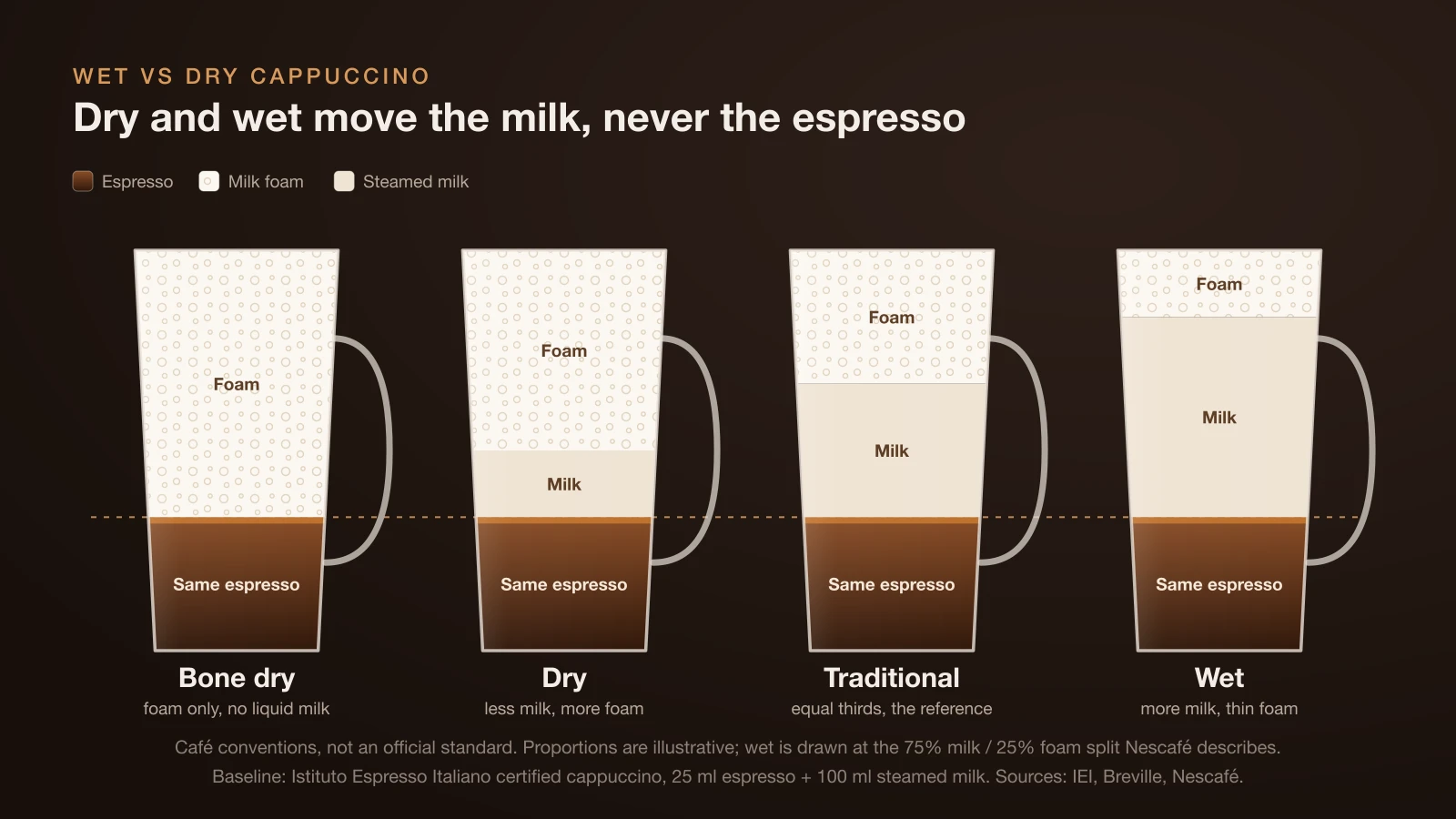
A traditional cappuccino contains espresso, steamed milk and milk foam, and it is the baseline that wet and dry are measured against. The Istituto Espresso Italiano’s certified Italian cappuccino is about 0.8 oz (25 ml) of espresso and 3.4 oz (100 ml) of steamed milk. That fixes how much milk goes in, but not how it splits between liquid and foam, which is exactly what wet and dry change.
The popular picture is the rule of thirds. Breville describes a cappuccino as equal parts espresso, steamed milk and milk foam, typically about 6 oz (180 ml) in total. Starbucks’ at-home recipe for a classic cappuccino uses 2 oz of espresso and 4 oz of whole milk, frothed, with the leftover foam spooned on top.
In café terms, a dry order shifts the milk third toward foam and a wet order shifts it toward liquid milk. The espresso third never moves.
Wet vs dry cappuccino: taste and texture
A dry cappuccino tastes bolder and lighter, while a wet cappuccino tastes creamier, sweeter and milder, even with the same shot. Steamed milk dilutes espresso and adds natural sweetness; foam adds volume and texture but, being mostly air, contains much less milk.
| Dry cappuccino | Wet cappuccino | |
|---|---|---|
| First sip | Light foam, then strong espresso | Coffee and creamy milk together |
| Texture | Airy, stiff cap on top | Smooth, velvety, blended |
| Coffee flavor | Bold | Softer |
| Sweetness from milk | Lower | Higher |
| Latte art | Hard, foam is too stiff to pour designs | Possible, microfoam pours well |
| Suits | Espresso lovers, foam fans | People who find cappuccinos too strong |
If you like the dry style’s intensity, a macchiato is the smaller, stronger option. If you like the wet style, a flat white or a latte may suit you better.
Is a dry cappuccino stronger? Caffeine and calories
A dry cappuccino has no more caffeine than a wet one. Milk and foam add none, so a bone dry, dry and wet cappuccino made with the same shots carry the same caffeine. USDA data puts espresso at about 212 mg of caffeine per 100 g, or roughly 63 mg in a 1 oz single shot. Starbucks lists its tall (12 fl oz) cappuccino, made with one shot, at 75 mg and its grande (16 fl oz), made with two, at 150 mg.
In flavor, a dry cappuccino is stronger. Less liquid milk means less dilution, so the espresso tastes stronger even though the dose is the same. For per-shot numbers and what changes them, see how much caffeine is in an espresso shot.
Calories follow the milk. Because foam is mostly air, a dry cappuccino in the same cup holds less milk than a wet one. USDA lists whole milk at 61 kcal per 100 g, so each ounce of milk (about 30 ml, or 31 g) left out saves roughly 19 kcal.
That is an estimate; the real difference depends on how much milk goes into your cup. For scale, Starbucks lists a regular grande cappuccino made with 2% milk at 140 calories.
How to order a dry or wet cappuccino
Most baristas know the words “dry” and “wet,” but not all of them pour them the same way. Clear phrases help:
- Bone dry: “Bone dry cappuccino, foam only, no steamed milk.”
- Dry: “Dry cappuccino, extra foam.”
- Traditional: simply “cappuccino.”
- Wet: “Wet cappuccino, light foam, more milk.”
Starbucks’ ordering options for its cappuccino use foam settings instead of wet and dry: Extra Foam, Foam, Light Foam and No Foam. Extra Foam moves the drink toward dry and Light Foam toward wet. No Foam leaves steamed milk only, which is essentially a small latte.
How to make a dry or wet cappuccino at home

To make a dry or wet cappuccino at home, change how long you add air while steaming: longer for dry, briefly for wet. Breville’s machine manuals split milk texturing into two phases: stretching, when the wand tip sits at the surface and draws in air, and swirling, when the tip goes lower and the milk spins into a smooth whirlpool. The longer you stretch, the more foam you get.
- Start with cold milk in a pitcher filled to just below the spout.
- Pull your shot into a warm cappuccino cup.
- Insert the wand with the tip about ¼–¾ in (1–2 cm) below the surface, start the steam, then lower the pitcher until the tip just breaks the surface and you hear a gentle hiss.
- Stretch to suit the style. For wet, add air only briefly, then sink the tip so the milk spins into glossy microfoam. For dry, keep the tip at the surface longer, until the volume grows clearly and the foam looks thick.
- Stop at 60–65 °C (140–150 °F), when the pitcher is too hot to hold for more than a moment.
- Pour to match. For wet, pour steadily so milk and foam flow in together. For dry, let the pitcher rest a few moments so the foam separates, pour a little milk, then spoon the foam on top. For bone dry, hold back the liquid and spoon only foam over the espresso.
Machines with automatic milk settings do the same job with a button. The Breville Bambino Plus, for example, offers Low, Medium and High foam settings; the high setting leans dry and the low one leans wet. Our guide to steaming milk for espresso drinks covers temperature and milk choice in more detail.
Plant milks behave differently. Breville advises keeping non-dairy milk below about 55 °C (130 °F) to avoid separation, and barista versions are made to hold foam better. Our oat milk latte guide explains how oat milk steams and foams.
Dry cappuccino vs macchiato, flat white and latte
A bone dry cappuccino is closest to a macchiato, a wet cappuccino is closest to a flat white or latte, and all of them sit on the same scale of milk and foam:
- Bone dry cappuccino vs macchiato: an espresso macchiato is a shot marked with a dollop of foam, so it is far smaller. Starbucks lists its double Espresso Macchiato at just 1.6 fl oz. We compare the two drinks in macchiato vs cappuccino.
- Wet cappuccino vs flat white: a flat white is a single or double shot in a cup of 8 oz or less, topped with silky microfoam only about 1/4 inch (6 mm) thick instead of a thick cap. Made with a double, it tastes stronger than a wet cappuccino.
- Wet cappuccino vs latte: a latte is larger and milkier, with only a thin layer of foam.
- Cold drinks: a Frappuccino is not a cold cappuccino but a blended ice drink; see cappuccino vs Frappuccino. An iced cappuccino, with cold milk and a frothy foam over espresso and ice, is the closer cold relative.
The bottom line
Dry and wet describe one thing: how a cappuccino’s milk is split between foam and liquid. Dry means more foam and a bolder, lighter cup; wet means more milk and a creamier, milder one; bone dry means foam only. The espresso and its caffeine stay the same, so choose by texture, and say what you want in plain words if a café’s terms are unclear.
Sources
- Istituto Espresso Italiano: Certified Italian Espresso and Cappuccino (25 ml espresso + 100 ml steamed milk)
- Breville: Wet vs. dry cappuccino, How to make a cappuccino, Cappuccino recipe (below 55 °C for non-dairy milk), Barista Express manual (stretching and swirling, tip 1–2 cm below the surface, 60–65 °C) and Bambino Plus manual (Low, Medium and High foam settings) and How to make a flat white at home (single or double shot, cup of 8 oz or less, microfoam about a quarter inch thick)
- Nescafé: The difference between wet and dry cappuccino (dry, bone dry, wet and super wet; 75/25 milk to foam)
- Starbucks: Cappuccino and its nutrition (foam options, sizes, shots, caffeine, calories), Espresso Macchiato nutrition (1.6 fl oz double) and Classic Cappuccino at-home recipe (2 oz espresso, 4 oz whole milk)
- USDA FoodData Central: Espresso, restaurant-prepared (212 mg caffeine per 100 g) and Milk, whole (61 kcal per 100 g)