To make a latte at home, pull a double shot of espresso (about 2 oz) into a 10–12 oz cup, steam about 6–8 oz of milk to 60–65 °C (140–150 °F) with a thin layer of foam, then pour the milk into the espresso. No machine? Froth hot milk with a frother, French press or jar.
A latte is simply espresso plus a lot of steamed milk and a little foam. That makes it one of the easiest espresso drinks with milk to learn at home. This guide covers the full method with an espresso machine, four ways to foam milk without a steam wand, and what to do if you only have a moka pot or brewed coffee.
The short answer
| Step | What to do | Typical target |
|---|---|---|
| 1. Espresso | Pull a double shot | 18 g coffee → about 36 g (2 oz) espresso in 25–30 s |
| 2. Milk | Steam cold milk, add a little air first | 60–65 °C (140–150 °F), thin foam layer |
| 3. Cup | Use a warm cup | 8–12 oz (240–350 ml) |
| 4. Pour | Tilt the cup, pour milk into the center | Finish with about 1 cm of foam |
| Ratio | Espresso : milk | About 1:3 to 1:5 |
These are common café conventions, not fixed rules. Adjust the milk to taste.
What you need to make a latte at home
| Equipment | Needed? | Why |
|---|---|---|
| Espresso machine with steam wand | Best option | Makes real espresso and silky microfoam |
| Burr grinder or fresh espresso grind | Recommended | Espresso needs a fine, even grind |
| Milk pitcher (12–20 oz) | Recommended | Room for milk to expand while steaming |
| Thermometer | Optional | Helps you stop at the right temperature |
| Handheld frother, French press or jar | Alternative | Foams milk without a steam wand |
| Moka pot | Alternative | Strong coffee for a latte-style drink |
| Scale | Optional | Makes shots repeatable |
Any espresso machine works. Our guide to how to use an espresso machine covers setup, dialing in and purging if you are starting from scratch.
How to make a latte with an espresso machine
- Heat the machine and the cup. Let the machine warm up fully, and rinse your cup with hot water so the drink doesn’t cool on contact.
- Dose and grind. Grind about 16–20 g of fresh coffee fine, slightly finer than table salt, into a double basket.
- Tamp level. Distribute the grounds evenly, then tamp firmly and flat.
- Pull the shot. Aim for about twice the dose in liquid, for example 18 g in and 36 g out, in roughly 25–30 seconds. Brew straight into the latte cup.
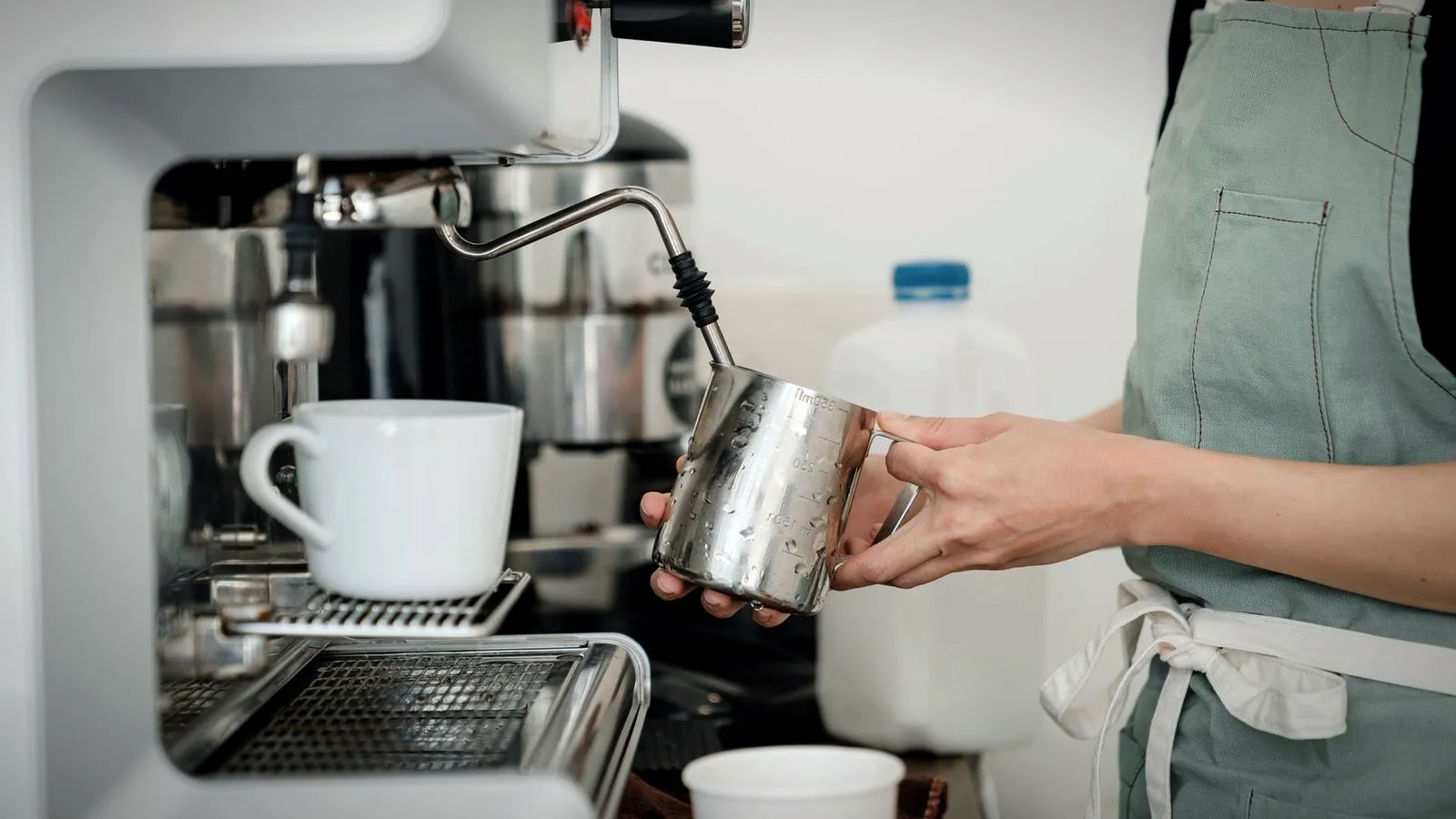
- Fill the pitcher with cold milk. Pour about 6–8 oz of milk, filling the pitcher no more than about a third of the way to leave room for foam.
- Purge the steam wand. Open it for a second to clear water.
- Stretch the milk. Put the tip just below the surface and open the steam fully. You should hear a soft tearing sound for a few seconds while air goes in. A latte needs only a little air.
- Texture and heat. Lower the tip slightly so the milk spins in a whirlpool. Stop at 60–65 °C (140–150 °F), when the pitcher is just too hot to hold comfortably.
- Tap and swirl. Tap the pitcher on the counter to pop large bubbles and swirl until the milk looks glossy, like wet paint.
- Pour. Tilt the cup, pour from a few inches up into the center, then lower the pitcher near the surface to let the foam float on top.
Wipe and purge the wand straight away so milk doesn’t dry inside it.
The right milk temperature for a latte
Aim for roughly 55–65 °C (130–150 °F), with 60–65 °C as the usual target. That range is hot enough to drink right away and keeps the foam smooth. Much hotter and the foam coarsens and the milk starts to taste cooked. For the details on temperature, foam and milk types, see our guide to espresso with milk. For wand position and the stretching phase step by step, see steaming milk with a wand.
How to make a latte at home without an espresso machine
Without a machine you can still foam milk well. What you can’t make is true espresso, so pair these with the strongest coffee you can brew (next section). For each method, start by heating the milk to about 60–65 °C on the stove or in the microwave, without boiling.
| Method | How it works | Foam quality |
|---|---|---|
| Handheld frother | Whisk hot milk for 20–30 seconds, tip just below the surface | Good, slightly bubbly |
| French press | Pump the plunger up and down 15–20 times in hot milk | Good, fine foam |
| Lidded jar | Shake cold milk hard for 30–60 seconds, then microwave uncovered for about 30 seconds | Fair, light foam |
| Microwave + whisk | Heat milk, then whisk fast by hand | Basic |
Frother or French press
- Heat 6–8 oz of milk until hot but not boiling.
- Froth: hold a handheld frother just under the surface, or pump a French press plunger 15–20 times, until the milk roughly doubles in volume at the top.
- Let it rest 30 seconds so large bubbles rise, then tap and swirl.
- Pour the milk over your coffee, holding back the foam with a spoon, then spoon the foam on top.
Jar method
Fill a heat-safe jar no more than halfway with cold milk, screw the lid on tight and shake hard for 30–60 seconds. Remove the lid and microwave for about 30 seconds so the foam rises and sets. Shaking before heating avoids pressure building inside a hot, sealed jar.
Making a latte-style drink with a moka pot or brewed coffee
A moka pot makes strong, concentrated coffee, though at much lower pressure than an espresso machine, so it isn’t technically espresso. It still makes the most convincing latte-style drink without a machine. Our guide on how to use a moka pot explains the brewing steps.
- Moka pot: use about 2–3 oz of moka coffee with 6–8 oz of foamed milk.
- Drip, pour-over or French press coffee: brew it about twice as strong as usual and use roughly equal parts coffee and milk. Regular-strength coffee gets lost under a full latte’s worth of milk.
- Instant espresso powder: DeLallo, a maker of instant espresso powder, suggests 1 tablespoon of powder in 4 tablespoons (2 oz, 60 ml) of hot water as a quick stand-in.
These are honest workarounds, not a café latte. The flavor is thinner and there is no crema, but with good foamed milk the drink is still satisfying. If you’re weighing whether a machine is worth it, compare an espresso maker vs an espresso machine.
Latte ratio and cup size

There is no official latte recipe, so sizes vary between cafés. For a deeper look at the numbers, see our latte milk ratio guide. These typical ranges are a sensible starting point:
| Cup size | Espresso | Steamed milk | Taste |
|---|---|---|---|
| 8 oz (240 ml) | Single or double, 1–2 oz | 5–6 oz | Stronger coffee flavor |
| 12 oz (350 ml) | Double, 2 oz | 8–9 oz | Classic café latte |
| 16 oz (475 ml) | Double or triple, 2–3 oz | 12–13 oz | Very mild; add a shot |
More milk makes a milder, sweeter drink but does not reduce the caffeine, which comes only from the espresso. For caffeine figures per shot, see how much caffeine is in espresso. If you want less milk and more coffee flavor, a cortado or flat white may suit you better; our cortado vs latte comparison explains the difference.
Which milk makes the best latte?
- Whole milk is the easiest to steam and tastes sweetest and creamiest.
- 2% and skim foam readily, but the foam is lighter and drier and the drink tastes thinner.
- Barista oat milk steams well and is the most popular dairy-free choice. See our oat milk latte guide for steaming tips and calories.
- Soy milk foams well; avoid pouring it into very hot or very acidic espresso, which can make it separate.
- Almond and coconut are harder to foam unless you buy a barista version.
Always start with cold milk. It gives you more time to add air and texture before it gets too hot.
Flavored and iced latte variations
Once the base is right, variations are easy:
- Vanilla, caramel or hazelnut latte: stir about 1–2 tablespoons of syrup into the espresso before adding milk. For more ideas, see our list of latte flavors.
- Mocha latte: mix 1–2 tablespoons of chocolate sauce into the hot espresso, then add steamed milk.
- Spanish latte: sweeten with condensed milk instead of syrup. See our Spanish latte recipe.
- Dirty chai: add a shot of espresso to a chai latte. Here’s how to make a dirty chai.
- Iced latte: pour espresso over a glass of ice, then add cold milk. No steaming needed.
Common latte mistakes
- Overheating the milk. Boiling milk tastes flat and cooked and won’t foam well. Stop at 60–65 °C.
- Too much foam. A latte needs only a thin layer. Thick, stiff foam belongs on a cappuccino.
- Weak coffee. Too little coffee under a lot of milk tastes like warm milk. Use a double shot for 10 oz or more.
- Stale beans. Beans past about a month from roasting make flat shots with little crema.
- Cold cup. A cold mug steals heat. Warm it with hot water first.
The bottom line
A great latte at home comes down to three things: a good double shot, milk steamed to about 60–65 °C with just a little foam, and a ratio of around one part espresso to three to five parts milk. An espresso machine gives the best result, but a frother or French press plus strong moka pot coffee makes a very good latte-style drink.
Sources
- Breville: Barista Express BES870 instruction book (steaming technique and milk temperature)
- Food Chemistry (2023): study of steam-heated milk for coffee drinks (steaming to 60–65 °C)
- Istituto Espresso Italiano: Certified Italian Espresso and Cappuccino (espresso and milk volumes)
- Specialty Coffee Association: Defining the ever-changing espresso (archived; dose, yield and time)
- DeLallo: All about espresso powder (1 tablespoon of instant espresso in 4 tablespoons of hot water)