Cortado vs latte is a question of milk. A cortado is espresso “cut” with roughly the same amount of warm milk, usually around 4 ounces in total. A latte is espresso with several times as much steamed milk and a thin layer of foam, usually 8 ounces or more. The cortado tastes bold and coffee-forward; the latte tastes mild and creamy.
Both use the same espresso, so a double cortado and a double latte carry the same caffeine. This guide compares them side by side, then covers the other questions people ask about the cortado: how it differs from a flat white, a cappuccino and a macchiato. For the full lineup of café drinks, see our types of espresso drinks chart.
The short answer
| Cortado | Latte | |
|---|---|---|
| What it is | Espresso cut with about equal warm milk | Espresso with lots of steamed milk and a thin foam layer |
| Typical espresso to milk | About 1:1 | About 1:3 to 1:5, more in large sizes |
| Typical size | About 4–4.5 oz | 8–20 oz |
| Milk texture | Warm, silky, little or no foam | Steamed, with a thin layer of microfoam |
| Served in | Small glass or small cup | Large cup or glass |
| Taste | Balanced but coffee-forward | Mild, creamy, sweeter |
| Caffeine | Same as the shots inside | Same as the shots inside |
| Origin | Spain | Italy (as caffè latte) |
Ratios and sizes vary a lot from café to café, and even more between countries. Read these as typical ranges, not fixed recipes.
What is the difference between a cortado and a latte?
The difference between a cortado and a latte is how much the milk dilutes the espresso.
- Cortado: from the Spanish cortar, “to cut,” in the sense of diluting. The espresso is cut with about the same amount of warm milk, which takes the edge off its acidity without hiding the coffee.
- Latte: short for caffè latte, “milk coffee.” The espresso is topped with a large amount of steamed milk and finished with microfoam, so milk is the main ingredient.
Put simply: a cortado is an espresso drink softened by milk. A latte is a milk drink flavored with espresso.
Cortado vs latte: ratio and size
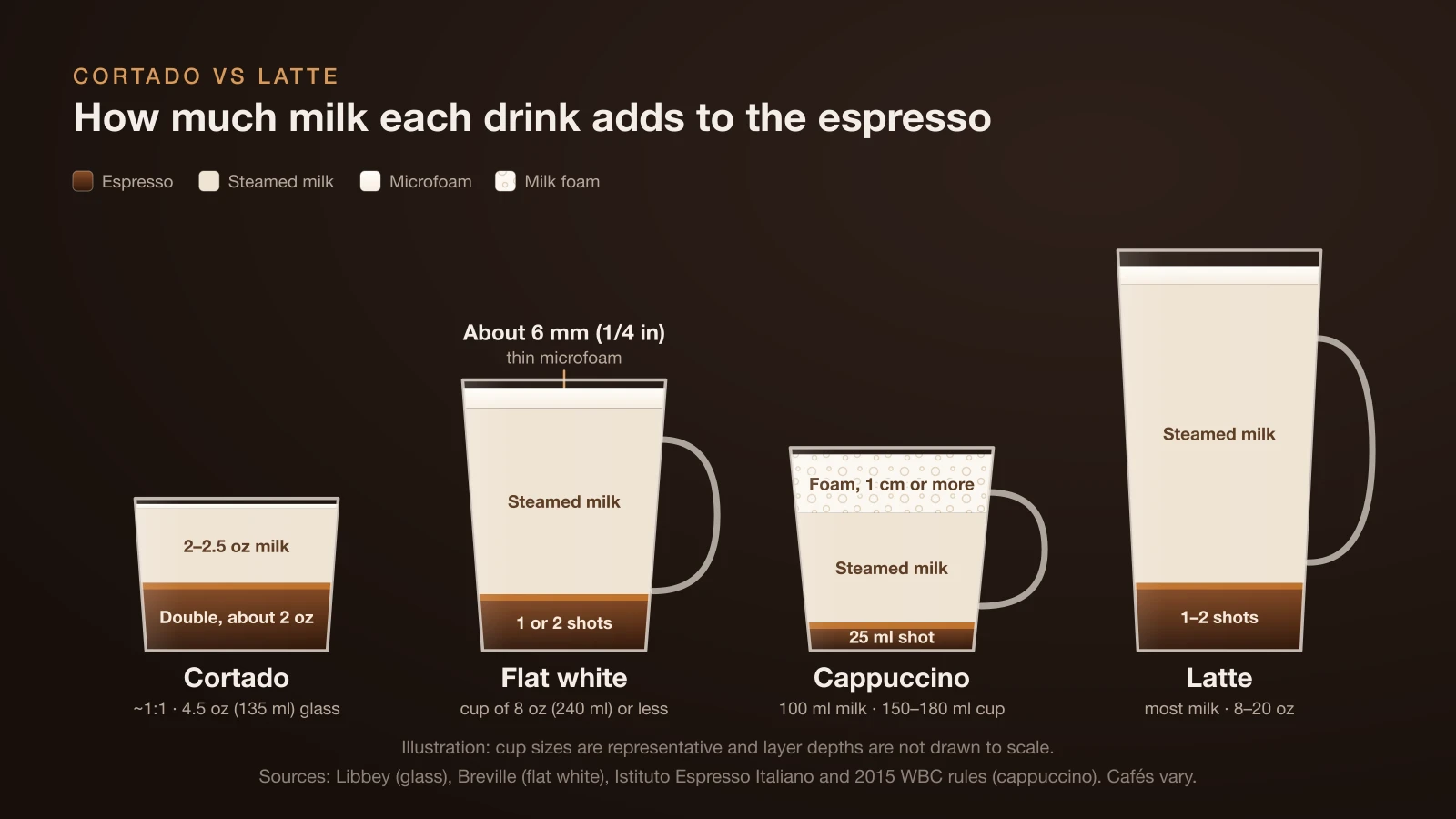
The ratio explains almost everything about the taste. In a 4.5 oz cortado glass, a double shot of about 2 oz leaves room for roughly the same amount of milk. A latte starts with the same shot and adds 6–12 oz or more of milk. The flat white and cappuccino, also shown in the diagram, sit between the two in size.
| Cortado | Latte | |
|---|---|---|
| Espresso | Usually a double, about 2 oz | 1–2 shots, 1–2 oz |
| Milk | About 2–2.5 oz | 6–12 oz or more |
| Foam | Little or none | A thin layer |
| Total | About 4–4.5 oz | 8–20 oz |
The Gibraltar glass
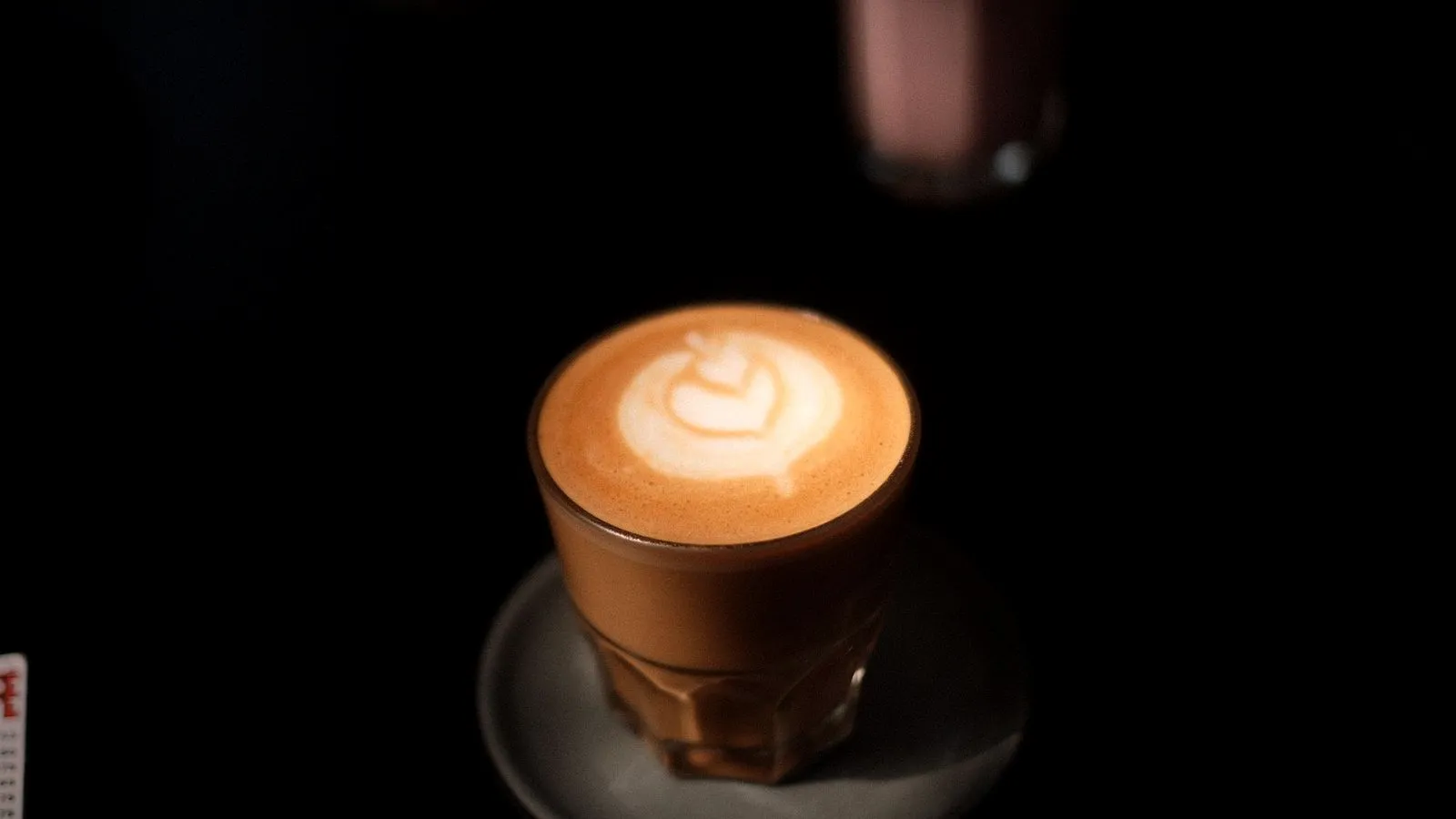
In the US, cortados are often served in a small, heavy glass. Libbey sells its 4.5 oz (about 135 ml) Gibraltar glass as a cortado glass, and some cafés name the drink a Gibraltar after it. That glass holds a double shot of about 2 oz plus a similar amount of milk, so a Gibraltar is essentially a cortado named after its glass.
A latte, by contrast, goes into a large mug or a tall glass of 8 oz or more. Our guide to ceramic espresso cups covers which cup size suits which drink.
Milk texture
Both drinks use milk heated with a steam wand, but it is handled differently.
- Cortado: the milk is warmed and lightly textured, with little or no foam. It should blend into the espresso rather than sit on top.
- Latte: the milk is steamed and stretched briefly to create glossy microfoam. Most of the drink is silky liquid milk, with a thin foam layer that allows latte art.
Getting the texture right is mostly about temperature and air. Our guide to steaming milk for espresso drinks explains how, and how to make a latte walks through the full recipe.
Is a cortado stronger than a latte?
In flavor, yes. In caffeine, not necessarily. Milk adds volume, not caffeine, so all the caffeine in both drinks comes from the espresso.
USDA data puts espresso at about 212 mg of caffeine per 100 g, or roughly 63 mg in a 1 oz shot. A double shot is therefore around 125 mg, whether it goes into a 4 oz cortado or a 16 oz latte. Café shots vary with dose and beans, so treat that as a ballpark.
What does change is concentration. In a cortado, about half the drink is espresso; in a large latte, it can be less than a sixth. That is why the cortado tastes much stronger. For per-shot details, see how much caffeine is in espresso.
Cortado vs flat white
This is the comparison people mix up most, because both are small, strong milk drinks.
| Cortado | Flat white | |
|---|---|---|
| Espresso | Usually a double | A single or double shot |
| Milk | About equal to the espresso | More than a cortado, less than a latte |
| Foam | Little or none | A thin layer of microfoam, about 1/4 inch (6 mm) |
| Size | About 4–4.5 oz | A cup of 8 oz or less |
| Origin | Spain | Australia and New Zealand (both claim it) |
A flat white is the creamier of the two, with a velvety texture from its microfoam. A cortado is smaller and stronger, with the milk simply cutting the espresso.
Cortado vs cappuccino
A cappuccino is defined by its foam. The Italian Espresso Institute’s certified cappuccino uses 25 ml of espresso and 100 ml of steamed milk, with a thick, fine-textured foam on top. World Barista Championship rules called for a single shot in a 150–180 ml cappuccino with at least 1 cm of foam.
- Cortado: about equal espresso and milk, flat surface, little foam.
- Cappuccino: more milk than espresso and a thick, airy cap of foam, served in a small cup.
The cappuccino feels lighter and airier; the cortado feels denser and tastes more of coffee. If you like the strength of a cortado but want some foam, a cappuccino is the closest step up.
Cortado vs macchiato
These two sit next to each other at the strong end of the menu, and the difference is quantity.
- Espresso macchiato: a shot “marked” with a spoonful or two of milk foam. It tastes almost like straight espresso.
- Cortado: the same shot with roughly an equal volume of warm milk. It is noticeably softer and smoother.
If a macchiato is too sharp and a latte too milky, the cortado is the drink in between. We compare the macchiato with the latte in detail in macchiato vs latte.
Where the cortado comes from
The cortado comes from Spain, where it is an everyday café order and the amount of milk varies from one bar to the next.
Two variations are common in the US:
- Cortadito: the Cuban version, popular in Miami. It is made with sweetened Cuban-style espresso, so it is much sweeter than a Spanish cortado.
- Gibraltar: a café name for a cortado served in the 4.5 oz Gibraltar glass, as described above.
Calories: cortado vs latte
Almost all the calories come from the milk. Using USDA figures for whole milk (61 kcal per 100 g, about 30.5 g per fluid ounce), here is a rough estimate:
- Cortado with 2 oz of whole milk: about 37 kcal from the milk, so roughly 40 kcal in total.
- Latte with 8 oz of whole milk: a cup of whole milk (244 g) is about 150 kcal, so a small latte lands around 150–160 kcal.
These estimates assume plain whole milk and no syrup. Skim or plant milk lowers the numbers; larger sizes and flavored syrups raise them a lot.
Which should you order?
| Choose a cortado if you… | Choose a latte if you… |
|---|---|
| Want to taste the espresso clearly | Prefer a mild, creamy drink |
| Like a small drink you finish quickly | Want a large drink to sip slowly |
| Find straight espresso too sharp | Find strong coffee too bitter |
| Want fewer calories from milk | Want a base for syrups, spices or latte art |
At home, both need the same thing: a good shot. If you are still learning your machine, start with how to use an espresso machine. Then, for a cortado, add an equal volume of warm, lightly textured milk; for a latte, steam 6–10 oz of milk and pour.
The bottom line
A cortado is espresso cut with about equal warm milk: small, balanced and coffee-forward. A latte is espresso with plenty of steamed milk: large, mild and creamy. With the same shots, both carry the same caffeine. Among the neighbors, the macchiato is stronger, and the flat white and cappuccino are milkier and foamier than a cortado.
Sources
- USDA FoodData Central: Beverages, coffee, brewed, espresso, restaurant-prepared (212 mg caffeine per 100 g) and Milk, whole, 3.25% milkfat (61 kcal per 100 g; 1 fl oz = 30.5 g; 1 cup = 244 g)
- Istituto Espresso Italiano: Certified Italian Espresso and Cappuccino (25 ml espresso + 100 ml milk)
- World Coffee Events: 2015 World Barista Championship Rules and Regulations (archived; cappuccino made with one single shot, 150–180 ml, at least 1 cm of foam)
- Libbey: Gibraltar DuraTuff cortado glasses, 4.5 oz (glass size, sold for cortados)
- Breville: How to make a flat white at home (single or double shot, cup of 8 oz or less, microfoam about a quarter inch thick, claimed by Australia and New Zealand)