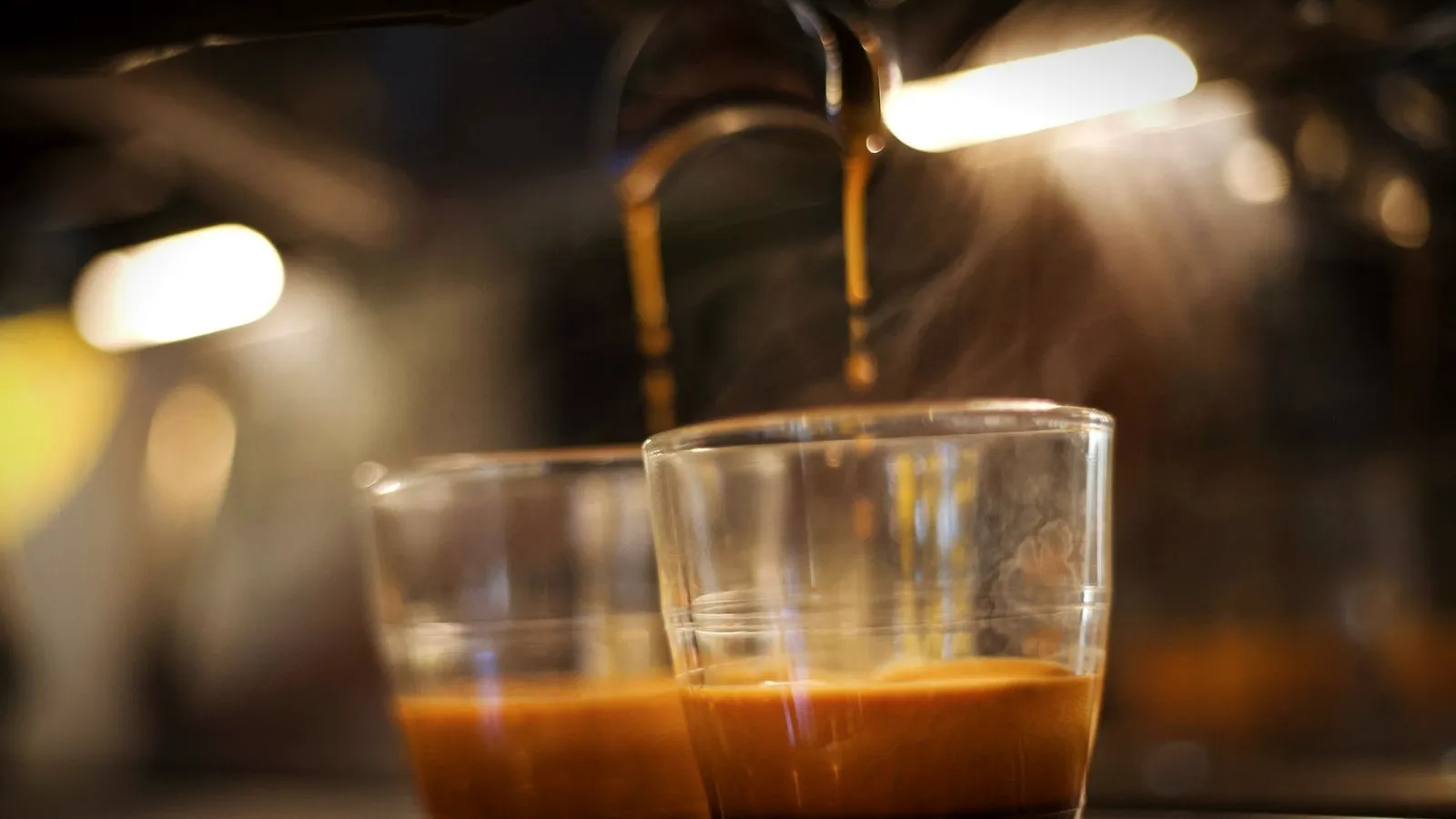
Ristretto vs long shot comes down to how much water passes through the same dose of coffee. A ristretto is stopped early, so it is short, thick, sweet and intense. A long shot, or lungo, keeps running, so it is larger, lighter in body and more bitter. A normal espresso sits between them, at roughly a 1:2 ratio.
All three use the same ground coffee and the same machine. Only the yield, the weight of liquid in the cup, changes, and with it the taste, the strength and the caffeine. If you want the exact numbers behind each style, our guide to the espresso ratio has a full chart.
The short answer
| Ristretto | Espresso (normale) | Long shot (lungo) | |
|---|---|---|---|
| Meaning | “Restricted” | Standard shot | “Long” |
| Brew ratio (coffee : yield) | About 1:1 to 1:2 | About 1:2 to 1:3 | About 1:3 to 1:4 |
| From an 18 g dose | About 18–36 g | About 36–54 g | About 54–72 g |
| Body | Thick, syrupy | Balanced | Thin, lighter |
| Taste | Sweet, intense, low bitterness | Balanced | Drier, more bitter |
| Total caffeine (same dose) | Lowest | Middle | Highest |
| Caffeine per sip | Highest | Middle | Lowest |
Ratios are La Marzocco’s ranges; Breville uses 1:1, 1:2 and 1:3 as single reference points. The 18 g row is La Marzocco’s ranges applied to our reference dose (yield = dose × ratio).
What is the difference between a ristretto and a long shot?
The difference between a ristretto and a long shot is the amount of water pushed through the same coffee. Both start with an identical dose in the basket. The ristretto stops at roughly the weight of the dry coffee; the long shot keeps going to three or four times that weight.
- Ristretto: Italian for “restricted.” Starbucks describes it as the first portion of a full-length espresso shot, made with less hot water and giving a smaller, more concentrated serving with a sweeter, richer flavor.
- Long shot: the English name for a lungo, Italian for “long.” The shot runs past the normal stopping point, so more water extracts more from the grounds.
Because the dose is the same, neither is “more coffee.” The ristretto is the same coffee with less water, and the long shot is the same coffee with more.
Ristretto vs espresso: what changes in the cup
A ristretto is a normal espresso cut short, so it is smaller, thicker and more concentrated. Breville’s Barista Express manual describes a ristretto as an extremely short espresso of about 15 ml (0.5 oz), with intense flavor and aftertaste. Breville’s single shot, by comparison, pours about 1 oz (30 ml).
By weight, the gap is easy to see. From an 18 g dose, a normal shot yields about 36 g (1:2). A ristretto stops anywhere from about 18 g (1:1, Breville’s reference point) up to 36 g (1:2, the top of La Marzocco’s ristretto range). La Marzocco notes that the smaller the ratio, the thicker and more viscous the espresso becomes.
Ristretto is not a different bean or roast. Starbucks makes its ristretto from the same espresso roast it uses for full shots. You can pull one on any espresso machine by stopping the shot early.
Lungo vs espresso: is a long shot the same as a lungo?
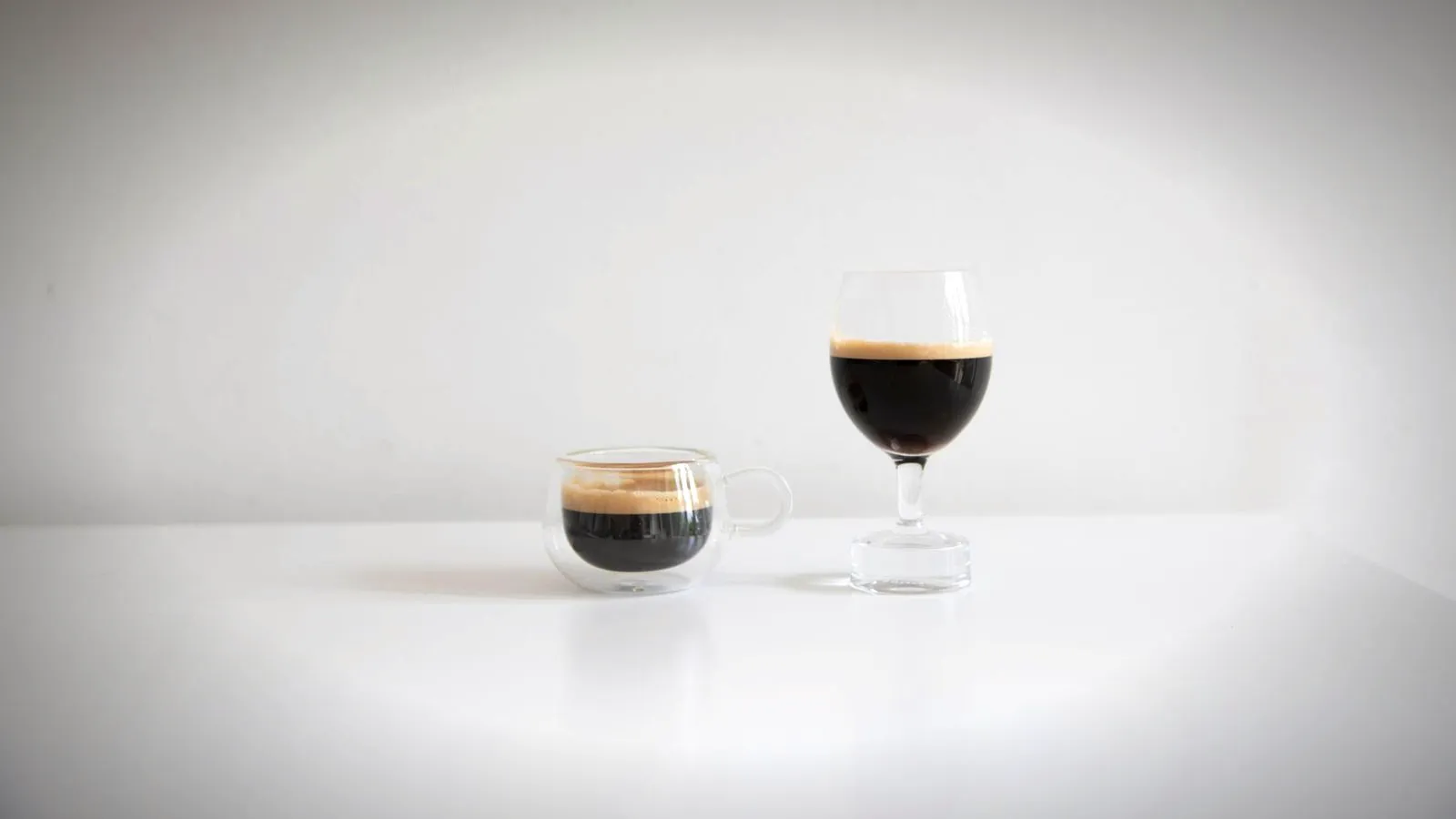
Yes. A long shot and a lungo are the same idea: an espresso pulled longer, so more water passes through the coffee. La Marzocco places lungo at 1:3 to 1:4, against 1:2 to 1:3 for a normale. From 18 g of coffee, that means about 54–72 g in the cup instead of about 36 g for a 1:2 espresso.
A lungo is lighter in body and more diluted than espresso. La Marzocco puts it simply: the larger the ratio, the more stretched-out and thin the espresso becomes. The extra water also keeps extracting compounds that a normal shot leaves behind, which is where a lungo’s drier, more bitter finish comes from.
A lungo is not an Americano. An Americano is a normal shot with hot water added afterwards, which dilutes without extracting more. Breville’s manual describes a long black, a close cousin, as espresso extracted over 120–180 ml (4–6 oz) of hot water.
Ristretto, espresso and lungo ratio chart
A brew ratio compares the weight of dry coffee with the weight of espresso in the cup, and it is the clearest way to tell the three shots apart. Manufacturers publish slightly different ranges, so treat the borders as soft.
| Style | La Marzocco | Breville | 18 g dose | 20 g dose |
|---|---|---|---|---|
| Ristretto | 1:1 to 1:2 | 1:1 | 18–36 g | 20–40 g |
| Espresso (normale) | 1:2 to 1:3 | 1:2 | 36–54 g | 40–60 g |
| Lungo (long shot) | 1:3 to 1:4 | 1:3 | 54–72 g | 60–80 g |
Yield = dose × ratio. A 1:2 shot sits right on La Marzocco’s border between ristretto and normale, so cafés may call the same drink by different names. Breville’s single figures (1:1, 1:2, 1:3) are the easiest targets to remember at home.
Shot time follows the yield. Breville’s ideal for a standard 1:2 shot is 25–30 seconds; with the same grind, a ristretto finishes sooner and a long shot runs longer. Our guide to espresso shot time explains how to read the clock.
Taste: why a ristretto is sweeter and a long shot more bitter
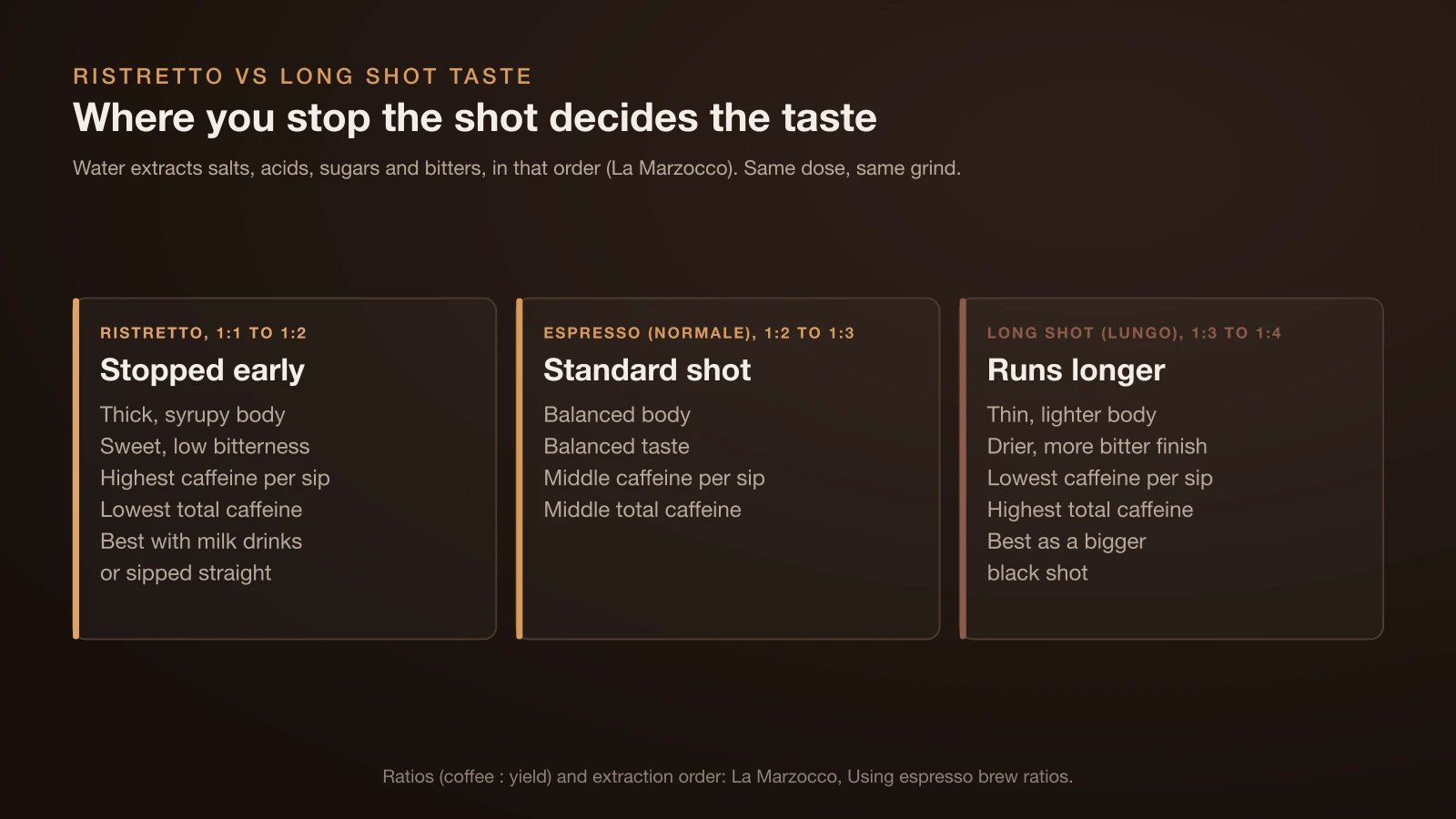
A ristretto tastes sweeter and a long shot more bitter because coffee compounds dissolve in a rough order. La Marzocco describes water extracting salts, acids, sugars and bitters, in that order. A ristretto captures the early, concentrated part of the shot, and a long shot keeps collecting the later, harsher part.
| Ristretto | Long shot | |
|---|---|---|
| Body | Thick, heavy | Thin, light |
| Sweetness | More noticeable | Less noticeable |
| Bitterness | Low | Higher, drier finish |
| Acidity | Can read as bright or sharp | More muted |
| Best with | Milk drinks, sipping straight | A bigger black shot |
Pushing either style too far creates a fault rather than a style. A very short, fast shot can turn sour; our guide to sour espresso explains why. A very long shot can taste harsh and astringent, which our guide to bitter espresso covers.
Ristretto vs long shot caffeine: which has more?
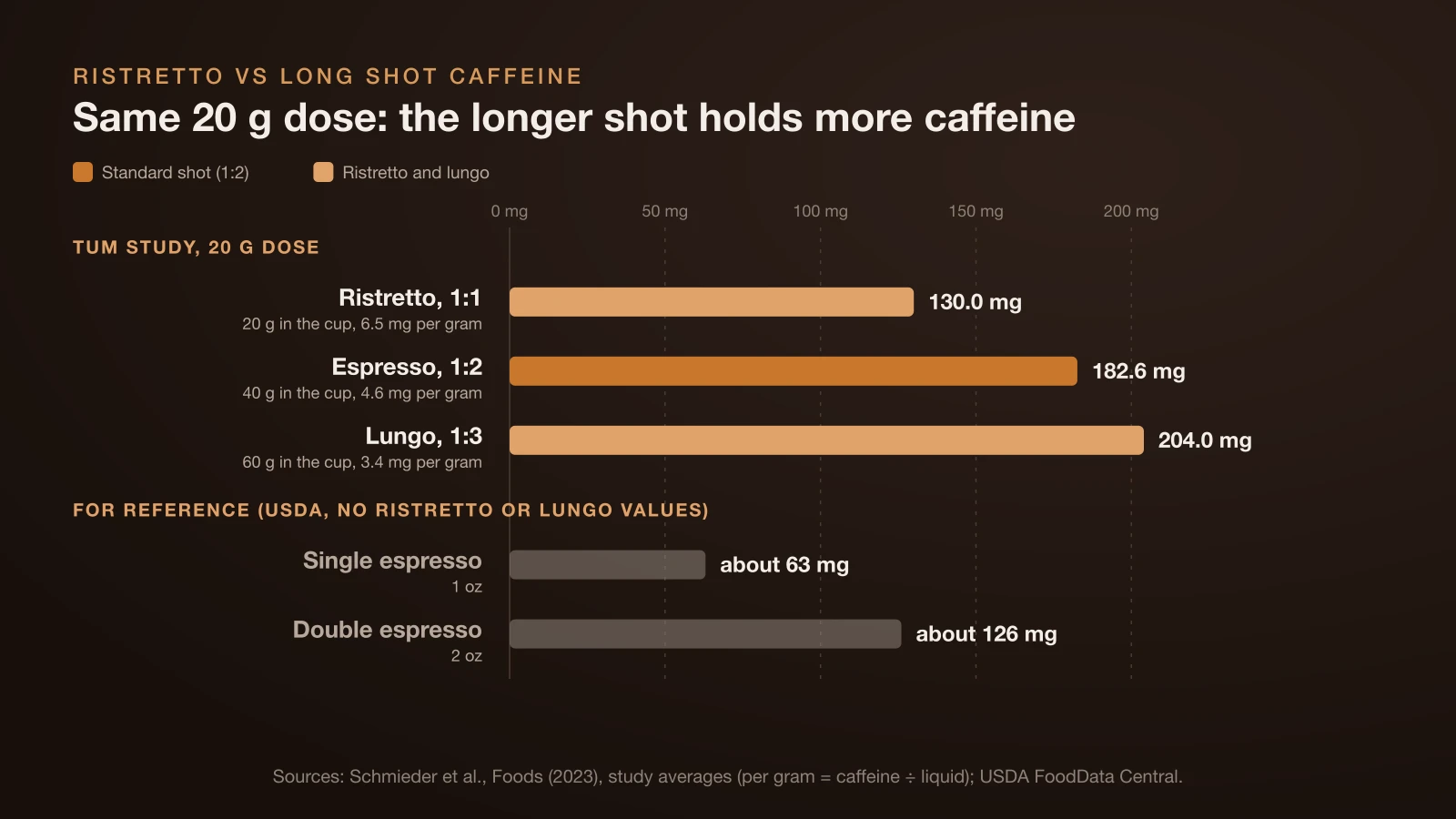
From the same dose of coffee, a long shot contains more total caffeine than a ristretto, while the ristretto is more concentrated per sip. Caffeine dissolves fastest at the start of the shot but keeps coming out as more water flows through the puck.
A 2023 study from the Technical University of Munich measured caffeine in ten consecutive fractions of each shot. From 20 g doses of arabica, the researchers calculated the caffeine in the cup at three ratios:
| Style (20 g dose) | Liquid in cup | Average caffeine | Caffeine per gram of drink |
|---|---|---|---|
| Ristretto (1:1) | 20 g | 130.0 mg | 6.5 mg |
| Espresso (1:2) | 40 g | 182.6 mg | 4.6 mg |
| Lungo (1:3) | 60 g | 204.0 mg | 3.4 mg |
Per-gram values are simple division of the study’s averages. So the ristretto held about 71% of the normal shot’s caffeine and the lungo about 112%. The concentration in the stream was highest in the first fraction and fell as the shot went on.
What the official data covers
The US Department of Agriculture (USDA) lists espresso at 212 mg of caffeine per 100 g, about 63 mg in a 1 oz single and 126 mg in a 2 oz double. USDA does not publish separate values for ristretto or lungo.
Starbucks lists a tall Flat White, made with two ristretto shots, at 130 mg, and a tall Caffè Latte, made with one standard shot, at 75 mg. Dividing each total by its number of shots gives an estimate of about 65 mg per ristretto shot (130 ÷ 2) against 75 mg per standard shot (75 ÷ 1); the three-shot grande Flat White, at 195 mg, gives the same 65 mg.
Starbucks itself publishes caffeine only per drink, not per shot, and no long shot figure. For more on per-shot numbers, see how much caffeine is in an espresso shot.
What Starbucks means by ristretto and long shot
Starbucks offers ristretto and long shot as a shot option, listed on its menu as “Ristretto or Long Shot,” for its espresso drinks. Its own definition of ristretto matches the Italian one: the barista pulls only the first portion of a full-length shot, using less hot water.
- Ristretto at Starbucks: the default shot in its Flat White and Cortado, and available in any espresso drink on request.
- Long shot at Starbucks: listed as the alternative option, with no published definition or caffeine value. In practice it is read as the lungo-style opposite of a ristretto.
If you order a latte with ristretto shots, expect a sweeter, rounder coffee flavor under the milk. With long shots, expect a slightly drier, more bitter edge. For the full menu of shot-based drinks, see our guide to types of espresso drinks.
How to pull a ristretto, espresso and long shot at home
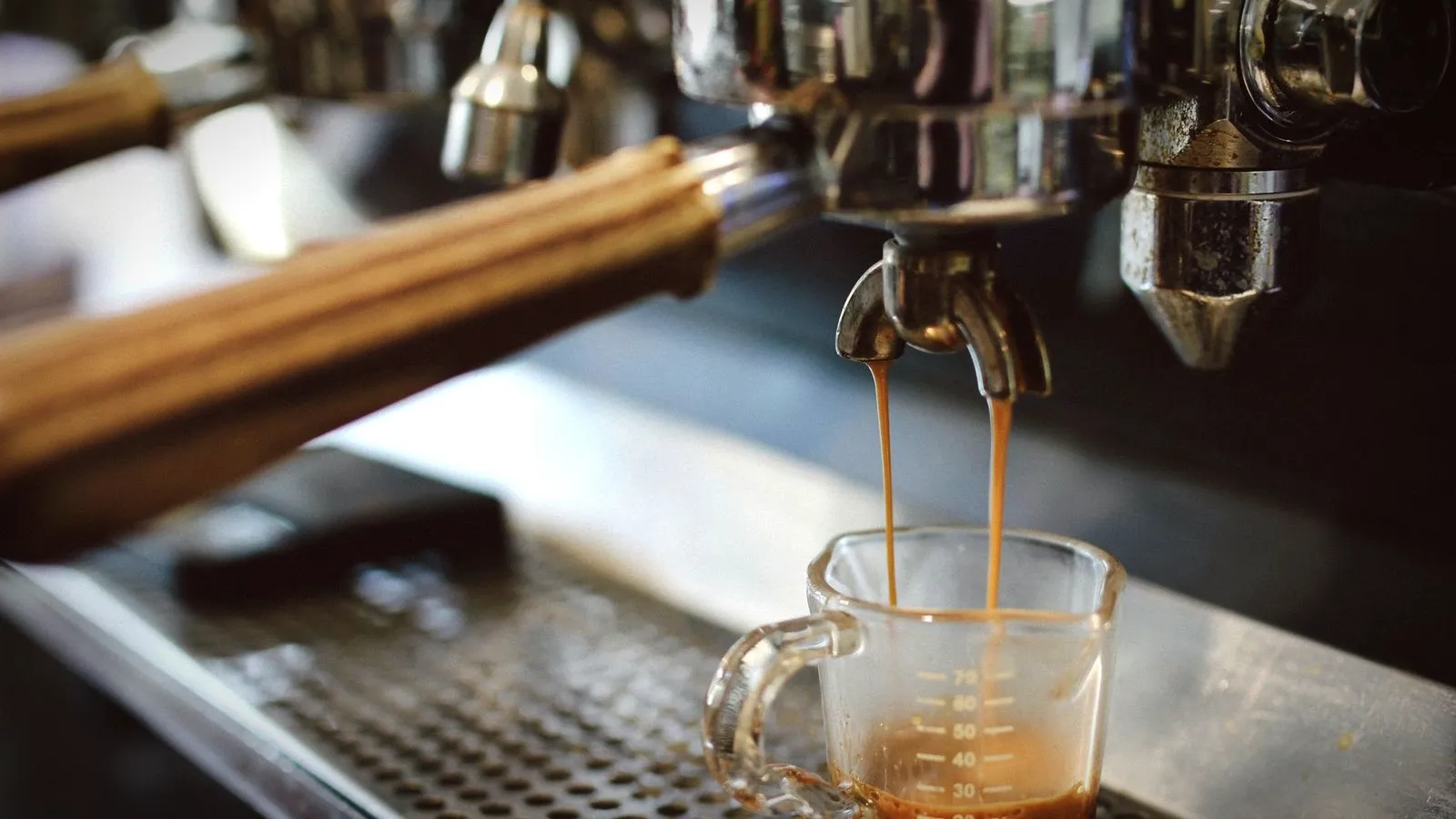
You can pull all three shots on any espresso machine by keeping the dose fixed and changing only where you stop the shot. A scale under the cup makes it repeatable.
- Dose the basket. Use your normal dose, for example 18 g in a double basket.
- Pick a target yield. Breville’s reference points are the easiest: about 18 g for a ristretto (1:1), 36 g for espresso (1:2) and 54 g for a long shot (1:3).
- Start the shot and a timer together. Watch the scale, not the color of the stream.
- Stop just before the target. A few drops keep falling after the pump stops.
- Taste and adjust. If a ristretto runs too fast and tastes sour, grind a little finer; if a long shot turns harsh, stop it earlier.
La Marzocco suggests grinding finer if you hit your target yield too fast, in under 20 seconds. Change one thing at a time so you can tell what made the difference.
Ristretto or long shot: which should you choose?
Choose a ristretto if you want maximum flavor and sweetness in a small cup, and a long shot if you want a bigger, lighter black coffee with a little more caffeine.
| Choose a ristretto if you… | Choose a long shot if you… |
|---|---|
| Like a thick, syrupy, sweet shot | Want more liquid without adding water afterwards |
| Drink flat whites, cortados or small milk drinks | Drink your espresso black and slowly |
| Find normal espresso too bitter | Find normal espresso too intense |
| Use darker roasts (La Marzocco suggests smaller ratios) | Use lighter roasts (La Marzocco suggests larger ratios) |
Neither style is better; you are choosing which part of the extraction ends up in your cup.
The bottom line
A ristretto and a long shot start with the same dose of coffee, and the only real difference is how much water runs through it. The ristretto, at about 1:1 to 1:2, is short, thick, sweet and the most concentrated per sip. The long shot, at about 1:3 to 1:4, is bigger, thinner and more bitter, and from the same dose it carries the most total caffeine.
Sources
- Espresso definitions: La Marzocco, Using espresso brew ratios (ristretto 1:1 to 1:2, normale 1:2 to 1:3, lungo 1:3 to 1:4; thicker and thinner shots; extraction order of salts, acids, sugars and bitters; darker and lighter roasts; grind finer if the target is reached in under 20 seconds)
- Breville: How to dial in espresso (1:1 ristretto, 1:2 standard, 1:3 lungo; 25–30 seconds) and Barista Express BES875 instruction book (ristretto about 15 ml; long black over 120–180 ml of hot water; single shot about 30 ml)
- Schmieder et al., Foods (2023): Influence of Flow Rate, Particle Size, and Temperature on Espresso Extraction Kinetics (20 g arabica dose; caffeine in the cup 130.0, 182.6 and 204.0 mg at 1:1, 1:2 and 1:3; highest concentration in the first fraction)
- Starbucks: Starbucks espresso explained (ristretto definition; Flat White and Cortado), Flat White and Caffè Latte (shots, “Ristretto or Long Shot” option, caffeine by size)
- USDA FoodData Central: Beverages, coffee, brewed, espresso, restaurant-prepared (212 mg caffeine per 100 g; 1 fl oz = 29.6 g)