Flat white vs cappuccino comes down to foam. A flat white is espresso, often a double shot, with silky steamed milk and a thin, flat layer of microfoam, about a quarter inch (6 mm). A cappuccino has less liquid milk and a thick, airy cap of foam, at least 1 cm deep. The flat white tastes stronger and smoother; the cappuccino tastes lighter and foamier.
Both drinks come in a small cup, 8 ounces or less, which is why they get confused. This guide compares them side by side: ratios, texture, strength, caffeine and calories. For how both fit into the wider café menu, see our overview of types of espresso drinks.
The short answer
| Flat white | Cappuccino | |
|---|---|---|
| What it is | Espresso, often a double, with silky steamed milk and a thin microfoam | Espresso with steamed milk and a thick layer of foam |
| Espresso | Single or double; often a double | A single, about 25 ml, in the Italian standard; often a double elsewhere |
| Milk | Less milk than a latte, mostly steamed with a little microfoam | About 100 ml of milk, much of it turned into foam |
| Foam | Thin, about 1/4 in (6 mm), glossy | Thick, at least 1 cm, airy |
| Typical cup | 8 oz (about 240 ml) or less | 150–180 ml (about 5–6 oz) |
| Texture | Velvety, integrated | Light, frothy |
| Taste | Coffee-forward | Milder, lighter |
| Origin | Australia and New Zealand | Italy |
Recipes vary between cafés and countries. Read these as typical reference values, not fixed rules.
What is the difference between a flat white and a cappuccino?
The difference between a flat white and a cappuccino is how the milk is textured, and how much of it becomes foam.
- Flat white: the milk is steamed with only a little air, creating fine microfoam that blends into the liquid milk. The surface stays “flat,” level with the rim, and usually carries latte art.
- Cappuccino: the milk is aerated more, producing a thick, light foam that sits on top of the drink. The “one third espresso, one third steamed milk, one third foam” rule is a helpful picture, not a formal standard.
The espresso often differs too. A flat white is frequently made with a double shot, so it keeps a strong coffee flavor. The Italian cappuccino is built on a single shot, with the foam doing most of the work.
Flat white vs cappuccino: ratios and size
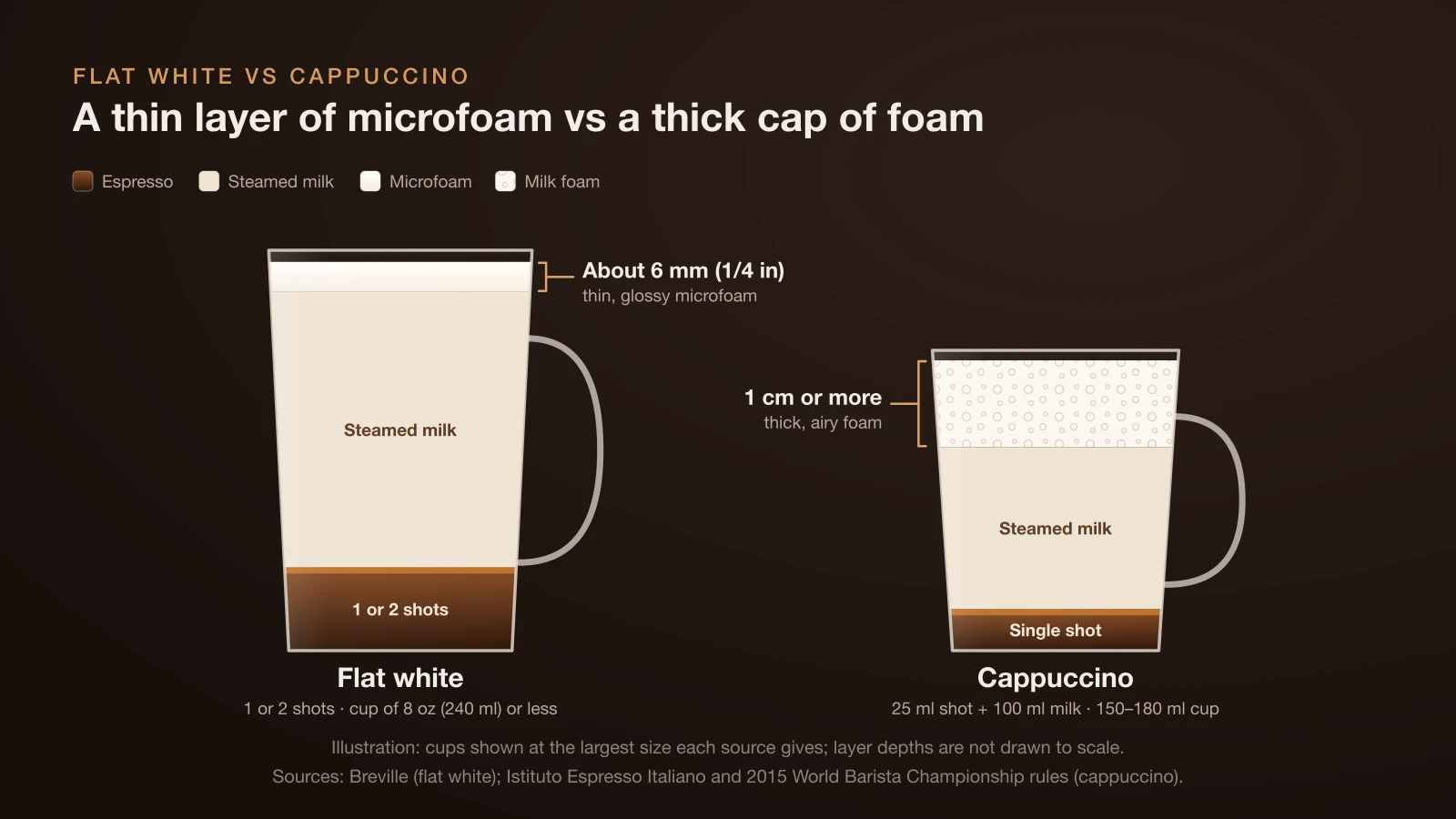
A flat white holds less milk than a latte in a cup of 8 oz or less, while a traditional cappuccino is a 150–180 ml drink built on one single shot and 100 ml of milk.
| Flat white (Breville’s guideline) | Cappuccino (Italian standard and competition rules) | |
|---|---|---|
| Espresso | Single or double shot; often a double | 25 ml single shot |
| Milk | Less than a latte | 100 ml steamed milk |
| Espresso to milk | Stronger than a latte, varies with the cup | About 1 : 4 |
| Foam layer | About 1/4 in (6 mm) microfoam | Thick foam, 1 cm or more |
| Cup | 8 oz or less | 150–180 ml |
The Italian Espresso Institute’s certified cappuccino uses 25 ml of espresso and 100 ml of steamed milk. World Barista Championship rules called for a single shot in a 150–180 ml cappuccino with at least 1 cm of foam. Breville suggests a single or double shot for a flat white, a cup no larger than 8 oz and a layer of microfoam about a quarter inch thick.
Chains stretch both drinks. Starbucks sells flat whites and cappuccinos in 12, 16 and 20 oz sizes, far larger than the traditional cups.
Milk texture: microfoam vs foam

A flat white has fine, glossy microfoam blended into the milk, while a cappuccino carries a thicker, lighter and drier cap of foam.
- Flat white microfoam: tiny, uniform bubbles with a glossy, wet-paint look. It pours easily and mixes into the espresso, so every sip tastes the same.
- Cappuccino foam: larger volume and a lighter, drier feel. The first sips are mostly foam, and the espresso and milk come through underneath.
Some cafés offer a wet cappuccino (more liquid milk, less foam) or a dry cappuccino (mostly foam). A wet cappuccino moves toward a flat white, but it still usually has more foam and a single shot. We compare the two styles in dry cappuccino vs wet cappuccino.
Both textures come from the steam wand. Our guide to steaming milk for espresso drinks explains how much air to add for each.
Is a flat white stronger than a cappuccino?
In flavor, a flat white is usually stronger. Made with a double shot, it starts with twice the espresso of an Italian cappuccino, which puts 25 ml of espresso under 100 ml of milk, about 4 parts milk to 1 part espresso. There is also no thick foam cap to soften the first sips.
In caffeine, the answer depends on the number of shots, since milk adds none. USDA data puts espresso at about 212 mg of caffeine per 100 g, or roughly 63 mg in a 1 oz shot. A double-shot flat white therefore carries about twice the caffeine of a single-shot cappuccino.
Starbucks shows the same pattern. Its grande (16 oz) flat white uses three ristretto shots and lists 195 mg of caffeine. Its grande cappuccino uses two shots and lists 150 mg. For per-shot details, see how much caffeine is in an espresso shot.
Flat white vs cappuccino calories
Almost all the calories come from the milk, so the milk type matters more than the drink name.
| Starbucks, grande (16 oz) | Flat white | Cappuccino |
|---|---|---|
| Default milk | Whole milk | 2% milk |
| Calories | 220 | 140 |
| Sugars (from milk) | 17 g | 12 g |
| Caffeine | 195 mg | 150 mg |
At home, you can estimate it yourself. USDA lists whole milk at 61 kcal per 100 g, so every 100 ml (about 103 g) of whole milk adds roughly 63 kcal. That is the milk in an Italian cappuccino; a flat white in a larger cup carries a little more. The espresso adds only a few calories.
These are estimates for plain whole milk without sugar. Skim or plant milk lowers them; syrups raise them quickly.
Where the two drinks come from
The cappuccino comes from Italy, while the flat white comes from Australia or New Zealand, depending on whom you ask.
The cappuccino takes its name from the Capuchin friars, whose brown robes matched the drink’s color. Breville traces it to the “kapuziner” of 19th-century Vienna, with the Italian name coined in the early 1900s as espresso machines spread. In Italy it is mostly a breakfast drink.
The flat white is much younger. Both Australia and New Zealand claim it: a Sydney café owner, Alan Preston, said he served the first “official” flat white in 1985, while New Zealand traces it to Wellington, where customers asked for “flat milk” instead of domes of foam. Starbucks introduced the flat white to its US stores on January 6, 2015.
Which one should you order?

Order a flat white if you want a smooth, coffee-forward drink with a thin layer of microfoam, and a cappuccino if you prefer a lighter, softer flavor under a thick, frothy cap of foam.
| Choose a flat white if you… | Choose a cappuccino if you… |
|---|---|
| Want the espresso to taste clearly | Prefer a lighter, softer coffee flavor |
| Like a smooth, velvety texture | Like a thick, frothy foam |
| Want latte art on a small drink | Want a classic Italian breakfast drink |
| Usually order a double shot | Like the option of wet or dry foam |
If both feel too milky, look at a cortado, which uses roughly equal espresso and milk. We compare it in cortado vs latte.
Making them at home
At home, both drinks start with a well-pulled shot, and the difference comes from how much air you add while steaming the milk. If you are still learning your machine, start with how to use an espresso machine.
Flat white
- Pull a single or double shot into a cup of 8 oz or less.
- Steam cold milk, adding air for only a second or two so it stays glossy.
- Pour steadily into the espresso, finishing with a level layer of microfoam about a quarter inch (6 mm) thick.
Cappuccino
- Pull a single or double shot into a 150–180 ml cup.
- Steam about 100 ml of cold milk, adding air longer so the volume grows noticeably.
- Pour the milk, then let the thick foam settle on top, at least 1 cm deep.
No steam wand? A moka pot makes a strong enough base for a home-style version, though the milk texture will be less refined.
The bottom line
A flat white is espresso, often a double shot, with silky milk and a thin microfoam: small, smooth and coffee-forward. A cappuccino is a shot with steamed milk and a thick cap of foam: lighter, airier and a little milder. Caffeine follows the number of shots, and calories follow the milk. Pick the flat white for strength, the cappuccino for foam.
Sources
- Istituto Espresso Italiano: Certified Italian Espresso and Cappuccino (25 ml espresso + 100 ml steamed milk)
- World Coffee Events: 2015 World Barista Championship Rules and Regulations (archived; cappuccino made with one single shot, 150–180 ml, at least 1 cm of foam)
- Breville: How to make a flat white at home (single or double shot, cup of 8 oz or less, microfoam about a quarter inch thick, claimed by Australia and New Zealand) and How are flat whites, cappuccinos & lattes different? (Capuchin name and Viennese “kapuziner”, Alan Preston’s 1985 claim, Wellington claim)
- USDA FoodData Central: Espresso, restaurant-prepared (212 mg caffeine per 100 g) and Milk, whole (61 kcal per 100 g)
- Starbucks: Flat White nutrition and Cappuccino nutrition (sizes, shots, milk, calories, caffeine) and Fact Sheet: Starbucks Flat White (archived; US and Canada launch, January 6, 2015)