Espresso with milk covers most of the drinks on any café menu, from a tiny macchiato to a large latte. What changes from one drink to the next is how much milk goes in and how it is prepared: steamed, foamed or cold. Get the ratio and the temperature right and almost any espresso with milk tastes better.
This guide explains what each drink is called, the typical espresso-to-milk ratios, the right milk temperature, and which dairy and plant milks work best.
The short answer
| Drink | Espresso : milk | Milk texture |
|---|---|---|
| Macchiato | about 1 : 0.25–0.5 | a spoonful of foam |
| Cortado | about 1 : 1 | warm milk, little foam |
| Flat white | less milk than a latte, in a cup of 8 oz or less | thin, velvety microfoam |
| Cappuccino | about 1 : 4 (Italian standard) | steamed milk with thick foam |
| Latte | 1 : 3 to 1 : 5 or more | steamed milk, thin foam |
| Latte macchiato | milk first, espresso on top | layered in a tall glass |
What is an espresso with milk called?
The name depends on how much milk is added:
- A spot of foam: macchiato (“marked”).
- Equal parts: cortado.
- More milk, thin foam: flat white.
- Steamed milk with thick foam: cappuccino.
- Lots of steamed milk: latte.
- Milk first, espresso poured in: latte macchiato.
For a complete list, including drinks without milk, see our types of espresso drinks chart. If you are choosing between two similar drinks, our side-by-side guides to macchiato vs latte and cortado vs latte compare ratio, size and taste.
What do Italians call espresso with milk?
In Italy, the milky morning coffee is caffè latte or caffelatte. Ask for a “latte” and you will get a glass of milk, because latte simply means milk. A caffè macchiato is a shot with a little milk, and milky coffees such as cappuccino are traditionally a breakfast drink rather than something ordered after lunch.
Espresso-to-milk ratios for every drink
Ratios explain why drinks with the same shot taste so different.
- Cappuccino: the Italian espresso institute’s reference cappuccino is 25 ml of espresso plus 100 ml of steamed milk, about 1 : 4. Breville’s espresso machine manual suggests a 150–220 ml (5–7.5 oz) cup.
- Flat white: a single or double shot in a cup of no more than about 8 oz, as Breville suggests, with a thin layer of microfoam. Less milk than a latte means more coffee flavor. We compare it with its closest neighbor in flat white vs cappuccino.
- Cortado: roughly equal amounts of espresso and warm milk.
- Latte: usually three to five times as much milk as espresso, and often more in large US sizes.
A useful rule: the more milk, the more you need a strong, fairly dark espresso to keep the coffee flavor in the cup. A light, fruity espresso that tastes great on its own can disappear in a large latte.
Steamed milk, foam and microfoam: what’s the difference?
Steaming does two jobs at once: it heats the milk and, at the start, stretches it by drawing in air.
- Steamed milk is heated milk with little added air. It is smooth and pourable.
- Milk foam has much more air, with visible bubbles. It sits on top of a cappuccino.
- Microfoam is milk with air broken into tiny, uniform bubbles. It is glossy, slightly thickened and pours like wet paint, which is what makes latte art possible.
Foam holds together because milk proteins surround the air bubbles and stop them from bursting. That is why milk with more protein tends to foam better, and why skimming away all the protein, as some plant milks do, makes foaming harder.
The right milk temperature
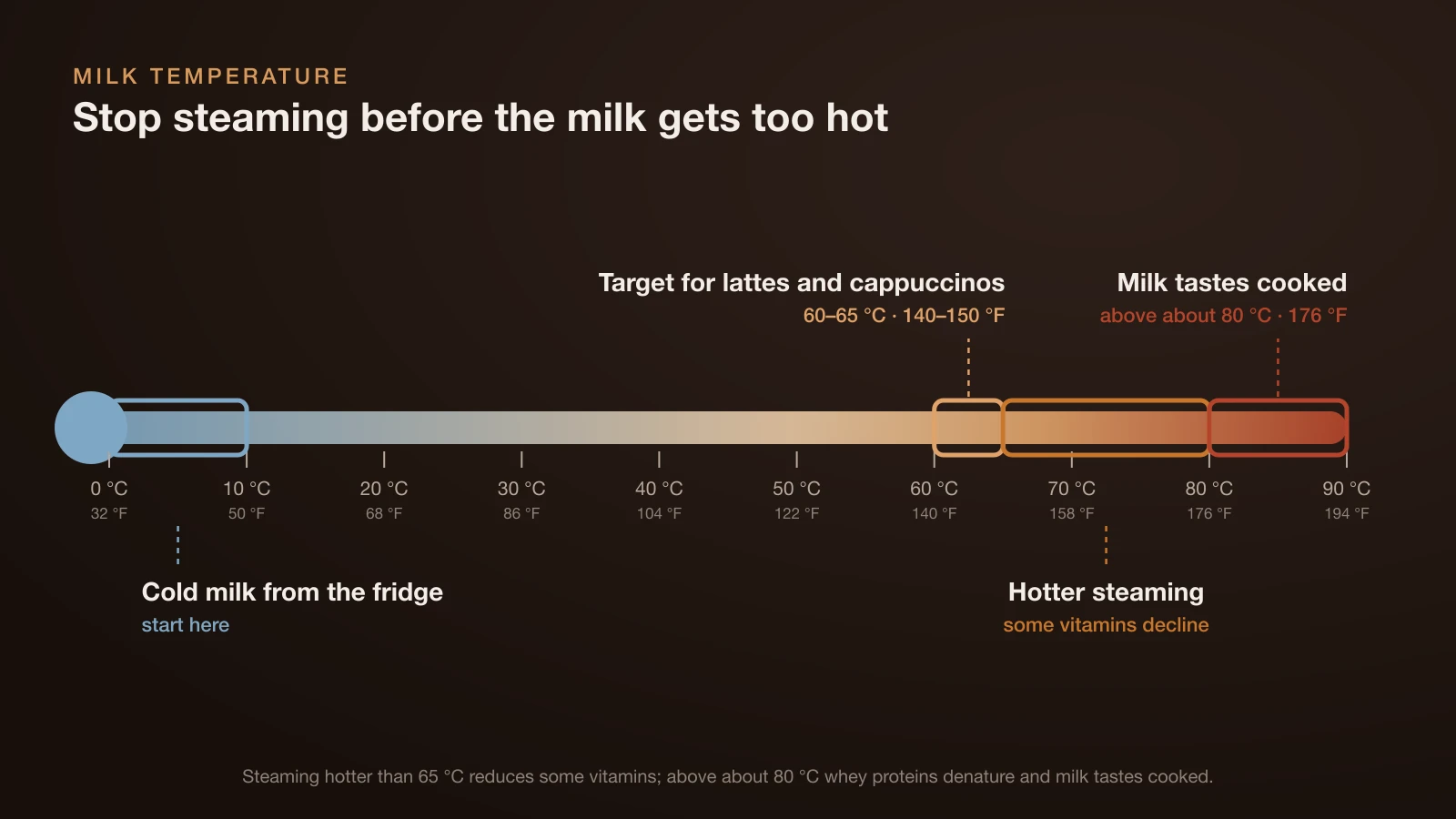
Aim for 60–65 °C (140–150 °F), the milk temperature Breville’s espresso machine manual recommends. It is hot enough to drink right away, and research on steamed milk found that steaming to 60–65 °C did not affect its nutritional quality.
- Start with cold milk straight from the fridge. It gives you more time to build microfoam before the milk gets hot.
- Stop around 65 °C. In the same research, steaming hotter than that reduced some vitamins.
- Never boil it. Above about 80 °C (176 °F), most of the milk’s whey proteins denature, which is what gives overheated milk its cooked flavor.
If you do not have a thermometer, stop when the pitcher becomes too hot to hold comfortably for more than a second or two.
Which milk is best for espresso?
Whole vs skim dairy milk
Whole milk is the easiest to work with and tastes sweetest and creamiest. A study of steamed milk for coffee found that higher fat content reduced foam stability, while higher protein slightly increased foam volume. In practice, that means skim milk makes a big, stiff foam that dries out quickly, while whole milk makes a smaller, silkier foam that suits lattes and flat whites.
Fresh vs UHT milk
Fresh pasteurized milk usually foams better than shelf-stable UHT milk. Research published in 2023 found that pasteurized milk formed a more consistent and longer-lasting foam, which the authors linked to its proteins being less changed by heat.
Plant milks
Plant milks vary widely. A 2024 study found that the soy milk closest to cow’s milk in protein was the best liked in coffee, and that a smooth mouthfeel drove liking of barista-style oat, almond and coconut milks. A 2025 review noted that matching dairy foam in hot coffee remains a challenge for plant milks.
The practical advice: buy the “barista” version of your favorite plant milk. These are formulated to steam and resist splitting in hot coffee.
How to steam milk at home
- Pour cold milk into a stainless steel pitcher, up to just below the spout.
- Purge the steam wand for a second to clear water.
- Start with the tip just under the surface to draw in air. You should hear a gentle tearing sound.
- Stretch briefly: a few seconds for a latte, longer for a cappuccino.
- Sink the tip slightly and angle the pitcher so the milk spins in a whirlpool. This breaks big bubbles into microfoam.
- Stop at 60–65 °C, wipe and purge the wand.
- Tap and swirl the pitcher until the milk looks glossy, then pour.
For the full routine, from pulling the shot to cleaning up, see how to use an espresso machine. To turn that milk into a drink, our step-by-step guide on how to make a latte also covers methods without a machine.
Espresso with cold milk: dirty coffee and iced drinks
Not every espresso with milk is hot.
- Dirty coffee: cold milk in a small glass with a hot double shot poured slowly on top, served without ice so the layers stay visible.
- Iced latte: espresso poured over ice and cold milk. It needs a stronger espresso because ice and cold milk mute the flavor.
- Espresso and a splash of cold milk: simple and fine at home, though it cools the shot quickly.
Can you just add milk to espresso?
Yes. Adding milk to espresso is the basis of most café drinks, and there is no wrong way to enjoy it at home. Steamed milk blends best and brings out sweetness, but cold milk works too. Keep in mind that milk dilutes flavor, not caffeine: a latte has the same caffeine as the shots inside it. Our guide to espresso vs coffee compares the caffeine in espresso drinks with a cup of coffee.
Serve it in the right cup
Cup size keeps the ratio right. Breville’s espresso machine manual suggests a 150–220 ml (5–7.5 oz) cup for a cappuccino and a 200–220 ml (about 7 oz) glass for a latte, and Breville keeps a flat white to 8 oz or less. A cortado goes in a small glass. See our guide to ceramic espresso cups for sizes.
The bottom line
Espresso with milk comes in many forms, but the rules are simple: more milk means a milder drink, microfoam gives the silkiest texture, and 60–65 °C is the right temperature. Use fresh whole milk or a barista-style plant milk, start it cold, and match the drink to the cup. The result is a better latte, cappuccino or flat white at home.
Sources
- Istituto Espresso Italiano: Certified Italian Espresso and Cappuccino (25 ml espresso + 100 ml milk)
- Breville: How to make a flat white at home (single or double shot, cup of 8 oz or less), Latte recipe (“latte” means milk) and Barista Express BES875 instruction book (milk temperature 60–65 °C, cappuccino cup 150–220 ml, latte glass 200–220 ml)
- Elsevier journals: Food Chemistry (2023), study of steam-heated milk for coffee drinks (60–65 °C steaming, fewer vitamins when hotter; pasteurized vs UHT foam); Münchow et al., International Dairy Journal (2015), Steam frothing of milk for coffee (fat, protein and foam stability); Jaeger et al., Food Research International (2024), study of plant-based milks in coffee
- MDPI journals: Gupta et al., Beverages (2025), review of barista-style plant milks; Zhang et al., Foods (2025), whey protein changes in heated milk (denaturation mainly above 80 °C; cooked flavor)
- UCLA Science and Food: The science of steamed milk (proteins stabilize foam; overheating scalds milk)