Macchiato vs latte comes down to how much milk goes in. A traditional macchiato is a shot of espresso “marked” with a spoonful of milk foam, about 2 ounces in total. A latte is espresso with several ounces of steamed milk and a thin layer of foam, usually 8 ounces or more. The macchiato tastes strong; the latte tastes mild and creamy.
Both start with the same espresso, so the caffeine can be identical. What changes is the ratio of coffee to milk, the size of the cup and the texture. For how these two fit among every other café drink, see our overview of types of espresso drinks.
One warning before the details: in many US chains, the word “macchiato” on the menu means something much closer to a latte. We cover that confusion below.
The short answer
| Macchiato (espresso macchiato) | Latte (caffè latte) | |
|---|---|---|
| What it is | Espresso marked with a little milk foam | Espresso with lots of steamed milk and a thin foam layer |
| Espresso | 1 or 2 shots | 1 or 2 shots (often 2 in the US) |
| Milk | A spoonful or two, mostly foam | Roughly 6–12 oz or more of steamed milk |
| Typical espresso to milk | Mostly espresso | About 1:3 to 1:5, more in large sizes |
| Typical size | About 1–3 oz | 8 oz and up |
| Cup | Demitasse (espresso cup) | Large cup or glass |
| Taste | Intense, espresso-forward | Mild, creamy, naturally sweet |
| Caffeine | Same as the shots inside | Same as the shots inside |
Café recipes vary. Treat these ratios and sizes as typical ranges, not rules.
What is the difference between a macchiato and a latte?
The difference between a macchiato and a latte is the balance. A macchiato is an espresso drink with a touch of milk. A latte is a milk drink with espresso in it.
- Macchiato: Italian for “stained” or “marked.” A barista pulls a shot and adds a small dollop of foamed milk, just a spoonful or two. You still taste the espresso first.
- Latte: short for caffè latte, “milk coffee.” One or two shots are topped with a large amount of steamed milk and finished with a thin layer of microfoam, which is what makes latte art possible.
A useful way to picture it: in a macchiato, the milk is the garnish. In a latte, the espresso is the flavoring.
Ratio and size: macchiato vs latte by the numbers
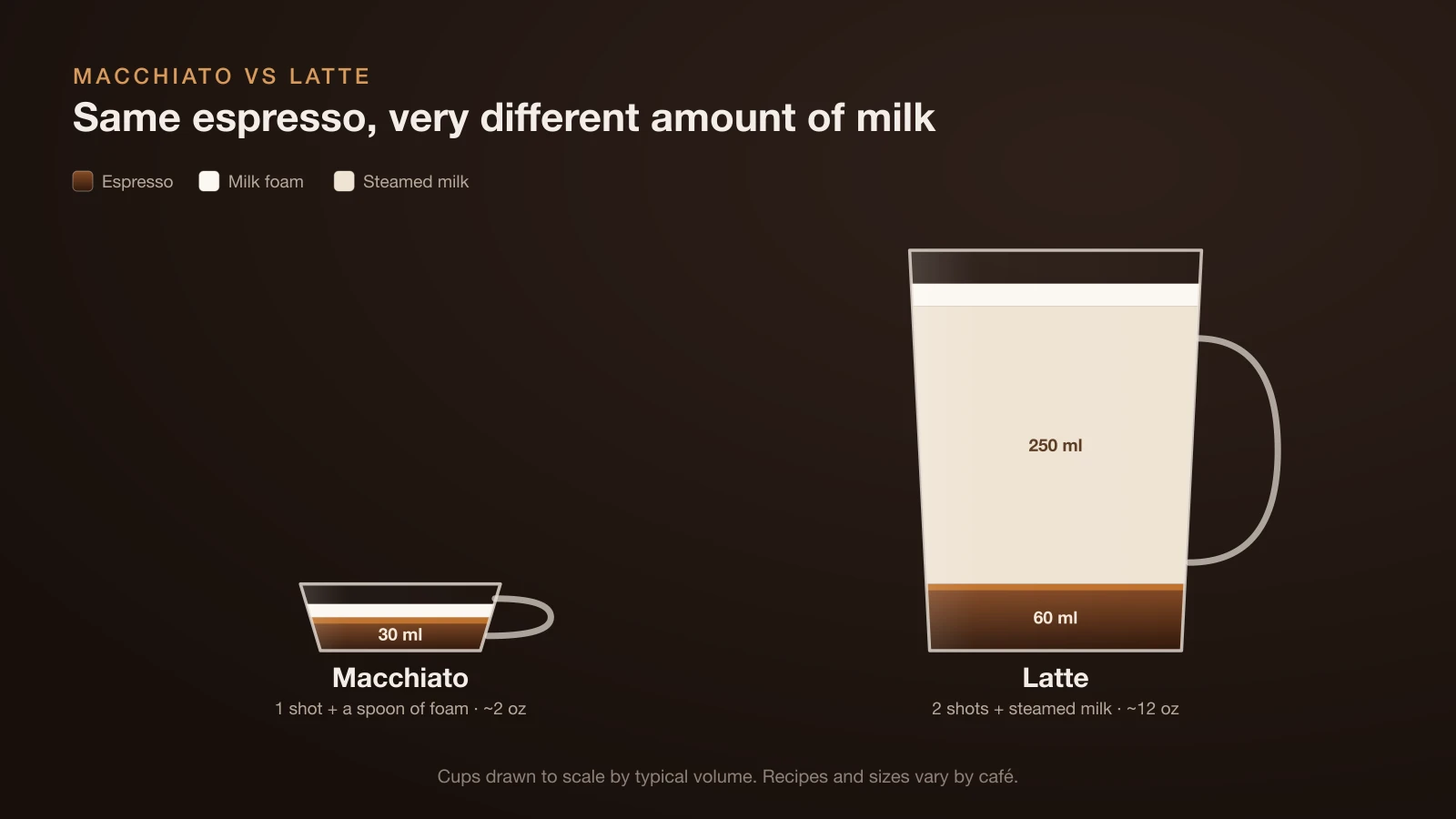
The numbers explain the taste. Here is how the two drinks usually break down, with the caveat that every café pours its own version.
| Macchiato | Latte | |
|---|---|---|
| Espresso | 1 oz (single) or about 2 oz (double) | 1–2 oz |
| Milk | A spoonful of foam | 6–12 oz steamed milk, more in large sizes |
| Foam | A small cap | A thin layer, about a centimeter or less |
| Total volume | About 1–3 oz | 8–20 oz |
For a real-world reference point, Starbucks lists its Espresso Macchiato at 1.6 fl oz for a two-shot doppio, while its standard grande Caffè Latte is 16 fl oz. That is ten times the volume for the same amount of espresso.
In Italy, drinks are smaller. The Italian Espresso Institute’s certified espresso is about 25 ml, so an Italian caffè macchiato is only about an ounce. Lattes can be modest too: Breville’s espresso machine manual describes one as a single shot with textured milk and about 10 mm of foam in a 200–220 ml (about 7 oz) glass.
Milk texture: foam vs steamed milk
Both drinks use steamed milk, but they use different parts of it.
- A macchiato takes mostly the foam from the top of the pitcher. The goal is a small white spot on the crema, not a layer.
- A latte uses mostly the silky, liquid steamed milk underneath, with just a thin skin of microfoam on top.
Latte milk should be stretched only briefly, so it stays glossy and pourable. If you want to try this at home, our guide to steaming milk for espresso drinks covers temperature and technique, and how to make a latte walks through the full recipe.
Caffeine: does a latte or macchiato have more caffeine?
Neither, if the number of shots is the same. Milk adds volume, not caffeine. All the caffeine in both drinks comes from the espresso.
USDA data puts espresso at about 212 mg of caffeine per 100 g, or about 63 mg in a 1 oz single shot. Chains often pull stronger or larger shots. Starbucks lists both its two-shot Espresso Macchiato and its grande Caffè Latte at about 150 mg.
So a double macchiato and a double latte deliver the same caffeine. The latte simply spreads it across more liquid, which is why it tastes weaker. For per-shot numbers and what affects them, see how much caffeine is in espresso.
Taste: which one should you order?
| Order a macchiato if you… | Order a latte if you… |
|---|---|
| Like straight espresso but want it a little softer | Find espresso too bitter on its own |
| Want a quick drink you finish in a few sips | Want a drink to sip slowly |
| Care about tasting the coffee itself | Like a creamy, mild, slightly sweet cup |
| Are watching calories | Want a base for syrups, spices or latte art |
A macchiato keeps the espresso’s acidity, bitterness and crema front and center. A latte softens all of that; the milk’s natural sugar makes it taste sweeter even without syrup.
If you want something in between, look at a cortado, which uses roughly equal espresso and milk. We compare it in cortado vs latte. If you are torn between the two foamier drinks, read macchiato vs cappuccino.
Why Starbucks-style macchiatos cause confusion
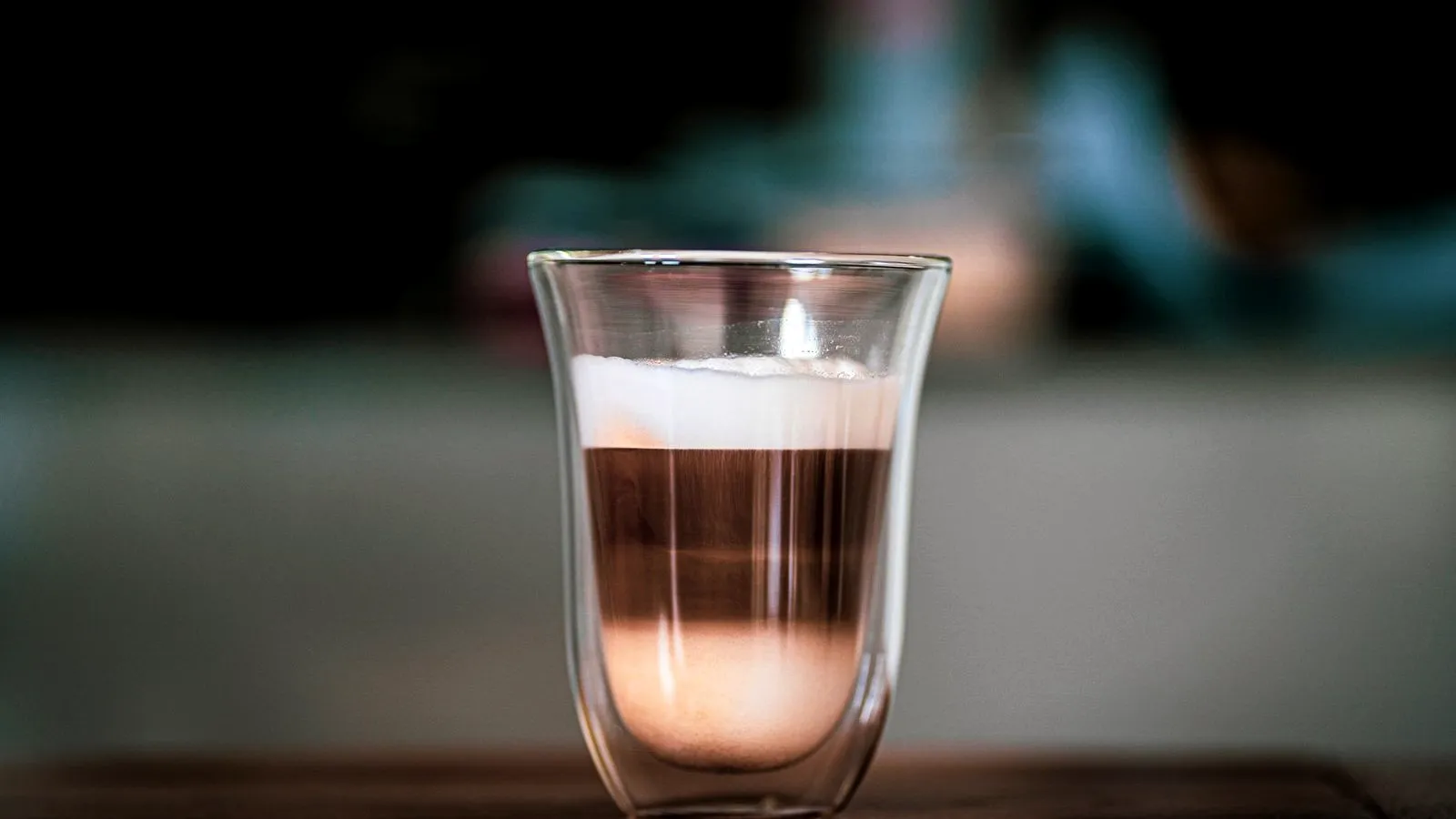
In the US, “macchiato” often means a sweet, latte-sized drink. That is why so many people search for the difference in the first place.
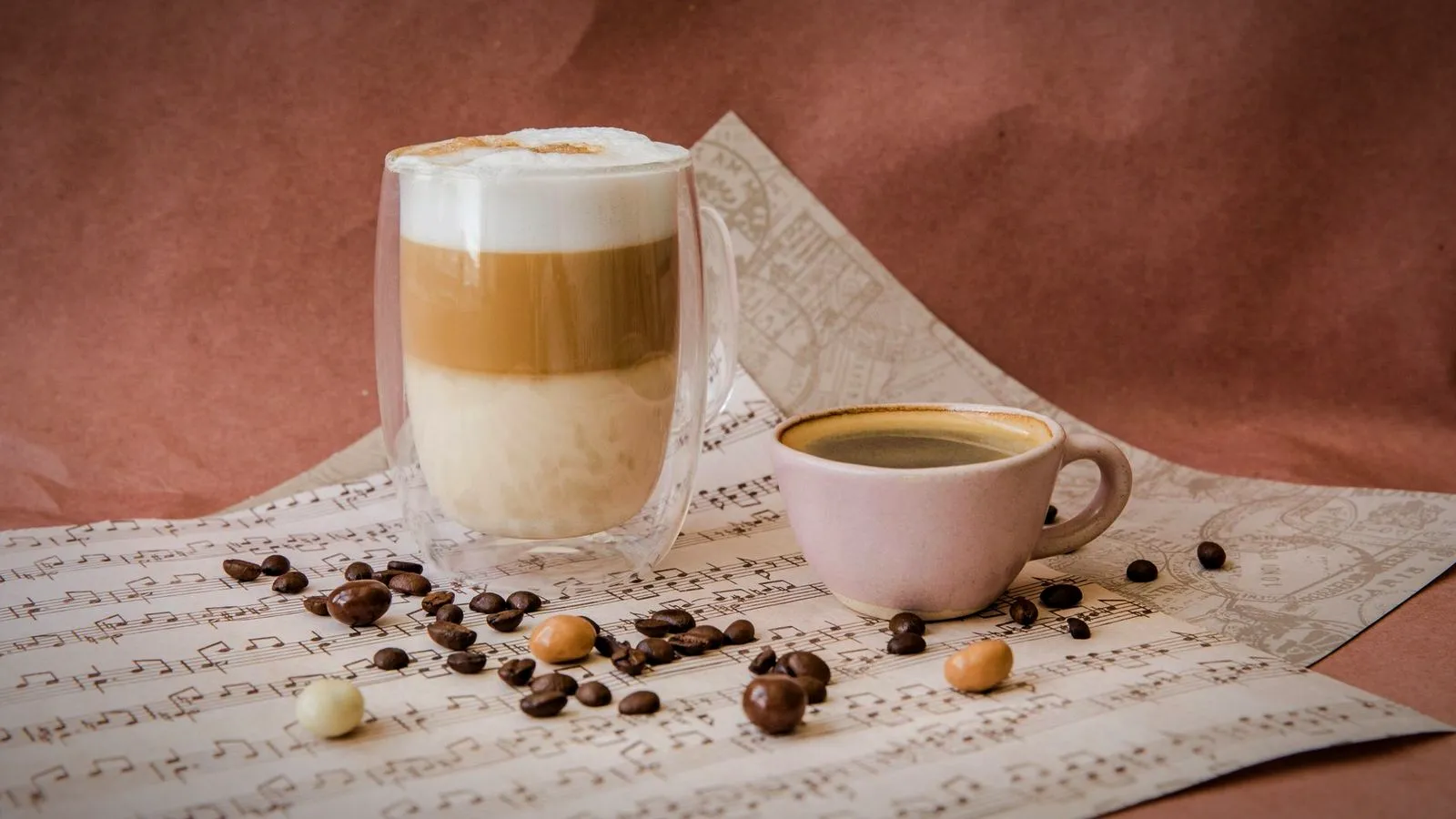
- Latte macchiato: a traditional Italian drink that flips the order. Steamed milk goes into a tall glass first and the espresso is poured in last, “staining” the milk and forming layers. It is milkier than a caffè latte.
- Caramel macchiato: Starbucks describes it as steamed milk with vanilla syrup, “marked” with espresso and topped with caramel drizzle. In practice it is a vanilla latte built upside down.
Starbucks lists the grande (16 fl oz) Caramel Macchiato at 250 calories and 33 g of sugar, against 190 calories and 18 g of sugar (naturally from the milk) for a grande Caffè Latte. Both have about 150 mg of caffeine.
If you want the traditional drink at a chain, ask for an espresso macchiato. If you order just a “macchiato,” you may get the caramel version.
Macchiato vs latte calories
Almost all the calories in both drinks come from the milk. Using USDA figures for whole milk (61 kcal per 100 g) and espresso (9 kcal per 100 g), here is a rough estimate:
- Traditional macchiato: assuming 1–2 teaspoons of milk (about 5–10 g, at 30.5 g per fluid ounce and 6 teaspoons per ounce), the milk adds about 3–6 kcal. With the espresso, the whole drink is usually under 10 kcal.
- Latte with 8 oz of whole milk: a cup of whole milk (244 g) is about 150 kcal, so a small latte lands around 150–160 kcal.
These are estimates based on those assumptions. Skim or plant milk, bigger sizes and syrups change the total a lot.
Making them at home
Both drinks are easy once you can pull a decent shot. If you are new to your machine, start with our guide on how to use an espresso machine.
Espresso macchiato
- Pull a single or double shot into a small espresso cup.
- Steam a small amount of milk until it has a thick foam on top.
- Spoon one or two teaspoons of the foam onto the center of the crema.
Latte
- Pull one or two shots into an 8–12 oz cup.
- Steam 6–10 oz of cold milk to about 60–65 °C (140–150 °F), stretching it only briefly.
- Pour the milk into the espresso, finishing with a thin layer of microfoam.
The right cup helps. A macchiato belongs in a thick-walled demitasse that holds heat; see our guide to ceramic espresso cups.
The bottom line
A macchiato is espresso with a spot of foam: small, strong and nearly calorie-free. A latte is espresso with plenty of steamed milk: large, mild and creamy. With the same number of shots, both carry the same caffeine. If a menu’s “macchiato” comes with syrup and caramel, it is really a latte-style drink, so ask for an espresso macchiato when you want the original.
Sources
- USDA FoodData Central: Beverages, coffee, brewed, espresso, restaurant-prepared (212 mg caffeine and 9 kcal per 100 g) and Milk, whole, 3.25% milkfat (61 kcal per 100 g; 1 fl oz = 30.5 g; 1 cup = 244 g)
- Starbucks: Espresso Macchiato nutrition, Caffè Latte nutrition and Caramel Macchiato nutrition (sizes, caffeine, calories, recipes)
- Istituto Espresso Italiano: Certified Italian Espresso (about 25 ml per espresso)
- Breville: Barista Express BES875 instruction book (latte: single espresso, about 10 mm of foam, 200–220 ml glass; macchiato with a dollop of textured milk)