How to descale an espresso machine: remove the water filter, empty the drip tray, mix your manufacturer’s descaler with water in the tank, start the descale mode and run the solution through the group head and steam wand. Then rinse with at least one full tank of fresh water. Most home machines need this every 2–3 months or when prompted.
Descaling removes mineral scale from the parts that heat water, which is a different job from the coffee-oil cleaning in our guide on how to clean an espresso machine. Every step below comes from manufacturer manuals, and where they disagree, we say so.
The short answer
| Question | Answer |
|---|---|
| What you need | Your maker’s descaler, a 68 fl oz (2 L) container, fresh water |
| How often | Every 2 months (Gaggia), or when the descale light comes on (Breville, De’Longhi) |
| How long | About 25 minutes on a De’Longhi Dedica; up to 1.5 hours on Breville’s Dual Boiler |
| Vinegar? | Only if your manual allows it; Gaggia forbids it |
| Rinse | At least one full tank of fresh water through the group and wand; Gaggia calls for 4 tanks |
| Big dual boiler or HX machine | Follow its manual; some makers advise soft water instead of home descaling |
What is scale, and why descale an espresso machine?
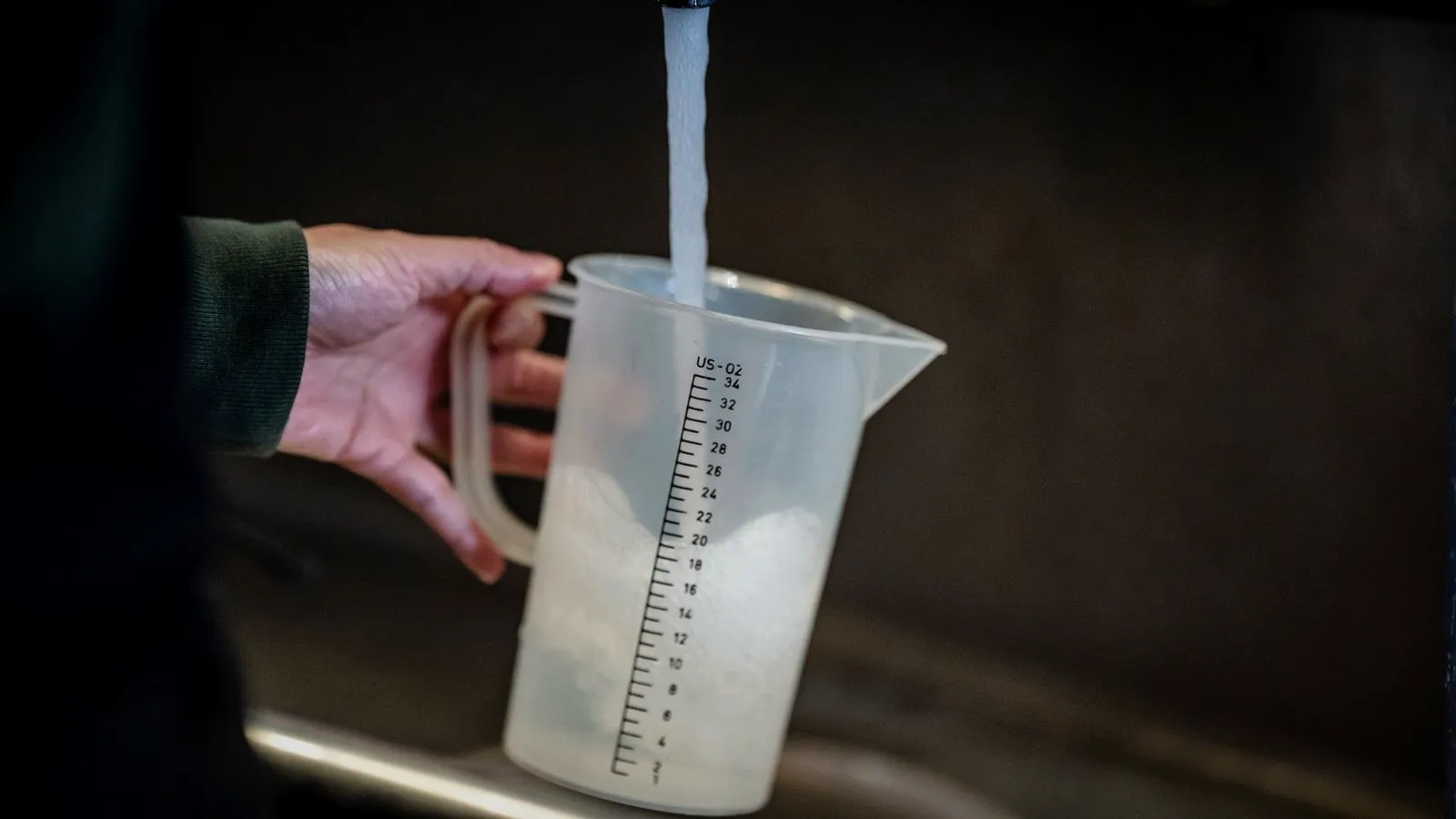
Scale is the hard mineral crust that forms when water containing calcium and magnesium is heated. The U.S. Geological Survey defines water hardness as the amount of dissolved calcium and magnesium, and notes that heating hard water can form solid deposits of calcium carbonate that shorten equipment life and clog pipes.
Inside an espresso machine, that crust lines the boiler or heater, the valves and the narrow tubes. Breville’s manuals say mineral build-up reduces brewing flow, brewing temperature, the power of the machine and the taste of the espresso. Lower brewing temperature alone can push shots toward sourness, as our guide to espresso brew temperature explains.
Descaling, cleaning and backflushing are separate jobs
Descaling is only one part of espresso machine care. Urnex, which makes cleaning products for both jobs, defines cleaning as removing coffee oils and descaling as removing mineral build-up from the heating elements.
| Job | Removes | Typical frequency (manufacturer) | Guide |
|---|---|---|---|
| Descaling | Mineral scale in boiler and pipes | Every 2 months to when prompted | This article |
| Cleaning | Coffee oils and milk residue | After every shot, daily and weekly | How to clean an espresso machine |
| Backflushing | Coffee oils in the group and 3-way valve | Water daily, detergent weekly (Rocket, La Marzocco) | How to backflush an espresso machine |
How often should you descale an espresso machine?
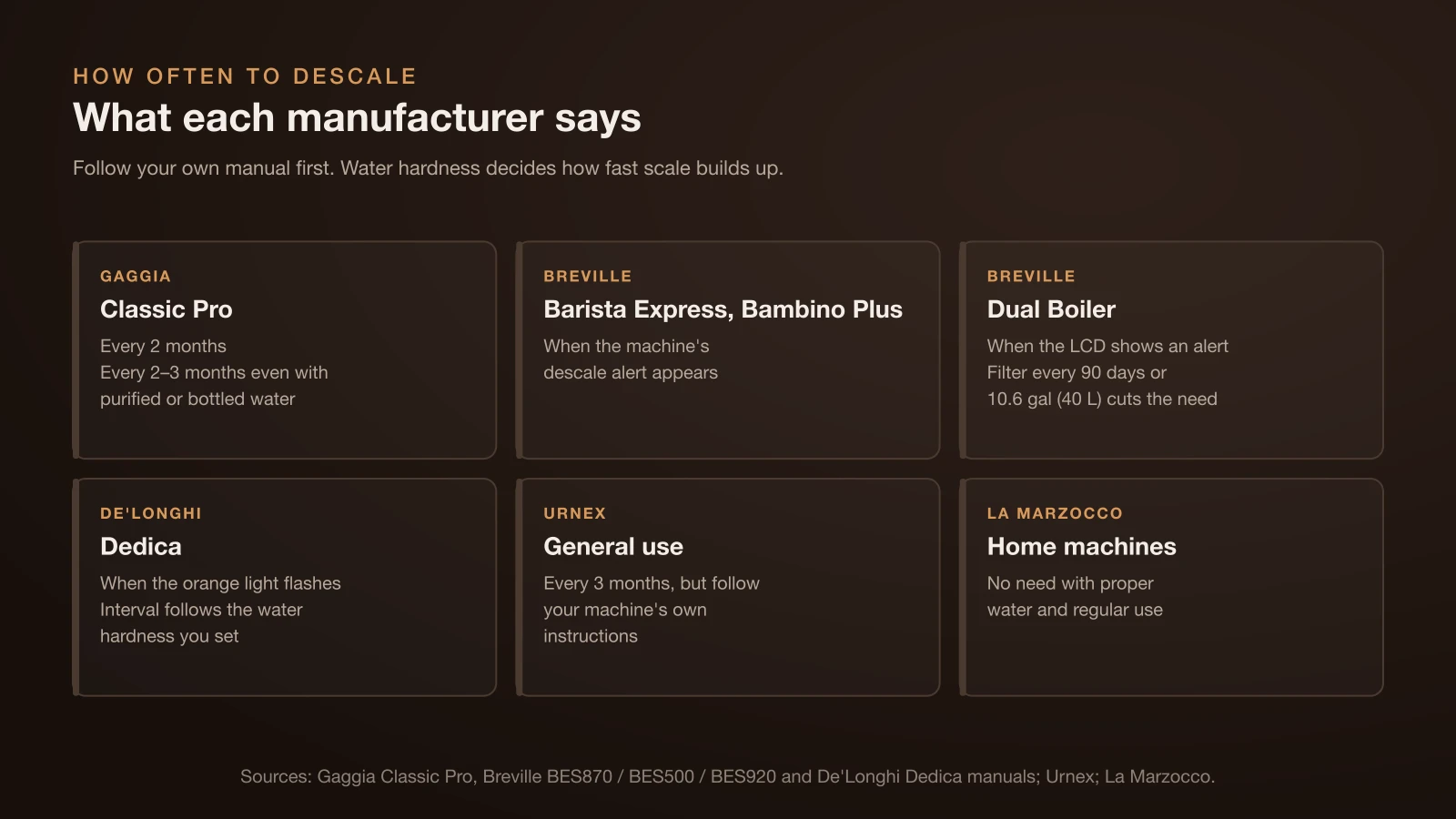
How often you should descale an espresso machine depends on your water hardness and on your maker’s instructions, which range from a fixed two-month interval to “only when needed”.
| Manufacturer | Descaling guidance |
|---|---|
| Gaggia (Classic Pro) | Every 2 months; every 2–3 months even with purified or bottled water |
| Breville (Barista Express, Bambino Plus) | When the machine’s descale alert appears |
| Breville (Dual Boiler) | When the LCD shows a descale alert; changing the filter every 90 days or 10.6 gal (40 L) reduces the need |
| De’Longhi (Dedica) | When the orange descale light flashes; the interval follows the water hardness you set |
| Urnex (general use) | Every 3 months, but follow your espresso machine’s own instructions |
| La Marzocco (home machines) | No need with proper water and regular use |
The hardness setting matters on machines that count. De’Longhi says the water hardness setting has a direct effect on how often you need to descale, and its Dedica manual asks you to set it as soon as possible after unpacking.
Descaler, vinegar or citric acid: what the manuals say
The safest descaling solution is the one your manufacturer names, because several makers warn that other products can damage the machine or void the warranty.
| Maker | Product it names | Vinegar |
|---|---|---|
| Gaggia | Gaggia descaler only | “Never use vinegar or other descaling agents” |
| De’Longhi | De’Longhi descaler only | Can leave lingering odors and may be too harsh for internal parts |
| Breville | Breville descaling powder, 1 sachet per 34 fl oz (1 L) of water | Cleaning guide lists 1 part vinegar to 1 part water, but says to use a store-bought solution for a deep clean |
| La Marzocco, Profitec | Prevention with the right water | Not addressed |
De’Longhi adds that an unsuitable descaler, or descaling done incorrectly, can cause faults not covered by its guarantee. Its Decalk Care descaler is based on lactic acid of vegetable origin, with one 3.4 oz (100 ml) dose per descale.
Citric acid sits in between. De’Longhi calls it a popular household cleaner but says its effectiveness depends on getting the dilution and use right. Urnex’s objection to vinegar is practical: it is slow, hard to rinse and can leave an odor and aftertaste in later brews.
How to descale an espresso machine step by step
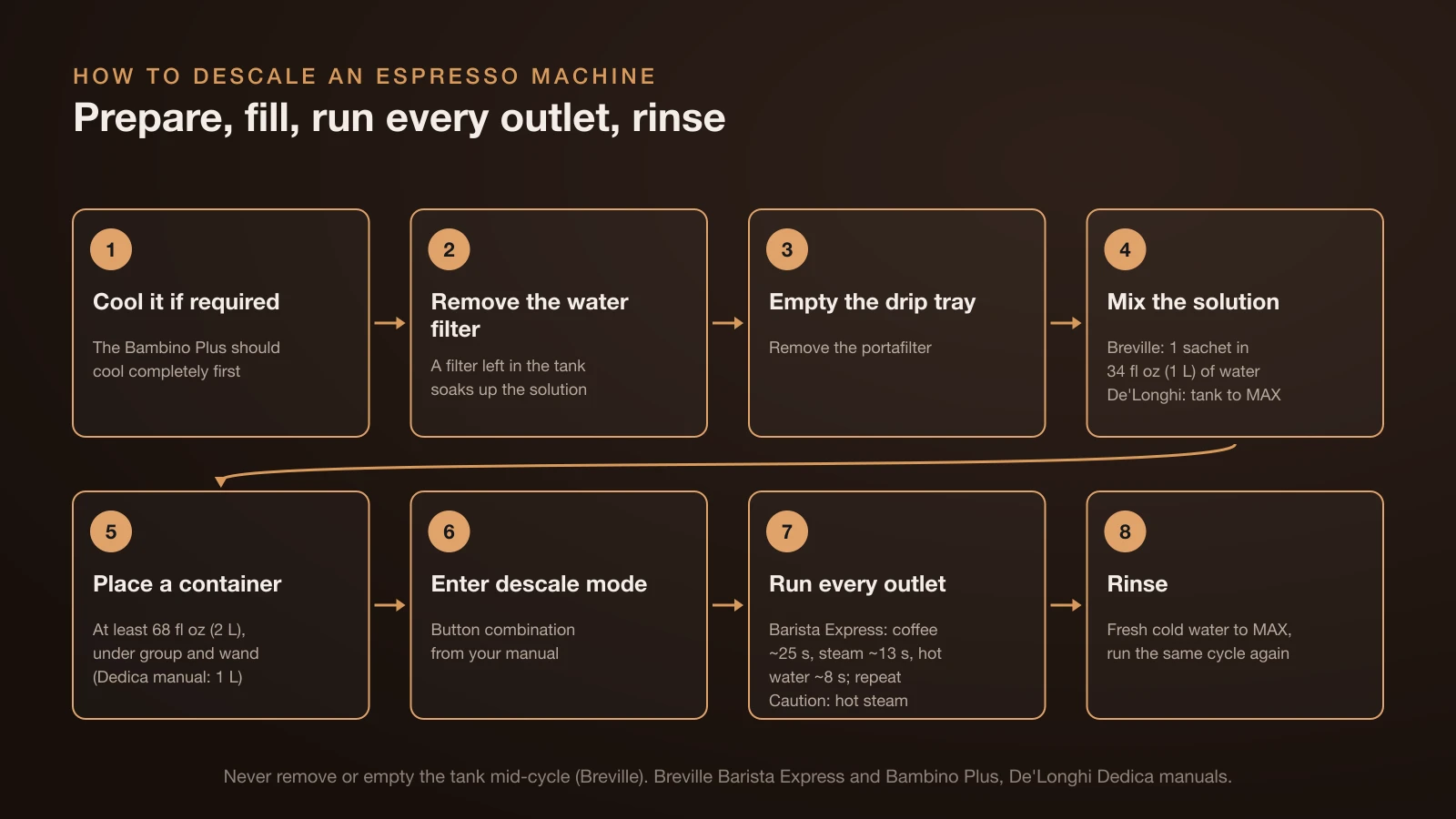
Most thermoblock and thermocoil home machines with a descale mode, such as Breville’s and De’Longhi’s, follow the same sequence: prepare, fill with solution, run it through every outlet, then rinse. The steps below combine the Breville Barista Express, Bambino Plus and De’Longhi Dedica manuals; your model’s button presses will differ.
- Let the machine cool if your manual says so. The Bambino Plus should cool completely before descaling.
- Remove the water filter. Breville says a filter left in the tank will soak up the descale solution.
- Empty the drip tray and remove the portafilter. De’Longhi asks you to check that the filter holder is not attached.
- Mix the solution in the tank. Breville dissolves one sachet of powder in 34 fl oz (1 L) of water; De’Longhi fills the tank to MAX with its diluted descaler.
- Place a large container under the group head and steam wand. Breville’s Bambino Plus manual and De’Longhi’s descaling guide call for one that holds at least 68 fl oz (2 L); the Dedica manual lists 1 L for that model.
- Enter descale mode with the button combination in your manual. The Barista Express, for example, heats up first and lights its buttons when ready.
- Run the solution through every outlet. On the Barista Express, the coffee circuit takes about 25 seconds, steam about 13 seconds and hot water about 8 seconds; about 17 fl oz (0.5 L) should remain after one round. Repeat until the tank is empty.
- Rinse. Empty the container, rinse the tank, refill it with fresh cold water to MAX and run the same cycle again.
Three warnings from Breville matter throughout: never remove or completely empty the water tank during descaling, never immerse the machine in water, and take care because hot steam may be released while descaling. De’Longhi runs a second rinse with the water softener filter back in place, and says the whole process can take 30 to 50 minutes, depending on the model.
Don’t skip the steam wand and group
The steam wand and group head need the solution as much as the boiler does, because each has its own path through the machine. De’Longhi’s Dedica sends most of the descaler out of the hot water and steam dispenser, so its manual tells you to close the steam dial from time to time to push small amounts through the coffee spouts as well.
Descaling a single boiler machine without a descale mode
A single boiler machine without a descale program is descaled by hand, in short bursts with long rests between them. Gaggia’s Classic Pro manual sets out the method:
- Remove the filter holder and empty the water tank.
- Add half the bottle of Gaggia descaling solution and fill the tank with fresh water to the max level.
- Switch on and dispense 2 cups of about 5 oz (150 ml) each from the steam wand, then 2 more through the brew group. Switch off.
- Wait about 20 minutes with the machine off so the solution can work.
- Repeat the 2 + 2 cups, then switch off for 3 minutes. Continue until the tank is empty.
- Rinse with fresh water, running one full tank through the steam wand and one through the group with the filter holder fitted. Repeat once more, for 4 tanks in total.
Never drink the solution, and Gaggia adds that nothing the machine dispenses should be drunk until the whole cycle is finished.
Heat exchanger and dual boiler machines: what the makers say
Heat exchanger (HX) and dual boiler machines hold far more water, and their makers split into two camps: some build in a guided boiler-draining program, while others advise soft water and professional service instead of home descaling.
Breville’s Dual Boiler has a guided descale mode that takes about 1.5 hours. You let the machine cool for at least 1 hour, remove the silicone cover marked DESCALE ACCESS and drain both boilers through their valves with a flat-head screwdriver, with a cloth over the drip tray because steam may escape. The machine then fills the boilers with solution; you drain them the same way and repeat with fresh water for two flushes.
La Marzocco says there should be no need to descale its machines if you use proper water regularly. Its home warranty excludes problems relating to poor water quality and scaling. Instead, it recommends draining the steam boiler every two months and switching the machine off if you will not use it for 36 hours.
Profitec, a German maker of E61 and dual boiler machines, says a machine filled with the correct soft water can run for years without descaling. When scale does build up, it recommends professional disassembly, warning that home pass-through descaling can dislodge particles that clog pipes.
Rocket publishes no home descaling routine; it sells an anti-limescale filter for the tank. Our guide to Rocket espresso machines covers what to ask the dealer. If you are still choosing a machine, water care is one of the running costs covered in our guide to high-end espresso machines.
How to prevent scale in an espresso machine
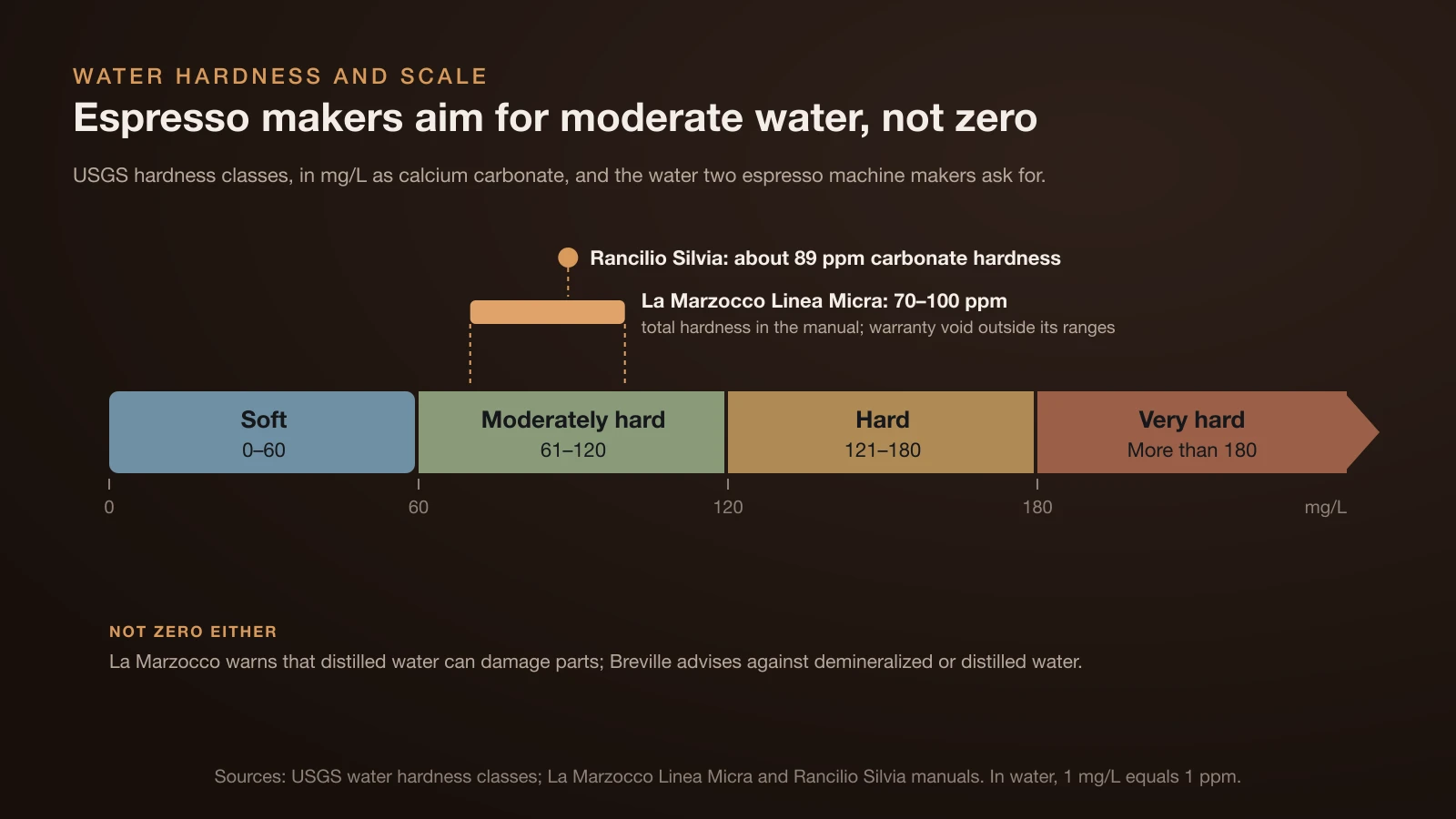
The best way to prevent scale is to know your water hardness and treat the water before it reaches the tank. The USGS classifies hardness, measured as calcium carbonate, like this:
| USGS class | Hardness (mg/L as calcium carbonate) |
|---|---|
| Soft | 0–60 |
| Moderately hard | 61–120 |
| Hard | 121–180 |
| Very hard | More than 180 |
Espresso makers aim for the moderate zone rather than zero. La Marzocco’s Linea Micra manual asks for total hardness of 70–100 ppm (parts per million) and total dissolved solids of 90–150 ppm, and says the warranty is void if water falls outside its ranges. Rancilio’s Silvia manual targets about 89 ppm of carbonate hardness.
Don’t swing to the other extreme. La Marzocco warns that distilled water can damage parts through leaching and can trigger “reservoir empty” alerts on machines that sense water by its minerals. Breville advises against highly filtered, demineralized or distilled water.
Practical steps:
- Find your hardness from your local water supplier or a test kit, as Rancilio suggests.
- Set the hardness level on machines that ask for it, such as De’Longhi’s.
- Replace tank filters on time. Breville says every two months on the Barista Express, or more often in hard water.
- Ask about filters on bigger machines. Jura, for its super-automatics, says descaling is not necessary when its filter is changed after 50 liters or two months.
Signs your espresso machine needs descaling
Your espresso machine likely needs descaling when shots run cooler, slower or taste different even though your coffee and recipe have not changed.
- Coffee is not as hot as usual, one of three signs De’Longhi lists.
- Crema looks thinner or less consistent (De’Longhi).
- Flavor changes with the same beans and grind.
- Flow slows or the machine seems weaker, which Breville links to scale.
- The brew group does not heat properly, the signal Profitec gives for considering a descale.
- The descale light comes on.
Slow flow can also come from coffee oils or a grind that is too fine, so rule those out first. On machines with a gauge, our guide to the espresso machine pressure gauge explains what a normal reading looks like.
Descaling mistakes to avoid
Most descaling problems come from using the wrong product or cutting the rinse short.
- Using a descaler your manual forbids. Gaggia and De’Longhi both limit you to their own product.
- Leaving the water filter in, where it soaks up the solution.
- Emptying or removing the tank mid-cycle on Breville machines.
- Skipping rinse tanks, which leaves solution for your next drink.
- Spilling descaler on the counter. De’Longhi warns it can damage delicate surfaces, so wipe spills immediately.
- Improvising on a big boiler. If your HX or dual boiler manual has no descale routine, ask the dealer or a technician.
The bottom line
To descale an espresso machine, use the descaler your manufacturer names, remove the water filter, run the solution through the group, steam wand and hot water outlet, then rinse with fresh water until it tastes clean. Do it every 2–3 months or when the machine asks. On large dual boiler and heat exchanger machines, soft water that meets the maker’s specification is the better long-term fix.
Sources
- Breville: Barista Express BES870, Bambino Plus BES500 and Dual Boiler BES920 instruction books, and How to clean an espresso machine (scale effects, 1 sachet per 1 L, 25/13/8 second cycles, 0.5 L left, 2 L container, cooling, 1.5 hour boiler descale, 90-day or 40 L filter, 1:1 vinegar option, remove the filter, no distilled water)
- De’Longhi and Gaggia: Dedica EC685 instructions, How to descale a coffee machine, Decalk Care descaler and Gaggia’s Classic Pro operating instructions (descaler-only rules, vinegar and citric acid, 25 and 30–50 minutes, hardness setting, signs, lactic acid 100 ml dose; every 2 months, 150 ml cups, 20 and 3 minute rests, 4 rinse tanks)
- La Marzocco: Water for home espresso machines, the dirty solenoid, home warranty and Linea Micra manual (no need to descale with proper water, scaling excluded from warranty, 2-month steam boiler drain, 36 hours, distilled water, 70–100 ppm hardness and 90–150 ppm TDS)
- Other makers: Profitec cleaning and care, Rancilio Silvia user manual (about 89 ppm), Rocket water reservoir filter, Jura maintenance FAQ (50 liters or two months) and Urnex FAQ and descaling powder (cleaning vs descaling, vinegar, every 3 months)
- U.S. Geological Survey: Hardness of water (calcium and magnesium, calcium carbonate scale, hardness classes)