To backflush an espresso machine, lock a portafilter fitted with a blind basket into the group head, run the pump for about 10 seconds, stop, and repeat. When the pump stops, the trapped water rushes back through the group and out the three-way valve into the drip tray. Add espresso machine detergent for the deeper weekly clean.
Backflushing is one part of the wider routine in our guide on how to clean an espresso machine. Here we go deeper: how it works, which machines can take it, the routines manufacturers publish and the safety points that matter.
The short answer
| Question | Answer |
|---|---|
| What it does | Sends water, with or without detergent, back through the group head and three-way valve to clear coffee oils |
| What you need | A blind basket or the maker’s cleaning disc, espresso machine detergent, a towel |
| Water-only backflush | Pump on for about 10–15 seconds, off, and repeat until the water runs clean |
| Detergent backflush | Up to 1/2 teaspoon (3 g) of powder; 10 seconds on, 10 off, 5 times; then 5 rinse cycles (Urnex) |
| How often at home | Water daily or after each session; detergent about weekly (Rocket, La Marzocco) |
| Never backflush | Any machine whose manual has no backflush step, such as La Pavoni lever machines |
What is backflushing?
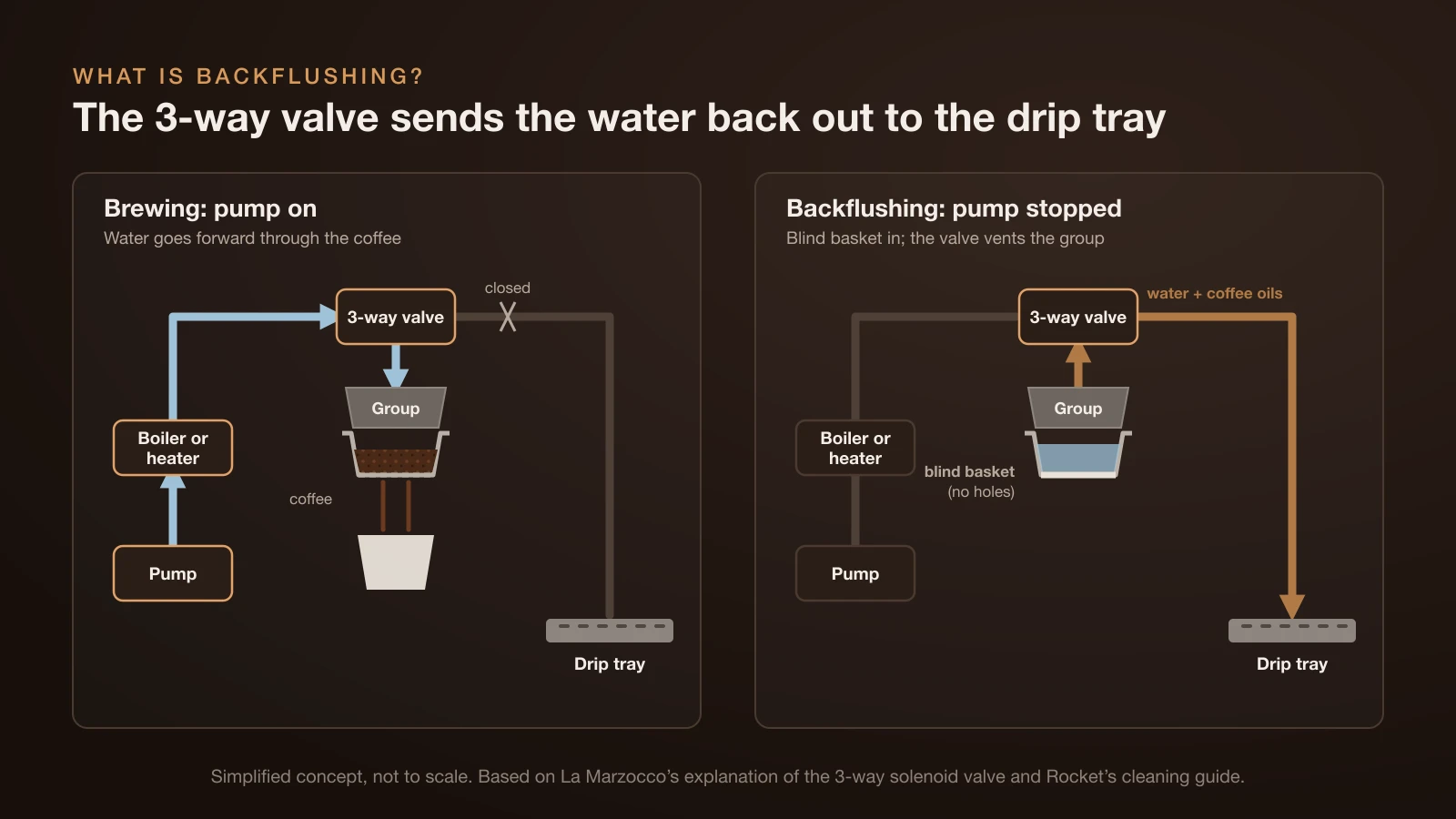
Backflushing is a cleaning method that forces water backward through an espresso machine’s group head instead of forward through the coffee. A blind basket, which has no holes, blocks the normal exit. The pump pressurizes the space above the blank basket, and when you stop the pump, the machine vents that water back up through the group.
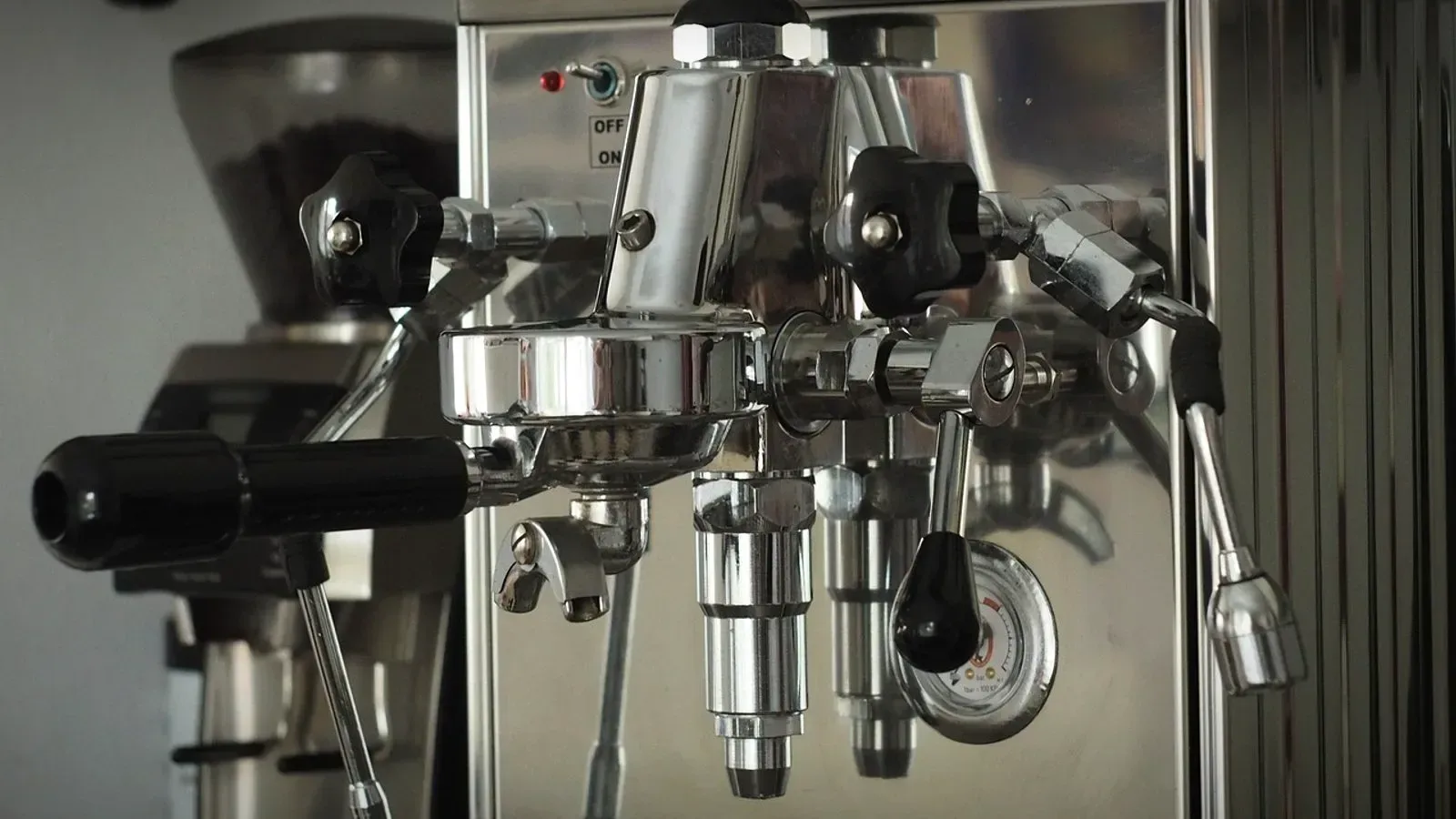
The part that makes this possible is the three-way solenoid valve. La Marzocco describes it as the valve that depressurizes the group at the end of every shot and diverts the leftover water into the drip tray, which is why you can remove the portafilter right away. Rocket’s cleaning guide explains the backflush the same way: fresh water is pushed back through the head and out through the exhaust solenoid.
Coffee oils build up in the shower screen, the group and that valve. Rocket warns that old oils turn rancid and taint the flavor of every shot, and stale buildup is a common cause of bitter espresso. La Marzocco adds a mechanical reason: the valve must stay clean so that the flow rate stays the same.
Which espresso machines can you backflush?
You can backflush an espresso machine only if its maker designed it for that, which usually means a three-way solenoid valve and a backflush step in the manual. Machines built for it include Rocket’s E61 models, the Rancilio Silvia and La Marzocco’s home machines, plus Breville grinder machines that run an automatic cleaning cycle.
| Machine | Backflush? | Manufacturer guidance |
|---|---|---|
| Rocket E61 machines (Giotto, Cellini) | Yes | Daily with water, weekly with detergent |
| Rancilio Silvia | Yes | Manual lists a group solenoid valve and a detergent backflush |
| La Marzocco Linea Micra | Yes | Manual has a detergent backflush; the app can automate it |
| Breville Barista Express and Barista Pro | Yes, as a cycle | Cleaning disc plus a tablet when the machine asks |
| La Pavoni lever machines | No | Do not use the blind filter on the group head |
| De’Longhi Dedica | No step in the manual | Rinse the spouts with water every 200 coffees instead |
| Gaggia Classic Pro | No step in the manual | No backflush described; check with Gaggia first |
Lever machines are the clearest case: La Pavoni warns that a blind filter on the group head can damage the machine and says to clean the parts with warm water and a neutral detergent instead. Kettle-fed hand presses have no pump or valve at all; see lever espresso machines and manual espresso machines for their care.
Some popular pump machines simply skip the step. De’Longhi’s Dedica manual asks you to run about 17 oz (0.5 L) of water through the spouts every 200 coffees instead, and Gaggia’s Classic Pro manual and maintenance page describe no backflush. Capsule machines and super-automatics have no portafilter at all, so they rely on their own cleaning programs.
What you need to backflush
A backflush needs only a few simple tools, and machines that support it usually include the key one in the box.
- A blind basket or cleaning disc. Rocket’s blind filter is a basket with no holes; Breville’s cleaning disc sits inside a normal basket.
- Espresso machine detergent. Rancilio says tablets or powder both work.
- A group brush. Brush the gasket area, but Rancilio’s manual warns not to brush the shower screen itself.
- An empty drip tray, because all the discharged water ends up there.
How to backflush with water only
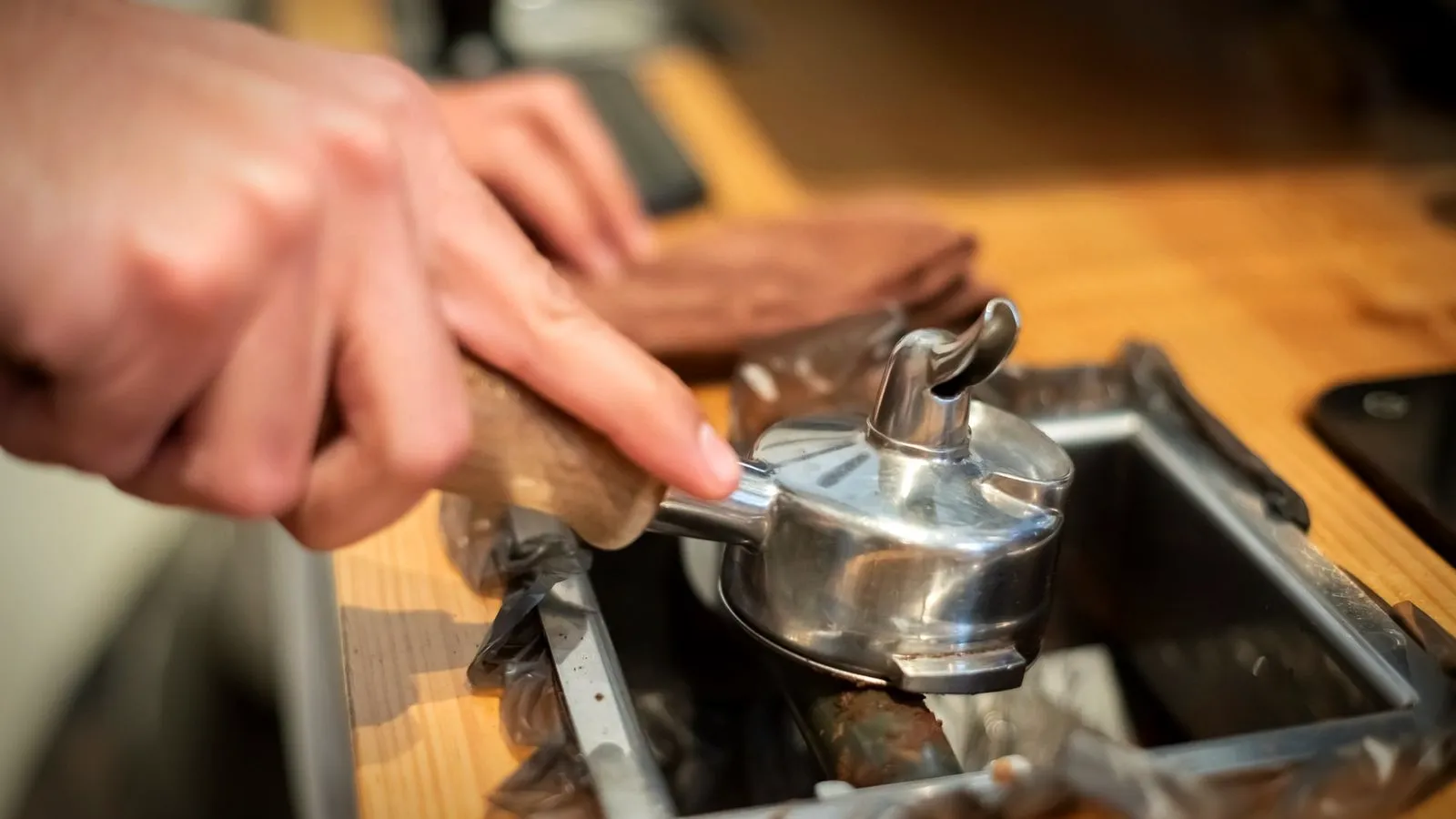
A water-only backflush rinses loose grounds and fresh oils out of the group, and it is the quick, frequent version of the job. Rocket’s guide for its E61 machines sets out the routine:
- Brush loose grounds off the group gasket.
- Fit the blind basket in the portafilter and lock it into the group head.
- Run the pump for about 15 seconds, then switch it off. Water discharges into the drip tray.
- Remove the portafilter and empty the water sitting in the blind basket.
- Repeat until the water comes out clean. La Marzocco’s home team suggests 5–7 repetitions.
- Refit your normal basket and run hot water through it a few times, as La Marzocco’s Linea Micra manual describes.
Breville recommends a clear water backflush after each brewing session on the Barista Express and shows the steps in a tutorial video.
How to backflush with detergent
A detergent backflush dissolves the coffee oils that water alone leaves behind, and most home guides schedule it about once a week. Urnex, which makes Cafiza espresso machine cleaner, publishes this routine for its powder:
- Add detergent. Put the blind basket in the portafilter and add up to 1/2 teaspoon (3 g) of powder.
- Pulse the pump. Lock the portafilter in, run the pump for 10 seconds, then stop for 10 seconds. Do this 5 times.
- Rinse the portafilter. Take it out, start the pump and rinse the portafilter in the stream from the group head.
- Rinse the group. Lock the portafilter back in without detergent and repeat the 10-on, 10-off pattern 5 more times.
- Pull one shot and pour it away. Swap back to your normal basket, make an espresso and discard it; Urnex says not to drink it.
Manufacturer routines compared
Manufacturers use different timings, but every routine follows the same pattern: short pulses, a pause so the valve can vent, and plenty of plain-water rinsing.
| Source | Detergent | Pump on | Detergent cycles | Rinse |
|---|---|---|---|---|
| Urnex (Cafiza powder) | Up to 1/2 tsp (3 g) | 10 s, then 10 s off | 5 | 5 cycles, then discard one shot |
| Rancilio (Silvia weekly guide) | Tablets or powder | 5 s, then 10 s off | 8–10, until clear | 8–10 cycles |
| La Marzocco home team | 1/4 tsp | 8–10 s on and off | 8–10 | 5–7 water-only cycles |
| La Marzocco Linea Micra manual | As the product directs | About 15–20 s | Until the water runs clear | Hot water through a normal basket |
| Rocket (Giotto, Cellini guide) | A small amount | About 15 s | Until it runs clean | Backflush again with plain water |
Where the amount is left to the product, follow the label, as Rancilio’s manual instructs.
Machines with an automatic backflush cycle
Some machines automate the backflush with a built-in cleaning cycle, so you load a tablet and press a button. Breville’s manual for the Barista Express calls its cleaning cycle a back-flushing cycle that is separate from descaling:
- When the Clean/Descale light flashes, put the 1 CUP basket in the portafilter, then the cleaning disc, then one cleaning tablet.
- Lock it in, place a large container under the spouts, fill the tank with cold water and empty the drip tray.
- Switch the machine off, then hold the 1 CUP, 2 CUP and POWER buttons together for about 10 seconds.
- The cycle runs for about 5 minutes and ends with 2 beeps. If the tablet hasn’t fully dissolved, run it again.
The Barista Pro shows a FLUSH alert and starts the same kind of cycle from its menu, and the Bambino Plus asks for one after 200 extractions. For how the Express and Pro differ in other ways, see our Breville Barista Express vs Pro comparison. La Marzocco’s app can also run an automated backflush of about two minutes on connected Linea Micra, Linea Mini and GS3 machines, after you fit the blind basket and detergent.
How often should you backflush?
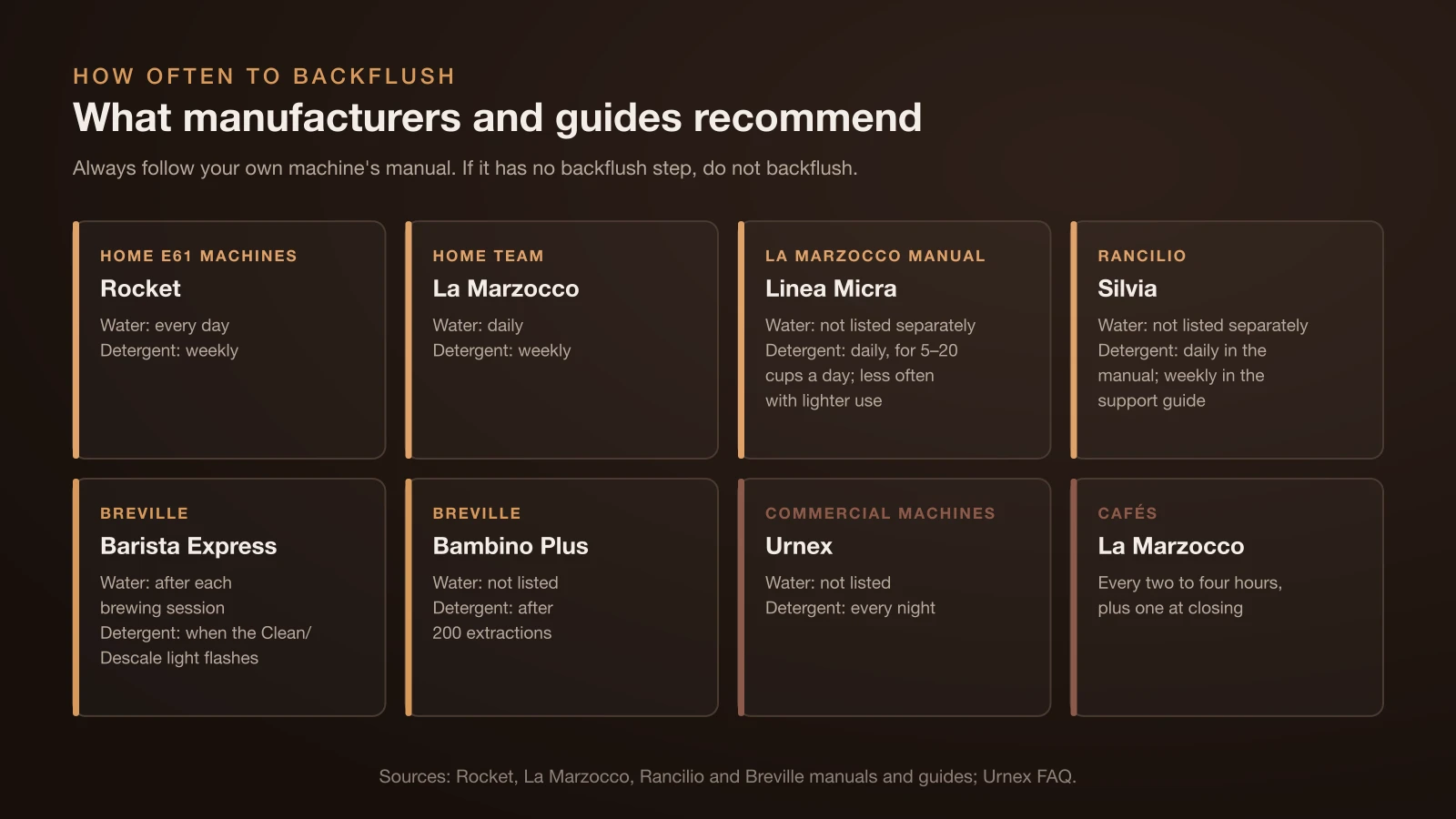
How often you should backflush depends on how much you use the machine, but most home guidance is water daily and detergent weekly.
| Source | Water only | With detergent |
|---|---|---|
| Rocket (home E61 machines) | Every day | Weekly |
| La Marzocco home team | Daily | Weekly |
| La Marzocco Linea Micra manual | Not listed separately | Daily, for 5–20 cups a day; less often with lighter use |
| Rancilio Silvia | Not listed separately | Daily in the manual; weekly in Rancilio’s support guide |
| Breville Barista Express | After each brewing session | When the Clean/Descale light flashes |
| Breville Bambino Plus | Not listed | After 200 extractions |
| Urnex, commercial machines | Not listed | Every night |
Cafés clean far more often because their groups run all day. La Marzocco’s café guidance goes as far as a backflush every two to four hours plus one at closing; our guide to commercial espresso machines covers the full café routine.
After the backflush: rinse, soak and reset
After a detergent backflush, rinse until no detergent is left, then clean the parts that the backflush cannot reach.
- Rinse until clear, with no suds in the blind basket, then pull and discard one shot.
- Soak the metal parts. Urnex’s soak uses 6 g of powder per 34 oz (1 liter) of hot water for 30 minutes, with the portafilter handle kept out.
- Clean the shower screen. The Linea Micra manual has you remove it and soak it in detergent solution as part of daily cleaning.
- Empty and wash the drip tray, which now holds the dirty discharge.
Descaling is a different job with its own schedule and products. Once everything is back in place, our guide on how to use an espresso machine walks through the first shot of the day.
Backflushing safety: hot water and detergent
Backflushing sends pressurized hot water back through the machine and uses a chemical cleaner, so a few precautions matter.
- Never remove the portafilter while the pump runs. La Marzocco’s manual warns that water above 52 °C (125 °F) can cause severe burns instantly.
- Expect pressure. Rocket notes that with a blind basket, pressure builds up and the water is very hot.
- Protect your eyes and skin. Urnex’s safety data sheet says Cafiza causes serious eye irritation and advises gloves, eye protection and keeping it out of reach of children.
- Empty the drip tray first, as Rancilio’s manual stresses.
- Unplug for other jobs. The Linea Micra manual says to switch off and unplug for any cleaning other than backflushing the group.
Common backflushing mistakes
Most backflushing problems come from skipping a step or using the method on the wrong machine.
- Backflushing a machine that isn’t built for it. If your manual has no backflush step, don’t improvise one.
- Using too much detergent. Urnex’s limit is 1/2 teaspoon; more just takes longer to rinse out.
- Skipping the rinse, which leaves detergent for your next shot.
- Using a normal basket. Without a blind basket, water simply runs out of the spouts and nothing flows back through the valve.
- Treating it as descaling. Urnex defines cleaning as removing coffee oils and descaling as removing mineral build-up; one does not replace the other.
The bottom line
A backflush is simple: blind basket in, short pump pulses, let the three-way valve vent, then rinse well. Do it with water daily or after each session and with detergent about weekly, or run your machine’s built-in cycle when it asks. If your manual has no backflush step, skip it and clean the group by hand instead.
Sources
- Urnex: Cafiza cleaning powder, FAQ and Cafiza safety data sheet (3 g dose, 10 second cycles, rinse, soak, nightly café cleaning, vinegar, handling precautions)
- La Marzocco: Linea Micra manual, 3-way solenoid valve, the dirty solenoid, backflushing in 5 steps and app cleaning and backflush (valve, timings, schedules, burn warning, automated cycle)
- Breville: Barista Express BES870, Barista Pro BES878 and Bambino Plus BES500 instruction books and clear water backflush tutorial (cleaning cycles and prompts)
- Rancilio: Silvia user manual and Silvia weekly cleaning guide (solenoid valve, 5 and 10 second cycles, drip tray, shower screen)
- Other manufacturer guides: Rocket How to clean your Giotto or Cellini (archived), La Pavoni instruction manual, De’Longhi Dedica EC685 instructions, Gaggia Classic Pro instructions and semi-automatic maintenance