
A conical vs flat burr grinder comparison comes down to geometry: conical burrs are a cone turning inside a ring, while flat burrs are two parallel discs. Both crush beans to an adjustable size, and both can grind well for espresso and filter. Burr shape affects grind speed, retention and taste only together with the burr design, alignment and motor.
That is why the grinder’s specs matter more than the label. Our espresso grinder guide covers the full buying checklist, from adjustment steps to portafilter fit.
Still deciding whether you need burrs at all? Our burr grinder vs blade grinder comparison explains why a spinning blade cannot match either shape.
The short answer
| Conical burrs | Flat burrs | |
|---|---|---|
| Shape | Cone-shaped inner burr inside a ring-shaped outer burr | Two parallel ring-shaped discs, one fixed and one turning |
| How grounds leave | Downward, through the gap at the bottom | Outward, from the center to the edge of the discs |
| Particle sizes | A mix of fines and larger particles | Also a mix of fines and larger particles |
| Taste, as commonly described | More body and texture | More clarity and separation |
| Retention | Depends on chute and chamber design | Depends on chute and chamber design |
| Home examples | Fellow Opus 2, Niche Zero, Turin DC63, hand grinders | Baratza Vario+, Turin DF64V, Fellow Ode Gen 2 |
| Espresso | Yes, with an espresso range | Yes, with an espresso range (not every model) |
Conical vs flat burr grinder: how the burrs are built
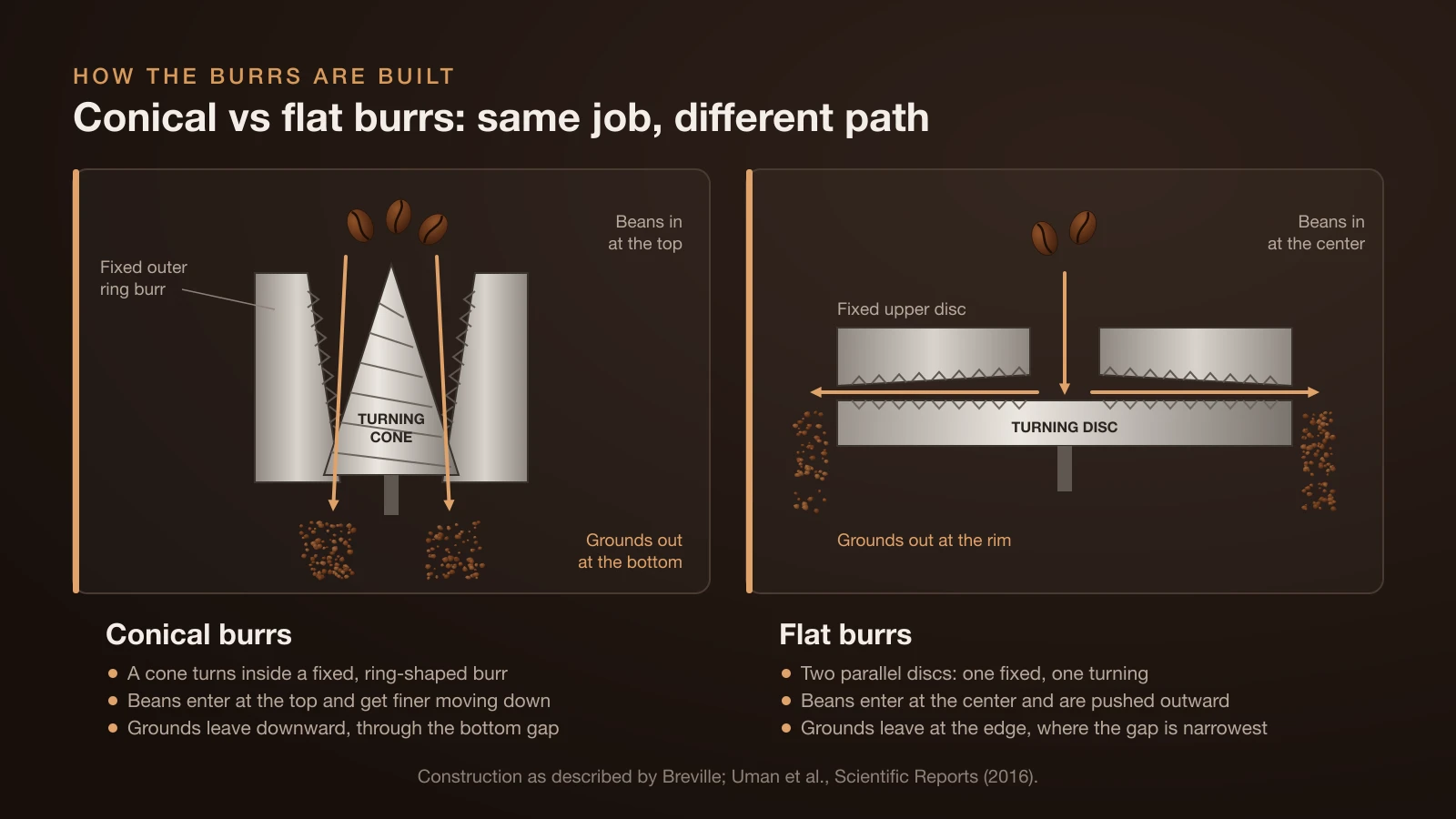
Conical and flat burrs both work by trapping beans between a turning burr and a fixed one, then crushing them through a gap you set. Breville describes conical burrs as two cone-shaped burrs with ridges, one stationary and one rotating, and flat burrs as two horizontally mounted burrs with the same arrangement. The gap between the burrs sets the grind size in both designs.
Conical burrs
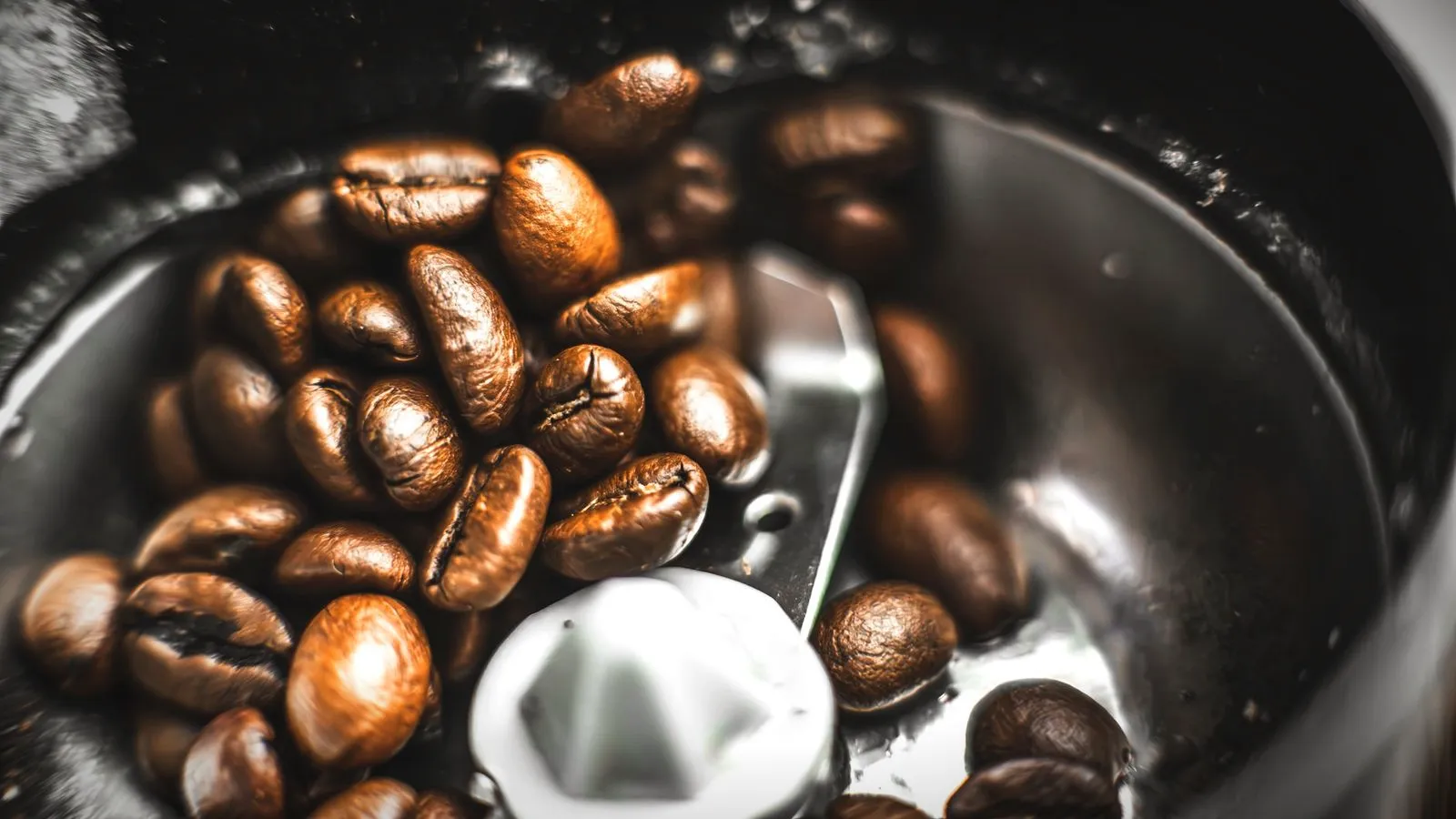
In a conical grinder, the inner cone sits inside the outer ring. Beans drop in from the top, get cracked into pieces by the coarse upper teeth, and are ground finer as they move down toward the narrowest gap. The grounds leave through the bottom, which Breville describes as a gravity-chute feed.
Flat burrs
In a flat grinder, beans enter at the center of the discs. The turning burr pushes the pieces outward, and they get finer as they travel toward the edge, where the gap is narrowest. A 2016 study in Scientific Reports used a flat burr Mahlkönig EK 43 and noted that its two grinding discs can become misaligned, meaning not perfectly parallel, which changes the spread of particle sizes.
Grind consistency: does burr shape change particle size?
Burr shape is only one influence on the particle mix, because every burr grinder produces fines along with larger particles. No peer-reviewed study comparing conical and flat burrs head to head was found for this guide, so claims that one shape is “unimodal” and the other “bimodal” are left out here.
What the research does show applies to both shapes:
- Even flat burrs make two groups of particles. In the Scientific Reports study, the flat burr EK 43 produced a distinctly bimodal grind: fine particles supplied most of the surface area, while larger particles one to two orders of magnitude bigger were also present.
- Espresso grinds split around 100 microns. A 2020 study in the journal Matter found “boulders” larger than 100 microns and “fines” smaller than 100 microns. At one espresso setting, 99% of the particles were under 100 microns and made up 80% of the surface area.
- Alignment changes the spread. The same 2016 study notes that misaligned burrs give a different particle size distribution, and its authors used the grinder that a Q-grader judged to be pulling sellable shots that day.
Turin, which sells both shapes, puts it plainly on its DC63 page: burr shape and cutting geometry influence how coffee is ground, but the beans and recipe remain central. For espresso, the shot clock is the real test, which is why espresso grind size is judged by time and taste rather than by eye.
Retention, heat, speed and noise
Conical and flat burr grinders differ in retention, heat, speed and noise mainly through motor and chamber design, not through burr shape alone.
Retention
Retention is the coffee left inside the grinder after a dose. Single-dose grinders of both shapes now aim to keep it low. Niche lists zero retention for its conical Niche Zero, Fellow says the conical Opus 2 uses an internal impeller for near-zero retention, and Fellow describes its flat Ode Gen 2 as low retention, with anti-static technology and a built-in knocker. Turin fits its flat DF64V with bellows and a plasma ion generator to clear the chamber and reduce static.
Heat
Heat matters because warm burrs change the grind. The Scientific Reports authors found that colder beans ground finer and more evenly, with the biggest change between room-temperature and frozen beans at −19 °C (about −2 °F). They suggest this explains why cafés grind finer as the day goes on: as the burrs warm up, the particle size distribution shifts, and simply grinding finer does not fully undo it.
Speed
Motor speed is set by the grinder, not the burr shape. In the 2016 study, the flat burr EK 43 ran at 1,480 rpm. Turin’s flat DF64V Gen 3 offers variable speed up to 1,800 rpm, and Turin calls a lower speed an option to explore, not a promise of better extraction.
Noise
Noise depends on the motor, the housing and the beans, and few makers publish a figure. Niche lists 72 dB during grinding for the Niche Zero. Fellow describes the Ode Gen 2 as engineered to reduce grind noise but gives no decibel figure, so maker data cannot settle which shape is quieter.
Burr sizes: maker spec examples
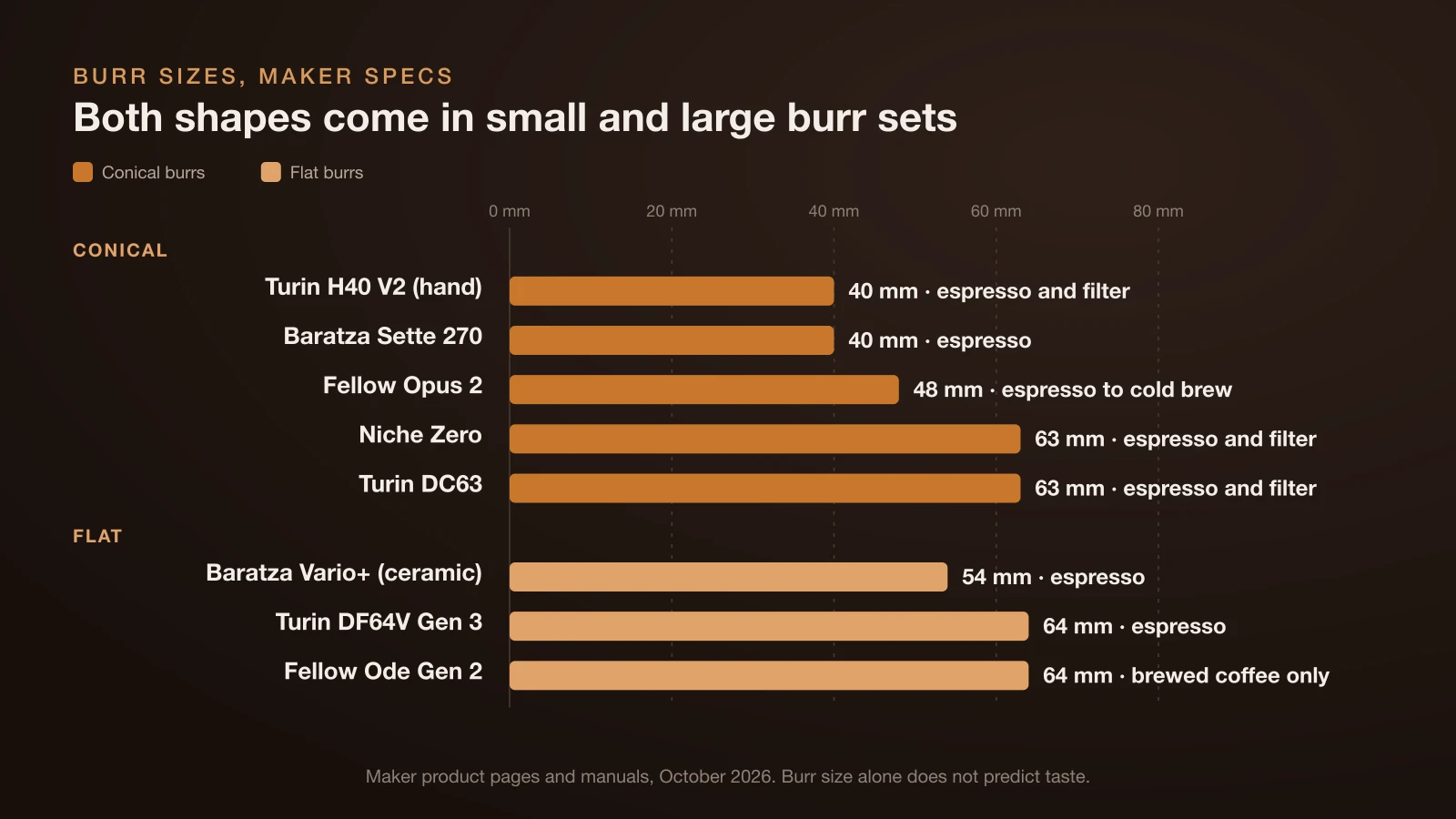
Burr diameter is listed on most spec sheets, and conical and flat grinders both come in a wide range of sizes. These examples come from each maker’s own product pages and manuals; they are not a ranking.
| Grinder | Burr shape | Burr size | Made for |
|---|---|---|---|
| Turin H40 V2 (hand) | Stainless steel conical | 40 mm | Espresso and filter |
| Baratza Sette 270 | Conical | 40 mm | Espresso to manual brew |
| Fellow Opus 2 | Stainless steel conical | 48 mm | Espresso to cold brew |
| Niche Zero | Conical | 63 mm | Espresso and filter |
| Turin DC63 | Red Titanium-coated conical | 63 mm | Espresso and filter |
| Baratza Vario+ | Ceramic flat | 54 mm | Espresso, with a portafilter holder |
| Turin DF64V Gen 3 | Red Titanium flat espresso burrs | 64 mm | Espresso |
| Fellow Ode Gen 2 | Stainless steel flat | 64 mm | Brewed coffee only |
Some makers do not list a diameter at all. Breville, for example, describes the Smart Grinder Pro’s burrs only as stainless steel conical burrs. Burr size alone does not tell you how a grinder performs in the cup.
Single dose flat burr grinders
A single dose flat burr grinder grinds only the beans you weigh out for one drink, instead of feeding from a full hopper. You weigh the beans, pour them in and grind until the chamber is empty. This suits anyone who switches between beans or decaf, because there is no hopper to empty first.
Turin’s DF64V Gen 3 is one example: a 64 mm flat burr grinder with a stepless dial, a slow-feed arrangement for bean entry and a metal dosing cup. The Fellow Ode Gen 2 offers single dose loading with 64 mm flat burrs, but for brewed coffee only. On the conical side, the Niche Zero and Turin DC63 work the same way.
Single dosing only works well when little coffee stays behind. Turin advises comparing the dose in with the grounds out while you establish a routine, because retention varies with beans, humidity and grind setting.
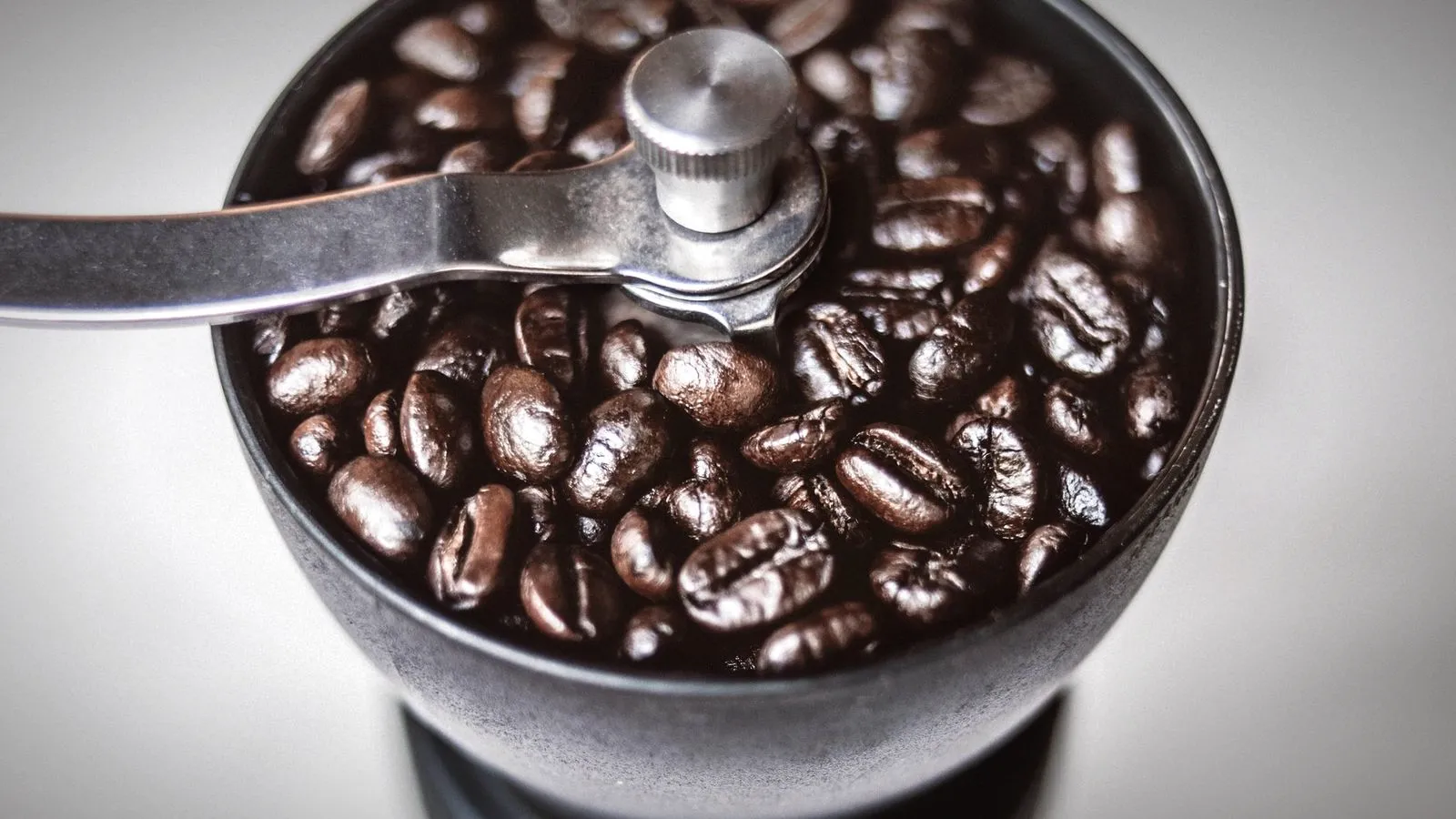
Flat burr hand grinders
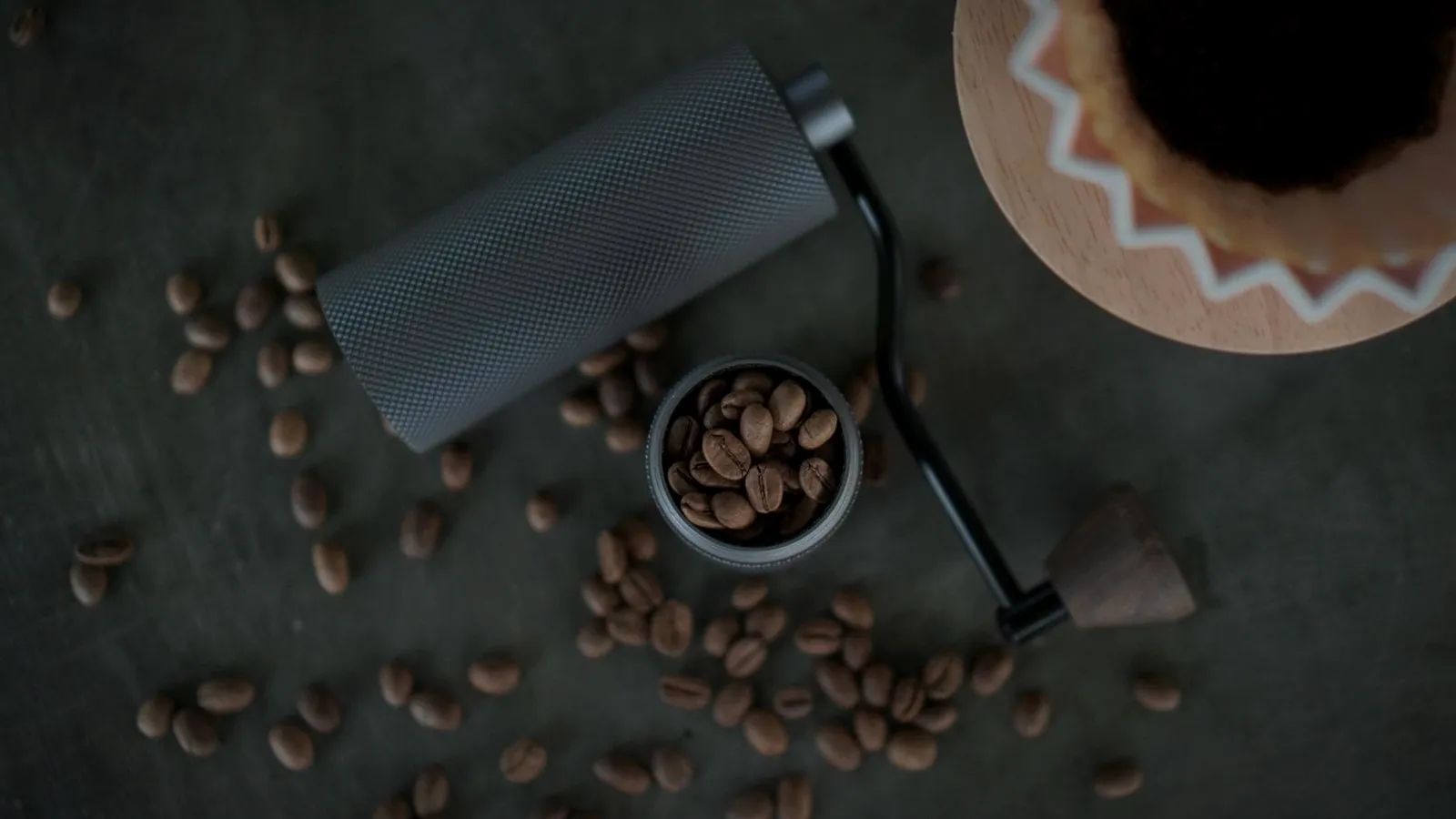
A flat burr hand grinder uses two parallel discs turned by a crank instead of a motor. Many hand grinders, such as the Turin H40 V2 with its 40 mm stainless steel conical burr, use conical burrs instead, so check the burr type on the maker’s spec sheet if you want a flat set.
Hand grinding fine takes effort. Turin notes that espresso usually demands a finer setting and more cranking effort than brewed coffee, and that dense light roasts take more work to grind finely. Look for an espresso range, small adjustment steps and a catch cup that holds a full double dose.
Flat burr espresso grinder or conical: which to choose
Choose by the grinder’s espresso range, adjustment and retention first, then let burr shape follow your taste and brewing. Both shapes can pull balanced shots, and the grind you dial in matters more than the burr geometry behind it.
| If you mostly brew | What to look for |
|---|---|
| Espresso with milk drinks | Conical or flat with an espresso range; Turin describes its DC63 conical as suited to milk drinkers who prefer a substantial texture |
| Straight espresso, light roasts | Conical or flat; flat burrs are commonly described as giving more clarity |
| Filter and pour-over only | A brew grinder, such as the flat burr Fellow Ode Gen 2, which is not intended for espresso |
| Espresso and filter | Stepless or finely stepped adjustment across both ranges |
| Travel or small budget | A hand grinder with an espresso range |
Taste descriptions such as “body” for conical and “clarity” for flat come from tasting, not from controlled studies, so treat them as a starting point. Whichever you choose, dialing in espresso on that grinder is what turns a good burr set into a good shot.
Price class follows the motor, build and features more than the burr shape, so compare grinders with similar features rather than by shape alone. If you would rather skip a separate grinder, an espresso machine with grinder has burrs built in.
The bottom line
Conical and flat burrs are two ways of doing the same job, and both make good espresso and filter coffee. Neither shape removes fines, and alignment, motor, retention and adjustment matter as much as geometry. Pick a grinder whose maker lists the range you brew in, then judge it by the shot clock and your taste.
Sources
- Peer-reviewed research: Uman et al., Scientific Reports (2016), The effect of bean origin and temperature on grinding roasted coffee (flat burr EK 43 at 1,480 rpm, misaligned discs, bimodal distribution, colder beans grind finer and narrower, −19 °C, warm burrs) and Cameron et al., Matter (2020), Systematically improving espresso (boulders and fines around 100 microns, 99% of particles, 80% of surface area)
- Turin: DF64V Gen 3 (64 mm flat espresso burrs, up to 1,800 rpm, stepless, bellows, ion generator, retention note), DC63 (63 mm conical, burr shape and recipe, milk drinks and texture) and H40 V2 (40 mm conical hand grinder, cranking effort)
- Fellow: Opus 2 (48 mm conical, near-zero retention) and Ode Brew Grinder Gen 2 (64 mm flat, not intended for espresso, single dose loading, low retention)
- Breville and Baratza: Burr grinder vs. blade grinder (conical and flat burr construction), Smart Grinder Pro (stainless steel conical burrs), Sette 270 manual (40 mm conical) and Vario+ manual (54 mm flat ceramic)
- Niche: Niche Zero (63 mm conical, single dose, zero retention, stepless dial, 72 dB)