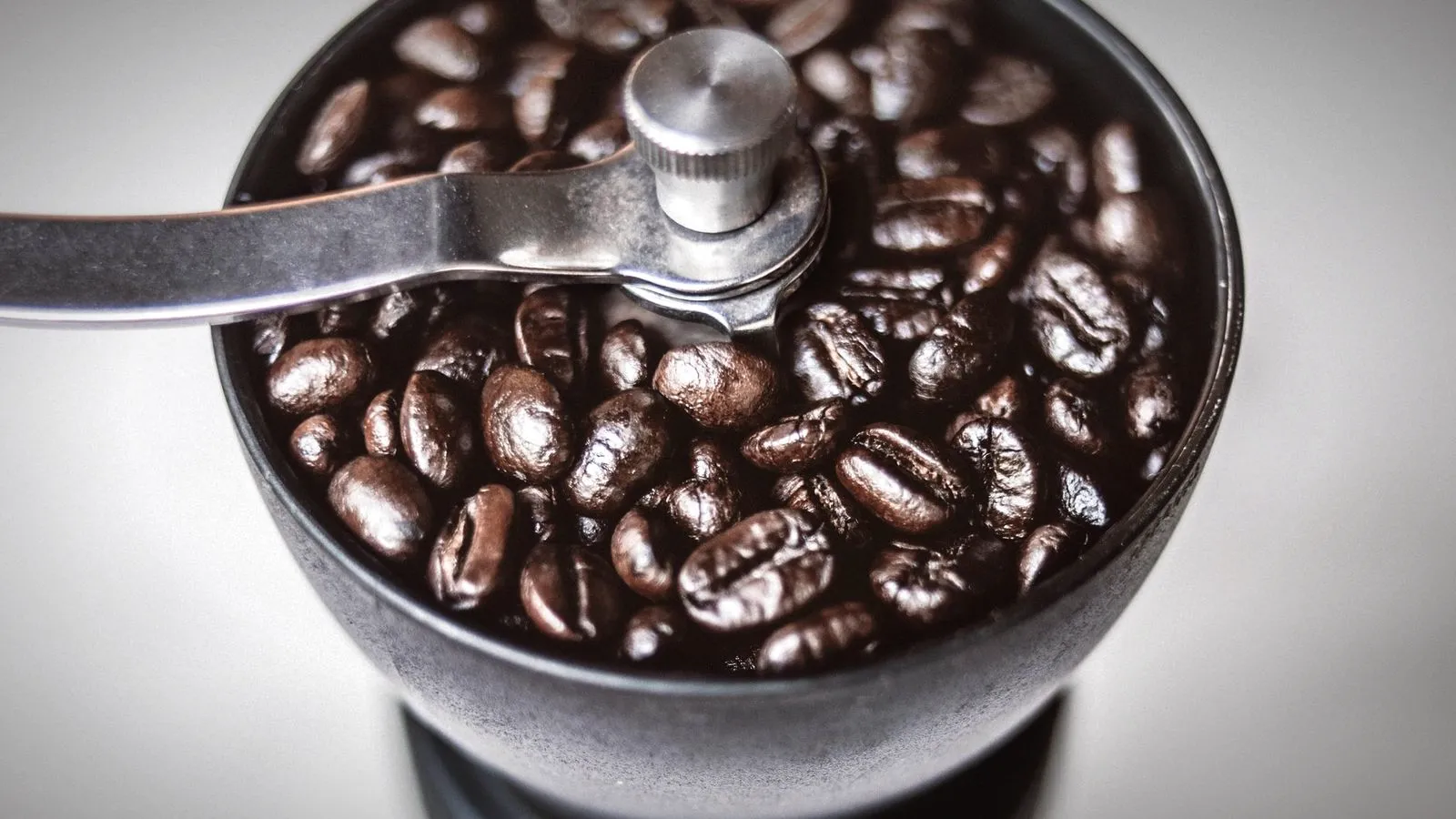

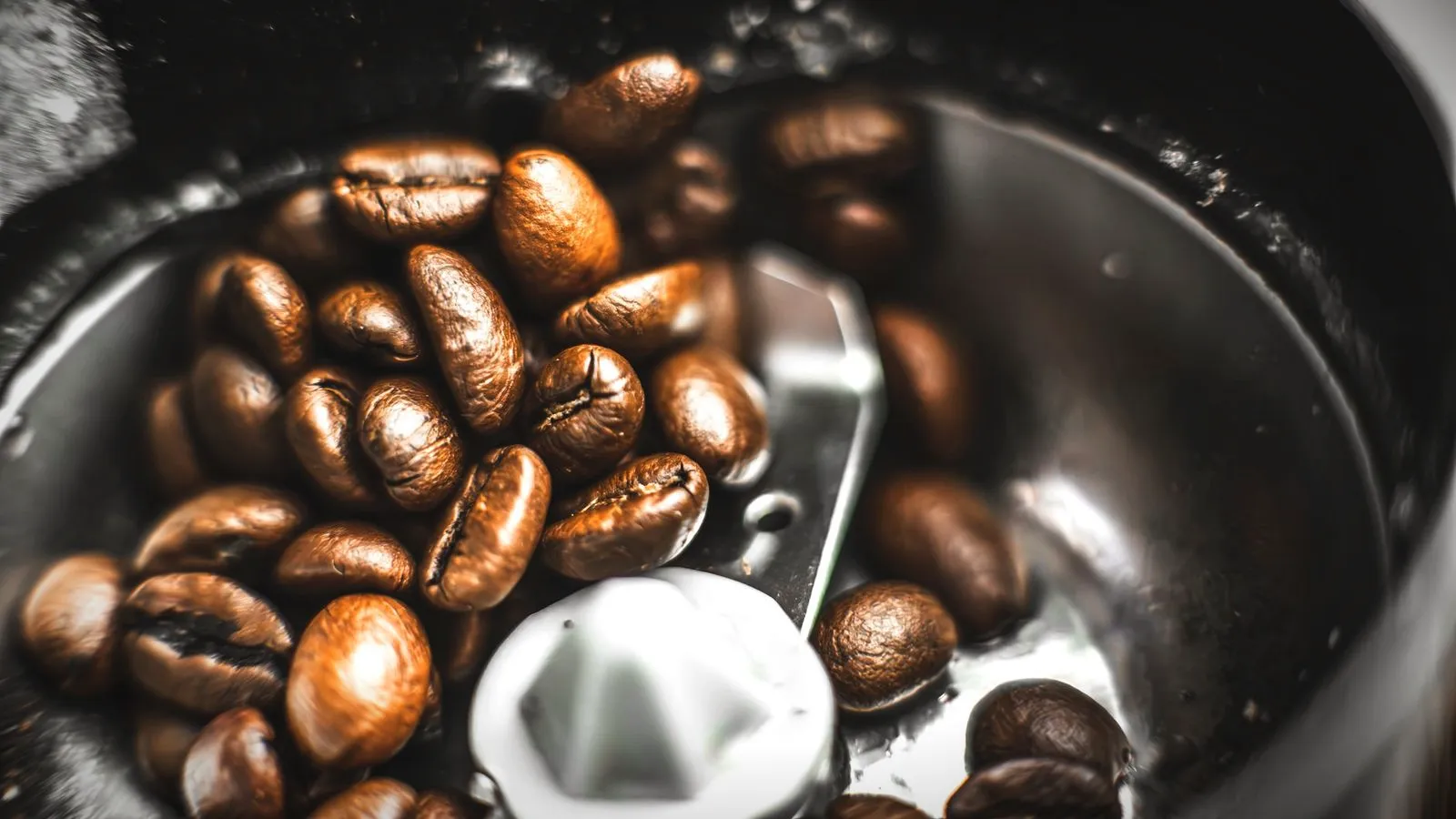
In the burr grinder vs blade grinder choice, the burr grinder wins on consistency: it crushes beans between two burrs set a fixed distance apart, so grounds come out at one adjustable size. A blade grinder chops beans with a spinning blade, and the size depends on how long it runs, leaving a mix of dust and chunks.
That consistency matters most for espresso, which brews in seconds and reacts to tiny grind changes. If you are choosing a grinder for shots, our espresso grinder guide lists what to check before you buy.
Blade grinders still have a place: they are cheaper, smaller and simple to clean. For drip or French press, a blade grinder used in short pulses can make a decent cup, while espresso needs burrs.
The short answer
| Burr grinder | Blade grinder | |
|---|---|---|
| How it grinds | Crushes beans between a turning and a fixed burr | Chops beans with one or two spinning blades |
| Consistency | Even particle size at a set gap | Mix of powder and chunks |
| Fines (dust) | Some, at every setting | Many; the longer it runs, the finer the mix |
| Adjustability | Dial or steps; repeatable | Run time only |
| Espresso capable | Yes, with an espresso range | No, not in a standard basket |
| Heat | Less likely to overheat grounds | Runs through the same beans repeatedly |
| Noise | Varies by model | Varies by model |
| Cost class | Higher; hand grinders are the low-cost entry | Lowest |
| Cleaning | Brush burrs, keep them dry | Wipe the cup and blade |
How a burr grinder and a blade grinder work
A burr grinder grinds coffee between two hard surfaces, while a blade grinder cuts it with a spinning blade, much like a small blender. The National Coffee Association (NCA) describes a burr grinder as crushing beans between a moving grinding wheel and a non-moving surface. Breville describes a blade grinder, also called a propeller grinder, as working more like a blender or food processor, with one or two blades that spin rapidly.
The key difference is what sets the grind size. In a burr grinder, it is the gap between the burrs: a bean piece cannot leave until it is small enough to pass. In a blade grinder, the NCA notes that how long you run the grinder decides how coarse or fine the grind is, so the same pulse gives different results with a full cup or a few beans.
Burrs come in two shapes, a cone inside a ring or two flat discs, and both grind far more evenly than a blade; our conical vs flat burr grinder comparison explains what the shape changes.
Burr grinder vs blade grinder: grind consistency and fines
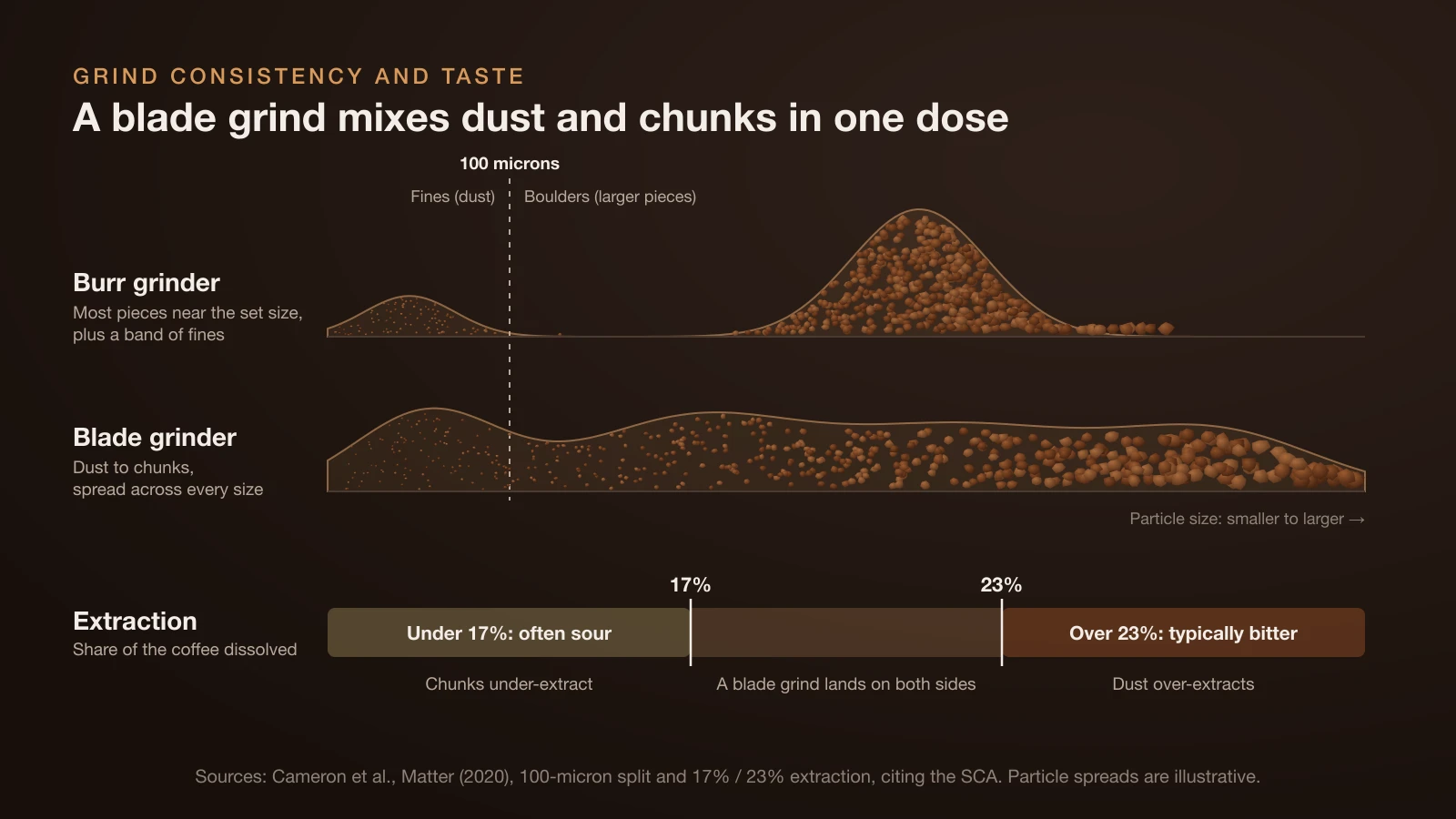
Grind consistency matters because coffee particles of different sizes extract at different speeds in the same brew. Fine particles have far more surface area for their weight, so they give up their flavor quickly, while large pieces give up theirs slowly. A blade grinder makes both in one dose, and Breville notes that its chopped grounds probably will not be uniform.
No grinder makes a single particle size. Even burr grinders produce two groups: a 2020 study in the journal Matter found espresso grounds split into “boulders” larger than 100 microns and “fines” smaller than 100 microns. A burr grinder narrows the spread around the size you set; a blade grinder widens it with every extra second.
How uneven grounds change the taste
Uneven grounds can make one cup taste bitter and sour at the same time. The coffee industry measures extraction as the share of the dry coffee that dissolves into the drink. The Matter authors, citing the Specialty Coffee Association (SCA), note that brews below 17% extraction are often sour and those above 23% typically taste bitter.
A mixed grind lands on both sides at once: the dust over-extracts toward bitter espresso flavors while the chunks stay under-extracted and push the cup toward sour espresso. With burrs, a grind change moves the whole dose finer or coarser, so you can steer the taste in one direction.
Can you use a blade grinder for espresso?
No, a blade grinder is not reliable for espresso in a standard basket. Espresso needs a fine grind, about like table salt in the NCA’s description, and it needs that grind to be uniform and adjustable in small steps. A blade grinder can produce fine powder, but not without chunks alongside it, and it cannot repeat the same result from one shot to the next.
The problem shows up on the shot clock. Breville’s extraction guide for the Barista Express puts a balanced double at 25–30 seconds; a grind full of chunks lets water rush through, while pockets of dust can clog the puck and cause uneven flow. Our guide to espresso grind size shows what a correct espresso grind looks like and how to adjust it.
Pressurized (dual-wall) baskets are the one partial exception. Breville recommends them for pre-ground coffee because the basket regulates the pressure regardless of grind. They hide some unevenness, but they do not make a blade grinder an espresso grinder.
Heat, noise and cleaning compared
Burr grinders are gentler on the coffee, while blade grinders are simpler to own. The NCA says burr grinders are less likely to overheat the grounds, which helps preserve the coffee’s oils and aromas. A blade grinder that runs longer to reach a fine grind keeps spinning through the same beans for the whole cycle.
Heat affects burr grinders too. A 2016 study in Scientific Reports found that warmer grinding shifts the particle size distribution, and its authors propose this as the reason busy cafés grind finer as the day goes on. Noise depends on the motor and the housing, and few makers publish a decibel figure for either type.
Cleaning favors the blade grinder. Breville notes that blade grinders need far less maintenance than burr grinders. A burr grinder needs its burrs brushed; Baratza recommends brushing the Encore ESP’s burrs about once a month with daily use and warns that washing them makes them rust.
How to get better results from a blade grinder
You can get a more even grind from a blade grinder by grinding less coffee at a time, in short pulses, and shaking it between them. These are practical habits rather than measured rules, and they help most for drip and French press, where the grind is coarser.
- Grind small batches. A few spoonfuls of beans move around the blade more freely than a full cup.
- Pulse instead of holding. Short bursts give large pieces a chance to fall back toward the blade.
- Shake between pulses. Tilt and shake the grinder so chunks stuck at the top reach the blade.
- Repeat the same routine. Use the same amount of beans and the same number of pulses each time, so your coffee tastes the same each morning.
- Grind right before brewing. The NCA says grinding whole beans immediately before brewing gives maximum freshness, whichever grinder you use.
- Brew coarse methods. Use the blade grinder for drip or French press, and leave espresso to burrs.
If the cup tastes muddy, the dust is the likely cause. Grinding a little coarser and brewing with a paper filter, which traps fine particles, gives a cleaner result than a metal mesh.
Manual burr grinder: the low-cost alternative
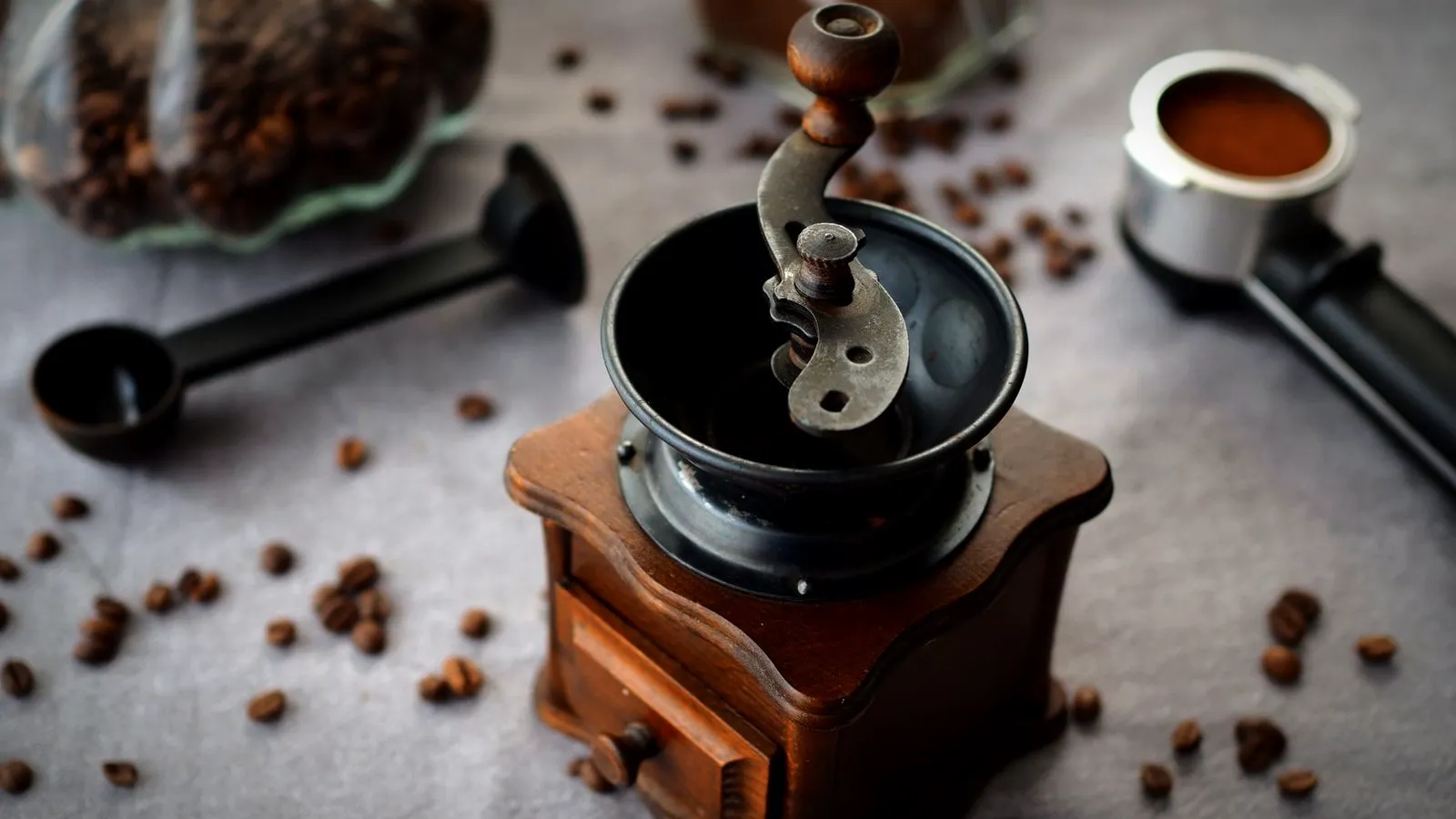
A manual burr grinder is the lowest-cost way to get burr consistency, because a hand crank replaces the motor. You load the beans, turn the handle and get the same burr-gap control as an electric burr grinder, with no outlet and little noise.
Turin’s H40 V2, for example, is a hand grinder with a 40 mm stainless steel conical burr and a catch cup that doubles as a 58 mm dosing cup. Turin notes the catch: espresso usually demands a finer setting and more cranking effort than brewed coffee, and dense light roasts take more work to grind finely.
For one or two cups a day, that effort is often a fair trade for burr quality. Before buying, check that the maker lists espresso in the grind range if you plan to pull shots, and that the catch cup holds a full double dose.
Which grinder suits each brew method
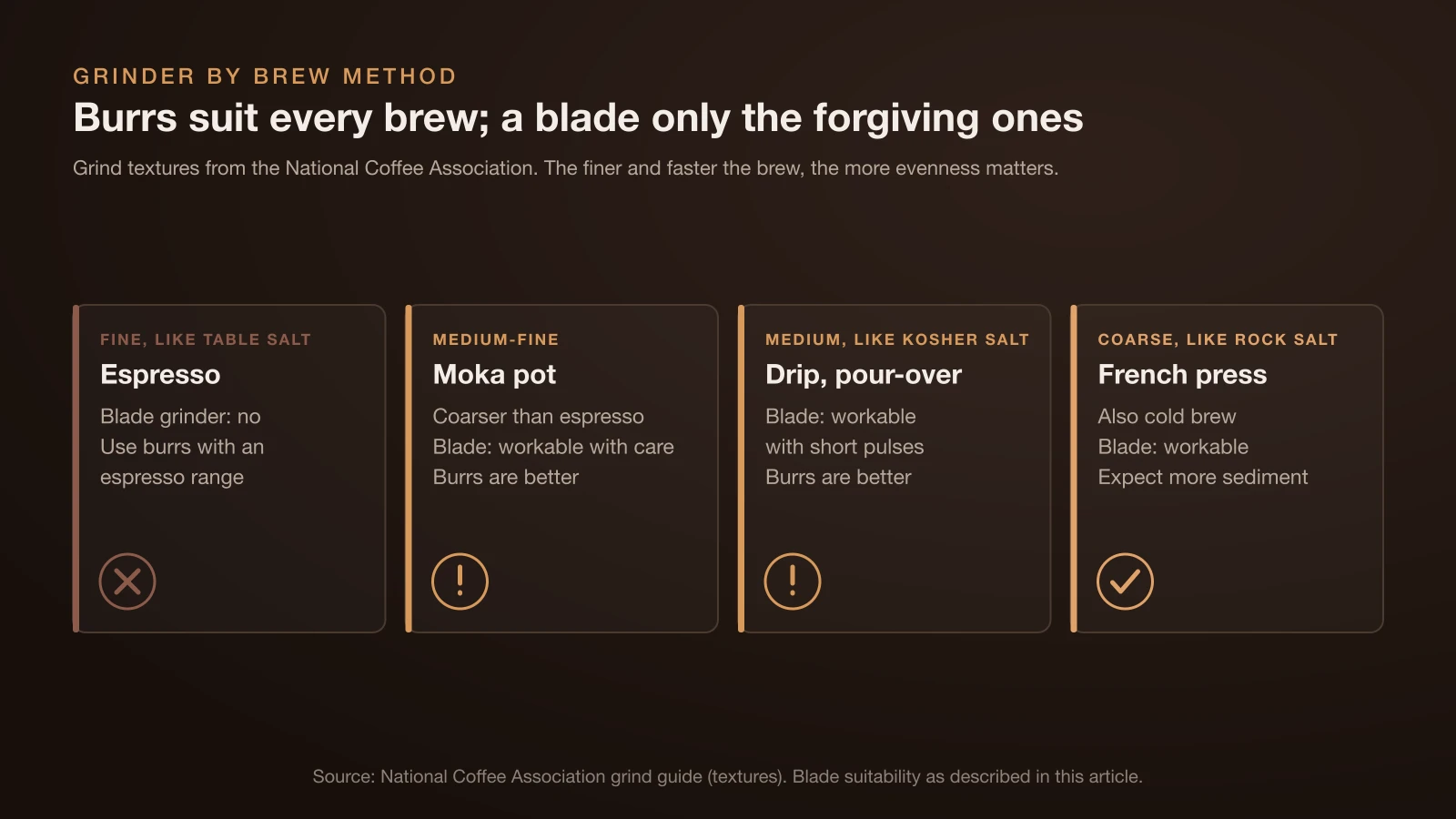
A burr grinder suits every brew method, while a blade grinder is acceptable only for the coarser, more forgiving ones. The NCA’s grind guide links espresso, drip and French press to a salt-like texture, which shows how much precision each one asks for.
| Brew method | Grind texture | Blade grinder? |
|---|---|---|
| Espresso | Fine, like table salt | No; use burrs with an espresso range |
| Drip and pour-over | Medium, like kosher salt | Workable with pulses; burrs are better |
| French press and cold brew | Coarse, like rock salt | Workable; expect more sediment |
| Moka pot | Medium-fine, coarser than espresso | Workable with care; burrs are better |
Moka pots sit between espresso and drip. Our guide to coffee for a moka pot covers the grind, and moka pot vs espresso explains why a moka pot still is not an espresso machine.
The bottom line
A burr grinder gives you a set, repeatable grind size, and that consistency is what lets you control taste. A blade grinder is cheaper and easy to clean, but its mix of dust and chunks limits it to drip and French press, used in short pulses. For espresso, choose burrs; a manual burr grinder is the low-cost way in.
Sources
- National Coffee Association: Espresso (burr grinder crushes between a moving wheel and a non-moving surface, more consistent grind, less likely to overheat, blade run time sets the grind, recommendation for burrs, grind just before brewing, grind descriptions from table salt to rock salt)
- Breville: Burr grinder vs. blade grinder (propeller grinder, one or two blades, non-uniform grounds, more affordable and compact, less maintenance) and Barista Express BES870 instruction book (25–30 second extraction guide, dual-wall baskets for pre-ground coffee)
- Baratza: Encore ESP operations manual (brush burrs about once a month with daily use, burrs rust if washed)
- Peer-reviewed research: Cameron et al., Matter (2020), Systematically improving espresso (boulders and fines around 100 microns; 17% and 23% extraction, citing the SCA) and Uman et al., Scientific Reports (2016) (warm burrs shift the particle size distribution)
- Turin: H40 V2 Hand Coffee Grinder (40 mm stainless steel conical burr, 58 mm dosing cup, cranking effort for espresso and light roasts)