
An espresso machine with grinder has a burr grinder built into its body, so whole beans go straight into the portafilter or, on a super-automatic, into an automatic brew unit. It saves counter space and the cost of a second appliance, but ties the grinder to the machine and usually offers fewer grind steps than a standalone grinder.
Example models appear with specs from their makers and prices from each maker’s own US store as of October 2026. For every other machine type, start with our guide to the best home espresso machines.
The short answer
| Semi-automatic with grinder | Super-automatic | Separate machine + grinder | |
|---|---|---|---|
| Who grinds | Built-in grinder, you trigger it | Built-in grinder, automatic | Standalone grinder |
| Who tamps | You (or an assisted lever) | The machine | You |
| Control over the shot | High | Low | Highest |
| Grind settings (examples) | 15–45 | 13 (Magnifica Duo) | 60 (Smart Grinder Pro) |
| Counter space | One appliance | One appliance | Two appliances |
| Upgrade path | Replace the whole machine | Replace the whole machine | Upgrade one part |
| Example US maker price | Barista Express $699.95 | Magnifica Duo $999.95 list | Bambino + Smart Grinder Pro $499.90 |
Choose a semi-automatic with grinder for hands-on espresso in one appliance, a super-automatic for one-touch drinks, and a separate pair if you want room to upgrade.
What is an espresso machine with a grinder?
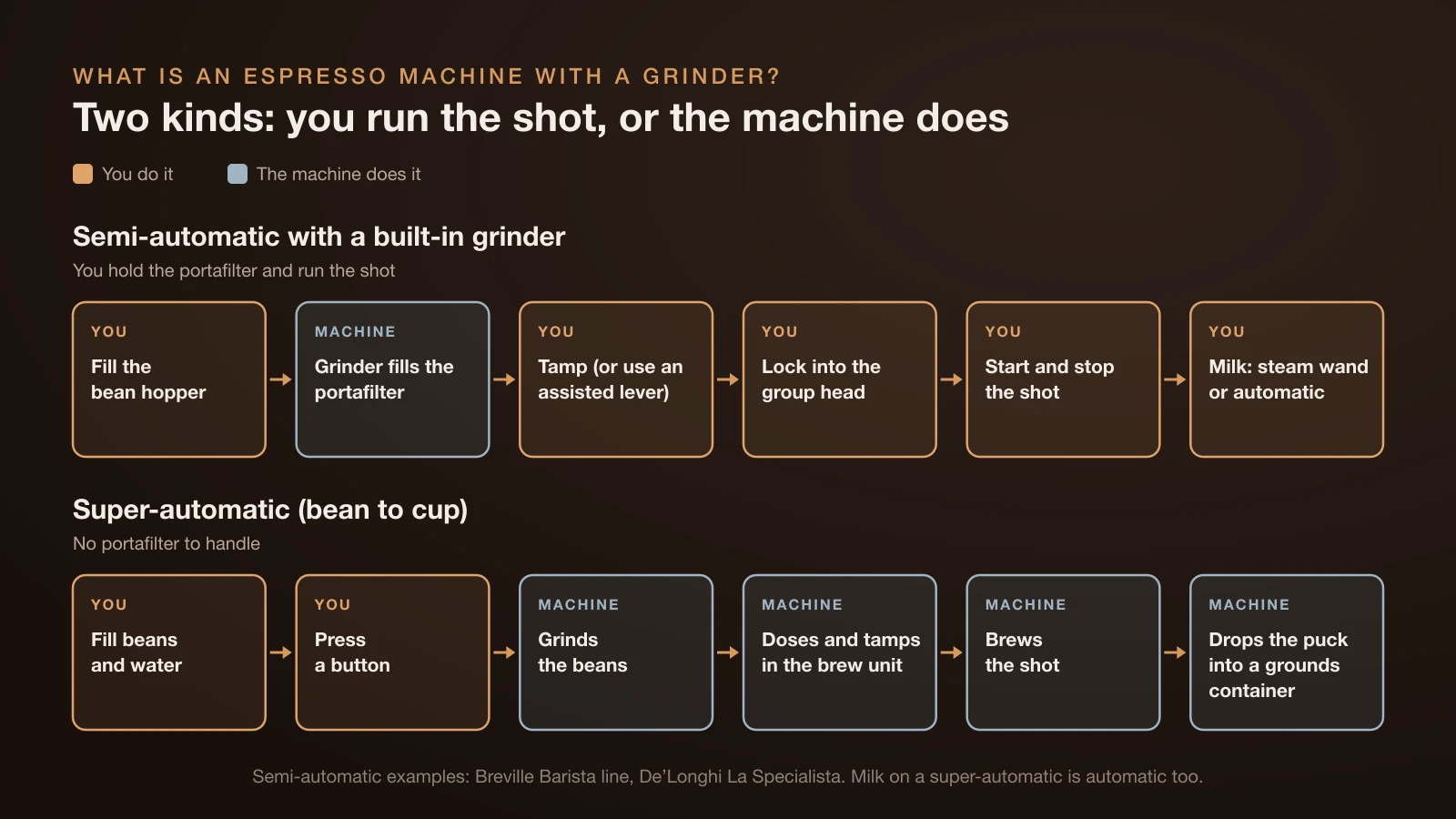
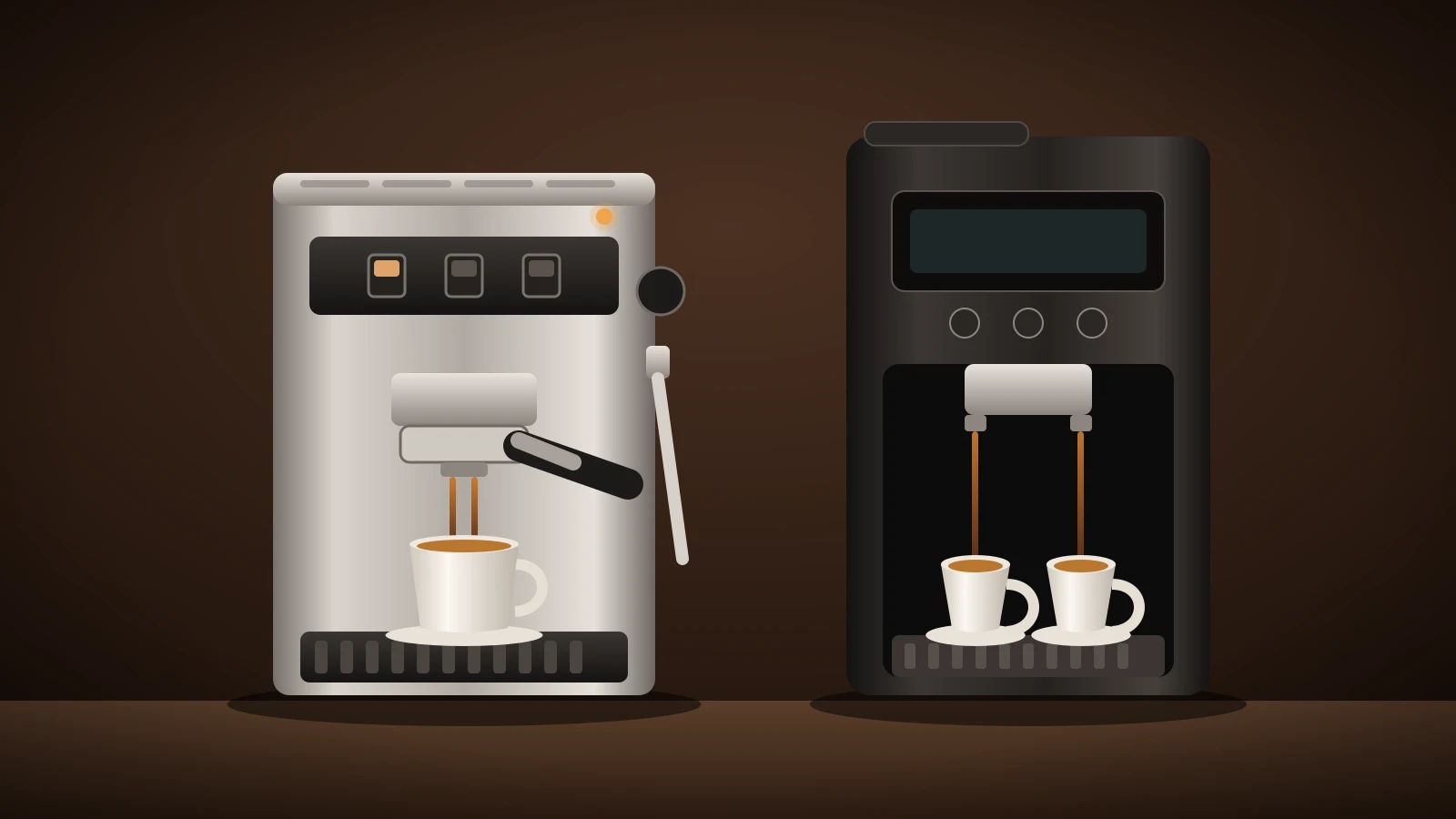
An espresso machine with a grinder combines a burr grinder and an espresso machine in one body, and it comes in two different kinds that work very differently.
Semi-automatic with a built-in grinder
On a semi-automatic, the grinder drops coffee into a portafilter that you hold under a cradle. You then tamp, lock the portafilter into the group head and start the shot, exactly as on a machine without a grinder. Breville’s Barista line and De’Longhi’s La Specialista range work this way, and some models add an assisted tamping lever.
Super-automatic (bean to cup)
A super-automatic grinds, doses, tamps and brews inside the machine when you press a button, then drops the used puck into a grounds container. There is no portafilter to handle. Our guide to super-automatic espresso machines covers their brew units, milk systems and upkeep.
What to check before buying an espresso machine with grinder
Before buying an espresso machine with a grinder, check the grinder as carefully as the machine, because you cannot swap it later.
- Number of grind settings. More steps mean smaller changes between them. The examples below range from 13 to 45 settings.
- Burr type. Look for burrs, not blades. Breville lists steel conical burrs on the Barista Express and Baratza European Precision Burrs on the Touch Impress and Oracle Jet; De’Longhi lists conical burrs on La Specialista.
- Range extension. Breville’s Barista Express and Pro let you move the upper burr to shift the whole range finer or coarser.
- Dose control. Check whether you set the dose by a grind amount dial, a timer or an automatic dose system.
- Bean hopper. Breville lists 8.8 oz (250 g) on the Express and Pro and 12 oz (340 g) on the Touch Impress and Oracle Jet.
- Tamping help. Assisted levers tamp at a fixed pressure: 22 lb (10 kg) on Breville’s Impress models and 20 kg (44 lb) on De’Longhi’s La Specialista Maestro.
- Milk system. A manual wand, an automatic wand or a milk carafe changes both price and cleaning time.
- Warranty. Breville lists 1 year on the Barista Express and 2 years on the Pro, so the grinder shares the machine’s coverage.
Espresso machine with grinder examples and maker prices
The models below show the range of built-in grinder machines; they are examples, not a ranking. Prices come from each maker’s own US store as of October 2026.
| Model | Grinder | Dosing and tamping | Milk | US maker price |
|---|---|---|---|---|
| Breville Barista Express | Steel conical burrs, 16 settings | Grind amount dial, manual tamp | Manual wand | $699.95 |
| Breville Barista Express Impress | 25 settings | Auto-corrected dose, assisted tamp | Manual wand | $799.95 |
| Breville Barista Pro | 30 settings, timed grind | Manual tamp | Manual wand | $849.95 |
| Breville Barista Touch | 30 settings | Manual tamp | Automatic or manual | $999.95 |
| Breville Barista Touch Impress | Baratza European Precision Burrs, 30 settings | Assisted tamp | Automatic | $1,499.95 |
| Breville Oracle Jet | Baratza European Precision Burrs, 45 settings | Grinds, doses and tamps automatically; 58 mm, 22 g | Automatic | $1,999.95 |
| De’Longhi La Specialista Arte Evo | Conical burrs, 15 settings | Dosing and tamping guide, tamping mat | Manual wand | $699.95 list |
| De’Longhi La Specialista Touch | Conical burrs, 15 settings | Bean Adapt guided setup | Automatic or manual wand | $799.95 list |
| De’Longhi La Specialista Maestro | Conical burrs, 15 settings, sensor grinding | Smart Tamping lever | Automatic system and manual wand | $1,299.95 list |
| De’Longhi Magnifica Duo (super-automatic) | Conical burrs, 13 settings | Fully automatic | LatteCrema Hot and Cool | $999.95 list |
De’Longhi lists these prices in its US store; check for sales before you buy. Breville’s Oracle Dual Boiler adds a second boiler to the automatic grind, dose and tamp system at $2,999.95. For how the five Barista models differ, see our Breville Barista Express vs Pro comparison.
How does the built-in grinder work?
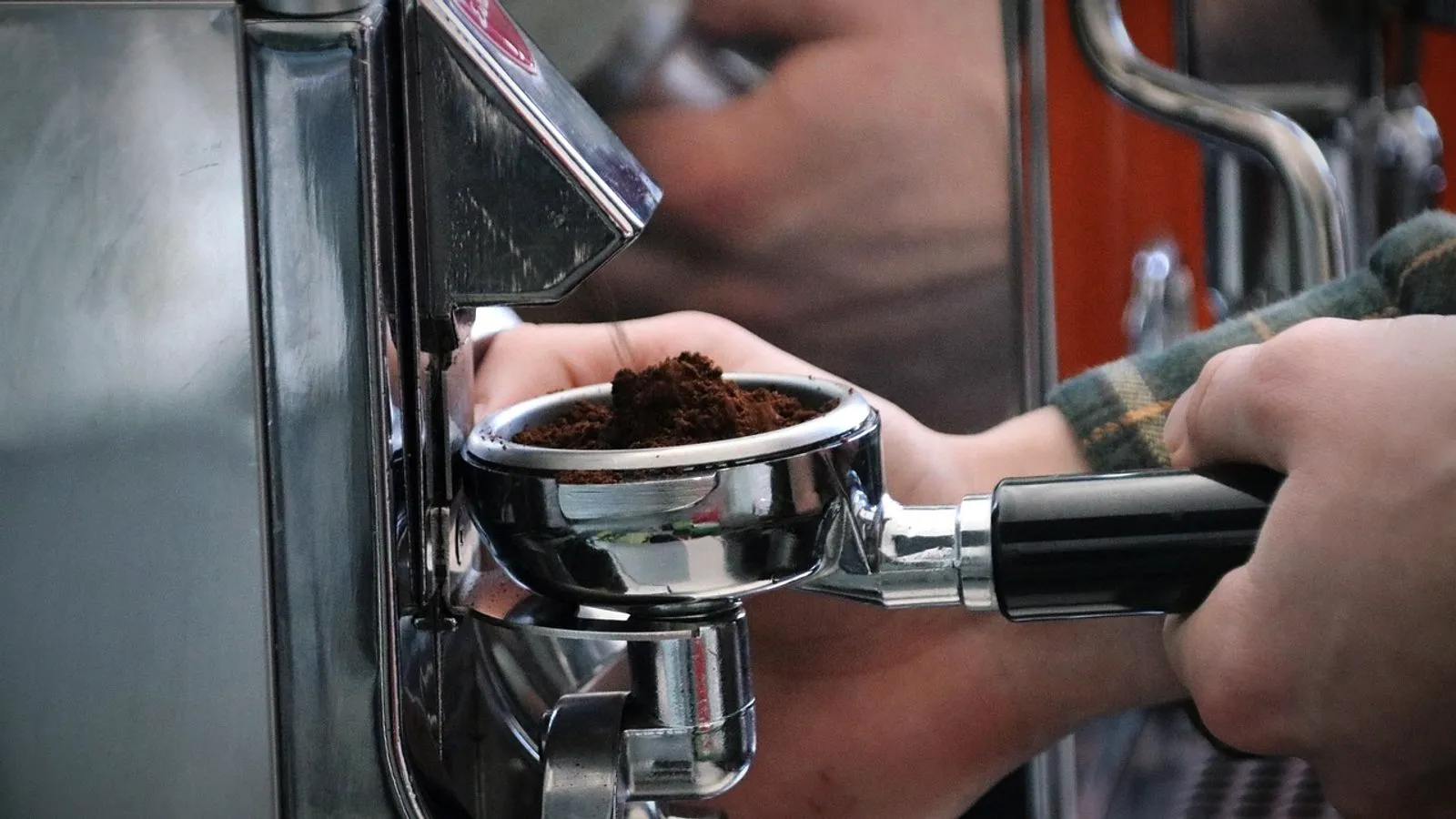
The built-in grinder works like a standalone burr grinder, but it sets the dose by time or by an internal measurement instead of by weight. You still change grind size with a dial or menu, and the grinder fills the portafilter for a single or double shot.
- Grind amount dial (Barista Express). Breville’s manual suggests starting at grind size 5 with the dial at 3 o’clock, then adjusting until, after tamping, the metal cap of the supplied tamper sits level with the top of the basket rim.
- Timed grinding (Barista Pro). The default grind times are 9.5 seconds for a single and 13 seconds for a double, changed in steps on the LCD.
- Automatic dose (Impress and Oracle). The Impress system calculates the dose from your last grind and corrects the next one, and the Oracle Jet grinds, doses and tamps a 22 g dose into its 58 mm portafilter.
- Sensor grinding (La Specialista Maestro). De’Longhi says it keeps the dose consistent even when you change the grind setting.
Because dose by time drifts as beans change, a small scale still helps. Our guide to espresso grind size explains which way to adjust when a shot runs fast or slow.
Built-in grinder vs separate grinder: pros and cons
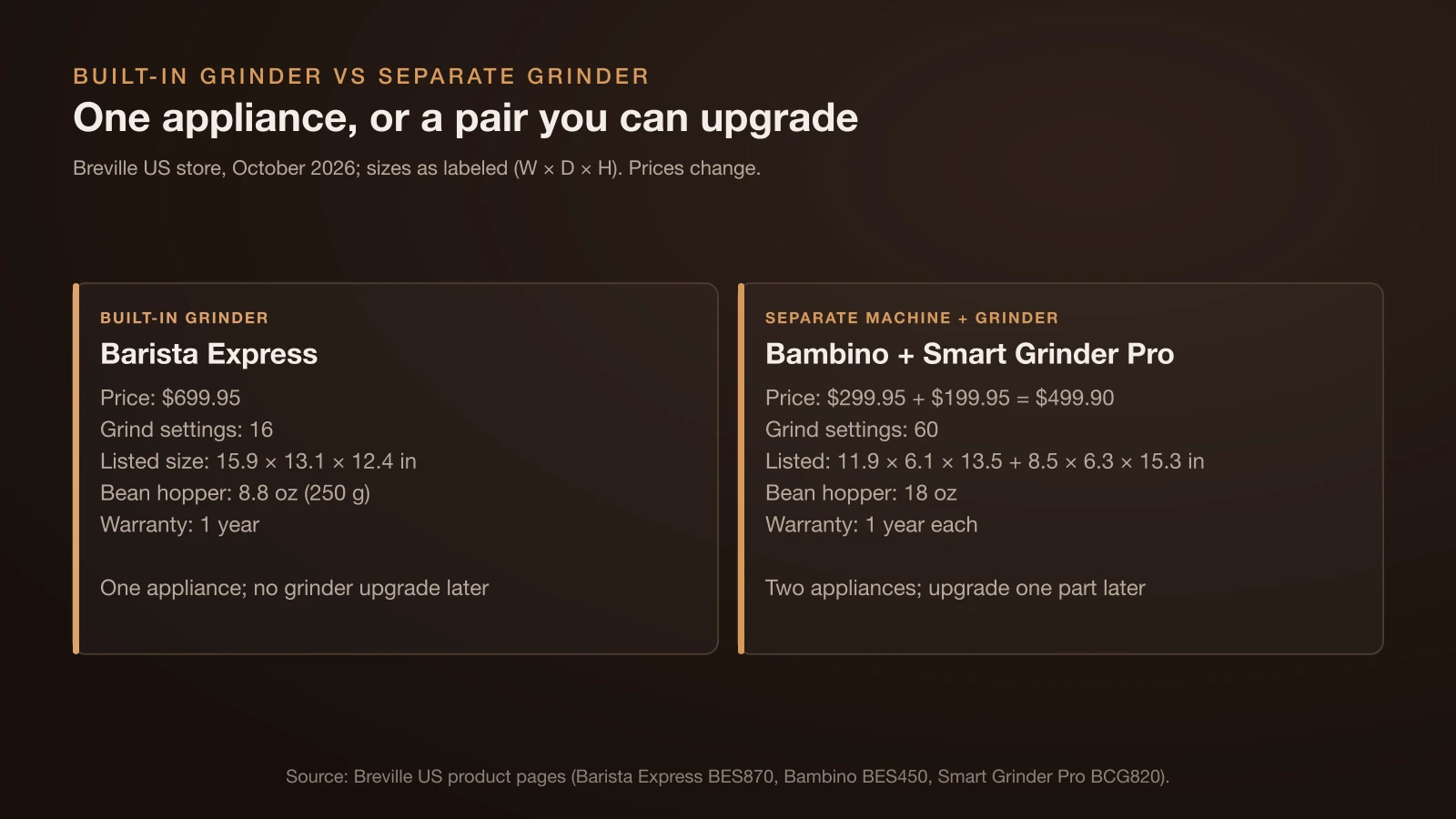
A built-in grinder wins on simplicity and a single appliance, while a separate grinder wins on price in Breville’s range, adjustment range and upgrades. The numbers below come from Breville’s US store.
| Built-in (Barista Express) | Separate (Bambino + Smart Grinder Pro) | |
|---|---|---|
| Price, October 2026 | $699.95 | $299.95 + $199.95 = $499.90 |
| Grind settings | 16 | 60 |
| Listed size (W × D × H as labeled) | 15.9 × 13.1 × 12.4 in | 11.9 × 6.1 × 13.5 in + 8.5 × 6.3 × 15.3 in |
| Bean hopper | 8.8 oz (250 g) | 18 oz |
| Warranty | 1 year | 1 year each |
Pros of a built-in grinder:
- one appliance to buy, plug in and clean;
- one footprint instead of two;
- no transfer of grounds between appliances.
Cons of a built-in grinder:
- fewer grind steps than many standalone grinders;
- if the grinder fails, the whole machine goes in for repair;
- you cannot upgrade the grinder later without replacing the machine.
If you already own a capable grinder, a machine without one is the better buy. Our guide to the espresso grinder explains what makes a standalone grinder suitable for espresso.
Cleaning and maintaining a machine with a built-in grinder
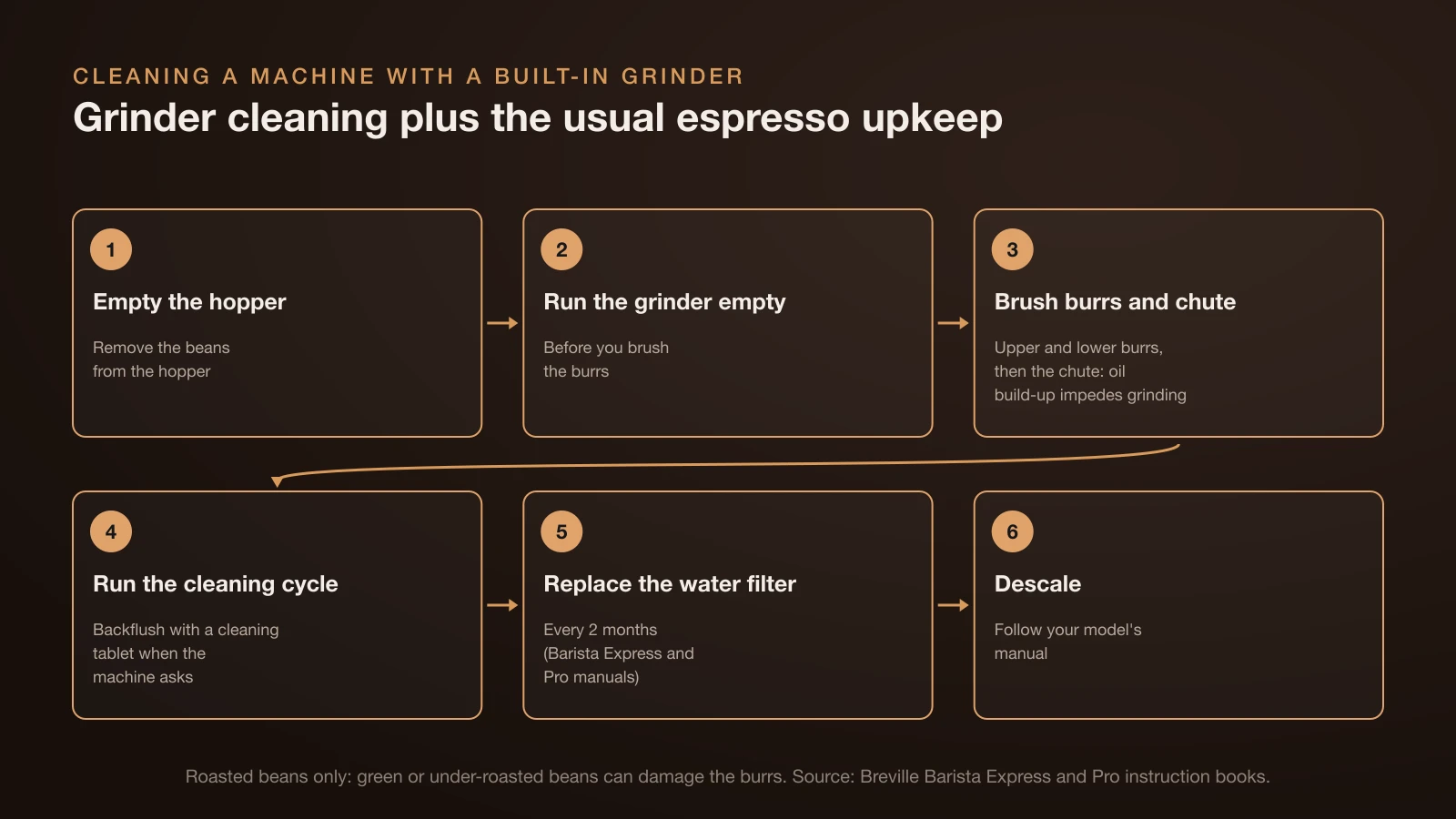
A machine with a built-in grinder needs the usual espresso maintenance plus grinder cleaning, and the manuals treat each job separately. Breville’s grinder cleaning routine removes oil build-up on the burrs, which it says can impede performance; you empty the hopper, run the grinder empty, then brush the upper and lower burrs and the chute.
- Beans only. Breville’s manual warns against green or under-roasted beans, which can damage the burrs, and De’Longhi warns that oily, caramelized or coated beans can stick in its super-automatic grinders.
- Cleaning cycle. The Barista machines run a backflush cycle with a cleaning tablet when the machine asks; see how to backflush an espresso machine.
- Water filter. The Express and Pro manuals say to replace the tank filter every 2 months.
- Descaling. Follow your model’s manual; our guide on how to descale a Breville espresso machine covers the Barista models step by step.
The bottom line
An espresso machine with a grinder puts the whole espresso workflow in one appliance, at the cost of fewer grind steps and no grinder upgrades. Check the number of grind settings, burr type, dose control, tamping help and milk system before you compare prices. If you plan to keep upgrading, a separate machine and grinder give you more room to grow.
Sources
- Breville US product pages: Barista Express BES870, Barista Express Impress BES876, Barista Pro BES878, Barista Touch BES880, Barista Touch Impress BES881, Oracle Jet BES985, Oracle Dual Boiler BES995, Bambino BES450 and Smart Grinder Pro BCG820 (prices, grind settings, burrs, hoppers, tamping, milk systems, dimensions, warranties)
- Breville instruction books: Barista Express BES870 and Barista Pro BES878 (hopper size 8.8 oz (250 g), grind size 5 and grind amount start, 9.5 and 13 second grind times, upper burr adjustment, dual wall baskets, grinder cleaning, green beans warning, 2-month filter, basket doses)
- De’Longhi US store: La Specialista Arte Evo, La Specialista Touch, La Specialista Maestro and Magnifica Duo (list prices, conical burrs, grind settings, Bean Adapt, sensor grinding, Smart Tamping 20 kg, milk systems)
- De’Longhi support: Common issues with fully automatic coffee machines (oily, caramelized or coated beans)