
A portable espresso maker is a small, non-plug-in brewer that forces hot water through finely ground coffee with a hand pump, a lever or a battery-powered pump. Hand and lever models need water from a kettle; battery models heat it themselves. Made with a fine grind, they can reach espresso-level pressure of about 9 bar.
They sit between two ideas covered elsewhere on this site: making espresso without a machine and the countertop presses in our guide to manual espresso machines. Every spec and price below comes from the maker’s own US store as of October 2026; the models are examples of each type, not a ranking.
The short answer
| Type | How it makes pressure | Heats water | Typical dose | Best for |
|---|---|---|---|---|
| Hand pump | You pump a small piston by hand | No | 8–18 g | Backpacks, hotel rooms, the office |
| Travel lever press | You pull a lever on a folding stand | No | 12–18 g | Car trips and cabins, gauge-guided shots |
| Battery-heated pump | Electric pump and heater on a battery | Yes | 8 g or a capsule | Places without a kettle |
| Capsule portable | Pump or adapter for pods | Depends on model | One capsule | Speed, no grinder |
| Moka pot | Steam pressure on a stove | Yes, on a burner | Fills the basket | Camping with a stove, strong coffee for several people |
Types of portable espresso maker
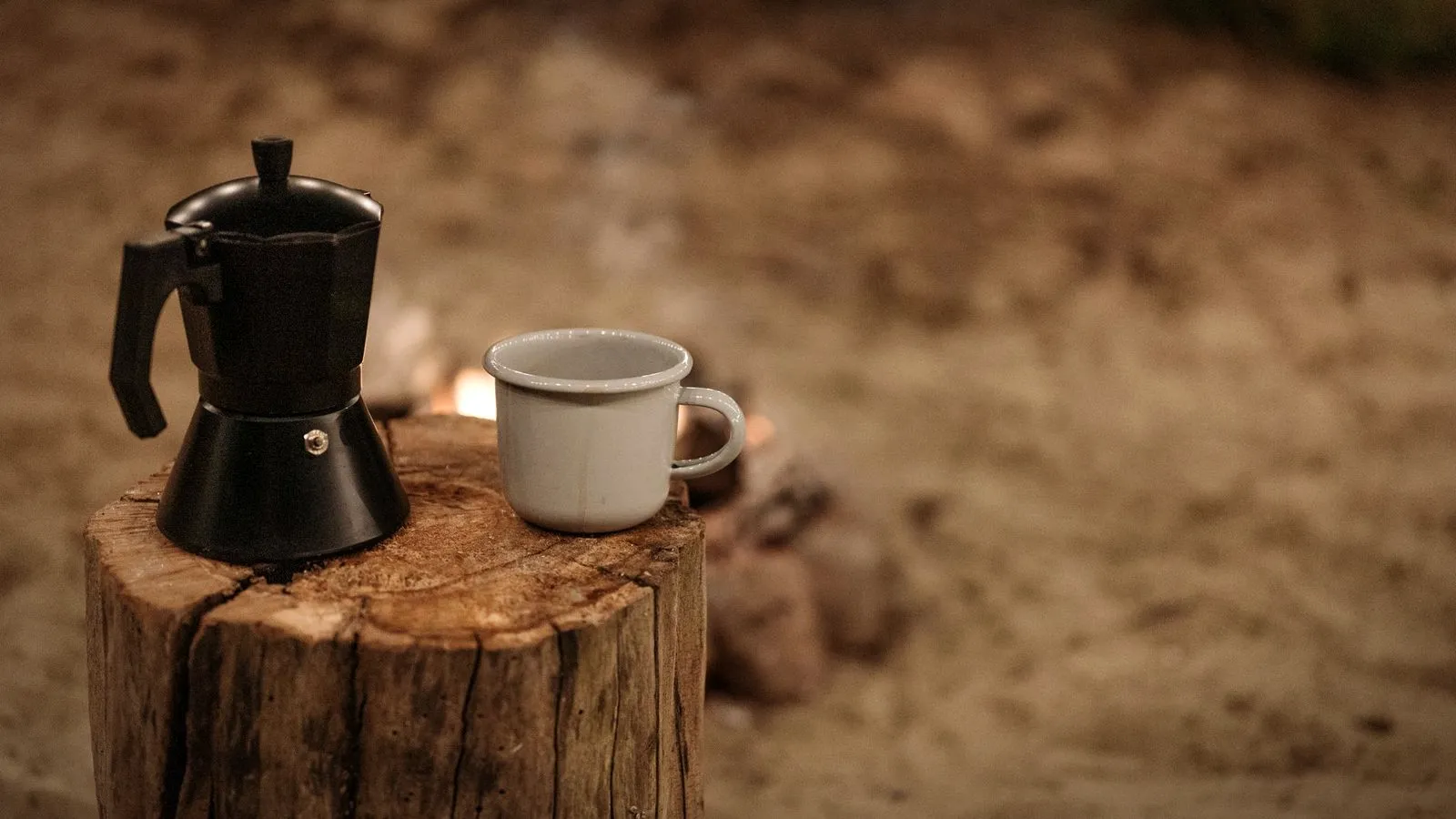
The four main types of portable espresso maker differ in where the pressure comes from and whether they need a separate source of hot water. A moka pot is the low-tech camping alternative, though it brews at much lower pressure.
Hand pump espresso makers
A hand pump maker is a cylinder with a water tank on one end, a coffee basket on the other and a piston you pump with two hands. Wacaco’s Nanopresso and Picopresso are well-known examples. Neither heats water, so you fill the tank with just-boiled water and pump until the shot flows. Wacaco estimates about 13 kg (28.7 lb) of hand force at maximum pressure.
Travel lever presses
A travel lever press is a folding stand with a brew cylinder, a portafilter and a long lever. The Flair 2GO, for example, takes a 12–18 g dose, holds 60 ml in its brew chamber and yields about 45 ml. It has a pressure gauge, so you can see when you are in the 6–9 bar range Flair targets. It packs into a 9.5 × 5.25 × 4 in case.
Battery-heated portable espresso machines
A battery-heated portable espresso machine has its own heater, pump and rechargeable battery, so cold water is enough. OutIn lists a 120 W heater in its Nano 2 that takes 50 ml from 25 °C (77 °F) to 93 °C (199 °F) in as little as 159 seconds. From room-temperature water, OutIn rates the 54 Wh battery at up to 9 cups per charge.
Capsule-compatible portables
Capsule-compatible portables brew from pods instead of ground coffee, which removes the grinder from your bag. The OutIn Nano 2 takes Nespresso Original Line-compatible capsules or an 8 g basket of ground coffee. Wacaco sells an NS Adapter for Nespresso Original capsules and a DG Kit for Dolce Gusto capsules on the Nanopresso, and the Flair 2GO is sold in a pod-compatible version.
The moka pot as a camping alternative
A moka pot brews strong coffee on a stove or camp burner, but it is not a portable espresso maker in the pressure sense. Bialetti puts its brewing pressure at about 1.5 bar, far below espresso. It makes several cups at once and needs no hand force; our guide on how to use a moka pot covers grind, heat and timing.
Portable espresso maker specs compared
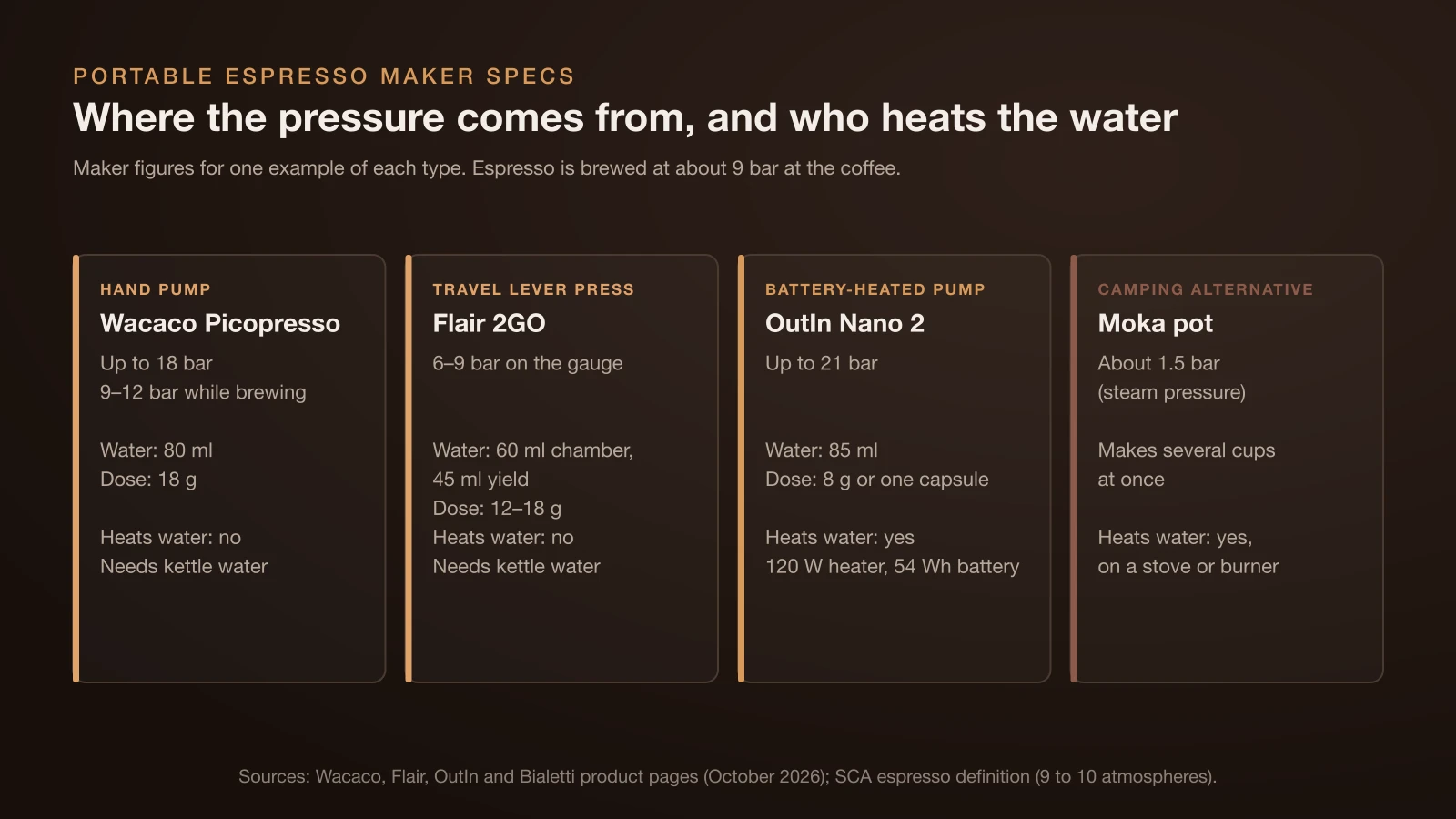
The specs that matter most on a portable espresso maker are brewing pressure, water capacity, dose, whether it heats water and weight. The table lists each figure as the maker publishes it, with US prices from each maker’s own store as of October 2026.
| Model (type) | Pressure (maker figure) | Water | Dose | Heats water | Weight | US maker price |
|---|---|---|---|---|---|---|
| Wacaco Nanopresso (hand pump) | Up to 18 bar | 2.7 oz (80 ml) | 8 g; 16 g with Barista Kit | No | 336 g (11.9 oz) | $64.90 (regular $69.90) |
| Wacaco Picopresso (hand pump) | Up to 18 bar; 9–12 bar while brewing | 80 ml | 18 g, 52 mm basket | No | 350 g (12.35 oz) | $129.90 |
| Flair 2GO (lever press) | 6–9 bar on the gauge | 60 ml chamber, 45 ml yield | 12–18 g | No | Not compared (maker figures differ) | $169 (regular $199) |
| OutIn Nano 2 (battery pump) | Up to 21 bar | 85 ml | 8 g or one capsule | Yes, 120 W heater | 740 g | $179.99 |
Accessories change the picture. Wacaco’s NS Adapter costs $21.90 and its DG Kit $32.90, and Flair sells a Pod Portafilter for the 2GO at $19. Prices change often, so check the maker’s store before you buy.
Do portable espresso makers make real espresso?
Portable espresso makers can make real espresso when they reach about 9 bar at the coffee with a fine, well-tamped grind. The Specialty Coffee Association’s heritage definition calls for 9 to 10 atmospheres and water at 195–205 °F (90–96 °C); the espresso maker vs espresso machine guide explains how other brewers compare.
Maximum ratings such as 18 or 21 bar describe what the pump can reach, not the pressure your shot needs. Wacaco itself suggests 9 to 12 bar during extraction on the Picopresso, and Flair’s gauge marks 6 to 9 bar.
Temperature is the weaker link on unheated models. The water cools as it meets cold metal parts, which is why Flair tells you to preheat the brew parts of its classic presses and fits the 2GO with a thin-walled, no-preheat cylinder. A moka pot, at about 1.5 bar, makes strong coffee but not espresso.
How to use a portable espresso maker
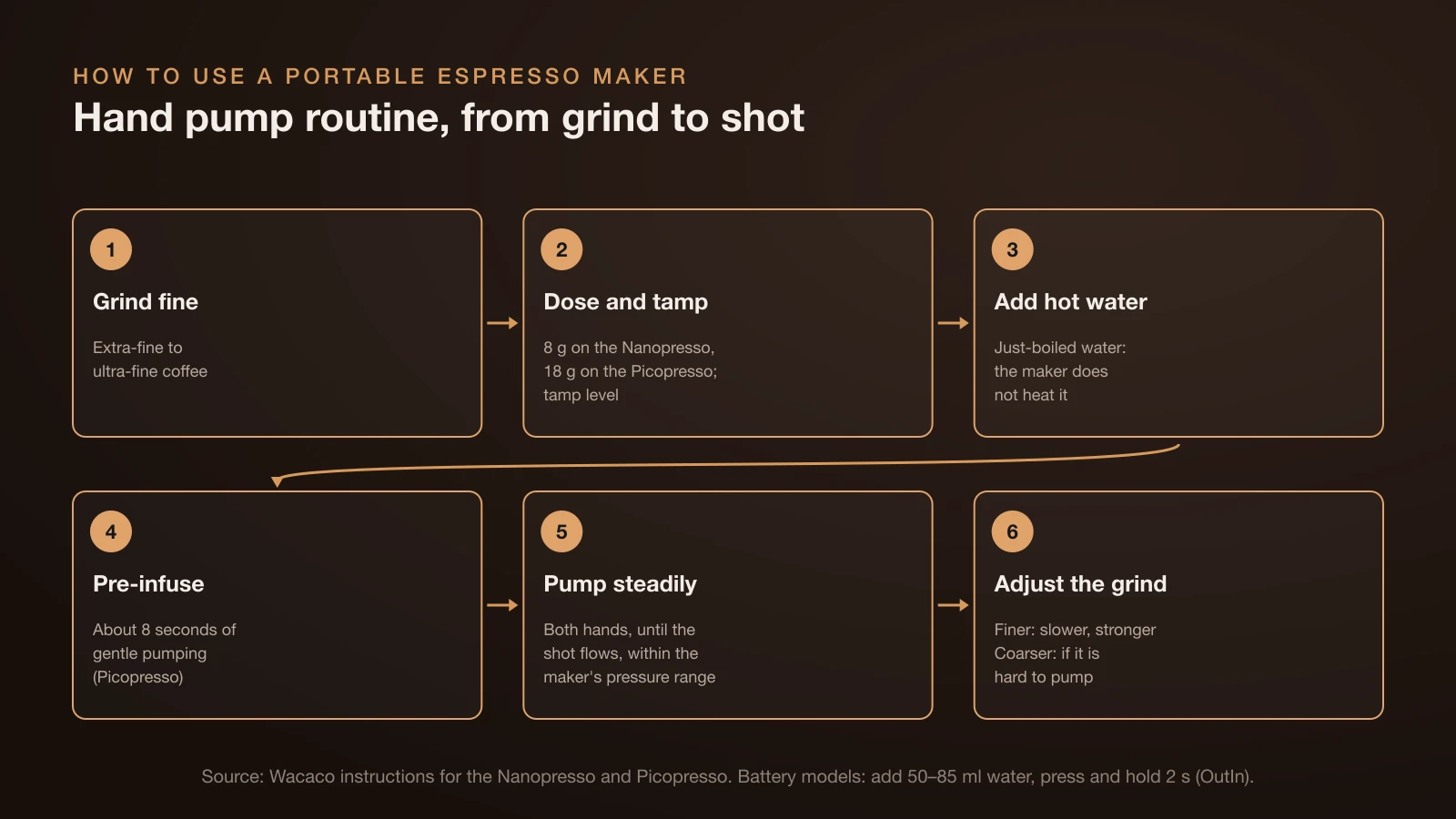
Using a portable espresso maker follows the same order on most hand-pump models: grind, dose, add hot water, then build pressure. These steps follow Wacaco’s instructions for the Nanopresso and Picopresso.
- Grind fine. Wacaco asks for extra-fine to ultra-fine coffee; our espresso grind size guide shows what that looks like.
- Dose and tamp. Fill the basket (8 g on the Nanopresso, 18 g on the Picopresso) and tamp level.
- Add hot water. Fill the tank with just-boiled water, since these models do not heat it.
- Pre-infuse. On the Picopresso, Wacaco suggests about 8 seconds of gentle pumping to wet the coffee.
- Pump steadily with both hands until the shot flows, aiming for the maker’s pressure range.
- Adjust the grind to change taste: finer for a slower, stronger shot, coarser if it is hard to pump.
Stopping a shot early gives a shorter, more concentrated drink, the same idea as a ristretto. On a battery model, the routine is shorter: OutIn says to fill 50–85 ml of water, insert the basket or capsule, then press and hold the button for 2 seconds to heat and brew.
Travel and camping tips for a portable espresso machine
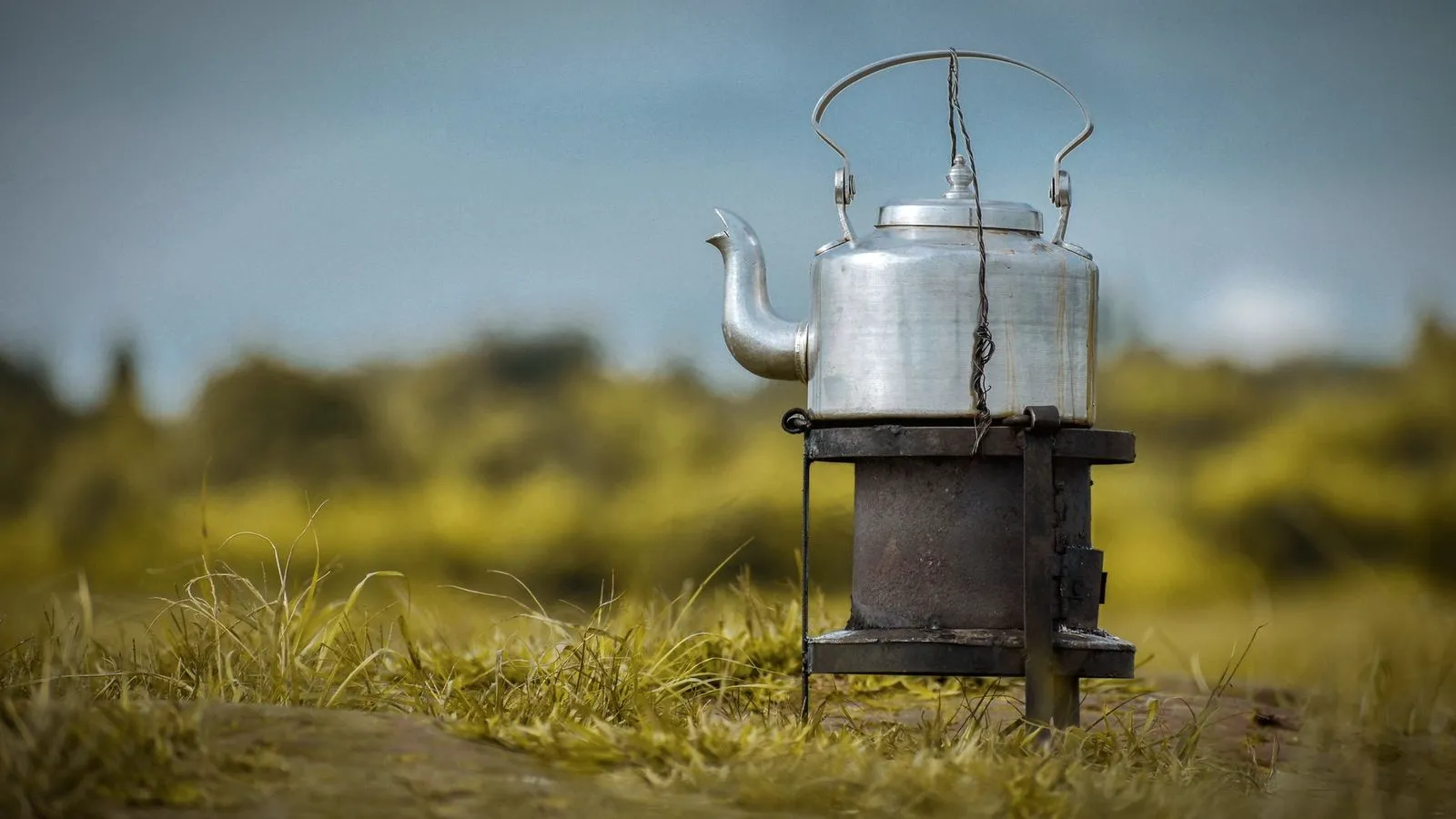
A portable espresso machine travels well only if you plan for hot water, grinding and storage. These points matter most away from the kitchen:
- Hot water. Hand pumps and lever presses need just-boiled water from a kettle, a stove or a camp burner. Battery models solve this but cost run time when they heat cold water.
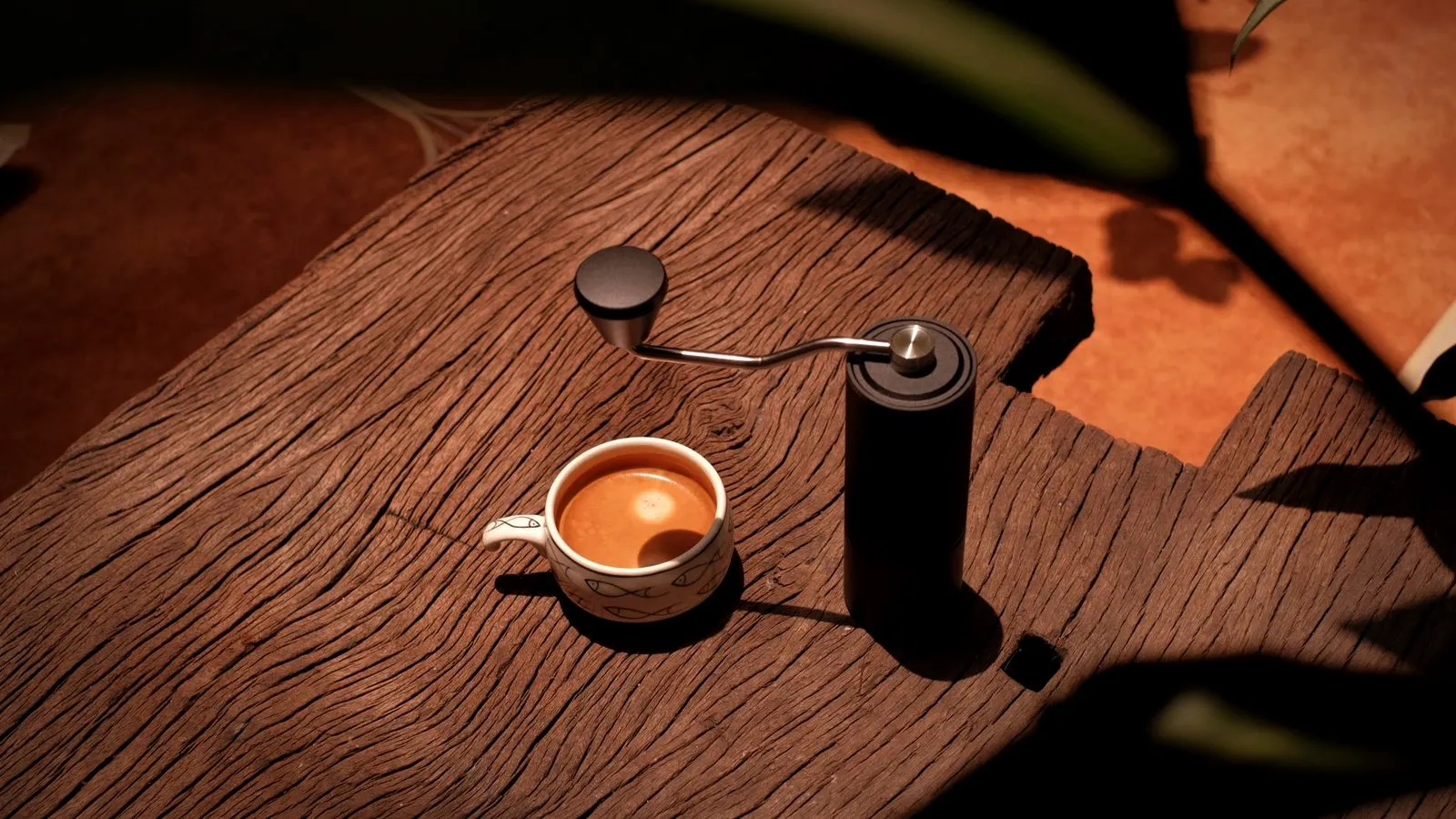
- Grinder. A small hand burr grinder gives you a fresh espresso grind anywhere. Otherwise, capsules or coffee ground just before the trip are the practical fallback.
- Batteries and flights. TSA limits each lithium-ion battery to 100 watt-hours and requires spare batteries to travel in carry-on bags. OutIn rates the Nano 2 at 54 Wh and asks you to carry it in your carry-on bag only. The TSA officer decides at the checkpoint.
- Packing. Dry every part before you pack it, and keep the basket and seals together in the case.
- Milk. None of these makers steams milk, so lattes need a separate frother; see our guide to milk frothers.
How to choose a portable espresso machine
The right portable espresso machine depends on whether you will have hot water, a grinder and space in your bag. Match the type to your trip:
| If you… | Consider | Why |
|---|---|---|
| Fly or hike and want the lightest option | Hand pump | Light, no battery, needs kettle water |
| Have a kettle and want to watch pressure | Travel lever press | Gauge, larger 12–18 g dose |
| Won’t have a kettle | Battery-heated pump | Heats its own water |
| Don’t want to carry a grinder | Capsule-compatible model | One pod per shot |
| Brew for a group at camp | Moka pot | Several cups at once, low pressure |
Check the dose and water capacity against the drink you want. An 8 g basket makes a single shot, while 16–18 g makes a double. If you mostly drink coffee at home, a countertop lever press or pump machine may suit you better.
Cleaning a portable espresso maker
Clean a portable espresso maker after every shot, because oils and grounds dry quickly in a small basket. Wacaco says the Nanopresso is not dishwasher safe.
- Separate the portafilter parts after each use.
- Rinse the basket, shower head and basket seat under warm running water.
- Wipe the body with a damp cloth.
- Let every part dry separately before you reassemble or pack it.
Flair’s guidance for the 2GO is similar: rinse the brew parts and fold the stand away. Replace worn O-rings when they stop sealing; Flair sells a replacement set for the 2GO.
The bottom line
A portable espresso maker gives you espresso away from a machine: a hand pump for the lightest kit, a travel lever press when you want a gauge, or a battery model when there is no kettle. Look past the maximum pressure on the box; what counts is about 9 bar at the coffee, hot water and a fine, fresh grind.
Sources
- Wacaco: Nanopresso (18 bar maximum, 80 ml tank, 8 g and 16 g baskets, 336 g, no water heating, NS Adapter and DG Kit, pressurized and non-pressurized modes, about 13 kg force, cleaning, price) and Picopresso (18 bar maximum, 9–12 bar during extraction, 8-second pre-infusion, 80 ml, 18 g, 52 mm basket, 350 g, price)
- Flair Espresso: Flair 2GO (6–9 bar, 12–18 g, 60 ml chamber, 45 ml yield, case size, pods, price), Replacement O-rings and Espresso University: basics of espresso (preheating)
- OutIn: Nano 2 portable espresso machine (21 bar, 85 ml, 8 g, capsules, 120 W heater, 25 °C to 93 °C in 159 seconds, 54 Wh, 9 cups per charge, carry-on only, 740 g, steps, price)
- Specialty Coffee Association: Defining the ever-changing espresso (archived; 9 to 10 atmospheres, 195–205 °F) and Bialetti: How the Moka works (about 1.5 bar)
- Transportation Security Administration: Lithium batteries, 100 watt hours or less (100 Wh limit, spare batteries in carry-on, officer decides)