
A milk frother is a small tool that whips air into milk to make foam for lattes, cappuccinos, hot chocolate and cold foam. Handheld wands and manual plungers froth only, while electric jug frothers heat and froth at once. Unlike an espresso machine’s steam wand, a frother whips air in mechanically, so its bubbles are lighter and larger.
That difference matters if you want latte art, which needs the fine microfoam from a wand; our guide on how to steam milk covers that technique.
The short answer
| Type | Heats milk? | Foam | Best for |
|---|---|---|---|
| Electric jug frother | Yes, plus a cold setting | Thick or silky, set by whisk or disc | Lattes, cappuccinos, hot chocolate, cold foam |
| Handheld whisk wand | No, heat milk separately | Light, bubbly | Quick single drinks, cold foam |
| Manual plunger (French press style) | No, heat milk separately | Fluffy, larger batches | Several drinks at once |
| Steam wand (espresso machine) | Yes, with steam | Fine, glossy microfoam | Latte art, flat whites |
What is a milk frother used for?
A milk frother is used to add air to milk so it grows in volume and turns light and creamy. Breville describes frothing as pushing air into milk to create small bubbles, which increases its volume and improves its texture.
Most people use one for:
- Cappuccinos and lattes at home, especially without an espresso machine wand. Our homemade latte guide shows where the foam goes.
- Cold foam on iced coffee and an iced latte, since frothers can work without heat.
- Hot chocolate and chai lattes, which Breville’s Milk Cafe manual lists alongside coffee drinks.
Types of milk frothers
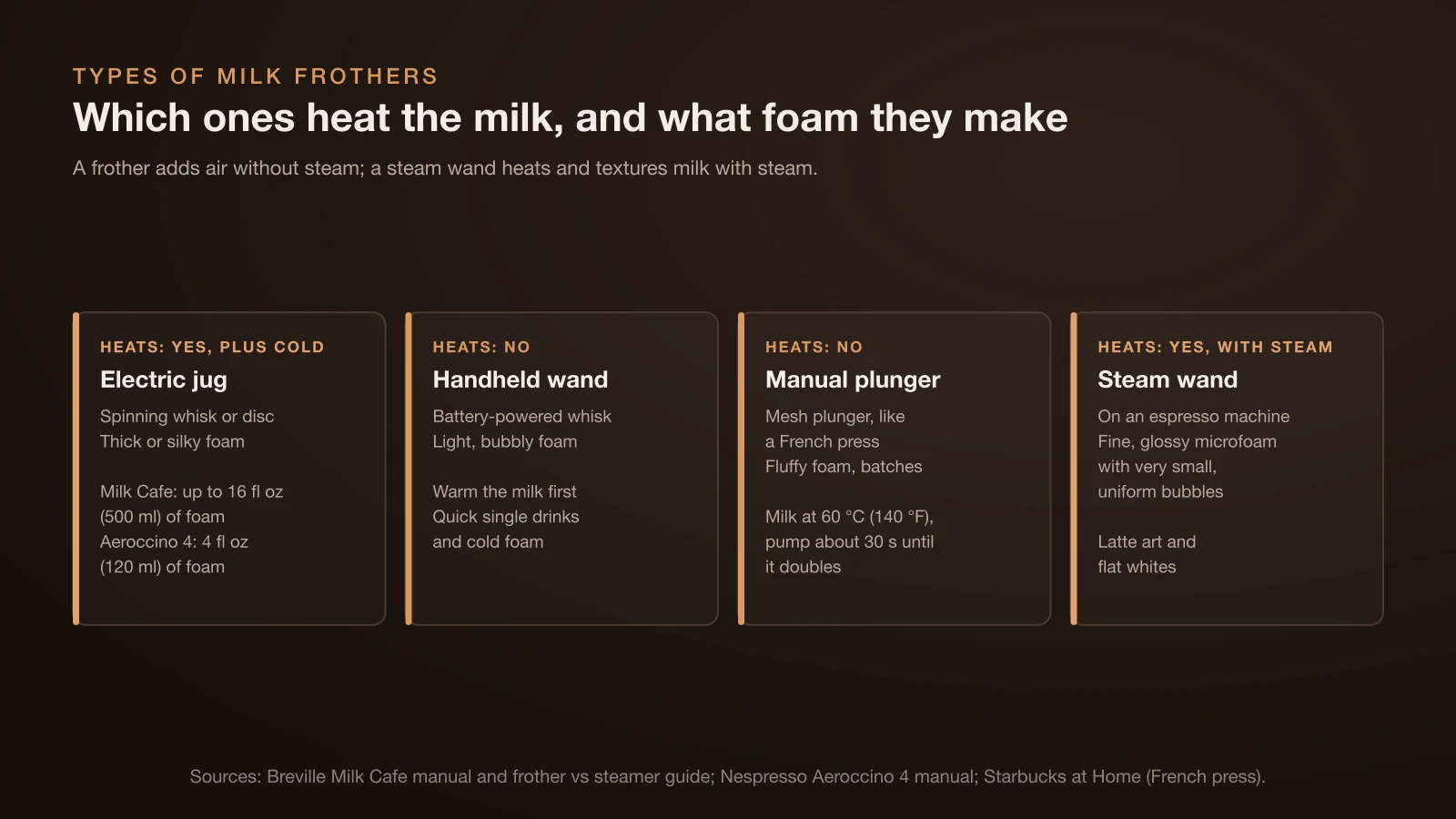
There are three types of milk frother, handheld, electric jug and manual plunger, plus the steam wand on an espresso machine, which steams rather than froths. They differ in whether they heat the milk and how much they make at once.
- Electric jug frother. A powered jug with a spinning whisk or disc in the base. Breville calls these electric or automatic frothers, larger appliances that both froth and heat milk.
- Handheld whisk wand. A battery-powered stick with a small spinning whisk. Breville notes that handheld frothers create foam by aeration alone, not with heat.
- Manual plunger. A jug with a mesh plunger you pump by hand, working like a French press.
- Steam wand. Part of an espresso machine; it heats and textures milk with steam.
Milk frother vs steam wand
A milk frother and a steam wand both add air, but they give different textures. Breville says frothing produces airier milk with more unevenly sized bubbles, while steaming makes a smoother, finer foam with very small, uniform bubbles. A frother is easier to learn and makes cold foam; a wand gives café-style microfoam. If you are still choosing a machine, our guide to the best home espresso machines explains what to look for in a steam wand.
How to use a milk frother
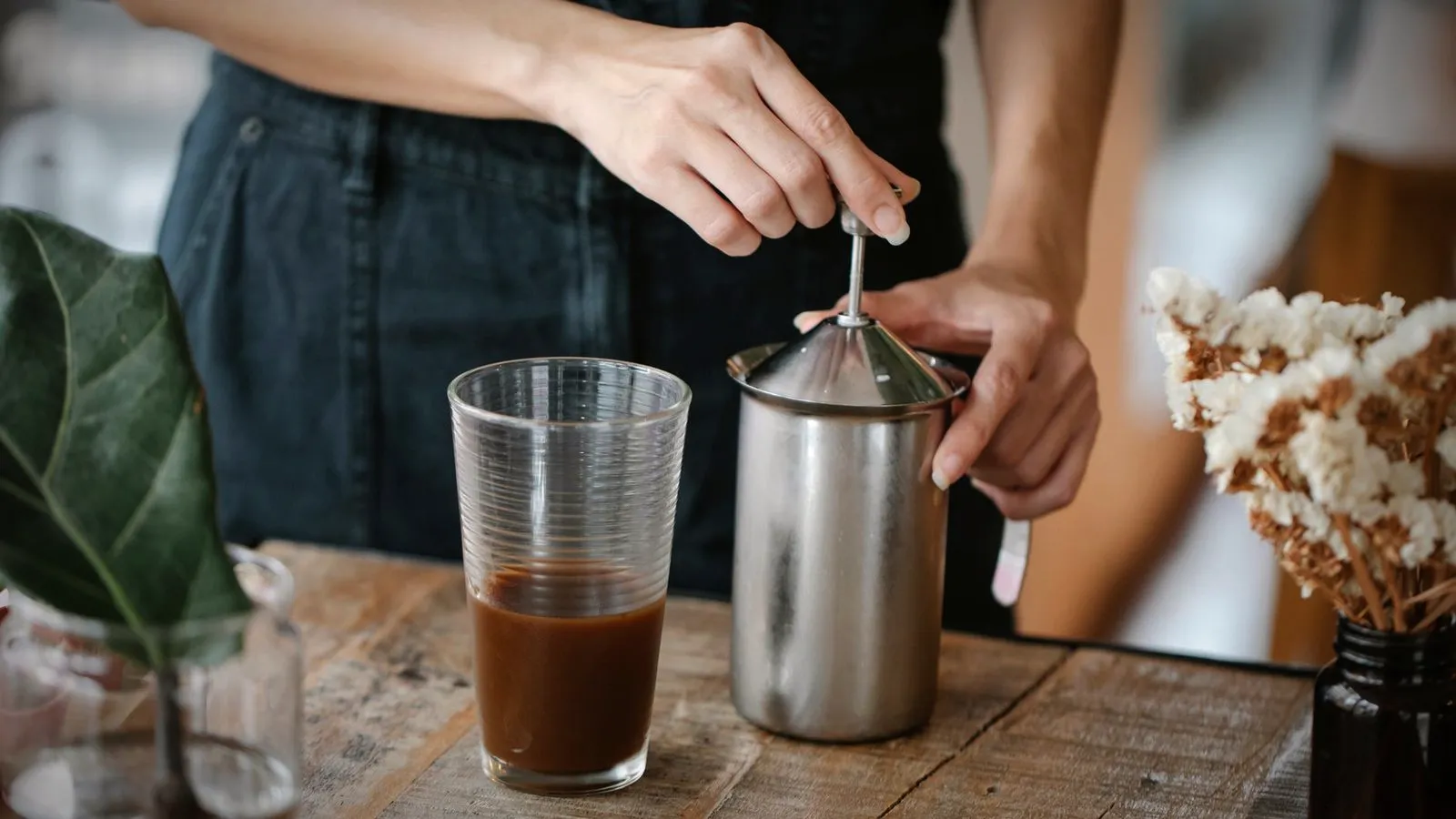
How you use a milk frother depends on the type, but every maker starts from the same rule: begin with cold, fresh milk and do not fill past the foam line.
Electric jug frother
These steps follow the manuals for Breville’s Milk Cafe and Nespresso’s Aeroccino 4.
- Fit the whisk or disc. The Milk Cafe has a Cappuccino disc for thick, creamy froth and a Latte disc for smooth, silky milk. Never run it without one.
- Pour in cold milk between the MIN line and the foam MAX line. On the Aeroccino 4, the lower line (4 fl oz, 120 ml) is for froth and the higher line (8 fl oz, 240 ml) is for hot milk only.
- Close the lid and set the jug on its base.
- Choose the setting. The Milk Cafe dial runs from Cold Stir through Warm and Optimum to Hot; the Aeroccino 4 has buttons for cold foam, hot milk, airy foam and dense foam.
- Press start and wait. The Aeroccino 4 takes about 80 seconds for hot or cold froth and about 150 seconds for hot milk. The Milk Cafe takes 2 to 7 minutes, depending on the amount.
- Tap, swirl and pour promptly. Breville suggests tapping the jug to pop large bubbles and pouring right away so the milk does not separate.
Handheld frother
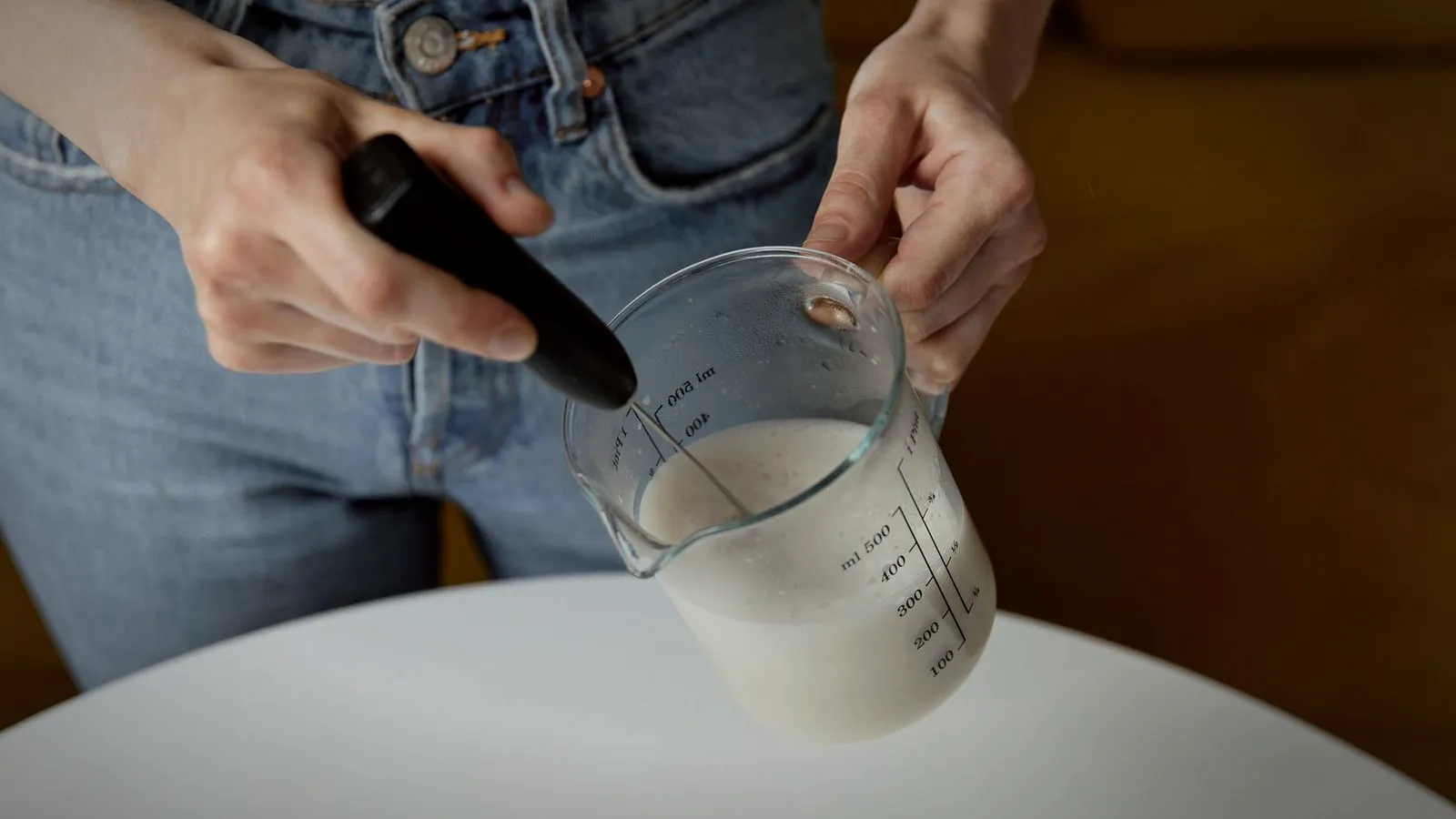
Breville notes that handheld frothers add air only, not heat, so warm the milk first on the stove or in the microwave and keep it below a boil. Use a tall mug or jug with room for the foam to grow. Put the whisk below the surface before switching it on, hold it just under the top while foam builds, then switch off before lifting it out to avoid splashes.
Manual plunger or French press
A French press makes a good manual frother for larger batches. Starbucks at Home’s method: heat the milk to 60 °C (140 °F) without boiling, pour it into the press leaving room for it to double, then pump the plunger, speeding up gradually, for about 30 seconds or until the milk has doubled.
Which milk froths best in a milk frother?
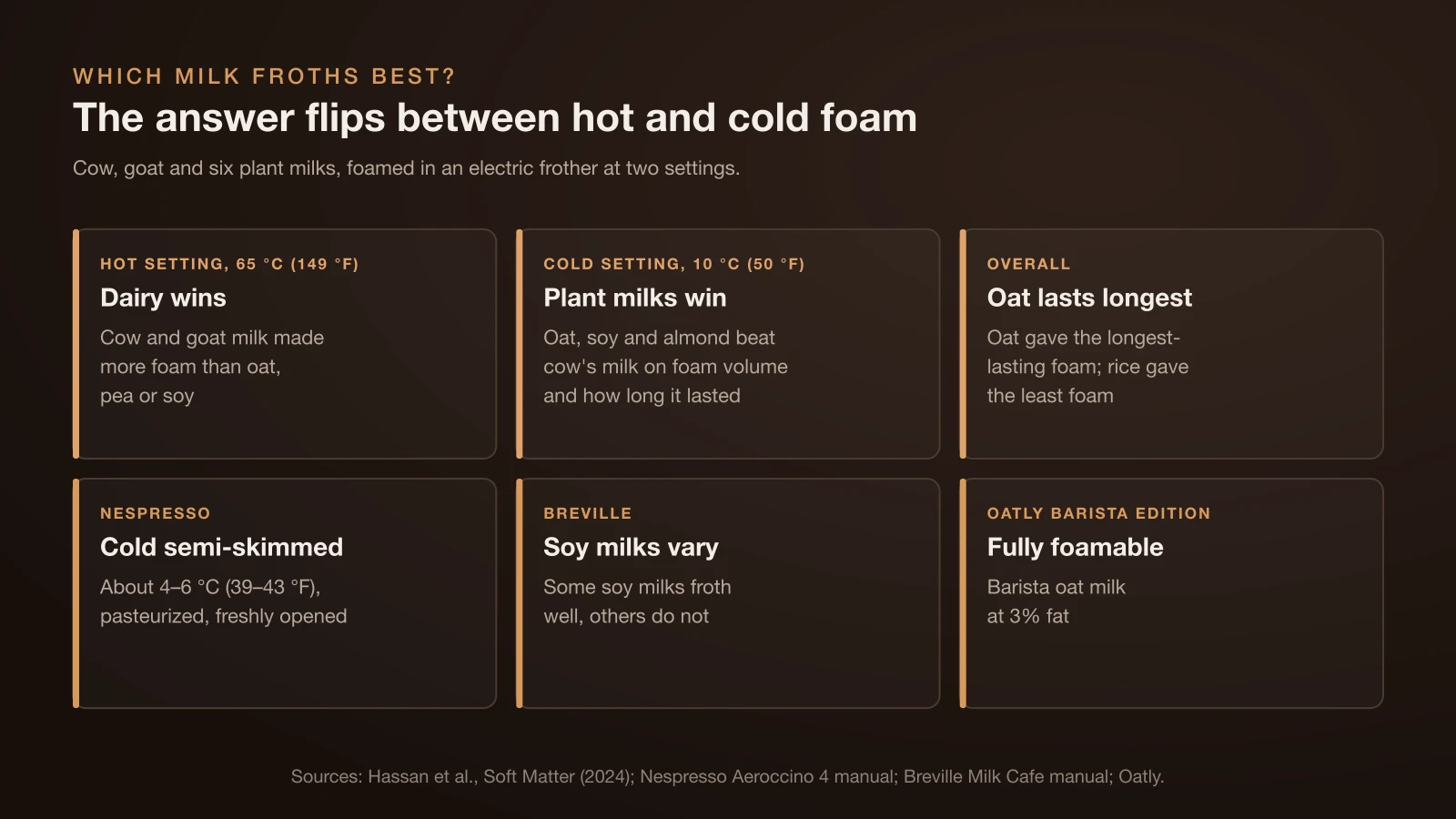
The milk that froths best depends on whether you froth hot or cold, because proteins, fat and added thickeners all change how foam forms and lasts. A 2022 review in Critical Reviews in Food Science and Nutrition describes milk proteins as excellent foaming agents, with results affected by protein content, fat, heat treatment and foaming temperature.
A 2024 study in Soft Matter tested cow and goat milk against six plant milks in an electric frother at a cold (10 °C, 50 °F) and a hot (65 °C, 149 °F) setting.
| Setting | What foamed best |
|---|---|
| Hot | Cow and goat milk made more foam than oat, pea or soy |
| Cold | Oat, soy and almond beat cow’s milk on foam volume and how long it lasted |
| Overall | Oat gave the longest-lasting foam; rice gave the least foam |
Makers add practical rules. Nespresso recommends cold semi-skimmed milk at about 4–6 °C (39–43 °F) for the Aeroccino, pasteurized and freshly opened. Breville found that some soy milks froth well and others do not. For dairy-free drinks, barista versions help: Oatly says its Barista Edition is fully foamable at 3% fat. Our oat milk latte guide covers how it tastes in coffee.
Why is my milk not frothing?
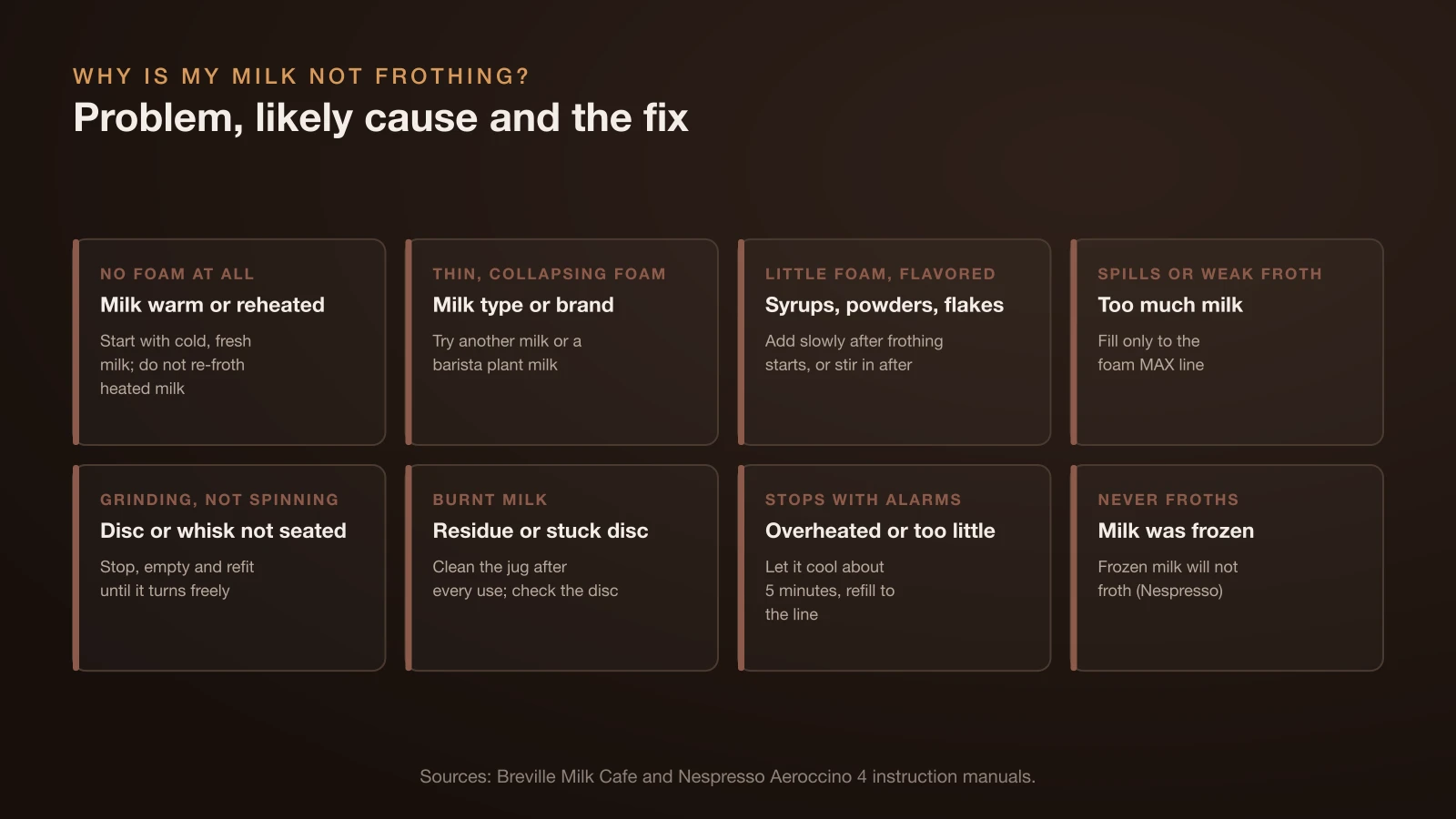
Milk usually will not froth because it is too warm to start with, already heated once, the wrong type, or overfilled. The fixes below come from the Breville and Nespresso manuals.
| Problem | Likely cause | Fix |
|---|---|---|
| No foam at all | Milk warm or already heated | Start with cold, fresh milk; do not re-froth heated milk |
| Thin, quick-collapsing foam | Milk type or brand | Try another milk or a barista plant milk |
| Little foam with flavorings | Thick syrups, powders or flakes | Add them slowly after frothing starts, or stir in afterwards |
| Spills or weak froth | Too much milk | Fill only to the foam MAX line |
| Grinding noise, milk not spinning | Disc or whisk not seated | Stop, empty and refit it until it turns freely |
| Burnt milk | Residue in the jug or disc not spinning | Clean the jug after every use; check the disc |
| Frother stops with alarms | Overheated or not enough milk | Let it cool about 5 minutes, then refill to the line |
Nespresso adds that milk which has been frozen will not froth, and it advises against enriched, powdered or flavored milks in the Aeroccino.
How to clean a milk frother
Clean a milk frother straight after every use, because dried milk is harder to remove and can burn on the next batch. Both electric makers say to let the jug cool, or fill it with cold water, before taking it apart.
- Breville Milk Cafe: wash the jug, lid, cap and disc in warm soapy water. They can go in the dishwasher on the top shelf, but Breville suggests washing the discs by hand.
- Nespresso Aeroccino 4: remove the seal, whisk and spring, wash with detergent and rinse. The jug can go in a dishwasher at up to 70 °C (158 °F); never immerse it or the base.
- Handheld wand: run the whisk in warm water, wipe it and keep the battery end dry.
- Plunger: rinse the mesh straight away and wash it like a French press.
Example electric milk frothers
Electric jug frothers differ mainly in capacity, settings and cleaning. These two examples show the range, using each maker’s published specs.
| Breville Milk Cafe (BMF600) | Nespresso Aeroccino 4 | |
|---|---|---|
| Foam capacity | Up to 16 fl oz (500 ml) | 4 fl oz (120 ml) |
| Hot milk capacity | Up to 25 fl oz (750 ml) for hot chocolate | 8 fl oz (240 ml) |
| Settings | Cold Stir, Warm, Optimum, Hot | Cold foam, hot milk, airy foam, dense foam |
| Time | 2–7 minutes | About 80 s froth, 150 s hot milk |
| Heating and power | Induction base, 500 W | 450 W (US) |
| US price (maker, October 2026) | $199.95 at Breville | Check Nespresso’s store |
How to choose a milk frother
Choose a milk frother by how many drinks you make at once, whether you need heat and how much cleaning you will tolerate.
- One drink at a time: a handheld wand or a small jug like the Aeroccino.
- Several drinks or hot chocolate: a larger jug or a French press.
- Cold foam: any frother with a cold setting, or a handheld wand.
- Latte art or a wet or dry cappuccino with exact foam control: a steam wand.
- Plant milks: budget for barista versions.
The bottom line
A milk frother is the easiest way to get foam at home: a handheld wand for quick single cups, an electric jug for hands-free hot and cold foam, and a French press for batches. Start with cold, fresh milk, stay below the foam line and clean it right after use. For glossy microfoam and latte art, a steam wand is still the better tool.
Sources
- Breville: The Milk Cafe BMF600 and its instruction book (discs, MIN/MAX lines, 500 ml and 750 ml, settings, 2–7 minutes, Cold Stir 60 seconds, troubleshooting, cleaning, 500 W, $199.95), Milk frother vs. steamer (handheld and electric types, bubble size)
- Nespresso: Aeroccino 4 instruction manual (120 ml and 240 ml lines, 80 and 150 seconds, 4–6 °C semi-skimmed milk, no additives, cleaning at 70 °C max, 450 W)
- Peer-reviewed research: Hassan et al., Soft Matter (2024), The bubbly life and death of animal and plant milk foams (10 °C and 65 °C frother tests); Ho, Bhandari and Bansal, Crit Rev Food Sci Nutr (2022), Functionality of bovine milk proteins in foaming properties of milk
- Starbucks at Home: How to froth milk with a coffee press (60 °C, room to double, 30 seconds)
- Plant milk makers: Oatly Barista Edition (fully foamable, 3% fat) and Califia Farms Oat Barista Blend