

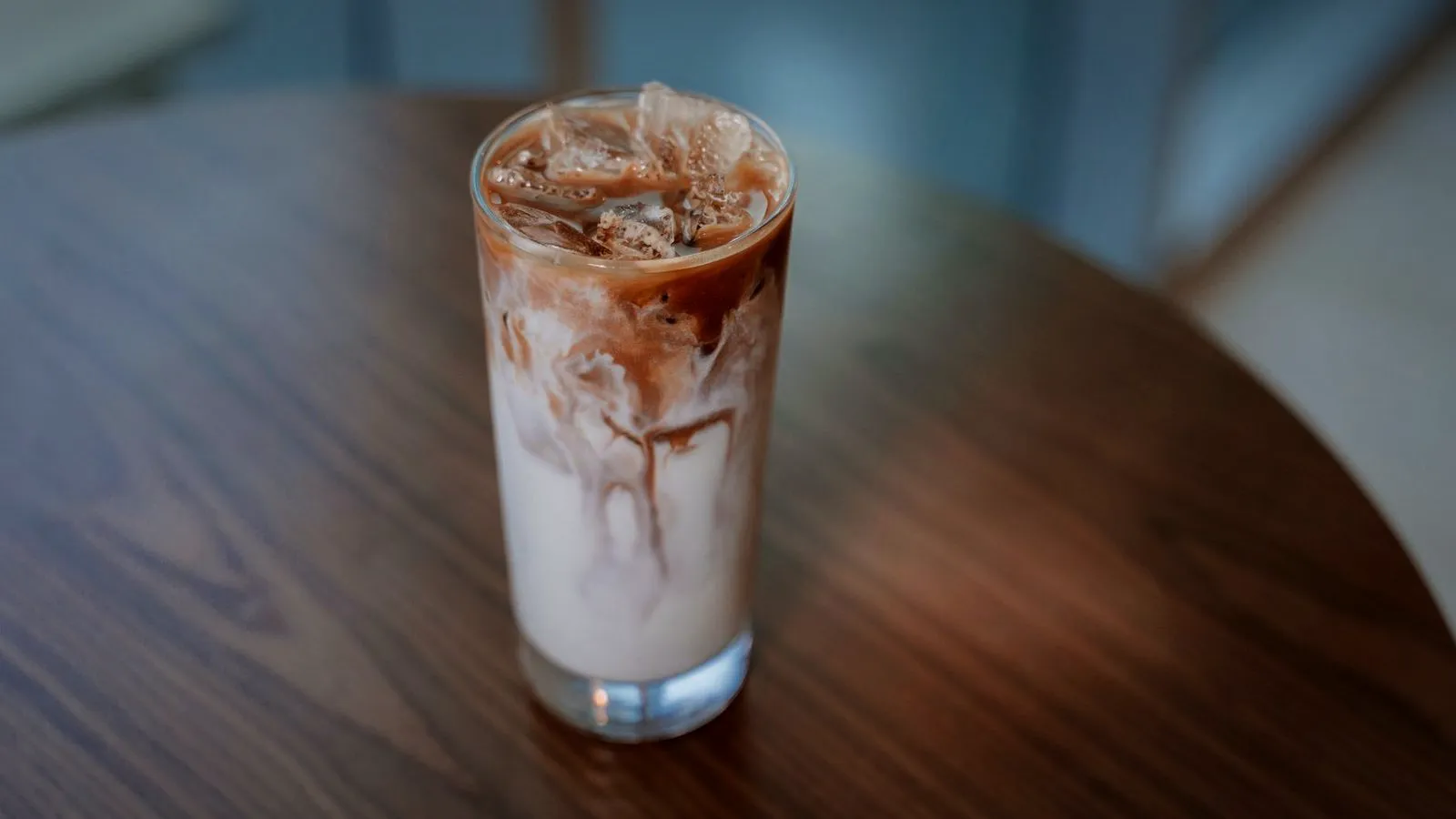
An iced latte is espresso and cold milk poured over ice. To make one, fill a 12–16 oz glass with ice, pour in a fresh double shot of espresso, then add about 6–9 oz of cold milk and stir. There is no milk to steam, and you can make it with a moka pot or instant espresso too.
It is the cold version of the classic latte, with the same espresso and milk but a little less milk to make room for the ice. If you want the basics of the hot drink first, see our explainer on what a latte is.
The short answer
| Iced latte recipe | Amount |
|---|---|
| Glass | 12–16 oz (350–475 ml) |
| Ice | Fill the glass |
| Espresso | Double shot, about 2 oz (60 ml) |
| Cold milk | About 6 oz (180 ml) in 12 oz, 8–9 oz (240–270 ml) in 16 oz |
| Sweetener (optional) | A spoonful or two of syrup, stirred into the hot espresso |
| Order | Ice, espresso, milk; or milk first and espresso on top for layers |
| Caffeine | About 126 mg with a double shot |
These amounts follow USDA’s reference iced latte and Starbucks’ sizes. Adjust the milk to taste.
What is an iced latte?
An iced latte is a latte made with cold milk instead of steamed milk and served over ice. Starbucks describes its Iced Caffè Latte as espresso combined with milk and served over ice, and its ingredient list is exactly that: milk, ice and espresso. Nothing is sweetened unless you add syrup.
USDA’s standard iced latte gives a useful reference recipe: about 62 g of espresso, 183 g of 2% milk and 111 g of ice, listed as water. That is roughly 2 oz of espresso to 6 oz of milk, a ratio near 1:3, which is stronger than a typical hot latte. The extra strength makes sense, because cold and melting ice both dull the coffee.
How to make an iced latte with an espresso machine

The easiest way to make an iced latte with an espresso machine is to pull the shot straight over ice and top it with cold milk. Here is the full method:
- Fill the glass with ice. Use a 12–16 oz glass and fill it to the top with ice.
- Pull a double shot. A double of about 18 g of coffee in and 36 g out in 25–30 seconds gives roughly 2 oz. For help with your machine, see how to use an espresso machine.
- Sweeten now, if you want. Stir a spoonful or two of syrup into the hot espresso so it dissolves completely.
- Pour the espresso over the ice. The ice chills it in seconds.
- Add the cold milk. Pour in about 6 oz for a 12 oz glass or 8–9 oz for a 16 oz glass.
- Stir and taste. Add a splash more milk if it is too strong, or another shot if it tastes milky.
The whole process is the same as a hot latte minus the steaming. Our guide on how to make a latte covers shot quality and milk choice in more depth.
Espresso first or milk first?
Espresso first is simpler and mixes evenly, while milk first creates the layered look. Starbucks’ home recipe fills a glass with ice, pours in the espresso and then adds the milk. For a striped drink, put ice and milk in first and pour the espresso slowly on top; it floats briefly before sinking.
Iced latte ratio by glass size
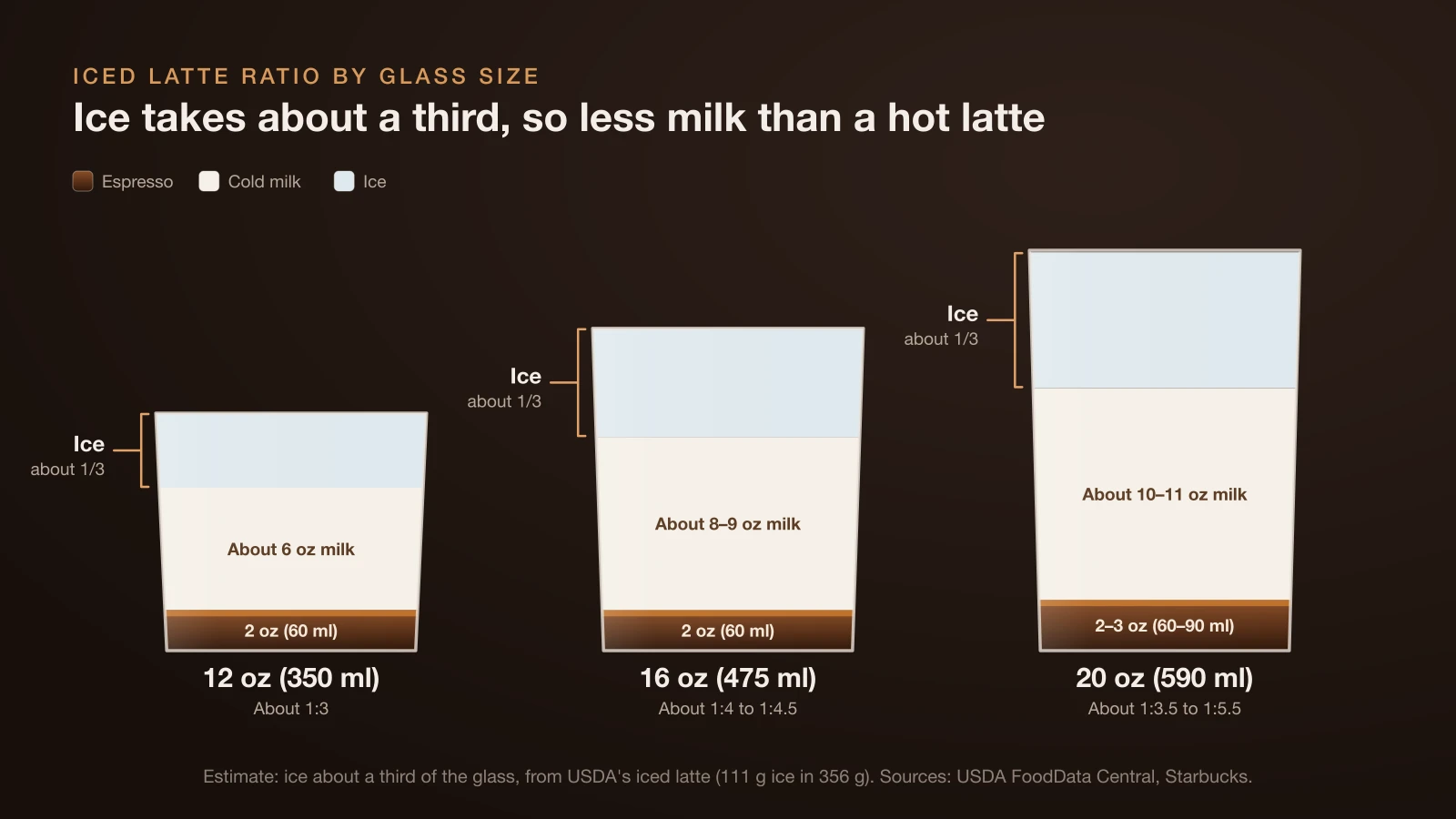
An iced latte needs less milk than a hot latte of the same cup size, because ice fills part of the glass. In USDA’s reference recipe, ice is 111 g of a 356 g drink, close to a third of the total. Assuming ice takes about a third of the glass and liquid the other two thirds, these amounts fill each size:
| Glass | Espresso | Cold milk | Espresso to milk |
|---|---|---|---|
| 12 oz (350 ml) | 2 shots, 2 oz (60 ml) | about 6 oz (180 ml) | about 1:3 |
| 16 oz (475 ml) | 2 shots, 2 oz (60 ml) | about 8–9 oz (240–270 ml) | about 1:4 to 1:4.5 |
| 20 oz (590 ml) | 2–3 shots, 2–3 oz (60–90 ml) | about 10–11 oz (300–325 ml) | about 1:3.5 to 1:5.5 |
These are estimates based on that one-third assumption. Large cubes leave more gaps for liquid, and crushed ice packs tighter, so pour the milk to the rim and stop.
For a café reference, Starbucks uses one shot in a 12 oz Tall Iced Caffè Latte, two in a 16 oz Grande and three in a 24 oz Venti. Our latte milk ratio guide compares these iced amounts with hot lattes.
How to make an iced latte without an espresso machine
You can make an iced latte without an espresso machine by using any strong, concentrated coffee as the base. Regular-strength coffee gets lost under ice and milk, so concentration matters more than the method.
- Moka pot. Starbucks’ own home iced latte recipe uses 4 oz of espresso-like coffee from a stovetop brewer, 1 cup of ice and 0.75 cup (6 oz) of whole milk. See how to use a moka pot for the brewing steps.
- Instant espresso. DeLallo, a maker of instant espresso powder, suggests 1 tablespoon of powder in 4 tablespoons (2 oz, 60 ml) of hot water for an espresso-style shot. Dissolve it fully in the hot water before adding ice and milk.
- AeroPress or French press concentrate. Brew strong, with less water than usual, and let it cool for a minute before pouring it over ice.
- Capsule machine. Starbucks suggests brewing a shot straight over a glass of ice, then adding cold milk.
None of these is true espresso, but all make a good iced latte-style drink. Our guide to making espresso without a machine compares the methods.
Shaken iced latte and cold milk foam
Shaking the milk is the easiest way to give an iced latte a foamy, café-style top without a frother. Starbucks’ home recipe pours the milk and any sweetener into a mason jar until it is three-quarters full, seals it, shakes hard, then pours the milk and its foam over the ice and espresso.
Whole milk gives a richer foam than skim. A handheld frother whisked in cold milk for a few seconds works too.
You can also shake the espresso itself. Shaking a hot shot hard with ice and a little syrup chills it and builds a light froth, which is the Italian espresso shakerato. Pour that over ice and add milk for a frothy shaken iced latte.
Iced vanilla, caramel and mocha lattes
Flavored iced lattes work best when the flavor goes into the hot espresso first, so it dissolves before meeting the cold milk.
- Iced vanilla latte: stir a spoonful or two of vanilla syrup into the shot, then build the drink as usual. Our vanilla latte guide includes a homemade syrup.
- Iced caramel latte: use caramel syrup in the same way. An iced caramel macchiato is different: vanilla syrup and milk go in first, the espresso is poured on top and caramel sauce is drizzled over it.
- Iced mocha latte: mix a spoonful or two of chocolate sauce into the hot espresso until smooth, then add ice and milk. Thick sauce will not blend into cold milk on its own.
- Seasonal flavors: pumpkin spice, hazelnut and brown sugar work the same way. See our list of latte flavors for more ideas.
Syrups add sugar and calories, so start with the smaller amount and taste.
Iced latte vs iced coffee
An iced latte is espresso with a lot of cold milk, while iced coffee is brewed coffee over ice with milk optional. Iced coffee usually has more caffeine and far fewer calories.
| Starbucks, Grande (16 oz) | Iced Caffè Latte | Iced Coffee (unsweetened) |
|---|---|---|
| Base | 2 shots of espresso | Brewed coffee |
| Caffeine | 150 mg | 185 mg |
| Calories | 130 kcal | 5 kcal |
For the full comparison, read latte vs coffee. If you want a cold espresso drink with no milk at all, an iced Americano is espresso and cold water over ice.
Iced latte caffeine and calories
An iced latte has about 63 mg of caffeine per shot of espresso, so roughly 126 mg with a double; ice and milk add none. USDA lists its reference iced latte at 37 mg of caffeine per 100 g, almost the same as a hot latte.
Starbucks publishes these figures for its Iced Caffè Latte made with 2% milk:
| Size | Shots | Caffeine | Calories | Sugar (from milk) |
|---|---|---|---|---|
| Tall, 12 fl oz | 1 | 75 mg | 100 kcal | 9 g |
| Grande, 16 fl oz | 2 | 150 mg | 130 kcal | 11 g |
| Venti, 24 fl oz | 3 | 225 mg | 180 kcal | 15 g |
An iced latte has fewer calories than a hot latte of the same size, because ice replaces some of the milk. More detail on sizes and chains is in our guide to caffeine in a latte.
Why is my iced latte watery?
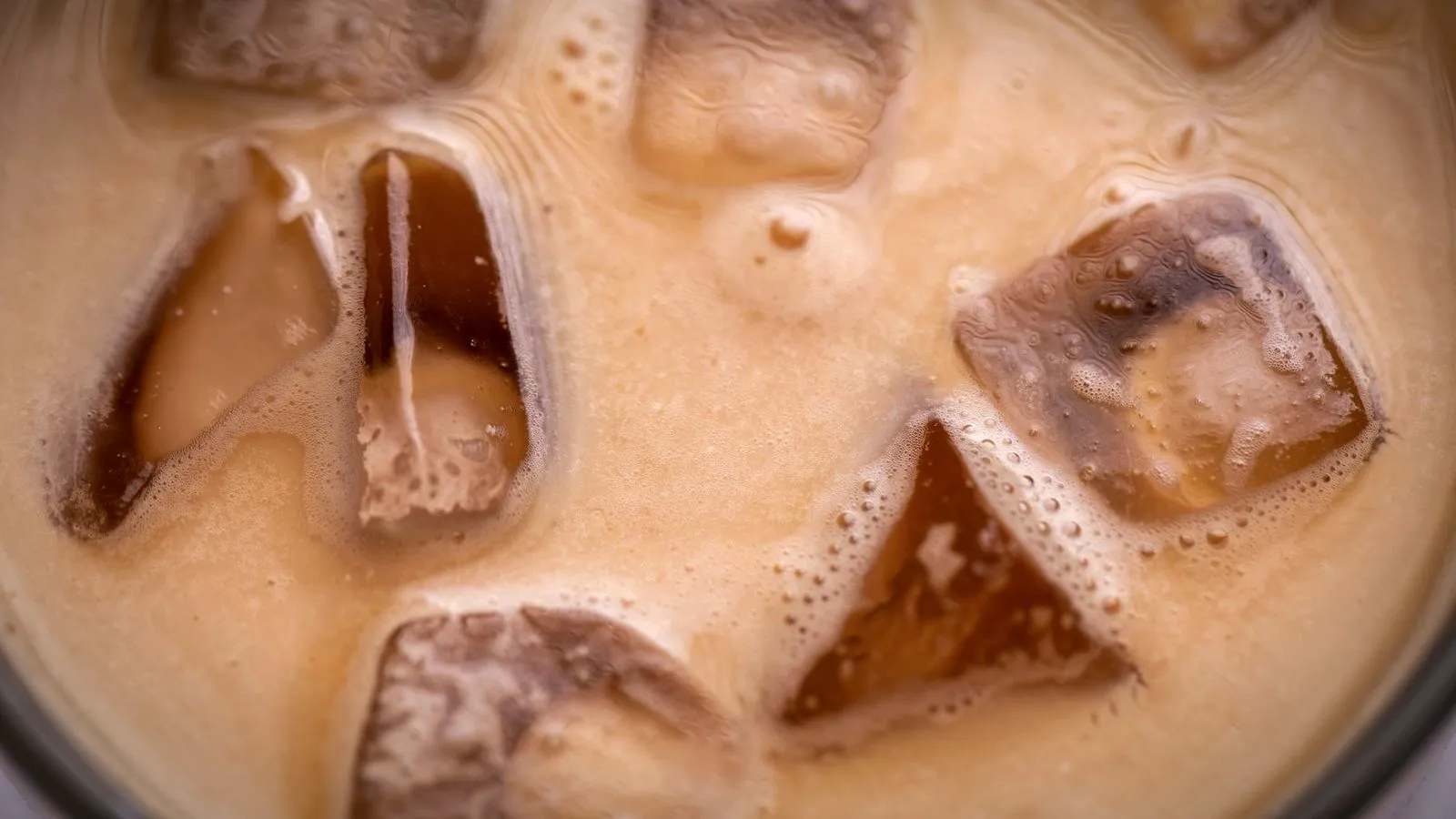
An iced latte goes watery when hot espresso melts too much ice or when the drink sits too long. A shot straight from the machine is still hot, so the first ice it hits melts quickly. These fixes help:
- Let the shot cool for a minute in a small cup before pouring it over the ice.
- Use coffee ice cubes. Freeze leftover coffee or espresso in an ice tray, so melting adds coffee instead of water.
- Use larger, colder cubes. Big cubes straight from the freezer melt more slowly than small or crushed ice.
- Keep the milk cold and go straight from the fridge to the glass.
- Add a shot. A third shot in a 16–20 oz glass keeps the coffee flavor through some melting.
- Drink it fresh. An iced latte does not hold well; make it right before serving.
The bottom line
An iced latte is espresso and cold milk over ice: a double shot with about 6 oz of milk in a 12 oz glass, or 8–9 oz in a 16 oz glass. Sweeten the hot espresso before it meets the ice, and use strong moka pot coffee or instant espresso if you have no machine. Cooling the shot or using coffee ice cubes keeps it from going watery.
Sources
- USDA FoodData Central: Coffee, Iced Latte (62 g espresso + 183 g 2% milk + 111 g ice as water; 37 mg caffeine per 100 g) and espresso (212 mg caffeine per 100 g; about 63 mg per 1 oz)
- Starbucks nutrition: Iced Caffè Latte (description, shots, caffeine, calories and sugar by size) and Iced Coffee (grande 185 mg, 5 kcal); Starbucks at Home: Iced Latte recipe (4 oz stovetop coffee, 1 cup ice, 0.75 cup whole milk; ice, espresso, then milk; shaken mason-jar foam; capsule method)
- DeLallo: All about espresso powder (1 tablespoon of instant espresso in 4 tablespoons of hot water)
- Specialty Coffee Association: Defining the ever-changing espresso (archived; barista survey: 18–20 g dose, 1:2 average ratio, 25–30 second shots)