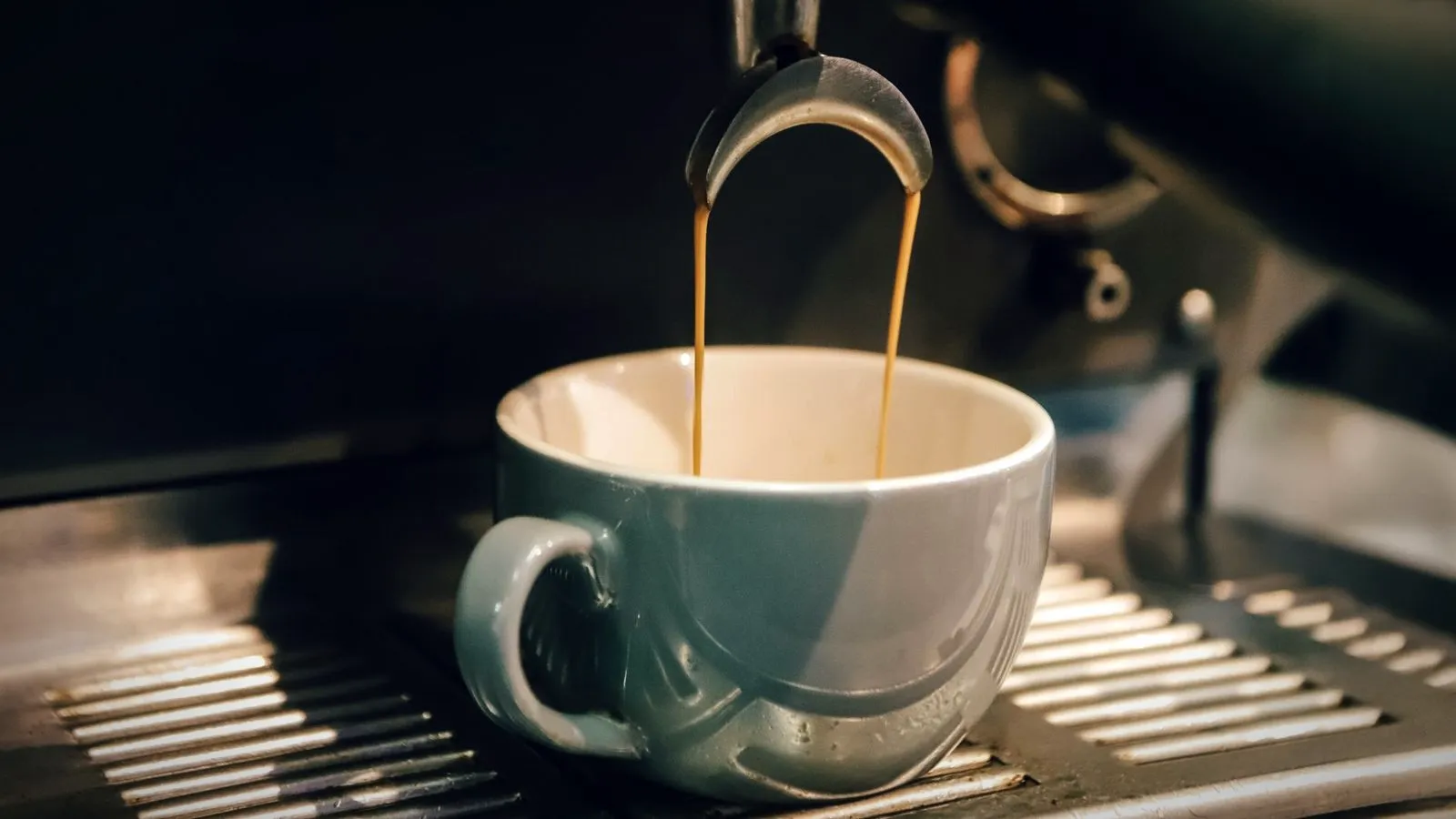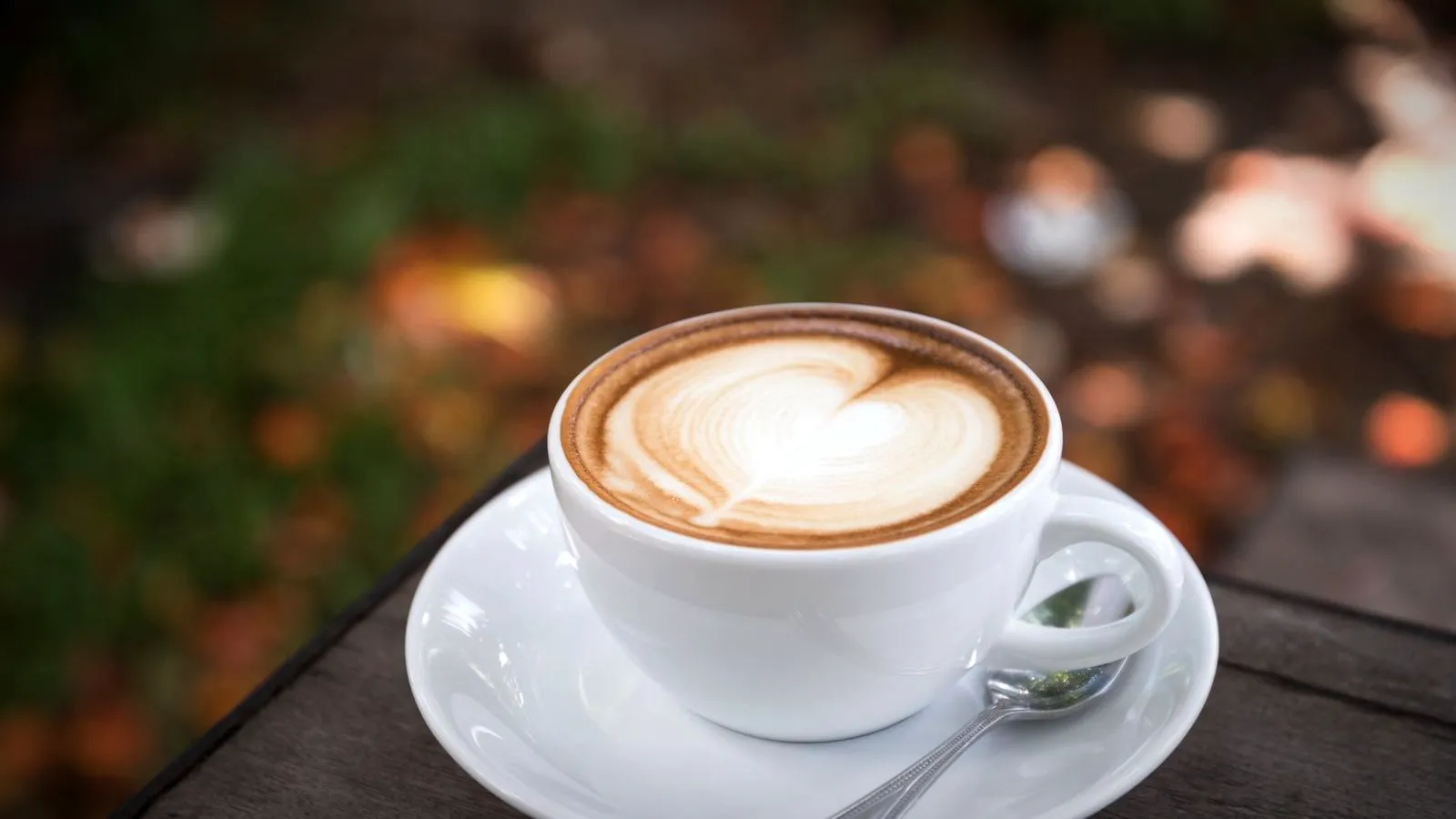

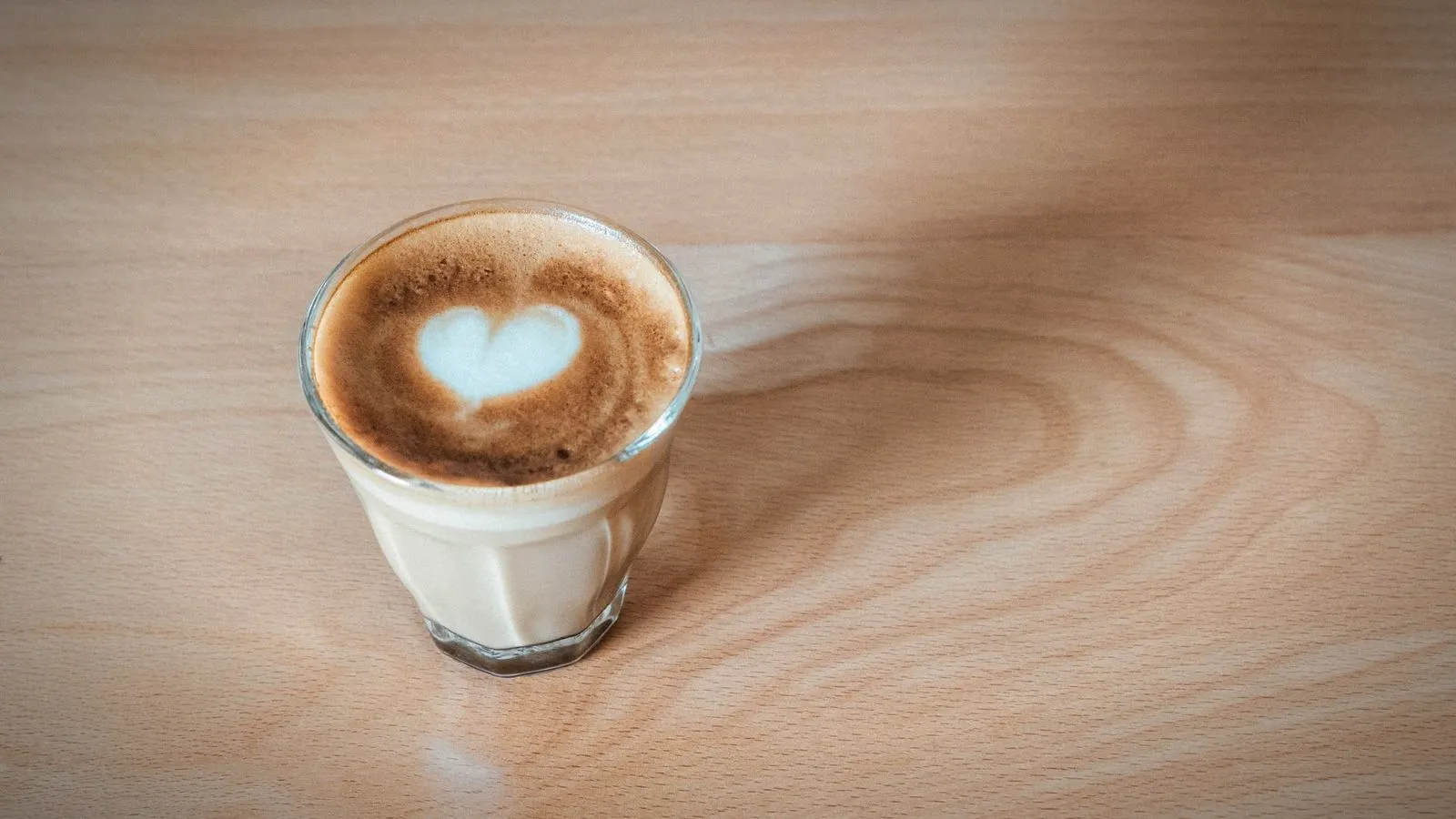
A cortado is a small espresso drink: a double shot of espresso “cut” with roughly the same amount of warm, lightly steamed milk, with little or no foam. It is usually about 4–4.5 oz (120–135 ml) in total, often served in a small glass, and it tastes strong but smooth, the milk softening the espresso’s sharp edges.
The name comes from the Spanish cortar, “to cut.” For how it stacks up against its milkier neighbor, see our side-by-side of cortado vs latte.
The short answer
| Cortado | |
|---|---|
| What it is | Espresso cut with about the same amount of warm milk |
| Meaning | Spanish for “cut,” from cortar |
| Pronunciation | kor-TAH-doh |
| Espresso | Usually a double, about 2 oz (60 ml) |
| Milk | About 2–2.5 oz, warm and lightly textured |
| Espresso to milk | About 1:1 |
| Foam | Little or none |
| Size | About 4–4.5 oz; often a 4.5 oz Gibraltar glass |
| Caffeine | About 126 mg with a double (USDA average); Starbucks lists 230 mg |
| Calories | About 40 kcal with 2 oz of whole milk and a double (USDA-based estimate); Starbucks lists 90 kcal |
| Origin | Spain |
Recipes vary by café and country, so read these as typical values; Starbucks figures are as of October 2026.
What is a cortado?
A cortado is espresso mixed with a roughly equal amount of steamed milk, which is how Webster’s New World College Dictionary, published by Collins, defines it. Starbucks describes its own version the same way: ristretto shots of espresso cut with steamed whole milk.
The milk is warmed and given very little air, so it blends into the espresso instead of sitting on top as foam. That keeps the drink dense and silky. On the scale of milkiness, a cortado sits between an espresso macchiato, which gets only a spoonful of foam, and a flat white. Our chart of types of espresso drinks shows the whole lineup.
Recipes drift by country. Collins’ British entry describes a small quantity of steamed milk poured over a single espresso, closer to a macchiato, while US cafés usually pour a double with equal milk.
What does cortado mean?
Cortado means “cut” in Spanish, from the verb cortar, because the milk cuts the strength of the espresso. Collins glosses the origin as “cut, diluted,” and Starbucks explains that the boldness of the espresso is cut with steamed milk in the classic recipe.
Collins gives the American pronunciation as /kɔrˈtɑdoʊ/, roughly kor-TAH-doh, with the stress on the middle syllable. The plural is cortados.
Where does the cortado come from?
The cortado comes from Spain, where it is an everyday café order. Starbucks traces it to Spain’s Basque Country more than a century ago and calls it part of coffee culture across the Spanish-speaking world.
In the US, Starbucks says customers in South Florida and Chicago had long asked for a cortado before the company added it to its US menu in January 2025. The Cuban cortadito, made with sweetened Cuban-style espresso, is a sweeter local variation.
Cortado ratio, size and shots
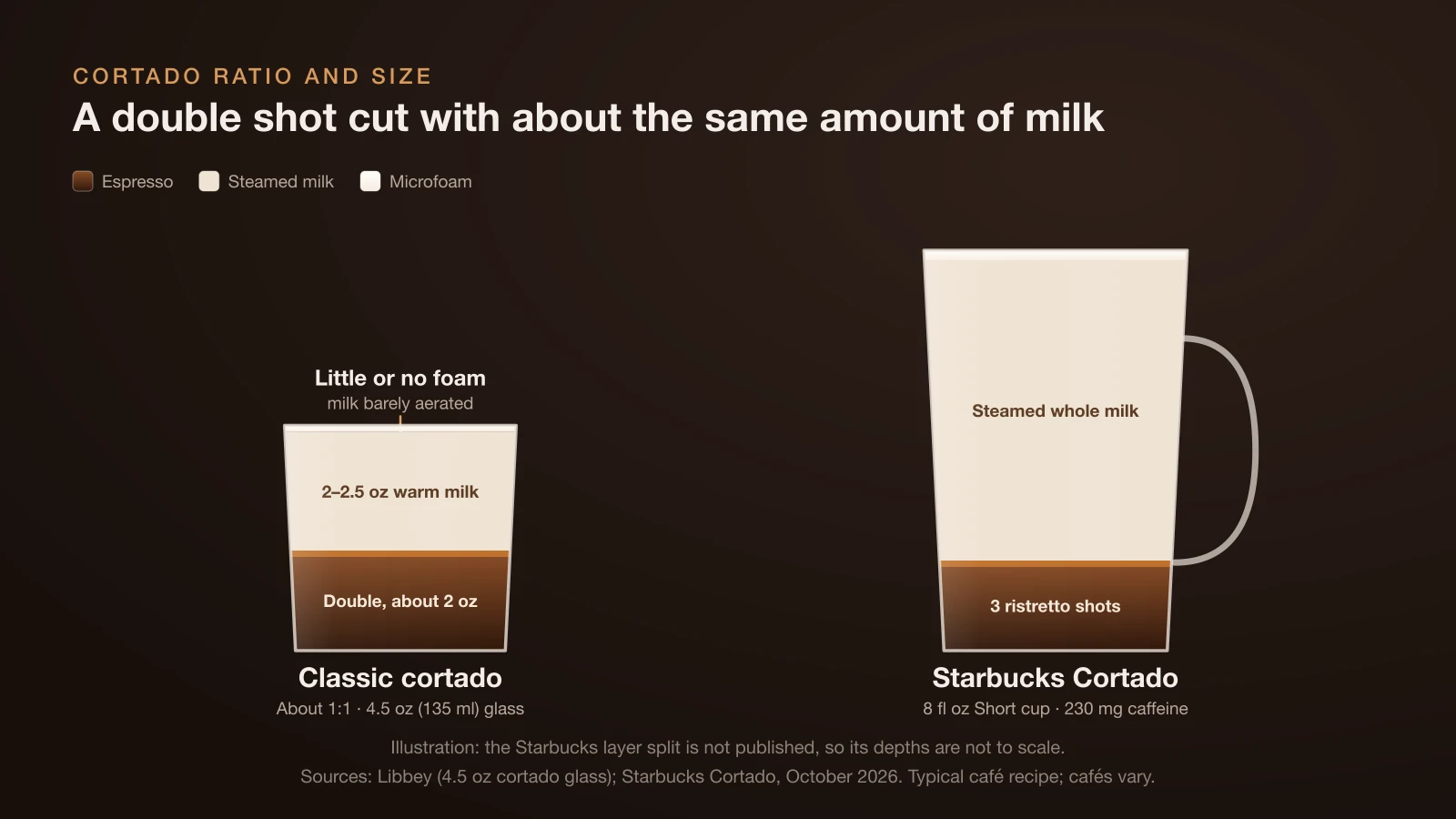
A cortado uses about a 1:1 ratio of espresso to milk, usually a double shot of about 2 oz with 2–2.5 oz of milk, for about 4–4.5 oz in total.
| Part | Typical amount |
|---|---|
| Espresso | Usually a double, about 2 oz (60 ml) |
| Milk | About 2–2.5 oz of warm, lightly textured milk |
| Foam | Little or none, a thin skin at most |
| Total | About 4–4.5 oz (120–135 ml) |
| Glass | Often a 4.5 oz glass |
How many shots are in a cortado? Usually two: a double of about 2 oz fills roughly half of a 4.5 oz glass. Starbucks builds its Cortado on three ristretto shots, short pulls that taste sweeter and more concentrated; our guide to the ristretto explains the difference.
How many ounces is a cortado? About 4–4.5 oz in a traditional glass. The Starbucks Cortado is served in its 8 fl oz Short cup, so it is larger than the classic version.
How to make a cortado at home
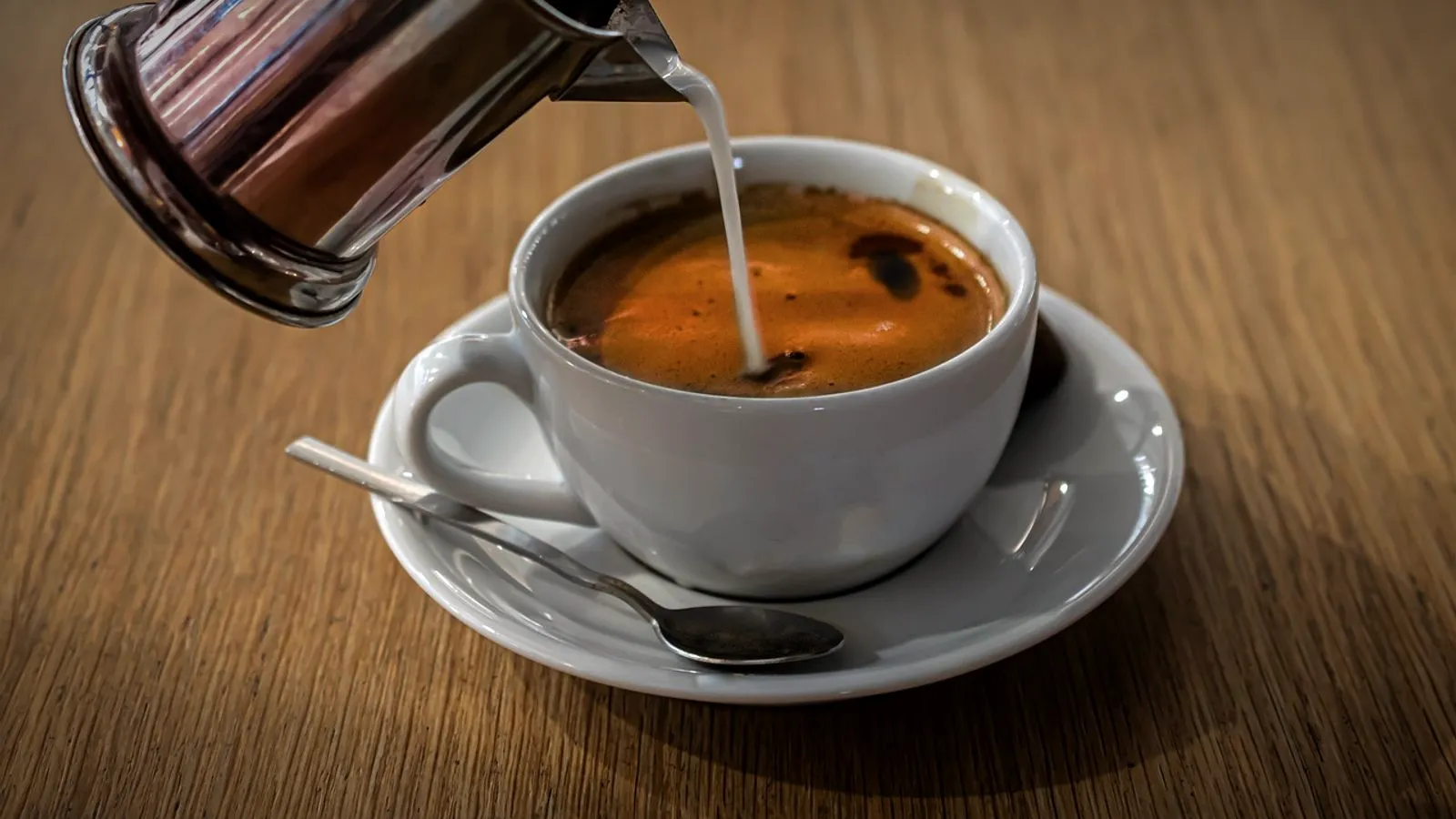
You make a cortado by pulling a double shot into a small glass and adding about the same amount of warm, barely aerated milk. You need an espresso machine with a steam wand, your smallest milk pitcher and a glass of about 4.5 oz.
- Pull a double shot. Brew about 2 oz of espresso straight into the glass; our guide to the doppio covers dose, yield and time.
- Pour the milk. Put about 3–4 oz of cold milk in the pitcher, the least your wand can steam well.
- Add almost no air. Open the steam with the tip just at the surface for a second or two, then sink it slightly so the milk swirls.
- Stop at 60–65 °C (140–150 °F). That is about when the pitcher becomes too hot to hold.
- Pour to equal parts. Add about 2 oz of milk to the espresso, holding back most of the foam with a spoon or the pitcher spout.
- Serve right away. A cortado is small and cools quickly.
You will have leftover milk, which is normal with such a small drink. Our guide on how to steam milk covers the technique in detail. Without a machine, strong moka pot coffee topped with an equal amount of warm milk makes a fair stand-in, though not true espresso.
The cortado cup: the Gibraltar glass
In the US, a cortado is often served in a small, heavy 4.5 oz (about 135 ml) glass. Libbey sells its faceted Gibraltar glass in that size as a cortado glass, and some cafés call the drink itself a Gibraltar after it.
That size is not an accident: a double shot of about 2 oz plus a similar amount of milk fills it almost to the rim. A glass also shows the drink’s caramel color, while a small thick ceramic cup holds the heat longer. Either works; our guide to ceramic espresso cups compares cup sizes and materials.
How much caffeine is in a cortado?
A cortado has the caffeine of its espresso shots, about 126 mg with a double on USDA averages, because milk adds none. USDA FoodData Central lists espresso at 212 mg of caffeine per 100 g, or about 63 mg per 1 oz shot.
| Cortado | Caffeine |
|---|---|
| Single-shot cortado | About 63 mg |
| Double-shot cortado | About 126 mg |
| Starbucks Cortado, 3 ristretto shots | 230 mg |
| Starbucks Brown Sugar Oatmilk Cortado | 230 mg |
| 8 oz brewed coffee, for comparison | About 95 mg |
So a standard cortado carries more caffeine than a small mug of drip coffee, and the Starbucks version more than twice as much. Café shots vary with dose and beans; for the details, see caffeine in a shot of espresso.
What does a cortado taste like?
A cortado tastes strong, smooth and balanced: clearly espresso, with the milk rounding off its acidity and bitterness. Because there is so little foam, the texture is silky rather than airy, and every sip tastes the same from top to bottom.
Warm milk also adds a gentle sweetness of its own, so many people drink a cortado without sugar. Darker roasts come through as chocolate and caramel; lighter roasts keep more fruit and brightness. If a macchiato is too sharp for you and a latte too milky, the cortado is the middle ground.
Starbucks Cortado and Brown Sugar Oatmilk Cortado
Starbucks sells two core cortados in the US, both built on three ristretto shots of its Blonde Espresso and served hot in an 8 fl oz Short cup.
| Starbucks, as of October 2026 | Cortado | Brown Sugar Oatmilk Cortado |
|---|---|---|
| Espresso | 3 ristretto shots, Blonde Espresso | 3 ristretto shots, Blonde Espresso |
| Milk | Steamed whole milk | Steamed oatmilk |
| Flavor | None | Brown sugar syrup and cinnamon, with a dash of cinnamon on top |
| Calories | 90 kcal | 130 kcal |
| Sugar | 6 g | 14 g |
| Caffeine | 230 mg | 230 mg |
In October 2026 its menu also listed flavored versions, such as a Pecan Cortado and a Pistachio Cortado. To make a brown sugar cortado at home, stir a little brown sugar syrup and a pinch of cinnamon into the espresso before adding steamed oat milk; our oat milk latte guide explains which oat milks steam best.
Iced cortado
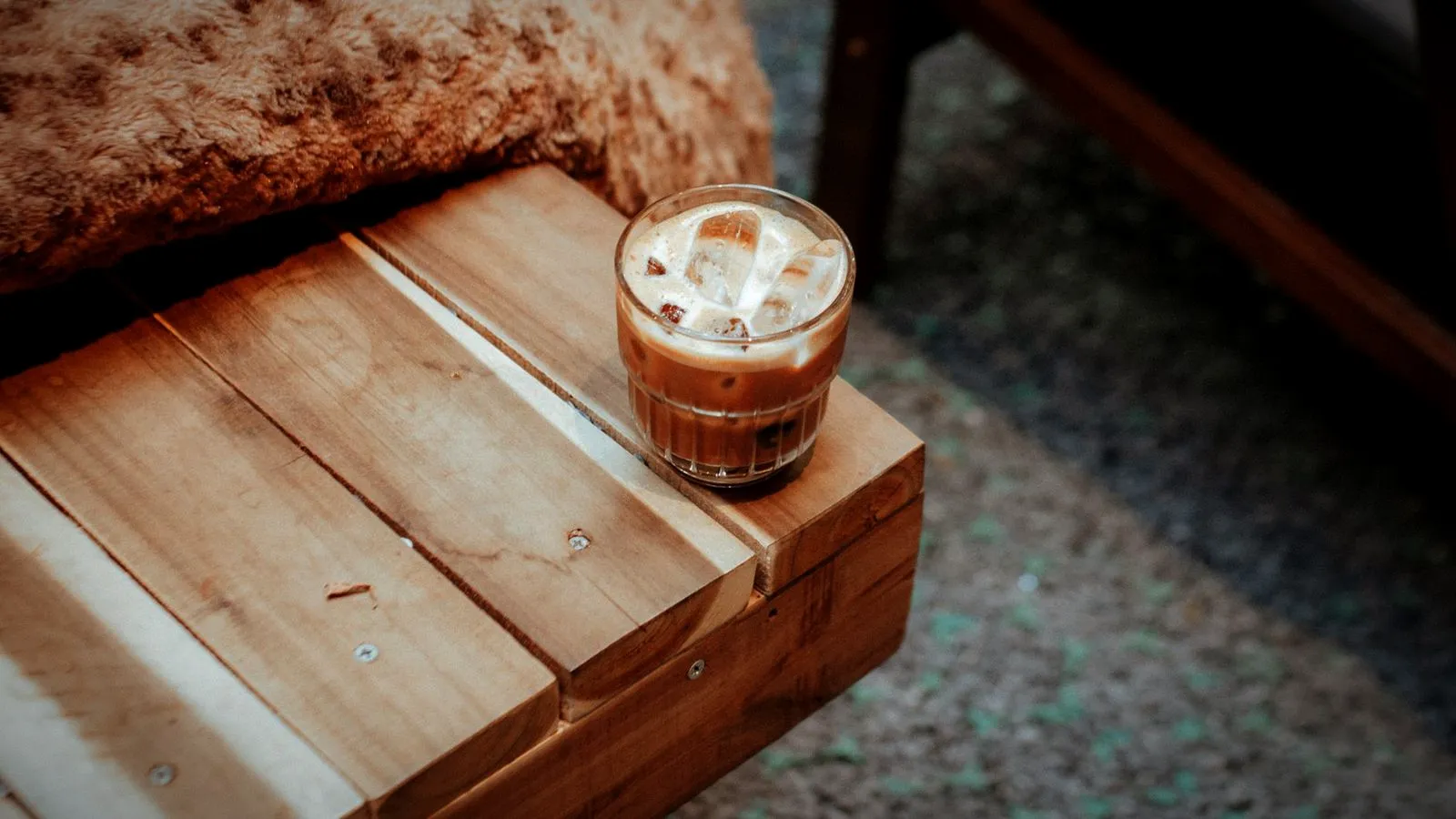
An iced cortado is a double shot poured over a few ice cubes in a small glass, topped with about the same amount of cold milk. It keeps the 1:1 balance of the hot drink, but ice takes up space, so use a slightly larger glass than the 4.5 oz cortado glass.
Pour the espresso over the ice first so it chills quickly, then add the milk. Starbucks lists its cortados as hot drinks only, so an iced cortado is one to make at home or to ask for at cafés that offer it.
How a cortado compares with other milk drinks
A cortado has more milk than a macchiato but less than a flat white, cappuccino or latte, and much less foam than a cappuccino.
| Drink | Espresso | Milk | Foam | Typical size |
|---|---|---|---|---|
| Espresso macchiato | 1–2 shots | A spoonful or two of foam | A small cap | About 1–2 oz |
| Cortado | Usually a double | About equal to the espresso | Little or none | About 4–4.5 oz |
| Flat white | Single or double | Less than a latte | About 1/4 in (6 mm) of microfoam | Cup of 8 oz or less |
| Cappuccino | 1 shot, 25 ml (IEI) | 100 ml steamed milk (IEI) | Thick, at least 1 cm | 150–180 ml (5–6 oz) |
| Latte | 1–2 shots | About 5–10 oz (150–300 ml) | Thin | 8 oz and up |
The cappuccino row follows the Istituto Espresso Italiano (IEI) standard. Our cortado vs latte guide compares the cortado with each of these in detail. For the neighbors on either side, see flat white vs latte, macchiato vs cappuccino and our explainer on what a cappuccino is.
The bottom line
A cortado is espresso cut with about the same amount of warm milk: usually a double shot and 2–2.5 oz of milk in a 4.5 oz glass, with little foam. It tastes strong but smooth and carries the caffeine of its shots, about 126 mg for a double. Make one at home by steaming a small amount of milk with almost no air and pouring it into the shot at roughly equal parts.
Sources
- Starbucks, as of October 2026: Cortado, Brown Sugar Oatmilk Cortado, Pecan Cortado and Pistachio Cortado nutrition (build, 8 fl oz, calories, sugar, caffeine; all listed hot only), Tiny but mighty: Meet Starbucks Cortado (archived; origin, cortar, 2025 launch) and Starbucks espresso explained (archived; ristretto shots cut with steamed whole milk)
- USDA FoodData Central: espresso (212 mg caffeine and 9 kcal per 100 g; 1 fl oz = 29.6 g), whole milk (61 kcal per 100 g; 1 fl oz = 30.5 g) and brewed coffee (about 95 mg per 8 oz)
- Collins: cortado (archived; definitions, pronunciation, origin); Libbey: Gibraltar DuraTuff cortado glasses, 4.5 oz
- Breville: Latte recipe (milk at 60–65 °C, 140–150 °F), Cappuccino recipe (non-dairy milk at or below 55 °C, 130 °F) and How to make a flat white at home (cup of 8 oz or less, microfoam about a quarter inch)
- Cappuccino references: Istituto Espresso Italiano, Certified Italian Cappuccino (25 ml espresso, 100 ml steamed milk) and World Coffee Events, 2015 World Barista Championship rules (archived; 150–180 ml, at least 1 cm of foam)