

Flat white vs latte comes down to size and milk. A flat white is espresso, often a double shot, with a short pour of steamed milk and a thin layer of microfoam, usually 5–6 oz in total. A latte uses one or two shots with much more milk, typically 8 oz or larger.
Both drinks are made from the same espresso and the same steamed milk, which is why they look alike in the cup. The difference is how much milk goes in and how deep the foam sits on top. For a full definition of the larger drink, see our guide on what a latte is.
The short answer
| Flat white | Latte | |
|---|---|---|
| What it is | Espresso, often a double, with a little silky milk and thin microfoam | Espresso with plenty of steamed milk and a thin foam layer |
| Espresso | Single or double shot; often a double | 1–2 shots, 1–2 oz (30–60 ml) |
| Milk | Less than a latte | About 5–10 oz (150–300 ml) of steamed milk |
| Foam | About 1/4 in (6 mm) of microfoam | About 10 mm (just under 1/2 in) |
| Typical size | About 5–6 oz, in a cup of 8 oz (240 ml) or less | 8 oz and up |
| Espresso to milk | Stronger than a latte; about 1:1.5 to 1:2 with a double (estimate) | About 1:3 to 1:5 |
| Taste | Coffee-forward, velvety | Mild, creamy, naturally sweet |
| Caffeine | Same as the shots inside | Same as the shots inside |
| Calories (home, whole milk) | About 80 kcal (estimate) | About 155 kcal in a 12 oz cup (estimate) |
Recipes change from café to café. The flat white ratio is our estimate for a 2 oz double in a 5–6 oz drink; the latte figures follow our latte milk ratio guide.
What is the difference between a flat white and a latte?
The difference between a flat white and a latte is the ratio of milk to espresso, plus the depth of the foam. Breville describes the flat white as having a distinct texture combined with a shorter ratio of milk to espresso.
- Flat white: a small drink built on a single or double shot, often a double. The milk is steamed with only a little air, so the surface stays level, or “flat,” with a layer of microfoam about a quarter inch deep.
- Latte: short for caffè latte, “milk coffee.” One or two shots are topped with several ounces of steamed milk and a thin layer of foam. Milk is the main ingredient, and the espresso flavors it.
The two also come from different places. Breville notes that the latte originated in late 19th-century Italy, while the flat white is claimed by both Australia and New Zealand.
Flat white vs latte: size and milk ratio
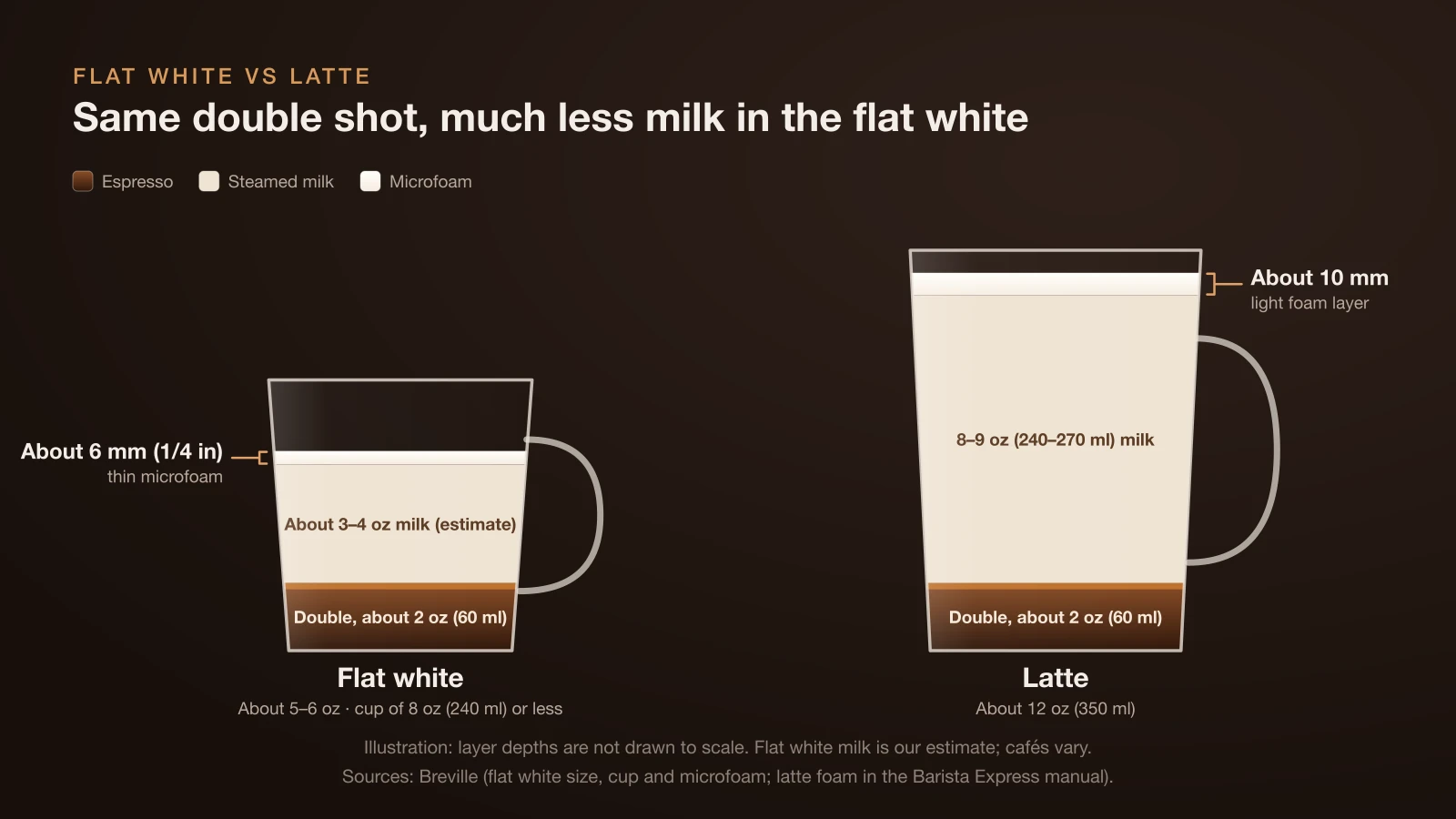
A flat white is usually 5–6 oz in a cup of 8 oz or less, while a latte is usually 8 oz or larger and carries three to five times as much milk as espresso. Breville calls flat whites generally 5 to 6 oz and suggests a cup no larger than 8 oz to keep the drink strong.
| Flat white | Latte (12 oz cup) | |
|---|---|---|
| Espresso | Double, about 2 oz (60 ml) | Double, about 2 oz (60 ml) |
| Steamed milk | About 3–4 oz (90–120 ml), estimate | 8–9 oz (240–270 ml) |
| Foam layer | About 1/4 in (6 mm) | About 10 mm |
| Total | About 5–6 oz (150–180 ml) | About 12 oz (350 ml) |
The latte column follows our cup-size table: a 12 oz latte holds a double shot and 8–9 oz of steamed milk. The flat white column is an estimate: a 2 oz double in a 5–6 oz drink leaves roughly 3–4 oz for milk and foam, a ratio near 1:1.5 to 1:2.
Milk texture: thin microfoam vs a light foam layer
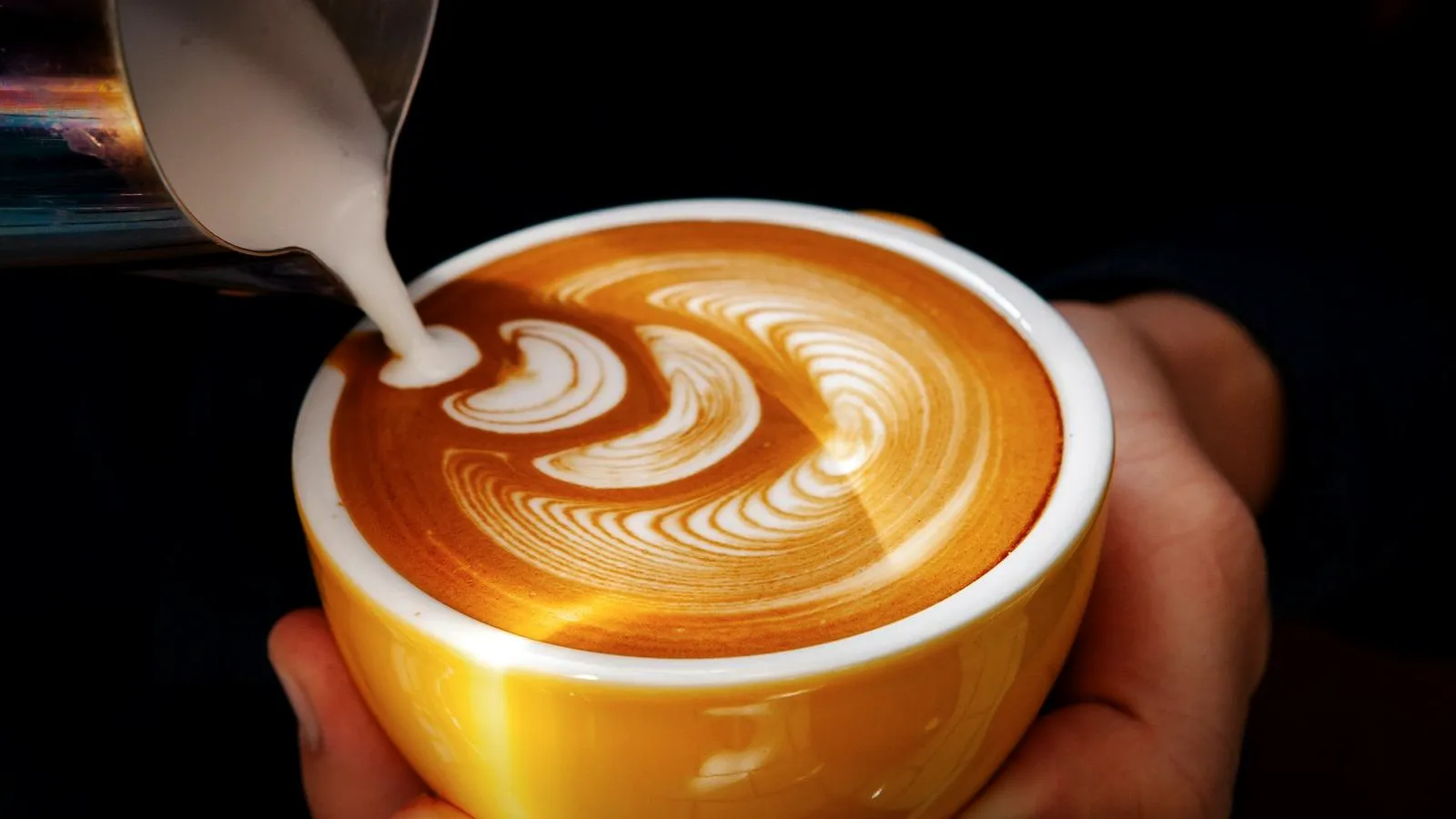
Both drinks use microfoam, but a flat white keeps it thinner and more blended into the milk. Breville describes the flat white’s milk as “relatively flat” across the surface, with a textured layer about a quarter inch (6 mm) deep. Breville’s machine manual gives a latte about 10 mm of foam.
- Flat white: air goes in for only a moment, so the milk turns glossy and smooth, like wet paint. It mixes into the espresso, and every sip tastes much the same.
- Latte: a little more air goes in, enough for a light foam cap that still pours easily and holds latte art.
Both are steamed to about 60–65 °C (140–150 °F). Our guide on how to steam milk explains how long to add air for each texture.
Is a flat white stronger than a latte?
A flat white tastes stronger than a latte because the same espresso meets less milk. In caffeine, the answer depends only on the number of shots, since milk adds none.
USDA data puts espresso at about 212 mg of caffeine per 100 g, roughly 63 mg in a 1 oz single and 126 mg in a 2 oz double. A double-shot flat white and a double-shot latte therefore carry about the same caffeine. A one-shot latte carries about half.
Chains often give the flat white more shots. Starbucks makes its flat white with ristretto shots, shorter and sweeter pulls of espresso, and lists 130 mg of caffeine for a 12 oz Tall Flat White (two shots) against 75 mg for a Tall Caffè Latte (one shot). For per-shot numbers, see how much caffeine is in an espresso shot.
Flat white vs latte calories
Nearly all the calories in both drinks come from milk, so the latte, with more milk, usually has more. Espresso adds only about 3 kcal per shot.
Here is a home estimate with whole milk, which USDA lists at 61 kcal per 100 g (about 30.5 g per fluid ounce):
- Flat white, double shot plus about 4 oz (122 g) of whole milk: about 75 kcal from the milk, so roughly 80 kcal in total.
- 12 oz latte, double shot plus 8 oz of whole milk: about 155 kcal, the figure in our calories in a latte guide.
These estimates assume plain whole milk and no syrup.
Starbucks flat white vs latte
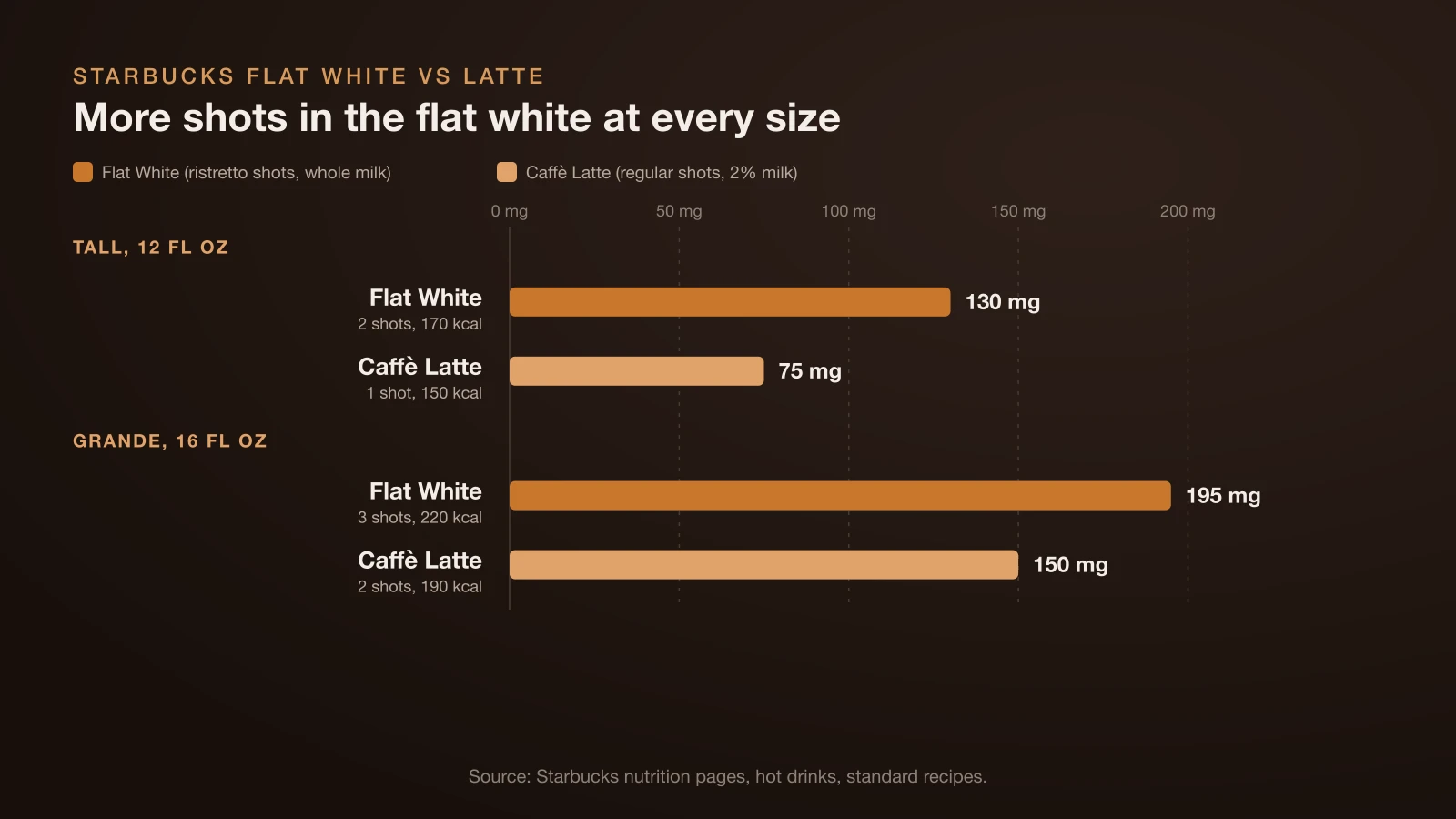
At Starbucks, the flat white uses ristretto shots and whole milk, while the Caffè Latte uses regular espresso shots and 2% milk. Starbucks describes the Flat White as ristretto shots with steamed whole milk, and the latte as espresso with steamed milk and a light layer of foam. Starbucks introduced the flat white to its US stores on January 6, 2015.
| Starbucks, hot | Flat White | Caffè Latte |
|---|---|---|
| Espresso | Ristretto shots | Standard shots |
| Default milk | Whole milk | 2% milk |
| Tall (12 fl oz) | 2 shots, 170 kcal, 130 mg | 1 shot, 150 kcal, 75 mg |
| Grande (16 fl oz) | 3 shots, 220 kcal, 195 mg | 2 shots, 190 kcal, 150 mg |
| Sugars, Grande (from milk) | 17 g | 18 g |
At Starbucks, the flat white is the stronger drink at every size, though in a 12 or 16 oz cup it is far larger than a traditional one.
Iced flat white vs iced latte
An iced flat white is built like an iced latte but with ristretto shots and whole milk, so it tastes stronger and richer. Starbucks lists its Iced Flat White and Iced Caffè Latte this way:
| Starbucks, iced Grande (16 fl oz) | Iced Flat White | Iced Caffè Latte |
|---|---|---|
| Espresso | 3 ristretto shots | 2 shots |
| Milk | Whole milk | 2% milk |
| Calories | 150 kcal | 130 kcal |
| Caffeine | 195 mg | 150 mg |
Ice takes the place of steamed microfoam, so the textural difference mostly disappears in the iced versions. What remains is the stronger coffee and the creamier milk. Our iced latte recipe covers glass sizes and milk amounts at home.
Cortado vs flat white vs latte
A cortado is the strongest of the three, a flat white sits in the middle and a latte is the milkiest. All three start with espresso; only the milk changes.
| Cortado | Flat white | Latte | |
|---|---|---|---|
| Espresso | Usually a double | Single or double; often a double | 1–2 shots |
| Milk | About equal to the espresso | Less than a latte | 5–10 oz (150–300 ml) |
| Foam | Little or none | About 1/4 in (6 mm) | About 10 mm |
| Size | About 4–4.5 oz | About 5–6 oz | 8 oz and up |
A cortado cuts the espresso with about the same amount of warm milk and little foam. Our cortado vs latte comparison covers it in detail. For the foamier cousin, read flat white vs cappuccino, and for every milk drink in one table, see cappuccino vs latte vs macchiato.
How to make a flat white and a latte at home
At home, both drinks start with a well-pulled shot; the flat white then gets less milk and less air. Follow the same steps for each and change only the cup and the milk.
Flat white
- Pull a double shot, about 2 oz (60 ml), into a cup of 8 oz or less.
- Steam cold milk to 60–65 °C (140–150 °F), adding air for only a second or two so it stays glossy.
- Pour about 3–4 oz of milk steadily, finishing with a level layer of microfoam about a quarter inch (6 mm) deep.
Latte
- Pull one or two shots into a 10–12 oz cup.
- Steam 7–9 oz of cold milk to the same temperature, adding air a little longer.
- Pour, leaving about 10 mm of foam on top.
For the full method, including latte art, follow our guide on how to make a latte.
Which one should you order?
Order a flat white if you want to taste the espresso clearly in a small, velvety drink, and a latte if you want a larger, milder, creamier cup.
| Choose a flat white if you… | Choose a latte if you… |
|---|---|
| Want the coffee to come through clearly | Prefer a mild, milky drink |
| Like a small, silky drink | Want a large cup to sip slowly |
| Usually order a double shot | Plan to add syrup or spices |
| Want fewer calories from milk | Like a little more foam and room for latte art |
If you like the latte but want more coffee flavor, add a shot rather than cutting milk.
The bottom line
A flat white is espresso, often a double, with a short pour of silky milk and about a quarter inch of microfoam: small, smooth and coffee-forward. A latte uses the same espresso with far more milk and a slightly deeper foam layer: larger, milder and creamier. Caffeine follows the number of shots, and calories follow the milk. Pick the flat white for strength and the latte for a long, gentle cup.
Sources
- Breville: How to make a flat white at home (single or double shot, cup no larger than 8 oz, microfoam about a quarter inch deep, shorter ratio of milk to espresso, claimed by Australia and New Zealand), How are flat whites, cappuccinos & lattes different? (flat whites generally 5 to 6 oz; latte from late 19th-century Italy) and Barista Express BES875 instruction book (latte with about 10 mm of foam)
- USDA FoodData Central: Beverages, coffee, brewed, espresso, restaurant-prepared (212 mg caffeine and 9 kcal per 100 g) and Milk, whole, 3.25% milkfat (61 kcal per 100 g; 1 fl oz = 30.5 g)
- Starbucks nutrition: Flat White, Caffè Latte, Iced Flat White and Iced Caffè Latte (descriptions, shots, milk, calories, sugar and caffeine by size)
- Starbucks: Starbucks espresso explained (archived; ristretto shots as the base of the Flat White) and Fact Sheet: Starbucks Flat White (archived; US launch on January 6, 2015)