
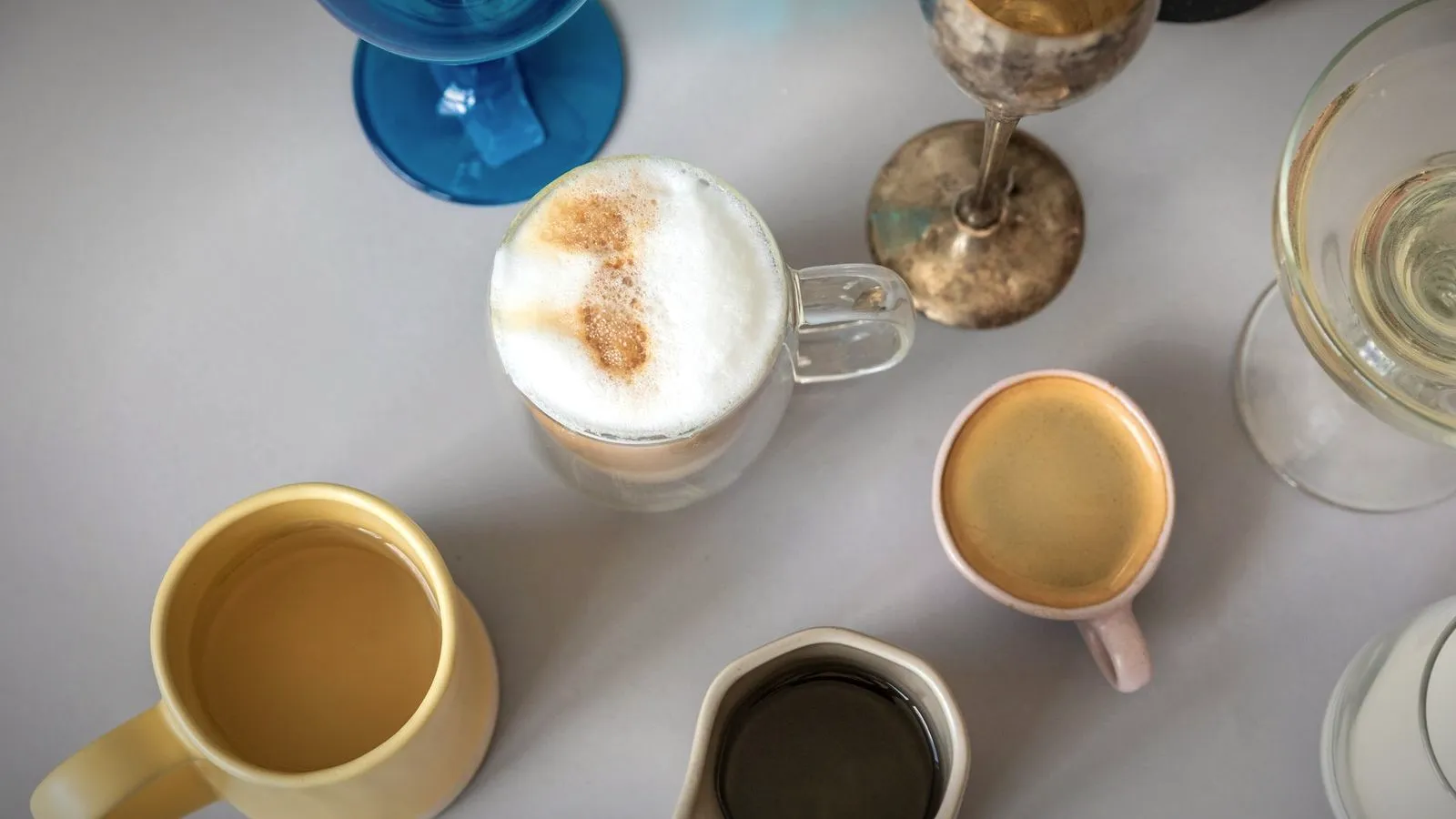
Cappuccino vs latte vs macchiato is a question of how much milk meets the espresso. A macchiato is a shot with a spoonful of foam, about 1–2 oz. A cappuccino adds about 100 ml of milk under a thick foam cap, about 5–6 oz. A latte adds the most steamed milk and a thin foam layer, 8 oz and up.
All three start with the same espresso, and so does the flat white, which this guide adds as a fourth drink. Read on for the master comparison, a layer-by-layer look at each cup and a quick way to decide which one to order. For the wider café menu, see our chart of types of espresso drinks.
The short answer
| Macchiato (espresso macchiato) | Cappuccino | Flat white | Latte | |
|---|---|---|---|---|
| Espresso | 1 or 2 shots | 1 shot, 25 ml, in the Italian standard; often 2 elsewhere | Single or double; often a double | 1–2 shots, 1–2 oz (30–60 ml) |
| Milk | About 2 teaspoons of foam | About 100 ml (3.4 oz) | Less than a latte | About 5–10 oz (150–300 ml) |
| Foam | A small spot on the crema | Thick, 1 cm or more | About 1/4 in (6 mm) of microfoam | About 10 mm |
| Typical size | About 1–2 oz | About 5–6 oz (150–180 ml) | Cup of 8 oz (240 ml) or less | 8 oz and up |
| Espresso to milk | Mostly espresso | About 1:4, much of it foam | Stronger than a latte | About 1:3 to 1:5 |
| Taste | Intense, espresso-forward | Balanced, light, airy | Coffee-forward, velvety | Mild, creamy, sweet |
| Caffeine | Same as the shots inside | Same as the shots inside | Same as the shots inside | Same as the shots inside |
| Calories (whole milk, home size) | Under 10 kcal | About 65 kcal | About 80 kcal (estimate) | About 155 kcal (12 oz) |
Cafés pour their own versions. Treat these as typical reference values, not fixed recipes; the calorie figures are estimates from USDA milk data.
What is the difference between a cappuccino, a latte and a macchiato?
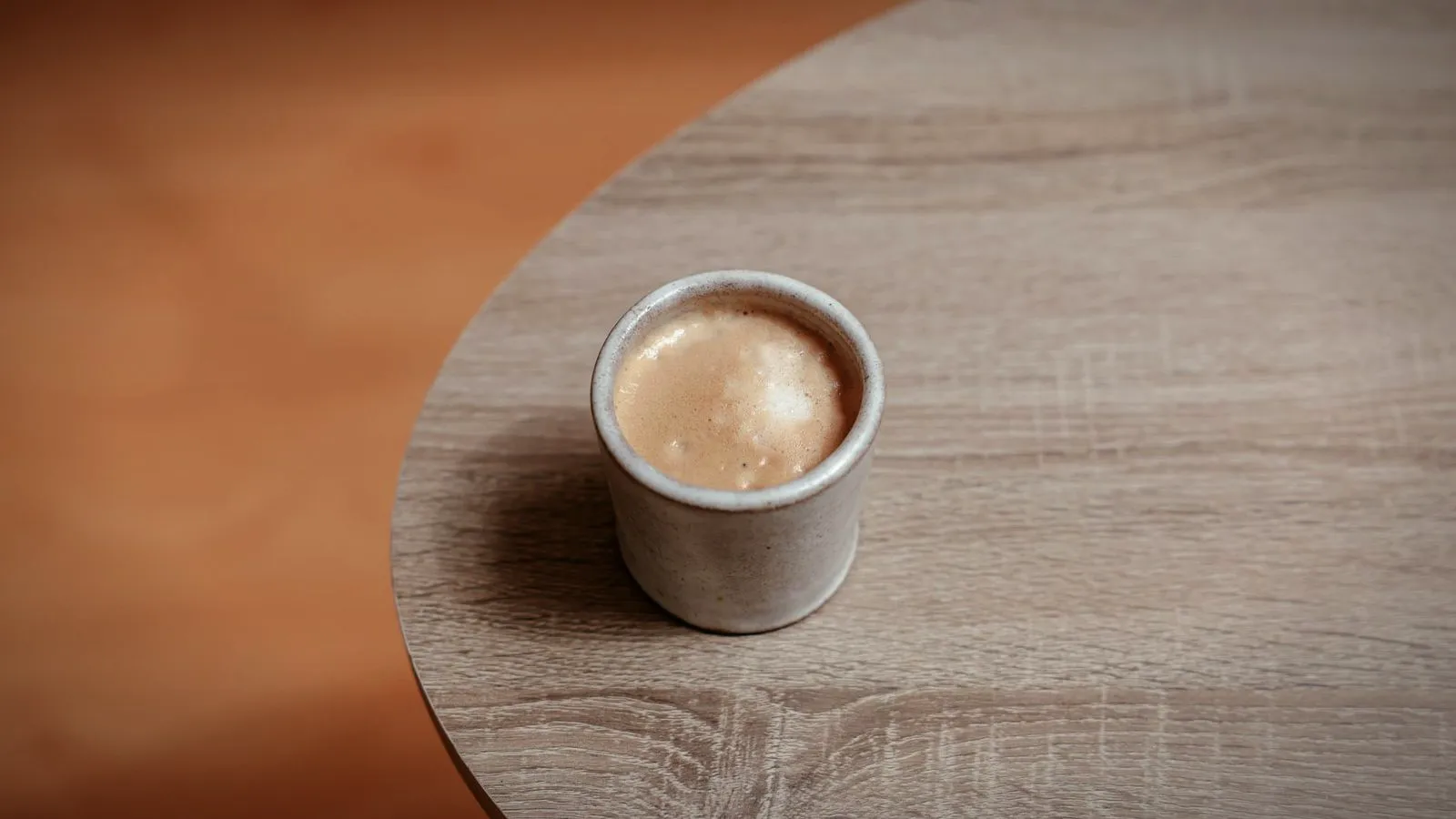
The difference between a cappuccino, a latte and a macchiato is the amount of milk and how much of it is turned into foam. The espresso at the bottom is the same; the layers above it change.
Macchiato: espresso with a mark of foam
“Macchiato” means “stained” or “spotted” in Italian, and Starbucks translates it as “marked.” A barista pulls a single or double shot and adds a small spoonful of foam, 2 teaspoons in Breville’s recipe, to the center of the crema. The cup is a demitasse, and the drink tastes almost like straight espresso. Our explainer on what a macchiato is covers its three meanings.
Cappuccino: espresso, milk and a thick cap of foam
A cappuccino is a shot topped with steamed milk and a thick layer of foam. The Istituto Espresso Italiano (IEI) certifies it as 25 ml of espresso and 100 ml of steamed milk, and World Barista Championship rules set a 150–180 ml cup with at least 1 cm of foam. The “one third espresso, one third milk, one third foam” picture is a helpful guide, not a formal standard.
Latte: espresso under plenty of steamed milk
A latte, short for caffè latte or “milk coffee,” is one or two shots under several ounces of steamed milk and a thin layer of foam, about 10 mm in Breville’s manual. It is the largest and mildest of the three. Our guide to what a latte is explains the name and the variations.
Flat white: a small, strong cousin
A flat white sits between the cappuccino and the latte. It uses a single or double shot, often a double, less milk than a latte and a thin, glossy microfoam about a quarter inch (6 mm) deep, in a cup of 8 oz or less.
Cappuccino vs latte vs macchiato: size and ratio
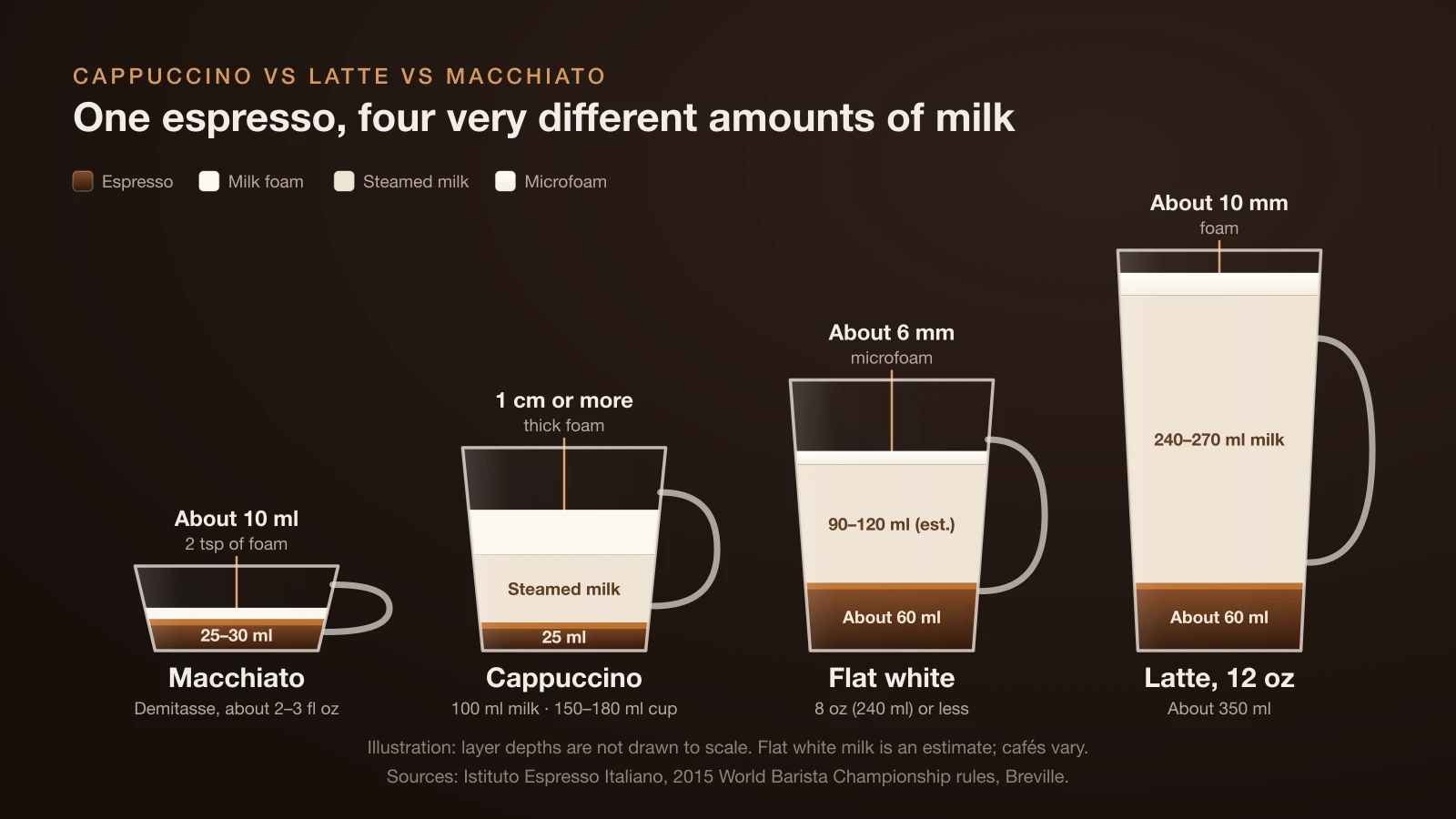
A macchiato holds about 2 teaspoons of foam, a traditional cappuccino about 100 ml of milk and a 12 oz latte 8–9 oz of milk, so the latte carries by far the most. Here is each cup in milliliters:
| Espresso | Milk and foam | Cup | |
|---|---|---|---|
| Espresso macchiato | About 25–30 ml (single) | About 10 ml (2 teaspoons) | Demitasse, about 2–3 fl oz |
| Cappuccino (IEI and WBC) | 25 ml | 100 ml, with at least 1 cm of foam | 150–180 ml |
| Flat white | About 60 ml (double) | About 90–120 ml (estimate) | 8 oz (240 ml) or less |
| Latte, 12 oz | About 60 ml (double) | 240–270 ml steamed milk, about 10 mm of foam | About 350 ml |
The flat white milk figure is an estimate for a double shot in a 5–6 oz drink. Ratios follow the size: the cappuccino is about 1 part espresso to 4 parts milk, and the latte about 1:3 to 1:5. Our latte milk ratio guide breaks down every latte cup size.
Foam is the hidden difference. A cappuccino turns a large share of its milk into foam, while a latte and a flat white keep most of it liquid. Some cafés also serve wet and dry cappuccinos; our wet vs dry cappuccino guide explains how much foam each one carries.
Cappuccino vs latte vs macchiato caffeine
A cappuccino, a latte and a macchiato with the same number of shots carry the same caffeine, because milk and foam add none. USDA data puts espresso at about 212 mg of caffeine per 100 g, roughly 63 mg in a 1 oz single and 126 mg in a 2 oz double.
What changes is how concentrated that caffeine is. A macchiato packs a shot into 1–2 oz, while a 16 oz latte spreads the same shots through a large cup. That is why the macchiato tastes so much stronger.
At Starbucks, a solo Espresso Macchiato, a Tall cappuccino and a Tall latte all list 75 mg. The Tall Flat White lists 130 mg, because it uses two ristretto shots instead of one. The drink with the most shots wins, whatever its name.
Calories in a cappuccino, latte and macchiato
Nearly all the calories in these drinks come from milk, so they rise from the macchiato to the cappuccino to the latte. USDA lists whole milk at 61 kcal per 100 g and espresso at 9 kcal per 100 g.
- Espresso macchiato: 2 teaspoons of milk add at most about 6 kcal, so a single stays under 10 kcal.
- Traditional cappuccino: 100 ml (about 103 g) of whole milk is roughly 63 kcal, so the drink lands around 65 kcal.
- Flat white: a double shot with about 4 oz (122 g) of whole milk comes to roughly 80 kcal (estimate).
- 12 oz latte: a double shot with 8 oz of whole milk is about 155 kcal.
These assume plain whole milk without sugar. Skim or plant milk lowers every figure; syrups and larger café sizes raise them.
Starbucks sizes: cappuccino, latte, macchiato and flat white
Starbucks sells its cappuccino, latte and flat white in 8–20 oz cups, while its Espresso Macchiato comes in espresso sizes of 0.8–3.1 fl oz. Its hot drinks list these values (cappuccino and latte with 2% milk, flat white with whole milk):
| Starbucks, hot | Size | Shots | Calories | Caffeine |
|---|---|---|---|---|
| Espresso Macchiato, solo | 0.8 fl oz | 1 | 10 | 75 mg |
| Espresso Macchiato, doppio | 1.6 fl oz | 2 | 15 | 150 mg |
| Cappuccino, Tall | 12 fl oz | 1 | 100 | 75 mg |
| Cappuccino, Grande | 16 fl oz | 2 | 140 | 150 mg |
| Flat White, Tall | 12 fl oz | 2 ristretto | 170 | 130 mg |
| Flat White, Grande | 16 fl oz | 3 ristretto | 220 | 195 mg |
| Caffè Latte, Tall | 12 fl oz | 1 | 150 | 75 mg |
| Caffè Latte, Grande | 16 fl oz | 2 | 190 | 150 mg |
At the same Grande size, the cappuccino has fewer calories than the latte because more of its cup is foam. The Starbucks caramel macchiato is a different drink: vanilla syrup and steamed milk marked with espresso, closer to a sweet latte than to an espresso macchiato.
Milk first or espresso first?
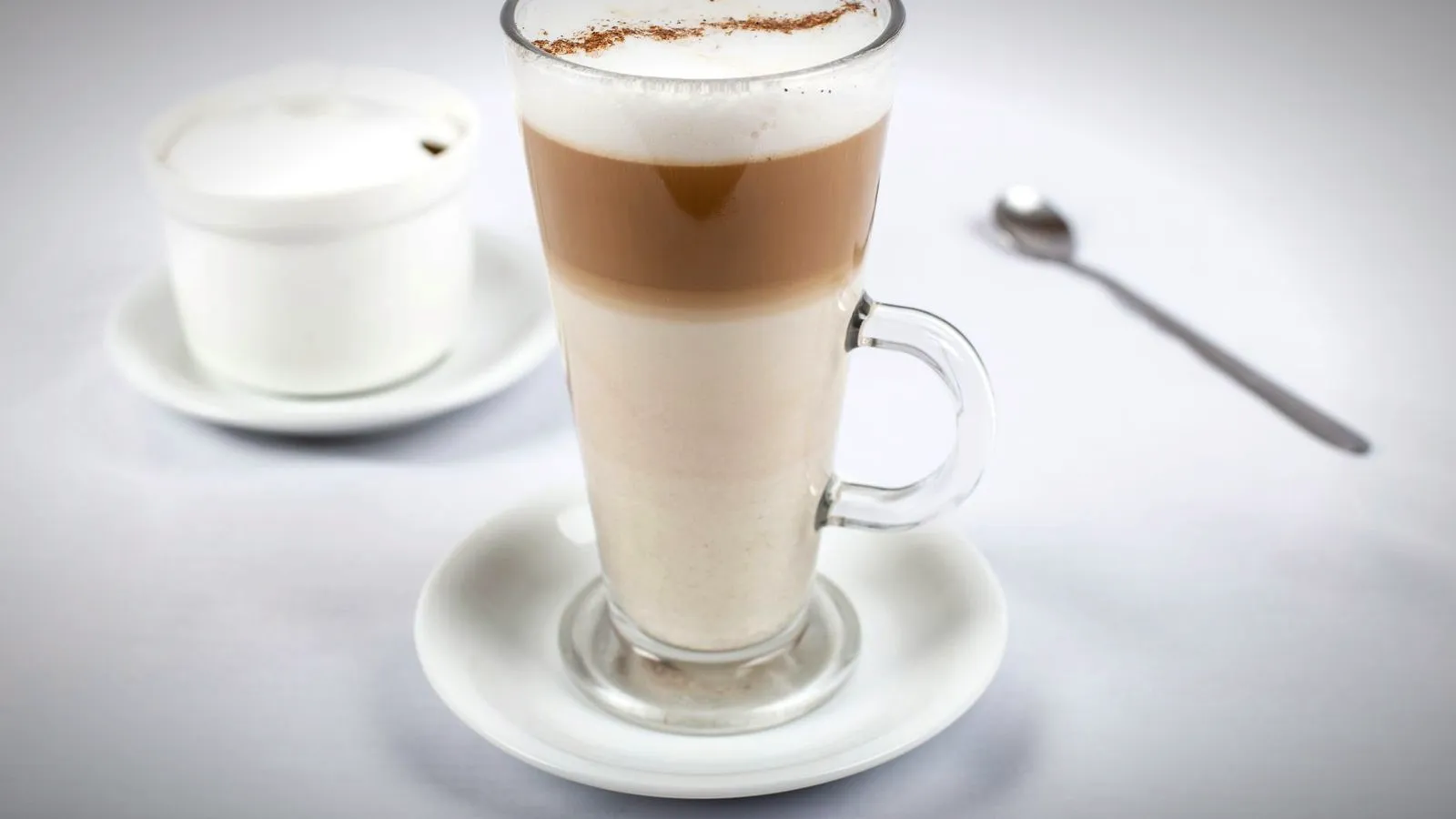
A latte macchiato is a tall glass of steamed milk “marked” by espresso poured in last, while a caffè latte has the milk poured into the espresso. The ingredients are the same; the order and the proportions differ.
| Latte macchiato | Caffè latte | |
|---|---|---|
| Order | Milk first, espresso poured in last | Espresso first, milk poured in |
| Look | Distinct layers in a glass | Mixed, often with latte art |
| Milk share | Milkier than a caffè latte | 1:3 to 1:5 |
| Served in | Tall glass | Cup or glass |
The espresso “stains” the milk in a latte macchiato, which is the reverse of an espresso macchiato, where foam marks the espresso. If you order just a “latte” in Italy, you may get a glass of milk, since latte means milk.
Which one should you order?
Order a macchiato if you want the espresso itself, a cappuccino for a small foamy drink, a flat white for a smooth strong one and a latte for a large, mild cup.
| If you want… | Order |
|---|---|
| Espresso with only its sharpest edge softened | Espresso macchiato |
| A small, light drink with a thick foam cap | Cappuccino |
| A small drink that still tastes clearly of coffee, with silky milk | Flat white |
| A large, mild, creamy cup to sip slowly | Latte |
| A base for syrups or spices | Latte |
| The fewest calories | Espresso macchiato |
For the pairwise details, read macchiato vs latte, macchiato vs cappuccino, flat white vs cappuccino and flat white vs latte. If you want something between a macchiato and a cappuccino, the cortado is covered in cortado vs latte.
How to make each one at home
All four drinks start with the same shot; only the amount of milk and the amount of air change.
- Pull the shot. A single or double shot into a warm cup sized for the drink.
- Steam the milk. Heat cold milk to about 60–65 °C (140–150 °F). Add air longest for a cappuccino, briefly for a latte and only a second or two for a flat white.
- Finish the drink.
- Macchiato: spoon 1–2 teaspoons of foam onto the crema.
- Cappuccino: pour about 100 ml of milk and let at least 1 cm of foam settle on top, in a 150–180 ml cup.
- Flat white: pour into a cup of 8 oz or less, leaving about 6 mm of microfoam.
- Latte: pour 8–9 oz of milk into a 12 oz cup, finishing with about 10 mm of foam.
Our guide on how to steam milk shows how to control the air for each texture.
The bottom line
The macchiato, cappuccino, flat white and latte share one espresso and differ only in milk and foam. The macchiato is a shot with a spot of foam, the cappuccino adds a little milk under a thick foam cap, the flat white adds silky milk with thin microfoam and the latte adds the most milk. Caffeine follows the shots, calories follow the milk, and taste gets milder from macchiato to latte.
Sources
- Istituto Espresso Italiano: Certified Italian Espresso and Cappuccino (about 25 ml espresso; cappuccino with 25 ml espresso + 100 ml steamed milk) and World Coffee Events: 2015 World Barista Championship Rules and Regulations (archived; cappuccino 150–180 ml with at least 1 cm of foam)
- Breville: Macchiato recipe (“stained” or “spotted”; 2 teaspoons of textured milk; demitasse of about 2–3 fl oz), How to make a flat white at home (single or double shot, cup of 8 oz or less, microfoam about a quarter inch) and Barista Express BES875 instruction book (latte with about 10 mm of foam)
- USDA FoodData Central: Beverages, coffee, brewed, espresso, restaurant-prepared (212 mg caffeine and 9 kcal per 100 g) and Milk, whole, 3.25% milkfat (61 kcal per 100 g; 1 fl oz = 30.5 g; 1 cup = 244 g)
- Starbucks nutrition: Espresso Macchiato, Cappuccino, Flat White, Caffè Latte and Caramel Macchiato (sizes, shots, milk, calories, caffeine, recipes) and Vanilla Macchiato story (archived; “macchiato” means “marked”)