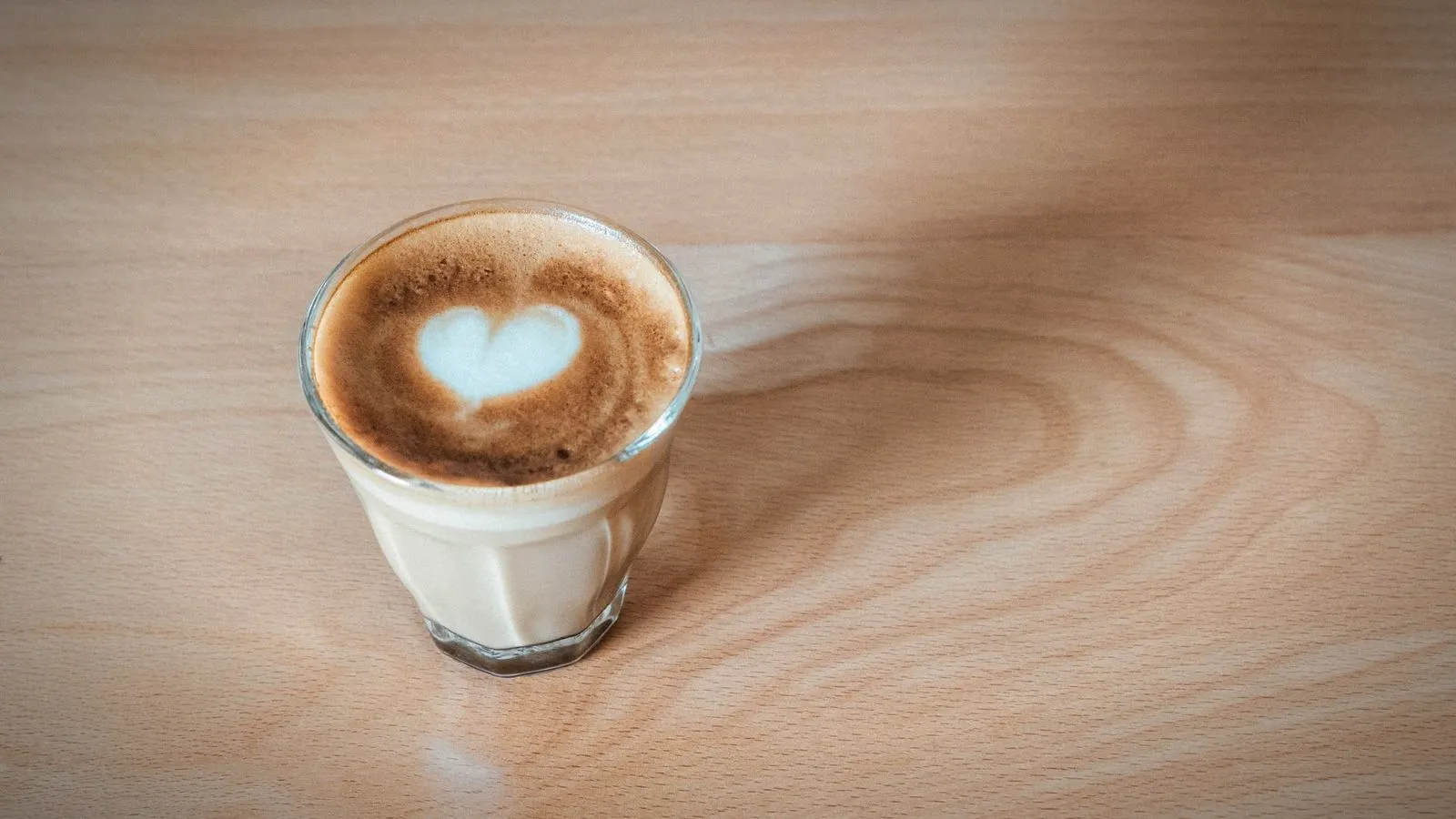

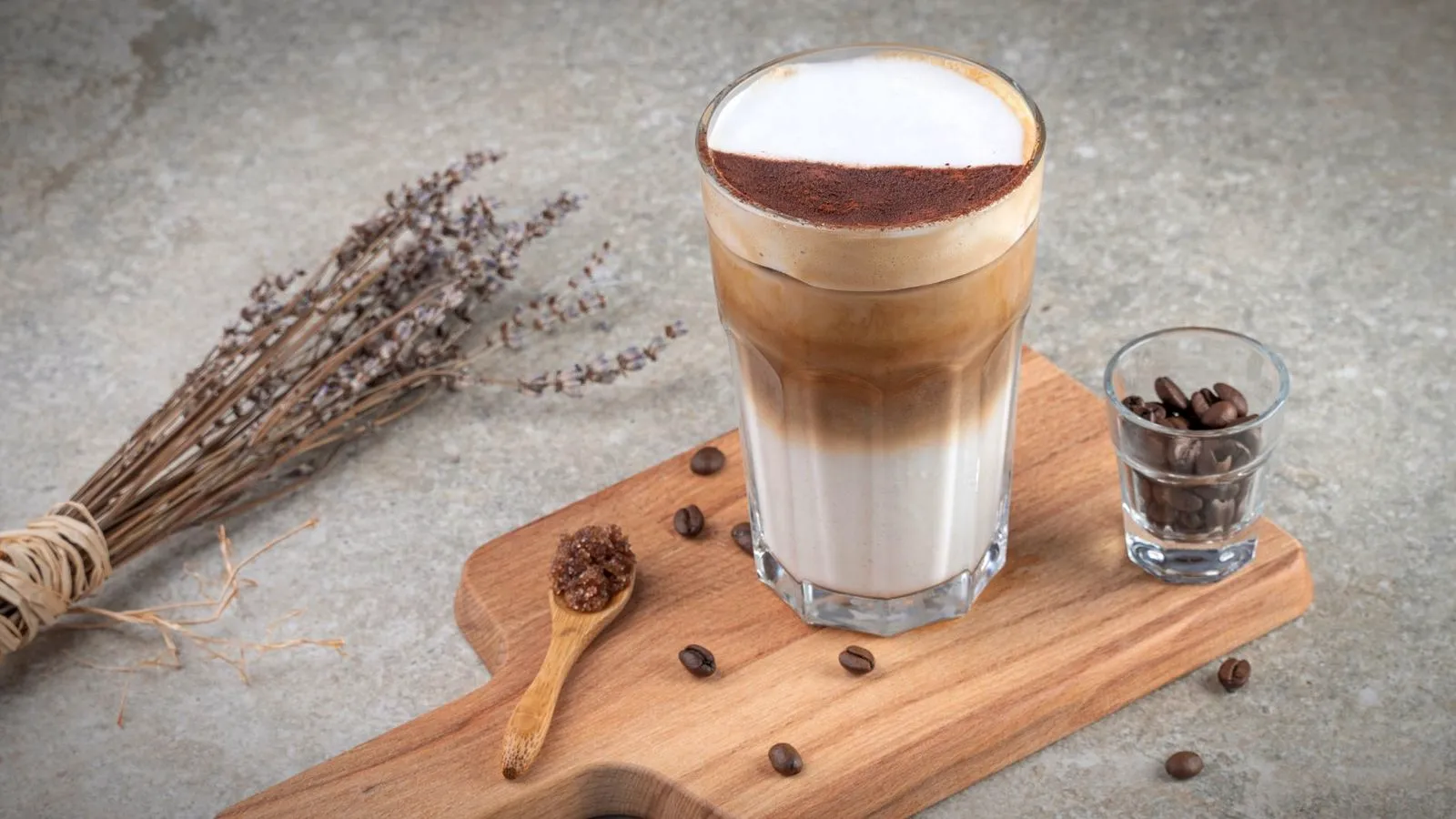
A latte macchiato is a tall glass of steamed milk “marked” by espresso, which is poured in last so it settles between the milk and the foam in visible layers. A typical one uses a single shot to about 5 to 6 ounces of milk, which makes it milkier than a caffè latte. The name means “stained milk” in Italian.
It is the reverse of an espresso macchiato, where a spoonful of foam marks the coffee. Our guide to what a macchiato is explains all three drinks that share the name.
The short answer
| Latte macchiato | |
|---|---|
| What it is | Steamed milk and foam in a tall glass, espresso poured in last |
| Espresso | Usually a single shot, about 1 oz (30 ml) |
| Milk | About 5–6 oz (150–180 ml) of steamed milk with a thick cap of foam |
| Espresso to milk | About 1:5 to 1:6 |
| Glass | Tall glass, about 8–12 oz (240–350 ml) |
| Look | White milk at the bottom, a tan coffee band, foam on top |
| Taste | Mild and milky, coffee strongest near the top |
| Caffeine | About 63 mg per single shot |
The espresso and milk amounts come from Starbucks’ home recipe and a Princeton University study of layered lattes; the glass size is the usual latte glass range. Cafés pour their own versions, so treat them as a starting point.
What is a latte macchiato?
A latte macchiato is a milk drink first and a coffee drink second. Breville explains that macchiato means “stained” or “spotted,” and in this drink the espresso stains the milk. Steamed milk and foam go into the glass, then the shot is poured through the foam.
The order is what sets it apart. In a caffè latte, the milk is poured into the espresso and the two blend into one even color. In a latte macchiato, the espresso enters last and does not fully mix, so the glass shows a pale bottom, a darker coffee band and a white foam cap.
That is why it is served in a clear glass rather than a mug. The layers are part of the drink, and the glass lets you see them.
Latte macchiato ratio and glass size
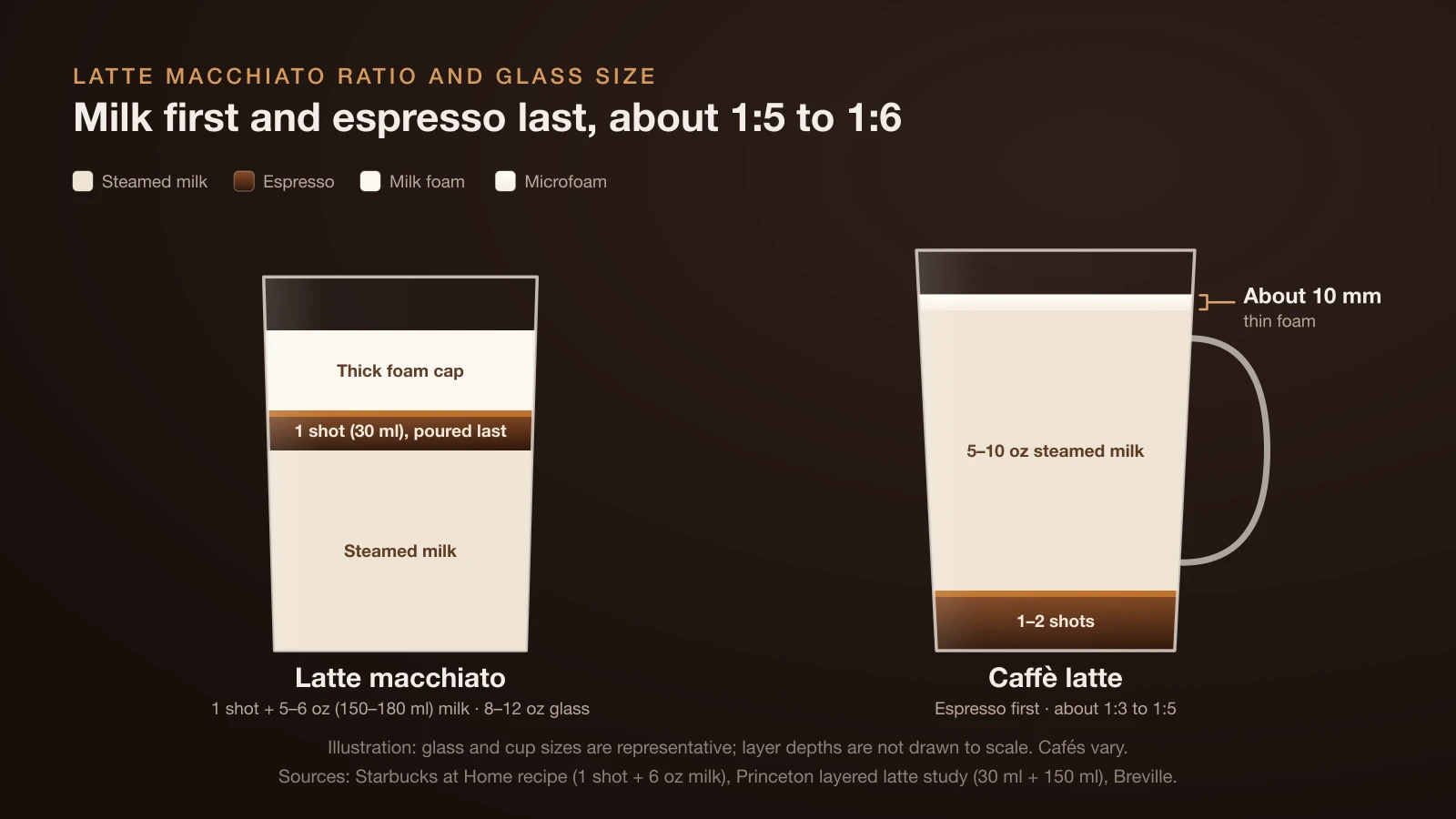
A latte macchiato uses one part espresso to roughly five or six parts milk, a little milkier than most caffè lattes. Two published recipes land in the same place:
| Source | Espresso | Milk | Ratio |
|---|---|---|---|
| Starbucks at Home recipe | 1 shot | 0.75 cup (6 oz, 180 ml) of milk, frothed | about 1:6 with a 1 oz shot |
| Princeton layered latte study | 30 ml | 150 ml warm milk | 1:5 |
| Caffè latte, for comparison | 1–2 shots | 5–10 oz of steamed milk | about 1:3 to 1:5 |
A tall glass of about 8 to 12 oz (240–350 ml) leaves room for the milk, the shot and a generous foam cap. For a stronger drink, use a double shot with the same milk; the layers still form, but the coffee band is darker and wider. The caffè latte numbers above follow our latte milk ratio guide.
How to make a latte macchiato at home
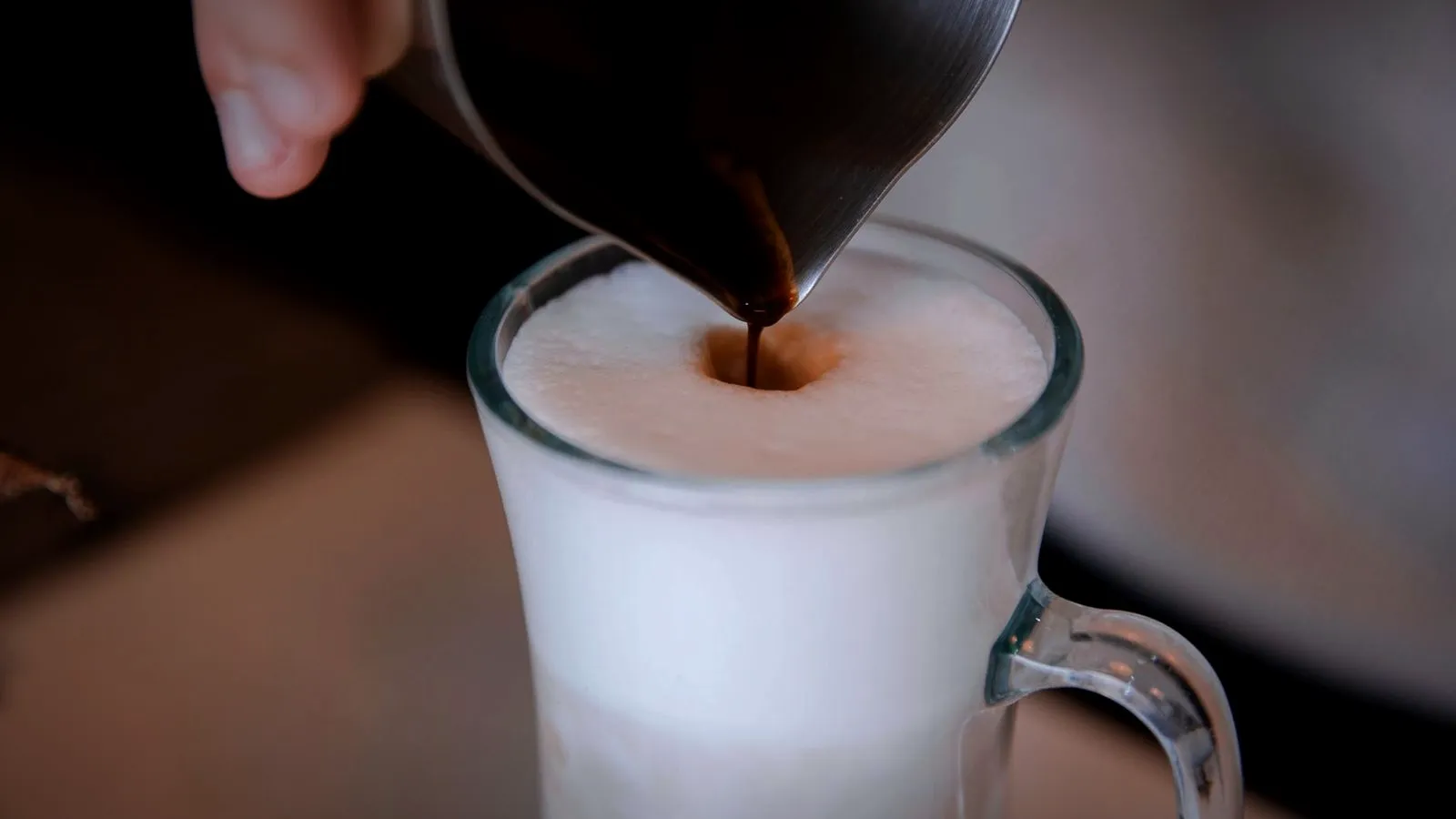
To make a latte macchiato at home, steam the milk with plenty of foam, fill a tall glass, then pour a fresh shot slowly into the middle. You need an espresso machine with a steam wand, or a separate milk frother, plus a heat-safe glass.
- Warm the glass. Rinse a tall glass with hot water so the milk does not cool too fast.
- Steam the milk. Steam about 6 oz (180 ml) of cold milk to 60–65 °C (140–150 °F). Add a little more air than you would for a latte, so a thicker foam forms on top. Our guide on how to steam milk covers the technique.
- Fill the glass. Pour the milk in, then spoon the foam on top, leaving about an inch (2–3 cm) free at the rim.
- Pull the shot. Brew a single shot of about 1 oz (30 ml), or a double if you want more coffee flavor.
- Pour the espresso into the center. Pour in one steady, gentle stream through the middle of the foam. Starbucks’ recipe pours it into the center so a dark dot shows on the white foam.
- Let it rest. Wait a minute or two before serving, so the layers can sharpen.
With plant milk, Breville suggests staying under about 55 °C (130 °F), because hotter non-dairy milk can separate or curdle.
Why the layers form
The stripes in a latte macchiato are a real fluid effect, not just a trick of pouring. Princeton University researchers poured 30 ml of espresso into 150 ml of warm milk, both at 50 °C, and watched layers develop over a few minutes as the glass cooled toward room temperature.
They linked the effect to double-diffusive convection, the same process that layers parts of the ocean. Once formed, the layers lasted for at least tens of minutes. In their lab model, layering appeared only when the liquid went in above a critical speed, so a hesitant dribble mixes too little and tends to leave the coffee floating on top without stripes.
Tips for clean layers
- Use foam as a cushion. A thick foam cap slows the shot and holds the coffee band high in the glass. Flat milk lets it mix in.
- Pour right after brewing. The Princeton layers start from a hot shot meeting warm milk, so pour the espresso while it is still hot.
- Serve it hot for stripes. In the Princeton work, the layers came from the warm drink losing heat to the room, so a cold, iced version should not be expected to stripe the same way.
- Don’t stir until after serving. One stir mixes everything into a plain latte.
Latte macchiato vs caffè latte
A latte macchiato and a caffè latte use the same ingredients, but the latte macchiato puts the milk in first and usually more of it per shot. That changes how both drinks look and taste.
| Latte macchiato | Caffè latte | |
|---|---|---|
| Order | Milk and foam first, espresso last | Espresso first, milk poured in |
| Look | Layers in a clear glass | Even color, often latte art |
| Foam | Thick cap | Thin layer, about 10 mm |
| Milk per shot | About 5–6 oz | About 3–5 oz in most recipes |
| Taste | Milder, changes from top to bottom | Even and creamy throughout |
If you were looking for the small espresso drink instead, our macchiato vs latte guide compares the espresso macchiato with the latte. For the cappuccino next to both, see cappuccino vs latte vs macchiato.
Caramel latte macchiato recipe
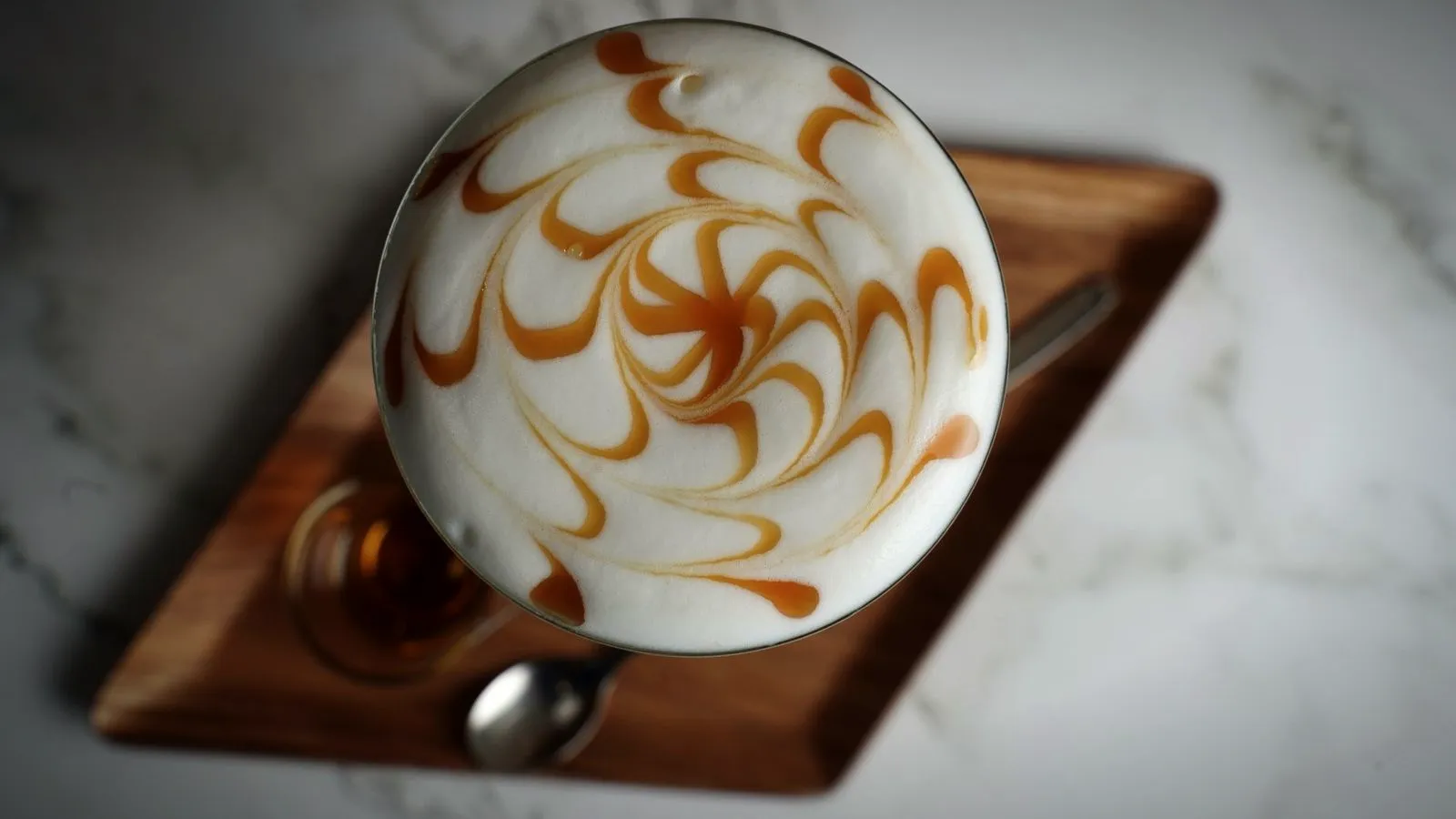
A caramel latte macchiato is the same layered drink with caramel sauce in the bottom of the glass and a thin drizzle over the foam. It tastes sweeter than a plain one, with caramel in the first and last sips.
| Ingredient | Amount |
|---|---|
| Caramel sauce, in the glass | 1 Tbsp (15 ml) |
| Steamed milk with foam | 6 oz (180 ml) |
| Espresso | 1 shot, about 1 oz (30 ml), or a double |
| Caramel sauce, on top | A thin drizzle, about 1 tsp |
- Spoon the caramel sauce into the bottom of a warm tall glass.
- Steam the milk with a thick foam and pour it gently over the sauce.
- Pour the fresh espresso slowly into the center of the foam.
- Drizzle a little caramel over the top and serve with a long spoon.
For a vanilla note, stir a little vanilla syrup into the milk before it goes in. With vanilla, the drink comes close to the Starbucks caramel macchiato, which is covered in our caramel macchiato guide, along with Starbucks’ own home recipe for caramel sauce.
Cold latte macchiato
A cold latte macchiato uses cold milk and ice, with the espresso poured over the top so it floats in a dark layer. Nothing needs to be steamed, which makes it the quickest version to make.
- Fill a 12–16 oz glass with ice.
- Add about 6 oz (180 ml) of cold milk.
- Pour a fresh single or double shot slowly over the ice.
Stir before drinking if you want an even taste. With the shot stirred in, it is essentially an iced latte; our iced latte guide covers ratios and glass sizes for that drink.
Latte macchiato caffeine and calories
A latte macchiato has only the caffeine of its espresso, about 63 mg for a single shot and 126 mg for a double, based on USDA data. Milk adds none, but it supplies nearly all of the calories.
| Latte macchiato, 1 shot + 6 oz milk | Caffeine | Calories (estimate) |
|---|---|---|
| Whole milk | about 63 mg | about 115 kcal |
| 2% milk | about 63 mg | about 95 kcal |
| Skim (nonfat) milk | about 63 mg | about 65 kcal |
| Oat milk (USDA average) | about 63 mg | about 85 kcal |
| Almond milk, unsweetened | about 63 mg | about 30 kcal |
| With a double shot | about 126 mg | add about 3 kcal |
The estimates multiply USDA’s values per 100 g (whole milk 61 kcal, 2% 50, skim 34, oat 45, unsweetened almond 15) by about 183 g of dairy milk (180 g for plant milks), plus about 3 kcal for the shot. Caramel, syrup or sugar comes on top. For more sizes, see latte calories and how much caffeine is in a latte.
The bottom line
A latte macchiato is steamed milk in a tall glass with the espresso poured in last, about one shot to 6 ounces of milk. Steam the milk with a thick foam, pour the shot steadily into the center and give the layers a minute to form. It carries the caffeine of its shots and the calories of its milk, so the milk you pick matters more than the recipe.
Sources
- Starbucks at Home (Nestlé): Latte Macchiato recipe (1 shot espresso, 0.75 cup milk; frothy milk first, espresso poured into the middle)
- Xue et al., Nature Communications (2017): Laboratory layered latte, full text at PMC (30 ml espresso into 150 ml milk at 50 °C; layers form over minutes as the drink cools and last tens of minutes; double-diffusive convection; critical injection velocity)
- Breville: Macchiato recipe (“stained” or “spotted”), Cappuccino recipe (milk at 60–65 °C, 140–150 °F; non-dairy under 55 °C, 130 °F) and Barista Express BES875 instruction book (latte with about 10 mm of foam)
- USDA FoodData Central: Espresso (212 mg caffeine and 9 kcal per 100 g; 1 fl oz = 29.6 g), Milk, whole (61 kcal and 5.05 g sugars per 100 g; 1 fl oz = 30.5 g), Milk, 2% (50 kcal), Milk, nonfat (34 kcal), Oat milk (45 kcal) and Almond milk, unsweetened (15 kcal)