
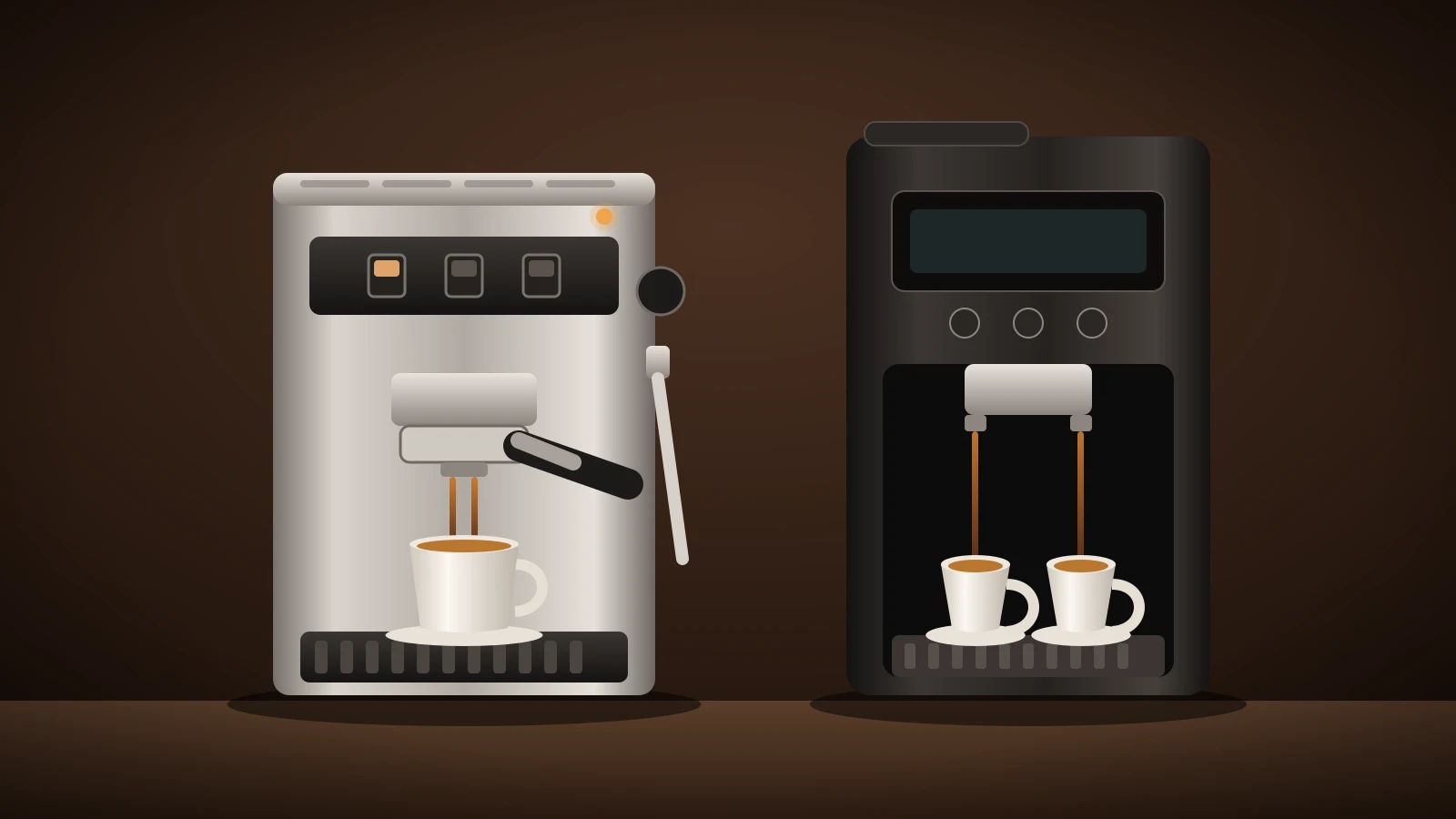
Gaggia espresso machines come in two families: semi-automatic machines with a portafilter, such as the Classic Pro E24 and the dual boiler Classic GT, and super-automatic bean-to-cup machines such as the Brera, Magenta, Cadorna and Accademia. In Gaggia’s US store as of October 2026, current machines run from $299.99 to $1,999.
Gaggia is one of the oldest names among Italian espresso machines, and today most of its range is super-automatic. If you are deciding between the two families, our guide to super-automatic espresso machines explains how bean-to-cup machines differ from manual ones. All prices below are from gaggia-na.com, and the models are listed as examples, not ranked.
The short answer
| Question | Gaggia semi-automatic | Gaggia super-automatic |
|---|---|---|
| Current US models | Espresso Evolution, Carezza Deluxe, Classic Pro E24, Classic GT | Brera, Anima, Velasca, Magenta, Cadorna, Accademia ranges |
| Who grinds and tamps | You, with a separate grinder | The machine |
| Milk | Pannarello or steam wand | Pannarello, steam wand or automatic carafe |
| Skill needed | Medium to high | Low |
| US price range, October 2026 | $299.99 to $1,699 | $499 to $1,999 |
Gaggia’s history in brief
Gaggia traces its start to Achille Gaggia, who filed a patent in 1938 for brewing with hot water pressure instead of steam and patented a lever-piston mechanism in 1947. According to Gaggia, its first espresso machine followed in 1948 and its first home machine, the Gilda, in 1952.
The Gaggia Classic, still the base of today’s Classic Pro E24, was introduced in 1991. Gaggia’s history page adds that Saeco bought a majority share in 1999, production moved to Gaggio Montano near Bologna in 2007, and Gaggia was sold with the Saeco Group to Royal Philips Electronics in 2009.
Gaggia semi-automatic espresso machines
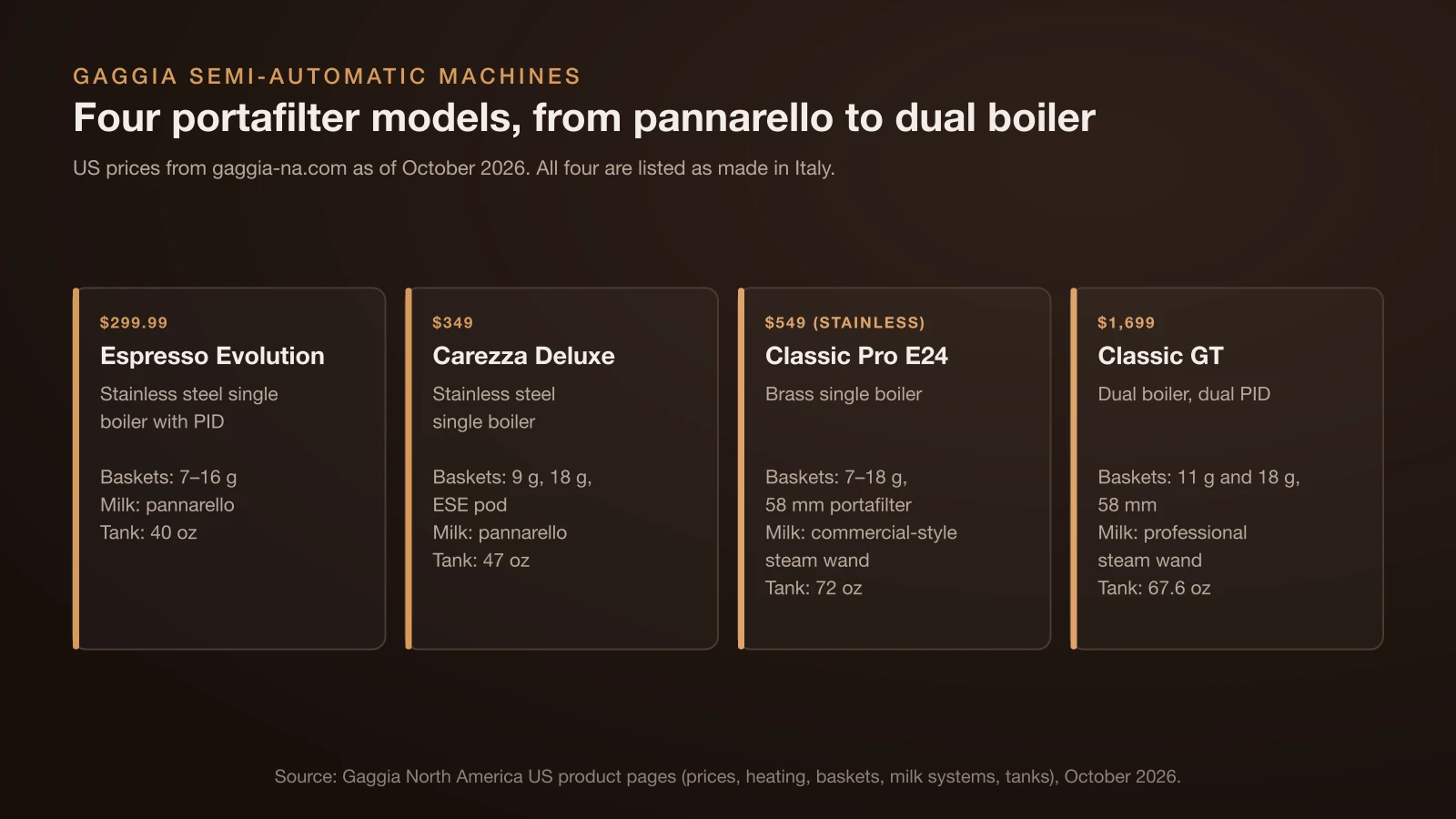
Gaggia’s semi-automatic espresso machines use a portafilter and a separate grinder, and the current US range has four models. The table lists the specs Gaggia publishes on each US product page.
| Model | Heating | Baskets | Milk | Water tank | US price |
|---|---|---|---|---|---|
| Espresso Evolution | Stainless steel single boiler with PID | 7–16 g | Pannarello | 40 oz | $299.99 |
| Carezza Deluxe | Stainless steel single boiler | 9 g, 18 g and ESE pod | Pannarello | 47 oz | $349 |
| Classic Pro E24 | Brass single boiler | 7–18 g, 58 mm portafilter | Commercial-style steam wand | 72 oz | $549 (stainless) |
| Classic GT | Dual boiler, dual PID | 11 g and 18 g, 58 mm | Professional steam wand | 67.6 oz | $1,699 |
A pannarello is a sleeve on the steam wand that pulls in air for you, which makes frothing easier but gives less control over texture. Gaggia lists all four as made in Italy. The Espresso Evolution, Classic Pro E24 and Classic GT name a 15 bar Italian-made Ulka pump, and both Classic models ship with the over-pressure valve set to 9 bar.
Gaggia Classic Pro E24
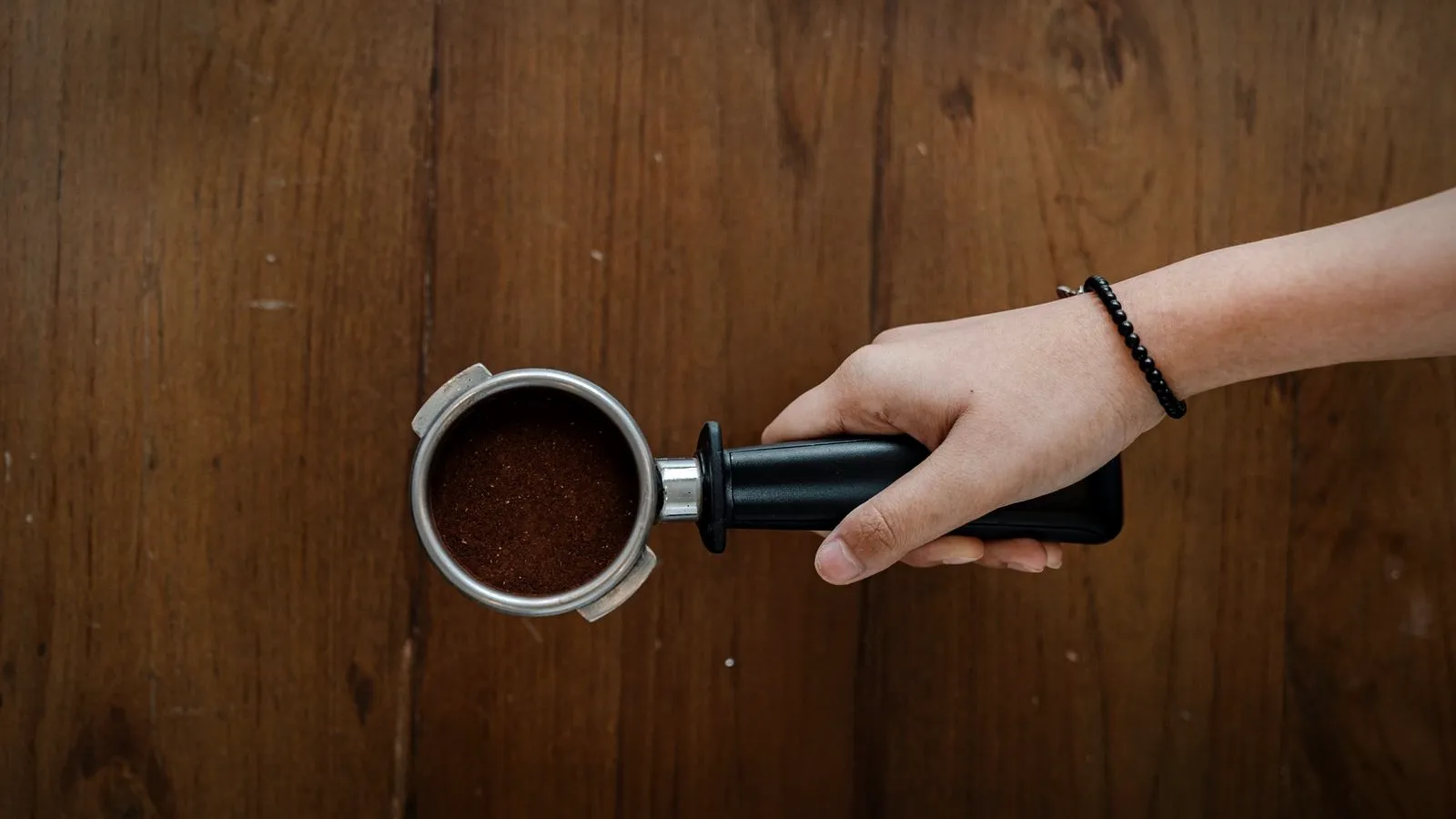
The Gaggia Classic Pro E24 is the current version of the Classic, a single boiler semi-automatic with a 58 mm stainless steel portafilter and a commercial-style steam wand. Gaggia lists it at $549 in stainless steel and $599 in its other colors as of October 2026.
| Spec | Classic Pro E24 |
|---|---|
| Boiler | Lead-free brass, 3.5 oz (about 100 ml), single boiler for brew and steam |
| Pump and pressure | 15 bar Ulka pump; over-pressure valve (OPV) calibrated to 9 bar |
| Portafilter | 58 mm stainless steel, baskets for 7–18 g |
| Steam wand | Commercial style, two-hole tip, rotating, insulated grip |
| Water tank | 72 oz (2.1 L) |
| Power | 1,425 W, 110–120 V |
| Size (H × W × D) | 14.2 × 8 × 9.5 in |
| Weight | 19 lb |
Gaggia says the E24’s solid brass boiler improves thermal stability and steaming. Gaggia’s manual describes two kinds of basket: a pressurized “crema perfetta” filter used with a small frothing jet device, and a traditional filter that needs more skill. Our guide to portafilter sizes explains how pressurized and single wall baskets differ.
Because it has one boiler, steaming takes a mode change. The manual says the steam light comes on after 15–20 seconds, that steaming should last no longer than 60 seconds, and that you should run water through the group afterward to lower the boiler temperature before the next coffee.
The Classic Pro and the Rancilio Silvia are often compared as single boiler machines with 58 mm groups; the Silvia’s boiler holds 0.3 L and it weighs 30.9 lb, as our Rancilio Silvia guide shows.
Gaggia Classic GT: the dual boiler model
The Gaggia Classic GT is Gaggia’s first dual boiler espresso machine, and it sells for $1,699 in Gaggia’s US store. Its technical sheet lists a 0.12 L lead-free brass brew boiler and a 0.9 L stainless steel steam boiler, each with its own PID.
Gaggia adds programmable volumetric shots, automatic and manual low-flow pre-infusion at 3 g per second, a heat-up of about 5 minutes and an externally adjustable OPV with a 6 to 12 bar range. It also has a brew pressure gauge, a shot timer and a three-way solenoid valve, so it can be backflushed with the blind filter Gaggia includes. Our dual boiler espresso machine guide compares it with other two-boiler designs.
Gaggia super-automatic espresso machines
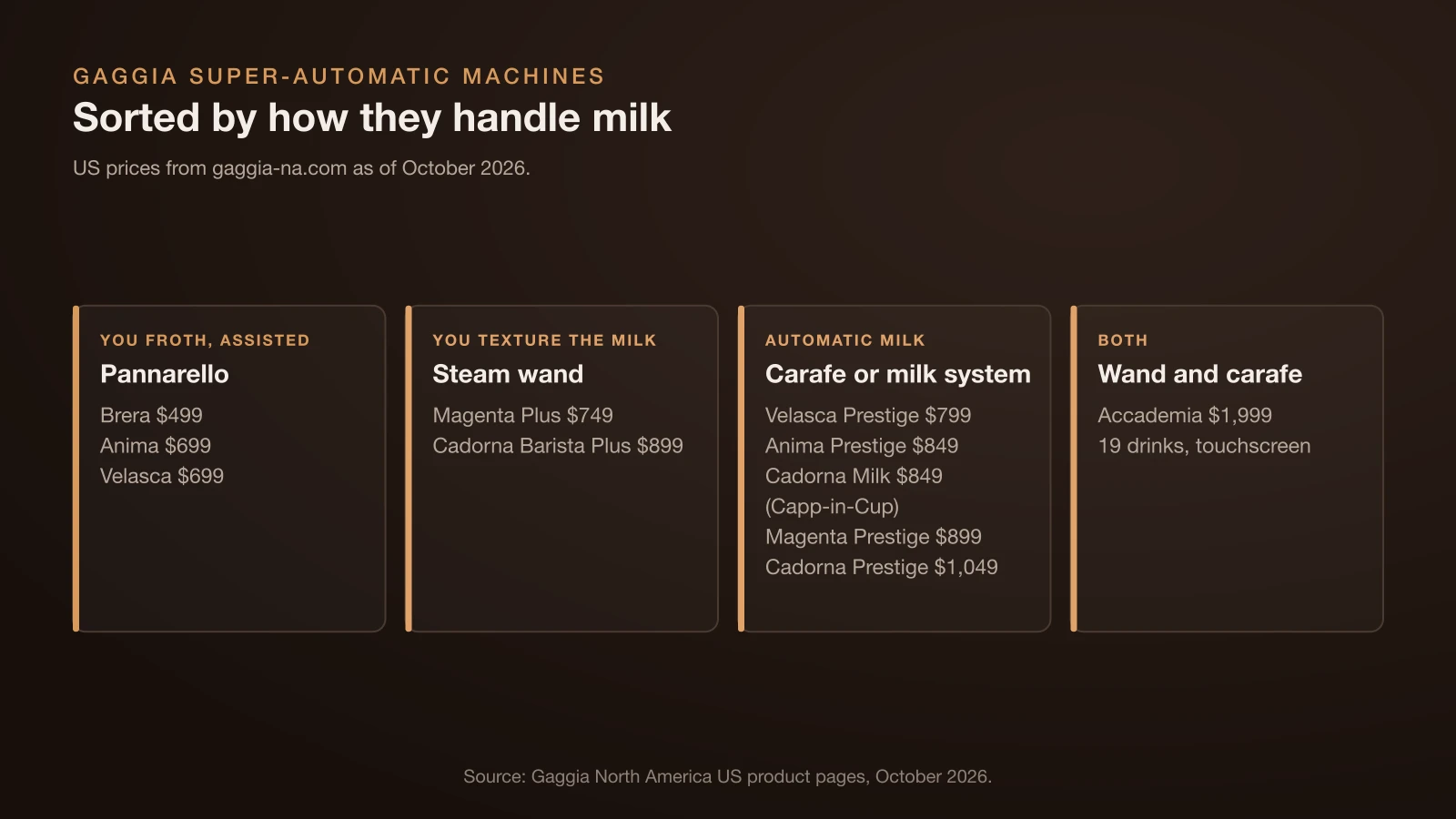
Gaggia super-automatic espresso machines grind, dose, tamp and brew at the press of a button, and they make up most of the current US range. The main differences are the milk system and the number of preset drinks.
| Model | Milk system | Notable features | US price |
|---|---|---|---|
| Brera | Pannarello | Ceramic flat burrs, 5 grind settings, 8.8 oz hopper, 1.2 L tank | $499 |
| Anima | Pannarello | Espresso and lungo buttons, LED interface | $699 |
| Velasca | Pannarello | Ceramic flat burrs, 10 grind settings, 1.6 L tank | $699 |
| Magenta Plus | Commercial-style steam wand | 5 drinks, color display | $749 |
| Velasca Prestige | Detachable automatic carafe | 5 aroma strength settings | $799 |
| Anima Prestige | Integrated milk carafe | 4 customizable drinks | $849 |
| Cadorna Milk | Capp-in-Cup milk system | 10 drinks, 4 user profiles | $849 |
| Magenta Prestige | Integrated milk carafe | 13 drinks, including over-ice | $899 |
| Cadorna Barista Plus | Commercial-style steam wand | 6 drinks, 4 user profiles | $899 |
| Cadorna Prestige | Milk carafe | 15 drinks, 4 user profiles | $1,049 (Moonlight Grey $1,099) |
| Accademia | Steam wand and automatic carafe | 19 drinks, touchscreen; adjusts strength, temperature, pre-infusion and flow | $1,999 |
Models with a steam wand let you texture milk yourself, while carafe models froth and pour it for you. Gaggia’s US page for the Brera, for example, lists it as made in Italy, and Gaggia sells brew units, carafes and other spare parts for them in the same store.
How to choose a Gaggia espresso machine
Choosing a Gaggia espresso machine starts with how much of the process you want to do yourself, then how you take milk. This table maps common needs to the models that match them.
| If you want | Look at | Why |
|---|---|---|
| Learn manual espresso on a budget | Classic Pro E24 | 58 mm portafilter, steam wand, separate grinder |
| The easiest manual machine | Espresso Evolution or Carezza Deluxe | Pannarello frothing, smaller size |
| To brew and steam at once | Classic GT | Separate brew and steam boilers |
| One-touch espresso, simple milk | Brera, Anima or Velasca | Built-in grinder, pannarello |
| One-touch milk drinks | Velasca Prestige, Anima Prestige, Magenta Prestige, Cadorna Prestige | Automatic carafe |
| One-touch coffee, but your own milk texture | Magenta Plus, Cadorna Barista Plus | Steam wand on a super-automatic |
| The most drink settings | Accademia | 19 drinks, both wand and carafe |
Budget for a capable grinder with any semi-automatic model. If you plan to buy secondhand, see our guide to used espresso machines for what to inspect.
Is Gaggia a good espresso machine brand?
Whether Gaggia suits you depends on criteria you can check: where the machines are made, how parts are supplied, how easy they are to service and what each model can do. On those points, Gaggia’s own pages give the facts below; they are not a verdict.
- Origin. Gaggia’s US store lists the Classic Pro E24, Classic GT, Espresso Evolution, Carezza Deluxe and Brera as made in Italy.
- History. The Classic line dates from 1991, and the brand from Achille Gaggia’s 1938 patent.
- Parts. Gaggia’s US store sells wear parts such as group gaskets, shower screens, steam valves and brew units directly.
- Standards. The Classic Pro E24 and Classic GT use 58 mm portafilters, one of the three common home sizes, so standard 58 mm baskets and tampers fit.
- Limits. The Classic Pro is a single boiler, so it cannot brew and steam at once, and Gaggia’s own US product pages do not state warranty terms.
Gaggia maintenance and descaling
Gaggia maintenance comes down to regular descaling with Gaggia’s own descaler and, on super-automatics, weekly care of the brew group. The rules differ by family, so follow the manual for your model.
| Task | Classic Pro (semi-automatic) | Magenta (super-automatic) |
|---|---|---|
| Descale | Every 2 months; every 2–3 months even with purified or bottled water | When the machine asks |
| Descaler | Gaggia descaling solution only; never vinegar | Gaggia descaling solution only |
| Brew group | Fixed group head; no brew unit to remove | Remove weekly and rinse under running water; no dishwasher or detergent |
| Oils | Wash filters daily | Gaggia coffee oil remover monthly |
| Lubrication | Not in the manual | Every 4 months (1–5 drinks a day), 2 months (6–10) or monthly (more than 10) |
| Water | Purified or bottled water suggested | Intenza+ filter recommended |
For the Classic Pro, the manual pours half a bottle of Gaggia descaler into a full tank and runs it through the group and wand in stages with rests in between. Our guide on how to descale an espresso machine walks through that method and compares other makers.
The bottom line
Gaggia espresso machines split into a small semi-automatic range, led by the single boiler Classic Pro E24 at $549 and the dual boiler Classic GT at $1,699, and a larger super-automatic range from $499 to $1,999. Decide first whether you want to grind and tamp yourself, then choose by milk system. Whatever the model, descale with Gaggia’s own solution on the schedule in its manual.
Sources
- Gaggia North America: US store product pages for the Classic Pro E24, Classic GT, Espresso Evolution, Carezza Deluxe, Brera, Velasca, Magenta Plus, Cadorna Prestige and Accademia (prices as of October 2026, boilers, pumps, OPV, baskets, steam systems, tanks, hoppers, grinders, drink counts, power, sizes, weights, made in Italy, spare parts)
- Gaggia: history (1938 and 1947 patents, 1948, Gilda in 1952, Classic in 1991, Saeco in 1999, Gaggio Montano in 2007, Philips in 2009)
- Gaggia: Classic Pro operating instructions (crema perfetta and traditional filters, 15–20 seconds to steam, 60 second limit, lowering boiler temperature, descaling every 2 months or 2–3 months, half a bottle, no vinegar) and Classic GT technical sheet (0.12 L and 0.9 L boilers, PID, 6–12 bar OPV, solenoid valve, blind filter, 58 mm)
- Gaggia: Magenta Plus operating instructions (weekly brew group rinse, no dishwasher or detergent, monthly oil remover, lubrication intervals, Gaggia descaler only, warranty, Intenza+ filter)