
A dual boiler espresso machine has two separate boilers: a brew boiler held at coffee temperature and a steam boiler held hotter for milk, each usually run by its own PID (proportional-integral-derivative) controller. That lets you pull a shot and steam milk at the same time, with no waiting or cooling flush between drinks.
The design sits at the top of home machine heating systems, and our guide to high-end espresso machines shows where it fits among the other café-grade parts. Prices below come only from each maker’s own US store or US page, marked “as of October 2026”, and the models are examples, not a ranking.
The short answer
- Two boilers, two jobs. One boiler is set for brewing, the other for steam, so both are ready at once.
- Direct brew temperature. You choose the brew temperature on the machine instead of managing it with flushes.
- Best for milk drinks in a row. Households that steam milk for several drinks gain the most.
- Trade-offs. Higher price, warm-up measured in minutes, more weight, and two boilers to protect from scale.
- Alternatives. A single boiler or thermoblock machine costs less; a heat exchanger also steams while brewing but sets brew temperature indirectly.
How a dual boiler espresso machine works
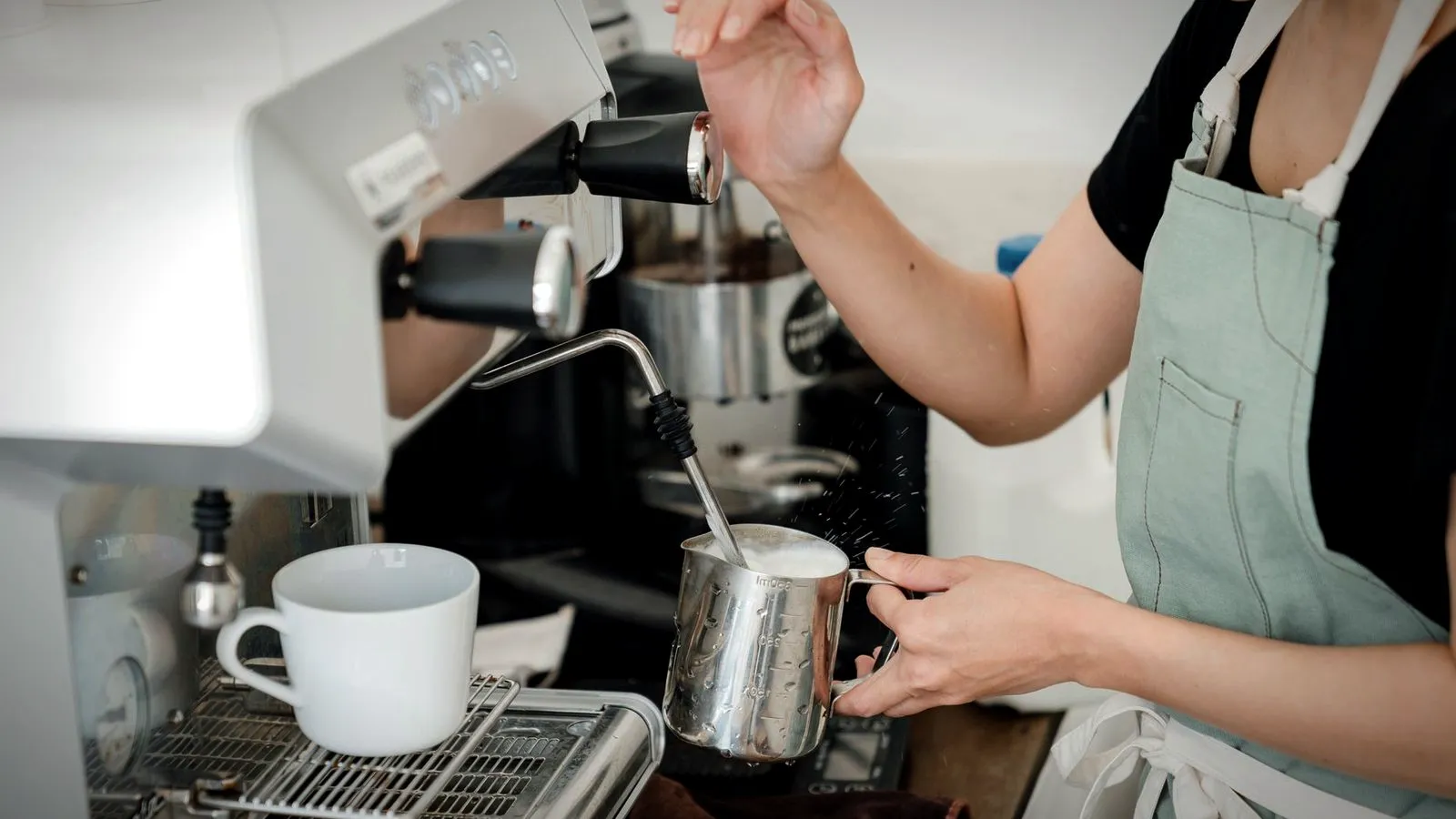
A dual boiler espresso machine works by keeping brew water and steam in two separately heated boilers. The brew boiler stays below boiling and feeds the group head, while the steam boiler runs much hotter to make the pressure that drives the steam wand and hot water tap.
Breville’s Dual Boiler manual shows the usual layout. The espresso boiler is PID controlled with a default of 93 °C (200 °F) and a range of 86–96 °C (190–205 °F), and the steam boiler defaults to 135 °C (275 °F). Its manual says lowering steam temperature gives more control for small amounts of milk, while raising it suits larger volumes.
Most dual boilers add more temperature control around the coffee itself:
- Heated or saturated group. Breville’s group head has its own embedded heating element, so the metal the water passes through stays hot.
- Separate pumps or valves. Breville uses one pump for each boiler to keep pressure steady while both run.
- Pre-infusion. Low pressure wets the coffee first; Rancilio’s Silvia Pro X lets you set this soft infusion for up to 6 seconds.
Single boiler vs heat exchanger vs dual boiler vs thermoblock
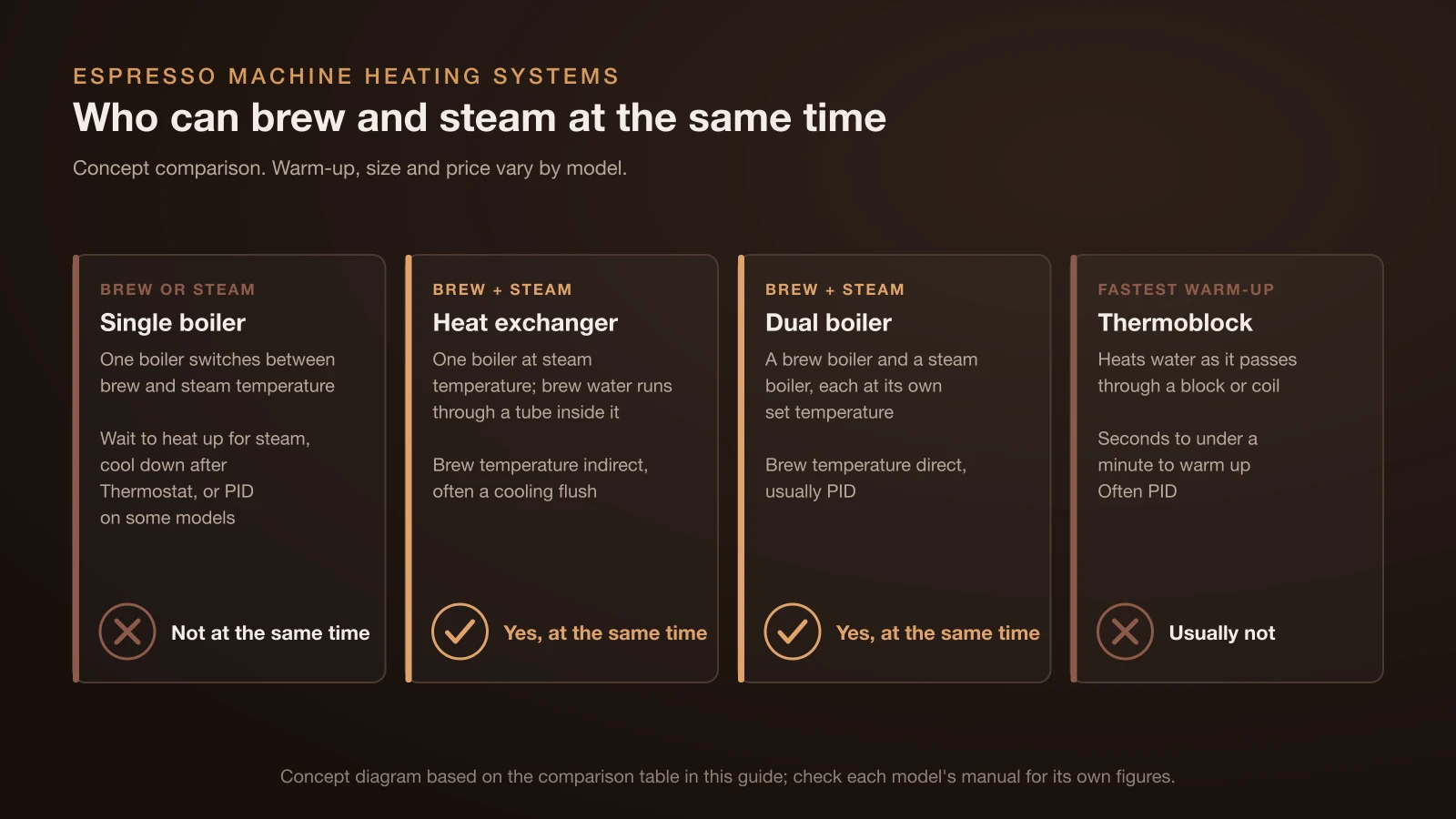
The four home heating systems differ mainly in whether you can brew and steam together and how directly you control brew temperature. Use this table to match the system to how you drink coffee.
| Question | Single boiler | Heat exchanger (HX) | Dual boiler | Thermoblock or thermocoil |
|---|---|---|---|---|
| How it heats | One boiler switches between brew and steam temperature | One boiler at steam temperature; brew water runs through a tube inside it | A brew boiler and a steam boiler, each at its own set temperature | Heats water as it passes through a block or coil |
| Brew and steam at the same time? | No | Yes | Yes | Usually no |
| Wait between brewing and steaming | Yes, heat up for steam and cool down after | No | No | Short on most models |
| Brew temperature control | Thermostat, or PID on some models | Indirect, often a cooling flush | Direct, usually PID | Often PID |
| Warm-up | Minutes | Minutes, often longer | Minutes, often longer | Seconds to under a minute |
| Size and power | Compact | Larger, heavier | Larger, heavier | Most compact |
| Maintenance | One small boiler | One large boiler | Two boilers to protect from scale | No boiler to drain |
| Price tier | Entry to mid | Mid to high | Mid to high | Entry |
The single boiler wait is real. Gaggia’s Classic Pro manual says the steam light comes on after 15–20 seconds, limits steaming to 60 seconds so the boiler does not run dry, and tells you to lower the boiler temperature by running water through the group before brewing the next coffee. Rancilio’s Silvia manual follows the same idea, with a refill step through the hot water switch after steaming.
Breville Dual Boiler: what the specs say
The Breville Dual Boiler (BES920) is a true dual boiler machine, with a separate espresso boiler and a 32 fl oz (950 ml) steam boiler, both in stainless steel. Breville lists it at $1,599.95 in its US store as of October 2026, and the product page lists PID control of the espresso boiler and of the heated group head.
Its manual lists the features that matter for this design:
- Actively heated group head with an embedded element and a 58 mm full stainless steel portafilter.
- Over-pressure valve (OPV) that limits maximum pressure, with low-pressure pre-infusion followed by 9 bar extraction.
- Dual pumps, one per boiler, so steaming does not pull pressure from the shot.
- Programmable temperatures: brew 86–96 °C (190–205 °F) and an adjustable steam temperature.
- Shot clock, auto start and a dedicated hot water outlet.
Breville recommends a grounded, dedicated circuit, and the product page rates the machine at 1,700 W. The Oracle Dual Boiler (BES995) keeps two stainless steel boilers and PID control, adds a grinder that doses and tamps for you plus automatic milk texturing, and is listed at $2,999.95. For Breville’s single heater models, see our Breville Barista Express vs Pro comparison.
Dual boiler espresso machine examples and maker prices
Dual boiler espresso machines now run from compact semi-automatics to café-style home machines, and the table below shows examples with each maker’s published specs. Prices are from each maker’s own US store or US page as of October 2026; “Not listed” means the maker publishes no price.
| Machine | Brew boiler | Steam boiler | Notable features | US maker price |
|---|---|---|---|---|
| Breville Dual Boiler (BES920) | Stainless steel, PID | 950 ml stainless steel | Heated 58 mm group, OPV, dual pumps | $1,599.95 |
| Breville Oracle Dual Boiler (BES995) | Stainless steel, PID | Stainless steel | Automatic grind, dose and tamp; automatic milk | $2,999.95 |
| Gaggia Classic GT | 0.12 L brass | 0.9 L stainless steel | Dual PID, adjustable OPV (6 to 12 bar), about 5 minute heat-up | $1,699 |
| Rancilio Silvia Pro X | 0.3 L | 1 L | Two PIDs, soft infusion, pressure gauge, 58 mm tamper | $2,195 |
| La Marzocco Linea Micra | 0.25 L | 1.6 L | 42 lb, compact café-style body | $4,500 |
| Lelit Elizabeth | 300 ml brass | 600 ml stainless steel | LCC display, adjustable pre-infusion, 2.5 L tank | Not listed |
Boiler size tells you how much steam is on hand before the steam boiler has to recover. Brew boilers stay small because a shot uses little water, while steam boilers grow with the amount of milk the machine is meant to handle. Our Rancilio Silvia guide compares the Silvia Pro X with Rancilio’s single boiler original.
Compact dual boiler espresso machines
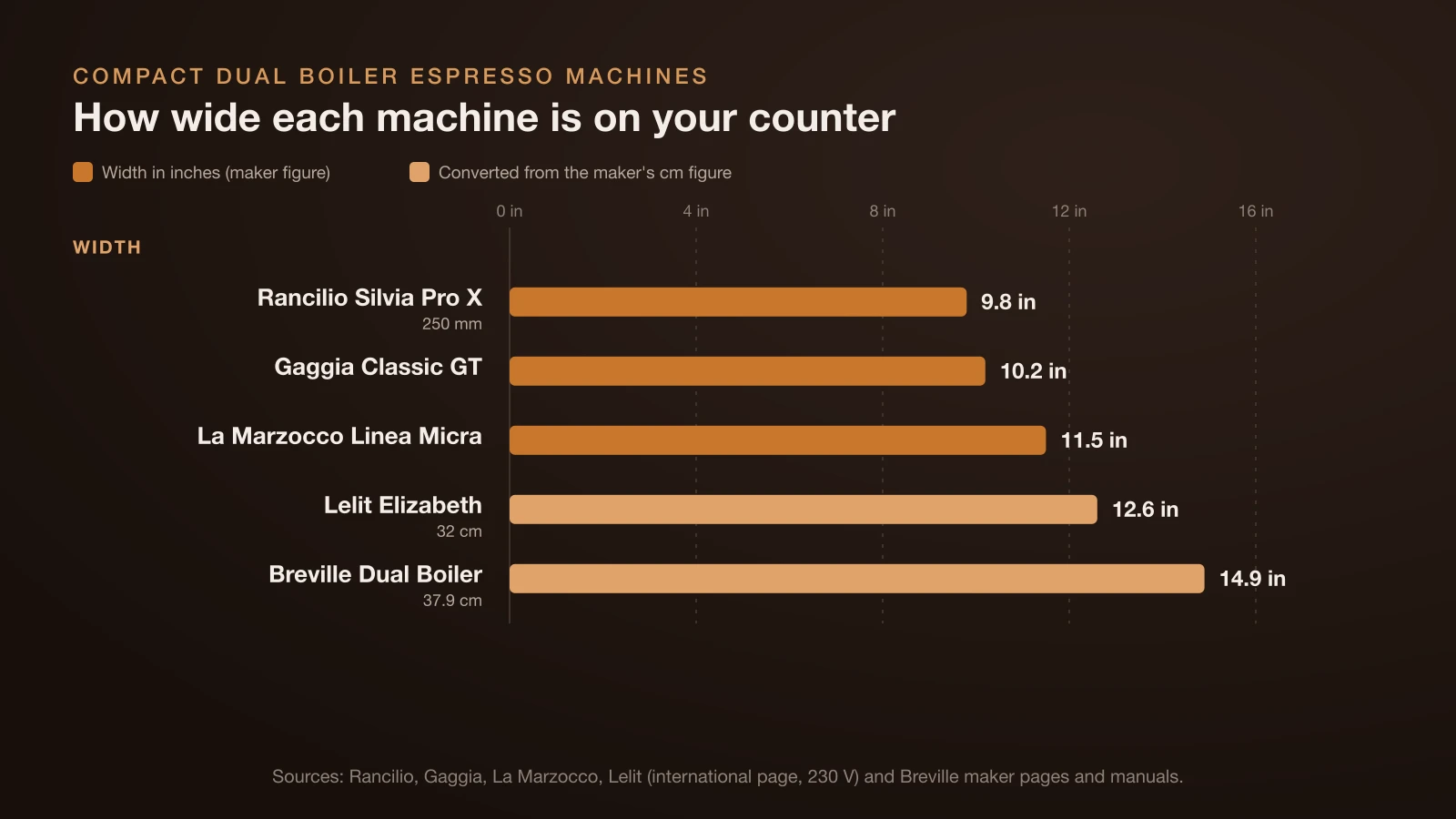
Compact dual boiler espresso machines exist, and the narrowest in the table below are about 10 in (25 cm) wide. Footprint, height under your cabinets and weight matter more than usual here, because two boilers add bulk.
| Machine | Width | Depth | Height | Weight |
|---|---|---|---|---|
| Rancilio Silvia Pro X | 9.8 in (250 mm) | 16.5 in | 15.3 in | 44.1 lb |
| Gaggia Classic GT | 10.2 in | 16.5 in | 16.7 in | 39 lb |
| La Marzocco Linea Micra | 11.5 in | 18 in | 13 in | 42 lb |
| Lelit Elizabeth | 32 cm (12.6 in) | 38 cm (15 in) | 38 cm (15 in) | 15.3 kg (33.7 lb) |
| Breville Dual Boiler | 37.9 cm (14.9 in) | 40.3 cm (15.9 in) | 37.1 cm (14.6 in) | 12.86 kg (28.35 lb) |
Lelit’s figures come from its international page, which also lists a 120 V version (PL92T-120); check that model’s specs before you buy. Leave room above the machine if its tank fills from the top, as the Silvia Pro X’s internal pour-over reservoir does.
Who needs a dual boiler, and who doesn’t
A dual boiler makes sense for people who make milk drinks back to back or want to set brew temperature precisely. If you drink one straight shot a day, its main advantage goes unused.
It suits you if you:
- make lattes or cappuccinos for two or more people at a time, and want to steam milk while the next shot runs;
- switch between light and dark roasts and want to change espresso brew temperature in small steps;
- want a machine that can keep pace with guests without a cooling flush between drinks.
A simpler machine may suit you better if you:
- drink mostly straight espresso or one milk drink a day;
- want coffee within a minute of switching on;
- have a narrow counter, low cabinets or a busy kitchen circuit;
- still need to budget for a capable grinder.
What to check before buying a dual boiler machine
Before buying a dual boiler machine, check its power draw, warm-up time, water needs and service options, because two heated boilers make these limits matter more.
- Power. Breville’s Dual Boiler draws 1,700 W and needs a dedicated circuit; Gaggia rates the Classic GT at 1,400 W, and Rancilio lists 950–1,000 W for the 120 V Silvia Pro X.
- Warm-up. Gaggia quotes about 5 minutes for the Classic GT; Breville’s manual says about 10 minutes to reach default temperature on first fill; Rancilio suggests 15–20 minutes after start-up for the best shots from the Silvia Pro X. Look for auto start or a power-on timer.
- Water. Two boilers mean two places for scale. Rancilio packs a water softener with the Silvia Pro X, and Breville uses a filter in the tank; our espresso machine water guide explains the options.
- Draining. Breville recommends draining both boilers before transport or long storage, and as a frost precaution.
- Service. Ask who repairs the machine locally; Rancilio, for example, sells through distribution partners.
If you are still weighing heating systems against everything else, our guide to the best home espresso machine covers grinders, budgets and machine types. Café machines with several groups are covered in commercial espresso machines.
The bottom line
A dual boiler espresso machine gives brewing and steaming their own boilers, so both are ready at once and brew temperature is set directly. It earns its price in homes that make several milk drinks in a row. Check power, warm-up, water care and counter space first, then compare models on each maker’s published specs and US price.
Sources
- Breville: Dual Boiler BES920 and Oracle Dual Boiler BES995 US product pages, Dual Boiler instruction book (prices, stainless steel boilers, 950 ml steam boiler, PID, heated 58 mm group, OPV, dual pumps, 9 bar, 86–96 °C range, 93 °C and 135 °C defaults, about 10 minutes on first fill, 1,700 W, dedicated circuit, draining boilers, dimensions, weight)
- Gaggia: Classic GT US store page and technical sheet, Classic Pro operating instructions (price, 0.12 L and 0.9 L boilers, dual PID, 6–12 bar OPV, 5 minute heat-up, 1,400 W, dimensions, 39 lb; 15–20 seconds to steam, 60 second limit, lowering boiler temperature)
- Rancilio Group North America: Silvia Pro X page, 2026 Home Line catalog, Silvia Pro X manual and Silvia manual (price, 0.3 L and 1 L boilers, two PIDs, soft infusion up to 6 seconds, size, weight, 950–1,000 W, water softener, 15–20 minute wait, Silvia steaming steps)
- La Marzocco and Lelit: Linea Micra US store page (price, 0.25 L and 1.6 L boilers, dimensions, 42 lb) and Lelit Elizabeth (300 ml and 600 ml boilers, LCC, 2.5 L tank, dimensions, 15.3 kg, simultaneous coffee and steam)