
An espresso machine water filter is a cartridge that sits in the tank and reduces the minerals that form scale and the chlorine that dulls flavor. Use one with fresh water of moderate hardness, replace it on the date your manual gives, usually every 2 or 3 months, and keep descaling whenever the machine asks.
Water is most of what ends up in your cup, and its minerals decide how fast scale builds inside the boiler or heater. Filters slow that process but do not stop it, so our guide on how to descale an espresso machine is the other half of the job.
The short answer
| Question | Answer |
|---|---|
| Best water | Fresh, cold tap or bottled water of moderate hardness |
| Avoid | Distilled, demineralized or reverse osmosis (RO) water with nothing added back |
| SCA(A) target | Calcium hardness 68 mg/L, total alkalinity 40 mg/L, total dissolved solids (TDS) 150 mg/L |
| Test it | Dip the strip that came with your machine and enter the level |
| Breville filter | Soak 5 minutes, set the date dial, replace every 2 to 3 months |
| De’Longhi filter | Activate under the tap, set the dial 2 months ahead, replace at 2 months |
| Still descale? | Yes, when the machine asks; remove the filter first |
Why water matters for espresso
Water matters because its dissolved minerals either leave scale in the machine or, if they are missing, can attack its metal parts. Both problems show up as shorter machine life and worse-tasting shots.
The U.S. Geological Survey defines hardness as dissolved calcium and magnesium, and notes that heating hard water forms calcium carbonate deposits. Breville’s manuals say that build-up reduces brewing flow, brewing temperature, the power of the machine and the taste of the espresso. Cooler brewing water can push shots toward sourness, while stale or chlorinated water adds its own off-notes, so check your water before you blame the beans for bitter espresso.
| Problem | Cause | What makers say |
|---|---|---|
| Scale | Too much hardness, heated over and over | Reduces flow, temperature and taste (Breville); scaling is excluded from warranty (La Marzocco) |
| Leaching | Too little mineral content | Distilled water can leach material from parts (La Marzocco) |
| Off flavors | Chlorine and odors | Carbon in the filter absorbs odors and chlorine (De’Longhi) |
The SCA water standard in plain numbers
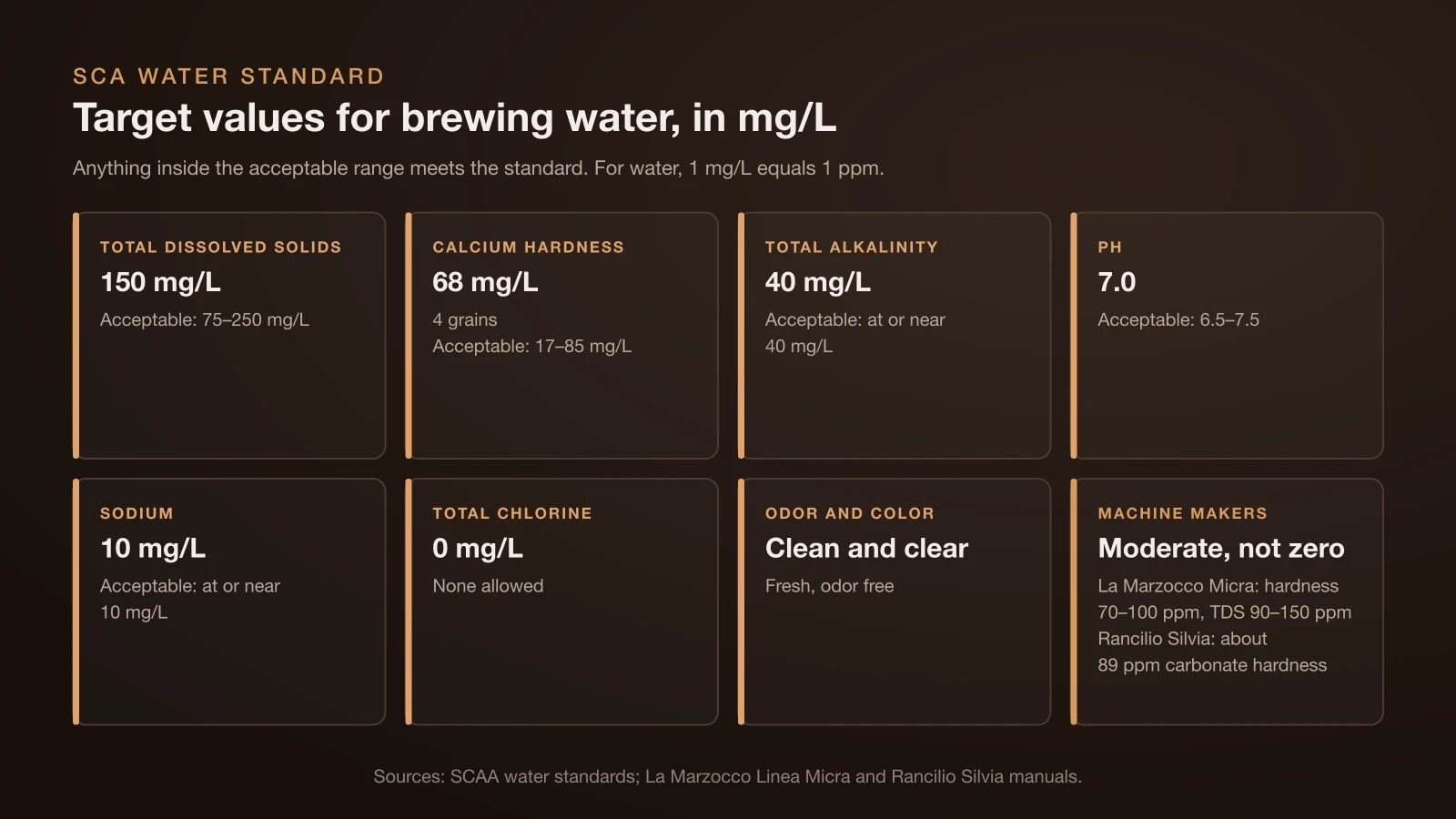
The Specialty Coffee Association (SCA) water standard, as published by its predecessor, the SCAA (archived copy from 2016), sets target values for the water used to brew specialty coffee. The target is the ideal point, but anything inside the acceptable range meets the standard.
| Characteristic | Target | Acceptable range |
|---|---|---|
| Odor | Clean, fresh, odor free | Same |
| Color | Clear | Same |
| Total chlorine | 0 mg/L | 0 mg/L |
| Total dissolved solids | 150 mg/L | 75–250 mg/L |
| Calcium hardness | 68 mg/L (4 grains) | 17–85 mg/L (1–5 grains) |
| Total alkalinity | 40 mg/L | At or near 40 mg/L |
| pH | 7.0 | 6.5–7.5 |
| Sodium | 10 mg/L | At or near 10 mg/L |
In plain terms, hardness is the scale-forming calcium, alkalinity is the water’s buffering capacity against acid, and TDS is everything dissolved in it. One mg/L is the same as one part per million (ppm) for water.
Espresso machine makers aim for a similar moderate zone. La Marzocco’s Linea Micra manual asks for total hardness of 70–100 ppm and TDS of 90–150 ppm, and Rancilio’s Silvia manual targets about 89 ppm of carbonate hardness. Neither asks for zero.
What water to use in an espresso machine
The best water for an espresso machine is fresh, cold water with some minerals left in it: filtered tap water where the tap is moderate, or bottled spring or mineral water where it is hard. The manuals agree more than they disagree.
| Water | Use it? | What the makers say |
|---|---|---|
| Tap water, filtered in the tank | Yes, if moderately hard | Breville recommends cold, filtered water |
| Bottled spring or mineral water | Yes, test the hardness first | Breville lists it for hard water areas; La Marzocco calls bottled water the easiest starting point |
| Softening pitcher water | Use with care | La Marzocco says some remove too many minerals |
| Reverse osmosis (RO) | Only with minerals added back | Breville’s Barista Touch manual says avoid it otherwise |
| Distilled or demineralized | No | Breville advises against it; La Marzocco says it can leach parts |
If your water tests at hardness 4 or 5 on a Breville strip, the Barista Touch manual strongly recommends switching to another water source. Change the water in the tank daily, as Breville’s Barista Express manual asks. The same manual says to take the tank filter out if you already use filtered or bottled water.
How to test water hardness for your machine
You test water hardness with the paper strip packed with most Breville and De’Longhi machines, then enter the result in the machine’s settings. The setting tells the machine when to ask for a new filter or a descale.
- Fill a glass with the water you will actually use.
- Dip the strip for about one second and shake it lightly.
- Wait about a minute and count the red squares.
- Enter the level. Breville’s Dual Boiler runs from Hrd1 (softest) to Hrd5 (hardest); De’Longhi machines use levels 1 to 4.
If your machine has no strip, your local water supplier can give you a hardness figure, as Rancilio’s manual suggests. Retest whenever you switch water sources, including a new bottled brand.
How espresso machine water filters work
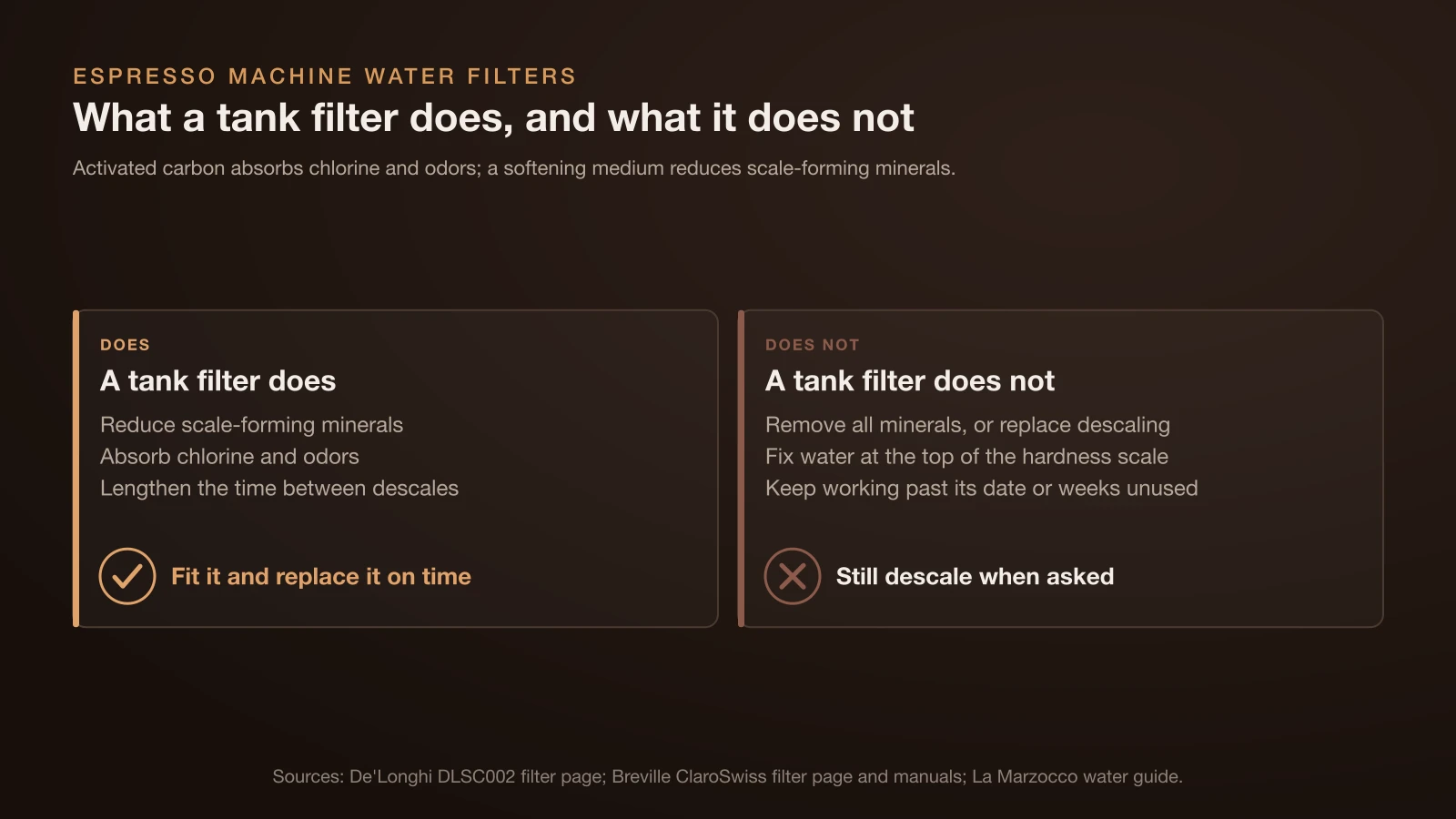
An espresso machine water filter does two jobs: activated carbon absorbs odors and chlorine, and a softening medium reduces the minerals that form scale. De’Longhi describes its DLSC002 cartridge this way, and Breville says its ClaroSwiss filter reduces chlorine, heavy metals and minerals and protects against scaling.
| A tank filter does | A tank filter does not |
|---|---|
| Reduce scale-forming minerals | Remove all minerals, or replace descaling |
| Absorb chlorine and odors | Fix water that tests at the top of the hardness scale |
| Lengthen the time between descales | Keep working past its date, or after weeks unused |
That limit matters in hard water areas. Breville’s Barista Touch manual still asks you to descale if you see scale in the tank with the filter fitted, and La Marzocco warns that softening pitchers can strip out too many minerals, so stronger filtering is not automatically better.
Breville water filter: models and replacement
The Breville water filter sits in a two-part holder inside the tank, and every Breville manual follows the same routine: soak, assemble, set the date dial and lock it in. Replacement intervals differ by model.
| Model | Replace the filter |
|---|---|
| Barista Express | Every 2 months; more often in hard water |
| Barista Pro | Every 2 months or 60 tank refills |
| Express Impress, Touch Impress | Every 3 months |
| Barista Touch, Dual Boiler, Oracle, Oracle Touch | 3 months or 10.6 US gal (40 L) at hardness level 4; 16 US gal (60 L) at level 2 |
| Bambino, Bambino Plus | No filter supplied |
To fit a new one:
- Soak the filter in cold water for 5 minutes.
- Rinse the holder and set the date dial to your replacement month.
- Assemble the filter into the two parts of the holder.
- Push it onto the adapter inside the tank until it locks, then fill the tank with cold water.
Breville’s US store lists the ClaroSwiss filter at $16.95 as of October 2026, with a 90-day replacement interval. Its product page lists the Barista Touch, Touch Impress, Dual Boiler, Oracle, Oracle Jet, Oracle Touch and Oracle Dual Boiler; it does not list the Barista Express or Barista Pro, whose manuals send you to Breville for replacement filters.
De’Longhi water filter (DLSC002)
The De’Longhi water filter DLSC002 is a softener cartridge that De’Longhi says suits all its automatic coffee makers and lets you descale 20% less often. Its US store lists one filter at $19.95 as of October 2026. The Magnifica and Dedica manuals print the same filter EAN code, 8004399327252, and on the Dedica it is an optional extra.
Installation, from the Magnifica Duo manual:
- Set the date dial to show the next 2 months.
- Activate the filter by running tap water through the center hole until it comes out of the side openings for more than a minute.
- Immerse it in the full tank and squeeze it 2 or 3 times to release air bubbles.
- Push it into its housing, refit the tank and run hot water into a 17 fl oz (0.5 L) container when the machine asks.
De’Longhi says the filter lasts about two months in normal use but no more than three weeks if the machine stands idle with it fitted. On machines with a filter setting, tell the machine when you remove it.
Water filter vs descaling: you still need both
A water filter reduces scale but does not replace descaling, and both Breville and De’Longhi still prompt for a descale with a filter fitted. Breville says replacing the filter on time reduces the need to descale; it does not say it removes it.
Always take the filter out before descaling, because Breville warns it soaks up the solution, and put it back for the final rinse. The step-by-step guides for descaling a Breville and descaling a De’Longhi show where the filter comes out and goes back in.
The cartridge is also one of the regular wear items in our map of espresso machine parts, and a machine’s scale history is worth asking about if you are shopping for used espresso machines.
The bottom line
The right espresso machine water has moderate hardness, no chlorine taste and some minerals left in it, roughly the SCA’s 68 mg/L calcium hardness target. Test your water with the supplied strip, enter the level, fit the maker’s filter and replace it on the date dial. Then descale when the machine asks, filter out first.
Sources
- Specialty Coffee Association: SCAA water standards (archived December 2016; odor, color, chlorine, TDS 150 and 75–250 mg/L, calcium hardness 68 and 17–85 mg/L, alkalinity 40 mg/L, pH 7.0 and 6.5–7.5, sodium 10 mg/L)
- Breville manuals and store: Barista Express BES870, Barista Pro BES878, Barista Touch BES880, Express Impress BES876, Dual Boiler BES920, Touch Impress BES881, Bambino Plus BES500, How to clean an espresso machine and ClaroSwiss water filter (no filter on the Bambino Plus, filter out before descaling because it soaks up the solution, scale effects, filter intervals, 5-minute soak, hardness strip and levels, RO and distilled water, $16.95, 90 days, compatible models)
- De’Longhi manuals and store: Magnifica Duo ECAM33080, Magnifica Evo ECAM29X.6Y, Dedica EC685 and water filter DLSC002 (activation, 2 months or 3 weeks idle, 0.5 L, EAN, carbon and softening, 20% less descaling, $19.95)
- La Marzocco and Rancilio: Water for home espresso machines, Linea Micra manual, home warranty and Silvia user manual (bottled water, distilled water leaching, softening pitchers, scaling and warranty, 70–100 ppm hardness, 90–150 ppm TDS, about 89 ppm, ask your water supplier)
- U.S. Geological Survey: Hardness of water (calcium and magnesium, calcium carbonate deposits when heated)