Yes, edible espresso beans are simply roasted coffee beans, and they are safe for most adults to eat in moderation. Most are sold coated in dark or milk chocolate. They carry a lot of caffeine for their size: USDA lists dark chocolate-covered coffee beans at about 12 mg per piece, so ten pieces roughly match a double shot of espresso.
There is no special “edible” variety. An espresso bean is a coffee bean roasted for espresso, as our guide to espresso beans vs coffee beans explains, and any roasted bean can be eaten plain.
This guide covers what to check when you buy them, how much caffeine and how many calories they contain, whether they give you energy and how many is a sensible amount.
The short answer
| Question | Answer |
|---|---|
| Can you eat espresso beans? | Yes, roasted coffee beans are a food |
| Caffeine, dark chocolate-covered | 839 mg per 100 g; about 12 mg per piece (USDA serving: 28 pieces = 40 g) |
| Caffeine, milk chocolate-covered | 800 mg per 100 g; about 227 mg per 1 oz (28 g) |
| Calories | About 540–550 kcal per 100 g for chocolate-covered beans (USDA) |
| Compared with espresso | About 5 dark chocolate-covered pieces ≈ one 63 mg single shot |
| Caffeine context | FDA cites 400 mg a day for most healthy adults |
| Lower-caffeine option | Decaf espresso beans |
Can you eat espresso beans?
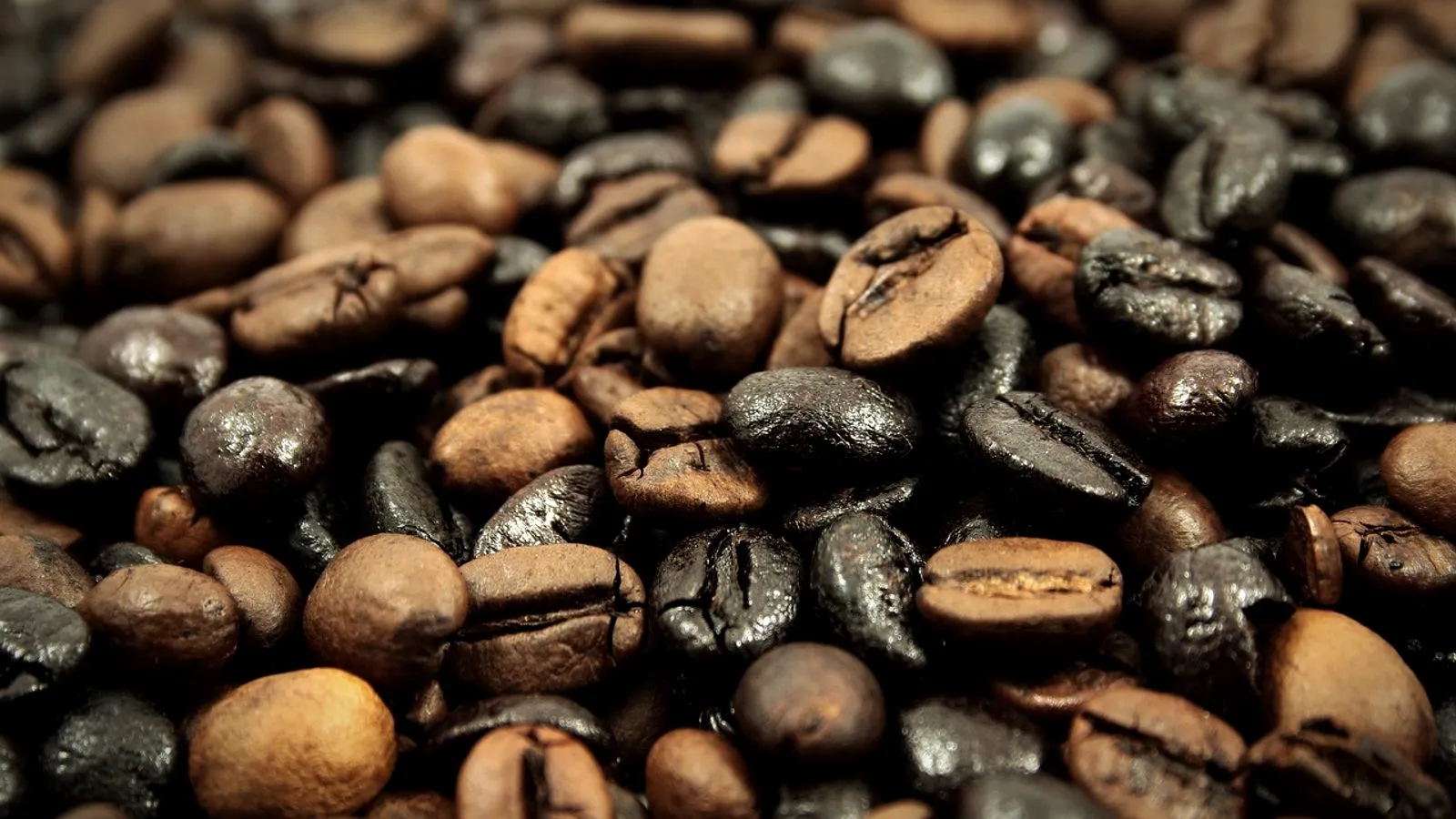
Yes, you can eat espresso beans, because they are ordinary roasted coffee beans. Roasting turns the hard green seed into a dry, brittle bean you can crunch, and the same beans you grind for a shot are the ones sold as snacks.
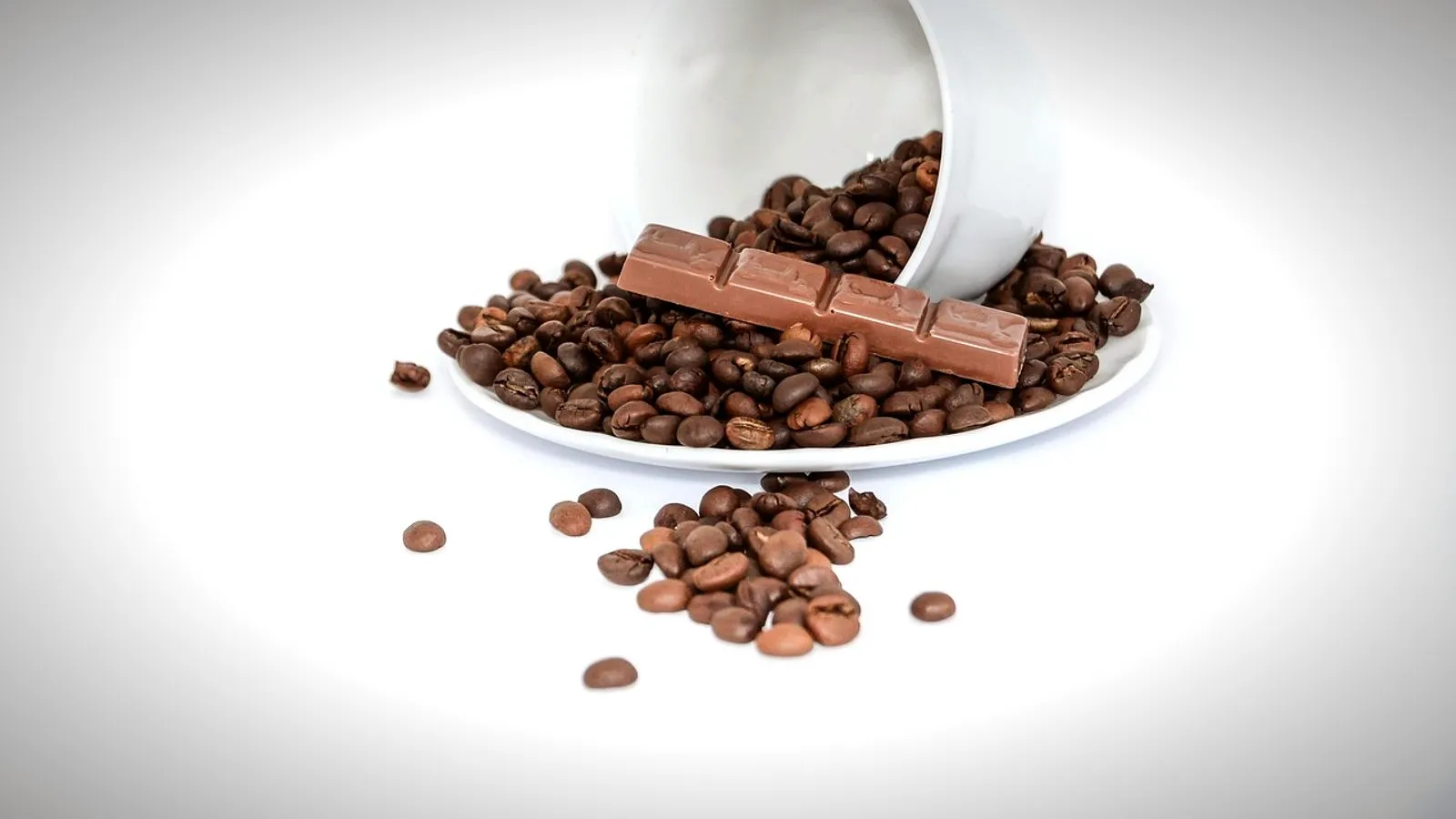
Plain beans taste intensely bitter and roasty, with a gritty texture. That is why most people eat them coated in chocolate, which balances the bitterness and adds sweetness. Darker roasts taste more bitter and less acidic; our guide to espresso roast explains how roast level changes flavor.
Unroasted green coffee is a different matter. It is very hard and is sold for roasting, not snacking.
Where to buy edible espresso beans and what to check
Edible espresso beans are sold as chocolate-covered snacks in grocery stores, candy shops and roasteries, while plain roasted beans work too. Labels vary a lot, so a quick check tells you what you are actually eating.
- Coating and cocoa content. Dark chocolate adds less sugar than milk or white chocolate. Check the sugar line on the label.
- Pieces per serving. US labels in USDA’s database list anywhere from about 14 to 30 pieces in a 40 g serving, so piece size, and caffeine per piece, can differ about twofold.
- Caffeine statement. Few labels list caffeine. Where one does, use it instead of any general estimate.
- Decaf option. Decaf chocolate-covered beans exist and cut the caffeine sharply. Our guide to decaf espresso beans explains how the caffeine is removed.
- Allergens. Milk and soy are common in chocolate coatings, and some labels warn of shared equipment with nuts.
- Not cannabis “edibles.” “Edibles” is also a common name for cannabis products, so check that the label lists only coffee, chocolate and coating ingredients.
If you want plain beans, buy the same fresh, whole espresso beans you would brew. Our espresso beans guide covers roast dates and storage.
How much caffeine is in edible espresso beans?
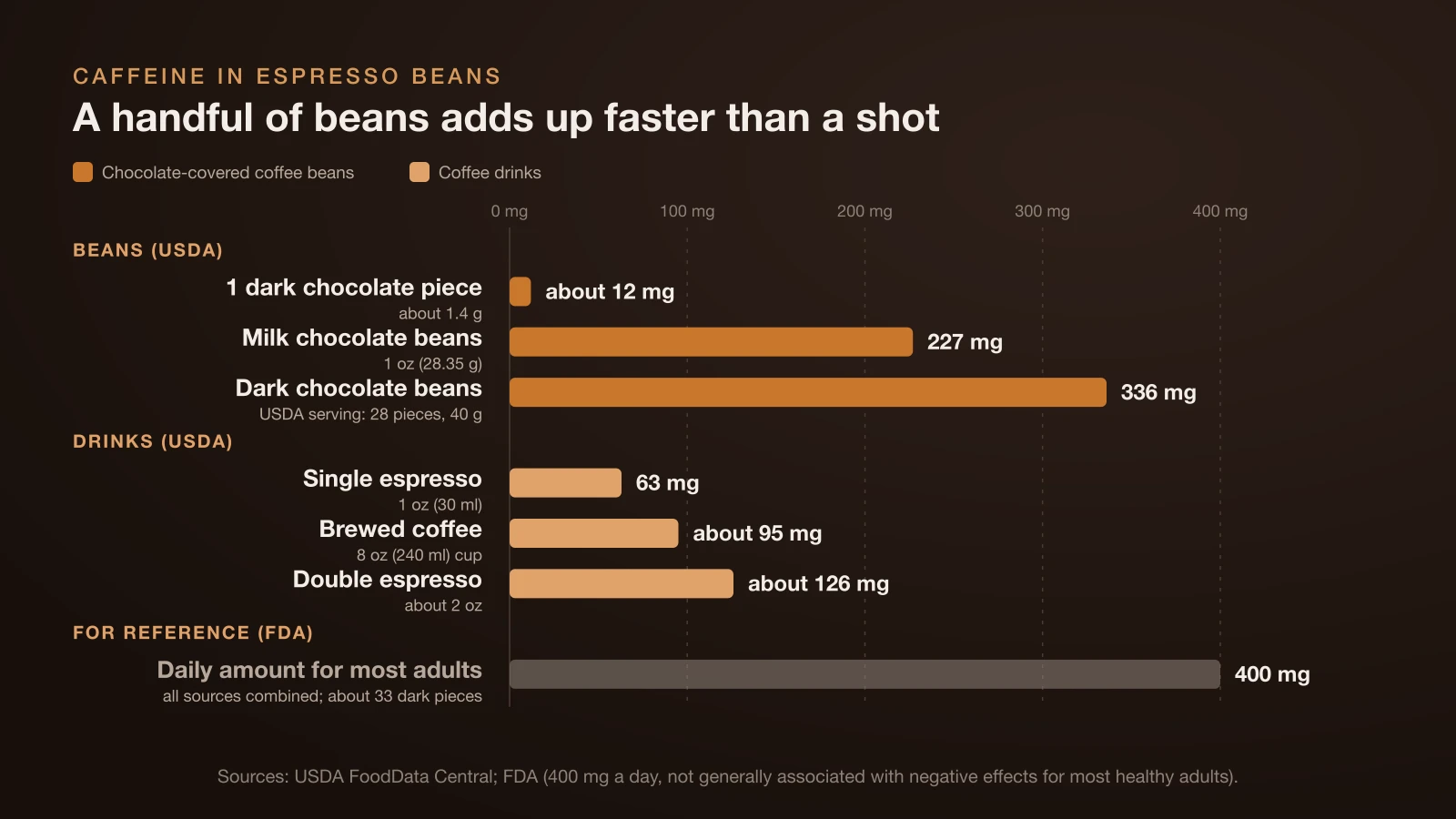
Chocolate-covered espresso beans contain about 12 mg of caffeine per piece, based on USDA data for dark chocolate-coated coffee beans. USDA lists 839 mg per 100 g and a serving of 28 pieces weighing 40 g, which gives about 1.4 g and 12 mg per piece.
| Food (USDA FoodData Central) | Caffeine per 100 g | Per serving |
|---|---|---|
| Dark chocolate-coated coffee beans | 839 mg | 336 mg per 40 g (28 pieces), about 12 mg each |
| Milk chocolate-coated coffee beans | 800 mg | 227 mg per 1 oz (28.35 g) |
| Espresso, brewed | 212 mg | 63 mg per 1 oz (30 ml) single shot |
| Brewed coffee | 40 mg | about 95 mg per 8 oz (240 ml) cup |
Plain beans have no USDA entry, so here is a labeled estimate. Lab measurements put caffeine at about 1.09% of arabica and 2.09% of robusta green beans, and caffeine stays stable during roasting. That means roughly 11 mg per gram of arabica and 21 mg per gram of robusta, a little more after roasting, since beans lose about 15% of their weight at a medium roast.
For how that compares with a brewed shot, see how much caffeine is in espresso.
Chocolate-covered espresso beans: calories and nutrition
Chocolate-covered espresso beans have about 540–550 kcal per 100 g according to USDA, which is similar to a chocolate bar. Most of the energy comes from the chocolate’s fat and sugar.
| Per 100 g (USDA) | Dark chocolate-coated | Milk chocolate-coated |
|---|---|---|
| Energy | 540 kcal | 549 kcal |
| Fat | 30 g | 33.2 g |
| Carbohydrate | 60 g | 55.3 g |
| Fiber | 7.5 g | 5.7 g |
| Protein | 7.5 g | 7.4 g |
| Sugars | 42.5 g | 50.8 g |
| Theobromine | 368 mg | 178 mg |
A USDA serving of 28 dark chocolate-covered pieces (40 g) therefore has about 216 kcal. Branded labels in the same database list roughly 450–540 kcal and 40–57 g of sugar per 100 g. Theobromine is a caffeine-related compound that comes from the cocoa, which is why the dark version has more.
Does eating espresso beans give you energy?
Eating espresso beans can make you feel more awake, because their caffeine is a stimulant. MedlinePlus, from the National Institutes of Health, says caffeine stimulates the central nervous system, which can make you feel more alert and give a boost of energy.
Timing is similar to drinking coffee. MedlinePlus notes that caffeine reaches its peak level in the blood within one hour of eating or drinking it, and the effects can last four to six hours.
The chocolate adds calories and sugar, but the “energy” you notice comes mostly from the caffeine. People also vary widely in how sensitive they are to it, so the same handful can feel very different from one person to the next.
How many espresso beans can you eat safely?
A safe amount depends on your total caffeine for the day, not on the beans alone. The FDA cites 400 mg a day as an amount not generally associated with negative effects for most healthy adults, and that includes every coffee, tea, soda and snack.
At USDA’s 12 mg per dark chocolate-covered piece, 400 mg would be about 33 pieces, before any coffee. If you already drink a double shot of about 126 mg, that leaves room for far fewer. This is general information, not medical advice.
- Watch for signs of too much caffeine. The FDA lists a fast heart rate, jitters, anxiety, sleep problems, upset stomach, nausea and headache.
- Mind your stomach. MedlinePlus notes that caffeine increases stomach acid, which can cause an upset stomach or heartburn in some people.
- Pregnancy and breastfeeding. The FDA recommends talking to a health care provider about whether to limit caffeine.
- Children and teens. The FDA notes that too much caffeine in children and teens can raise heart rate and blood pressure and lead to anxiety, sleep problems, digestive problems and dehydration.
Eating espresso beans vs drinking espresso
Eating espresso beans delivers all of their caffeine, while brewing leaves part of it behind in the spent grounds. Here is a labeled estimate: a typical double shot uses about 16–19 g of ground coffee. At about 1.09% caffeine for arabica (green-bean basis, a little more after roasting), 18 g holds roughly 196 mg, while USDA puts a double shot at about 126 mg.
So eating the coffee from one double shot would give you more caffeine than drinking it. You also eat all of the fiber and oils, while a brew leaves the fiber in the puck or filter, and a paper filter holds back most of the oils too. The taste is far more intense, which is why beans are usually eaten a few at a time.
How to eat espresso beans
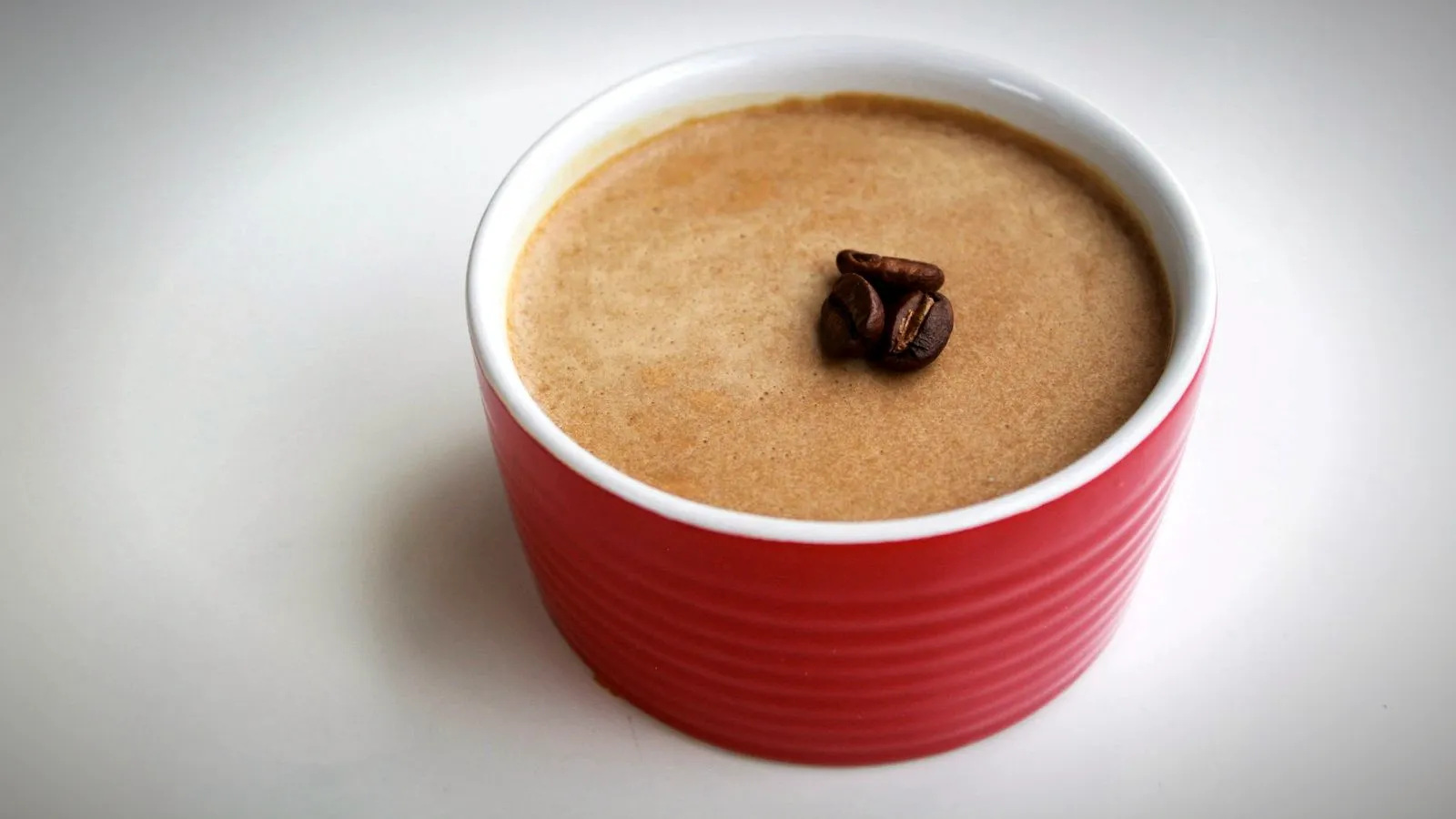
The simplest way to eat espresso beans is a few at a time as a snack, chewed slowly. Beyond that, they work well as a crunchy, coffee-flavored accent:
- Garnish drinks. Three beans on the foam of an espresso shakerato or an espresso martini is a classic finish.
- Top desserts. Crush chocolate-covered beans over ice cream, tiramisu or brownies.
- Bake with them. Chop them into cookies or muffins for bursts of coffee flavor.
- Choose decaf for evenings. Decaf beans give the taste with only a small fraction of the caffeine.
Store them airtight in a cool, dry place so the chocolate does not bloom and the beans stay crisp.
The bottom line
Edible espresso beans are just roasted coffee beans, usually coated in chocolate, and they are safe for most adults in sensible amounts. USDA data puts a dark chocolate-covered bean at about 12 mg of caffeine, so ten pieces roughly equal a double shot. Count them toward your daily caffeine, read the label for sugar and piece size, and choose decaf if you want the flavor without the buzz.
Sources
- USDA FoodData Central: Candies, dark chocolate coated coffee beans (839 mg caffeine, 540 kcal, 42.5 g sugars, 368 mg theobromine per 100 g; 28 pieces = 40 g), Candies, milk chocolate coated coffee beans (800 mg caffeine, 549 kcal, 50.8 g sugars per 100 g; 1 oz = 28.35 g), Coffee, brewed, espresso, restaurant-prepared (212 mg per 100 g), Coffee, brewed (40 mg per 100 g) and branded labels such as Milk chocolate covered espresso beans and Chocolate espresso beans (14 to 30 pieces per 40 g; calories and sugar)
- U.S. Food and Drug Administration: Spilling the Beans: How Much Caffeine Is Too Much? (400 mg a day, signs of too much caffeine, pregnancy, children and teens)
- MedlinePlus (National Institutes of Health): Caffeine (stimulant effect, stomach acid, peak within one hour, effects for four to six hours)
- Peer-reviewed studies: Biotropia, arabica and robusta green beans (1.09% and 2.09% caffeine); Ludwig et al., Food & Function (2014), caffeine stable during roasting; Caporaso et al., Food Research International (2018), single roasted beans (15.3% weight loss at a medium roast)
- Breville: Barista Express BES875 instruction book (16–19 g of coffee for a double shot)