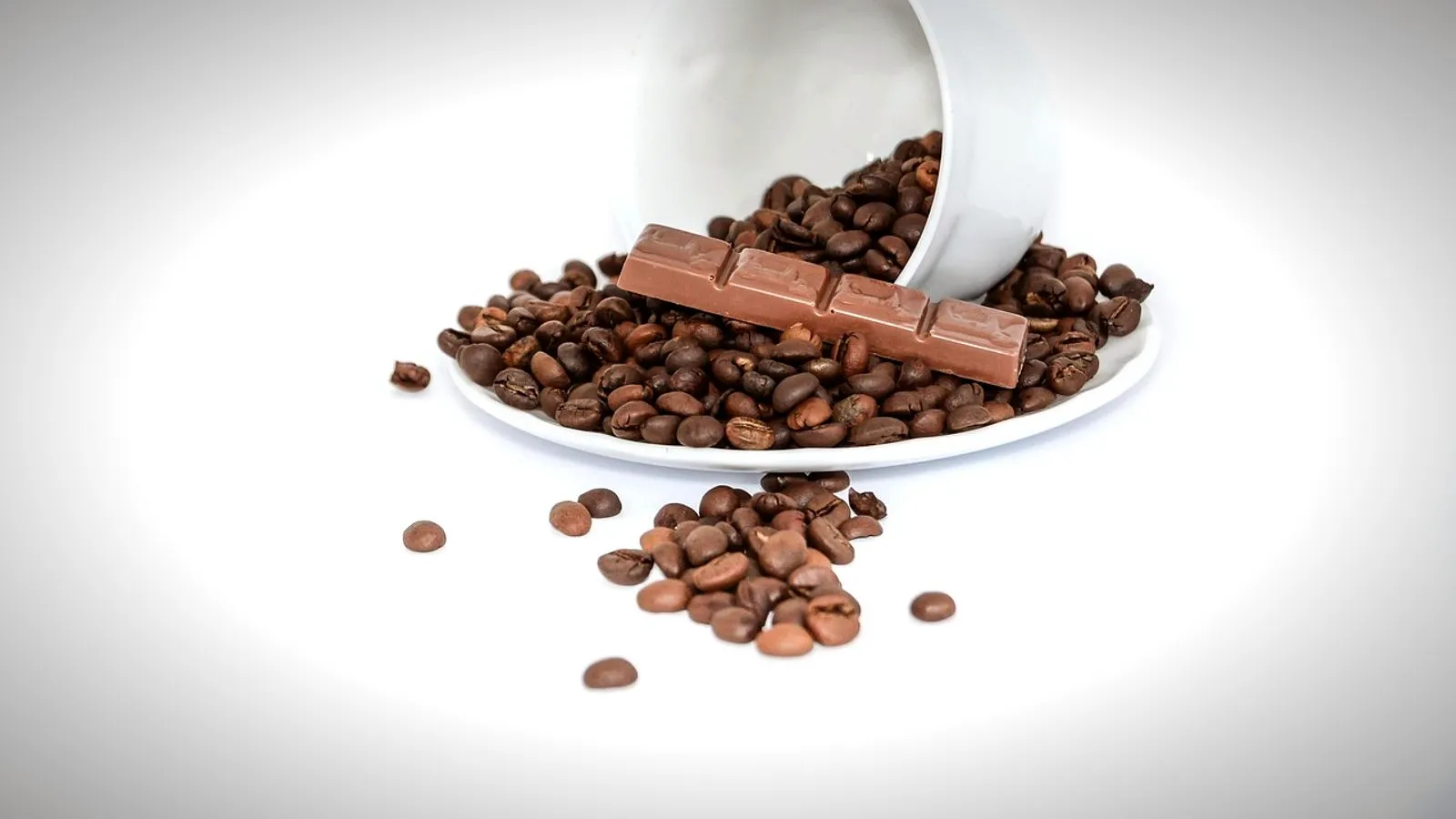
Chocolate covered espresso beans are whole roasted coffee beans coated in dark, milk or white chocolate. They taste crunchy, bittersweet and strongly of coffee, and they carry real caffeine: USDA data puts a dark chocolate-coated bean at about 12 mg. You can buy them in candy aisles and roasteries, or make them at home in an afternoon.
They are a confection built on an ordinary espresso bean, the same roasted seed you would grind for a shot. Our guide to edible espresso beans covers eating plain beans and caffeine safety in depth.
The short answer
| Question | Answer |
|---|---|
| What are they? | Roasted coffee beans in a chocolate shell |
| Caffeine | About 12 mg per dark chocolate-coated piece (USDA) |
| Calories | About 540–550 kcal per 100 g; about 216 kcal in 28 dark pieces (40 g) |
| Sugar | 42.5 g (dark) to 50.8 g (milk) per 100 g (USDA) |
| Dark vs milk | Dark: less sugar, more bitter; milk: sweeter, creamier |
| Make at home | Melt and temper chocolate, coat beans, let them set |
| Storage | Airtight, cool and dry, around 18–21 °C (65–70 °F) |
What are chocolate covered espresso beans?
Chocolate covered espresso beans are a candy made by coating whole roasted coffee beans in chocolate. The bean gives a crisp, bitter, roasted center, and the chocolate adds sweetness and fat that soften the bitterness.
Commercial versions are usually made by panning: beans tumble in a rotating pan while thin layers of chocolate are added and set one after another. Dandelion Chocolate, for example, says its partner Feve coats espresso beans in more than 20 layers of Dandelion’s 70% chocolate by hand panning. Panning gives the round, even, glossy pieces you see in candy shops.
Homemade beans are usually dipped instead, which gives a thinner, less even shell.
The beans themselves are often a darker roast, which tastes less acidic and pairs well with chocolate. Our guide to espresso roast explains how roast level changes flavor.
Where to buy chocolate covered espresso beans
Chocolate covered espresso beans are sold in most grocery stores, coffee shops and online. Common places to look:
- Grocery stores: the candy aisle, the bulk bins and the nuts and dried fruit section.
- Coffee roasters and cafés: many sell their own beans coated by a local chocolatier.
- Chocolate shops: often the best place for single-origin or high-percentage dark coatings.
- Online: from candy makers, roasters and grocery delivery services.
Labels differ more than you might expect, so check a few lines before you buy:
- The chocolate named in the ingredients. Federal standards in 21 CFR Part 163 define what can be sold as milk chocolate, semisweet or bittersweet chocolate and white chocolate. A plain “coating” may use other fats, so look for cocoa butter rather than oils such as palm kernel oil.
- Pieces per serving. Branded labels in USDA’s database list anywhere from 14 to 30 pieces in a 40 g serving, so piece size, and caffeine per piece, varies about twofold.
- Sugar per serving, especially for milk and white chocolate.
- Decaf beans, if you want the flavor in the evening. See decaf espresso beans for how the caffeine is removed.
- Allergen statements for milk, soy and nuts, since chocolate is often made on shared equipment.
Dark vs milk vs white chocolate espresso beans
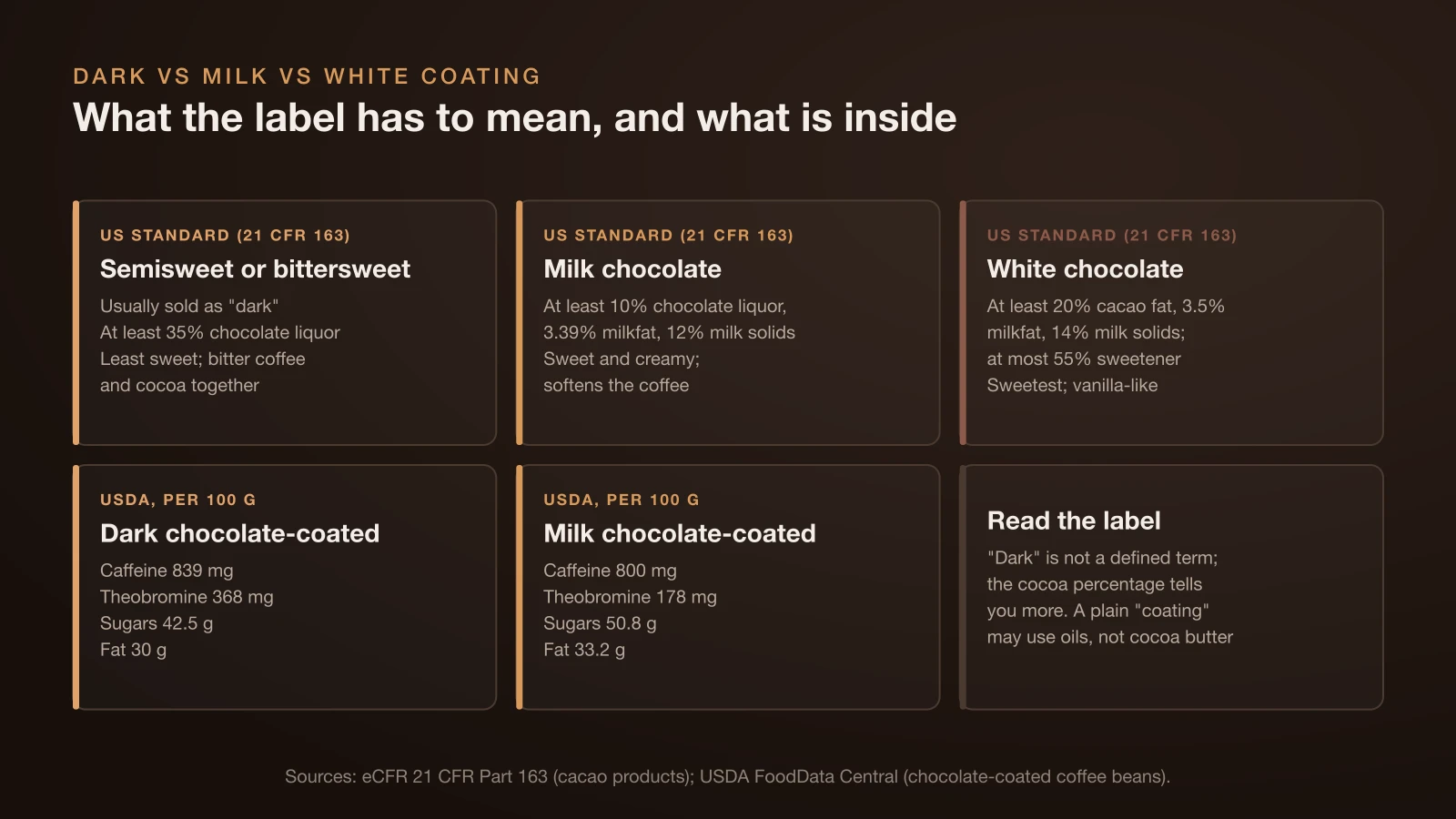
The coating changes sweetness, bitterness and nutrition more than anything else. US federal standards set minimum amounts for each type of chocolate:
| Coating | What US standards require (21 CFR 163) | Taste with coffee |
|---|---|---|
| Semisweet or bittersweet (usually sold as “dark”) | At least 35% chocolate liquor | Least sweet; bitter coffee and cocoa together |
| Milk chocolate | At least 10% chocolate liquor, 3.39% milkfat and 12% milk solids | Sweet and creamy; softens the coffee |
| White chocolate | At least 20% cacao fat, 3.5% milkfat and 14% milk solids; at most 55% sweetener | Sweetest; vanilla-like contrast to the bean |
“Dark chocolate” itself is not a defined term in those standards, so a dark coating’s cocoa percentage on the label tells you more than the word “dark.” Higher percentages taste less sweet and more bitter.
USDA’s data compares the two most common types directly:
| Per 100 g (USDA) | Dark chocolate-coated | Milk chocolate-coated |
|---|---|---|
| Caffeine | 839 mg | 800 mg |
| Theobromine | 368 mg | 178 mg |
| Sugars | 42.5 g | 50.8 g |
| Fat | 30 g | 33.2 g |
Theobromine, a caffeine-related compound, comes from the cocoa, so dark has about twice as much.
Calories and sugar in chocolate covered espresso beans
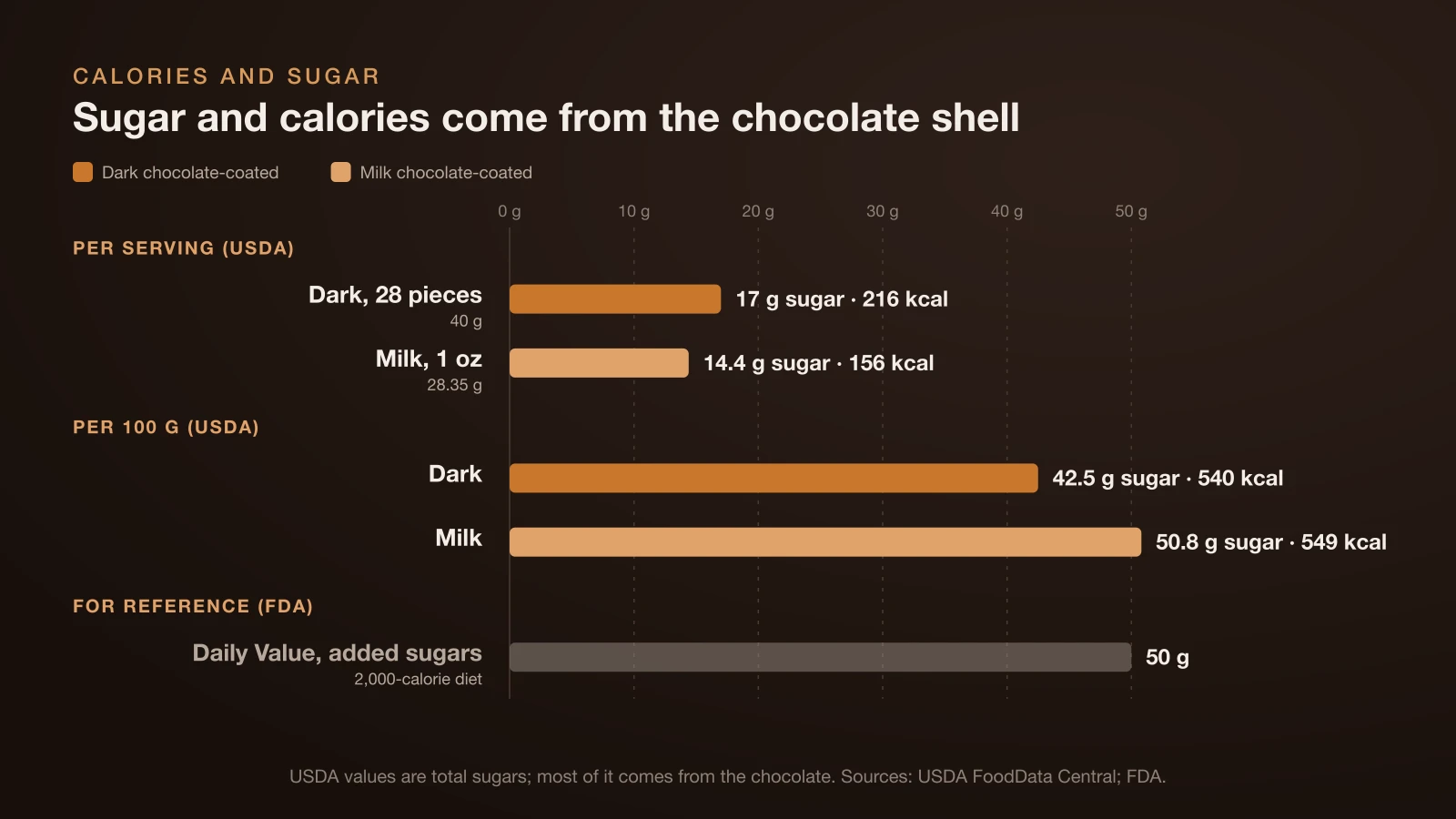
Chocolate covered espresso beans have about 540–550 kcal per 100 g, according to USDA, which puts them in the same range as a chocolate bar. Almost all of the energy comes from the chocolate’s sugar and fat, not from the coffee bean.
| Nutrient (USDA) | Dark, per 100 g | Dark, per 28 pieces (40 g) | Milk, per 100 g | Milk, per 1 oz (28.35 g) |
|---|---|---|---|---|
| Energy | 540 kcal | 216 kcal | 549 kcal | 156 kcal |
| Sugars | 42.5 g | 17 g | 50.8 g | 14.4 g |
| Fat | 30 g | 12 g | 33.2 g | 9.4 g |
| Saturated fat | 15 g | 6 g | 18.1 g | 5.1 g |
| Fiber | 7.5 g | 3 g | 5.7 g | 1.6 g |
| Protein | 7.5 g | 3 g | 7.4 g | 2.1 g |
That works out to about 8 kcal per dark chocolate-coated piece. For context, the FDA’s Daily Value for added sugars is 50 g a day on a 2,000-calorie diet. USDA’s figure is total sugar, which includes a little natural sugar from milk, but most of it comes from the sugar in the chocolate.
Brands vary: two branded labels in USDA’s database list 475 and 525 kcal per 100 g.
How much caffeine is in chocolate covered espresso beans?
A dark chocolate-coated espresso bean has about 12 mg of caffeine, based on USDA’s 839 mg per 100 g and its serving of 28 pieces in 40 g. That means about five pieces roughly match a 63 mg single shot of espresso.
The FDA’s general figure of 400 mg a day for healthy adults equals about 33 pieces with no other caffeine. For a full breakdown, safe amounts and how eating beans compares with drinking a shot of espresso, see our guide to edible espresso beans.
How to make chocolate covered espresso beans at home
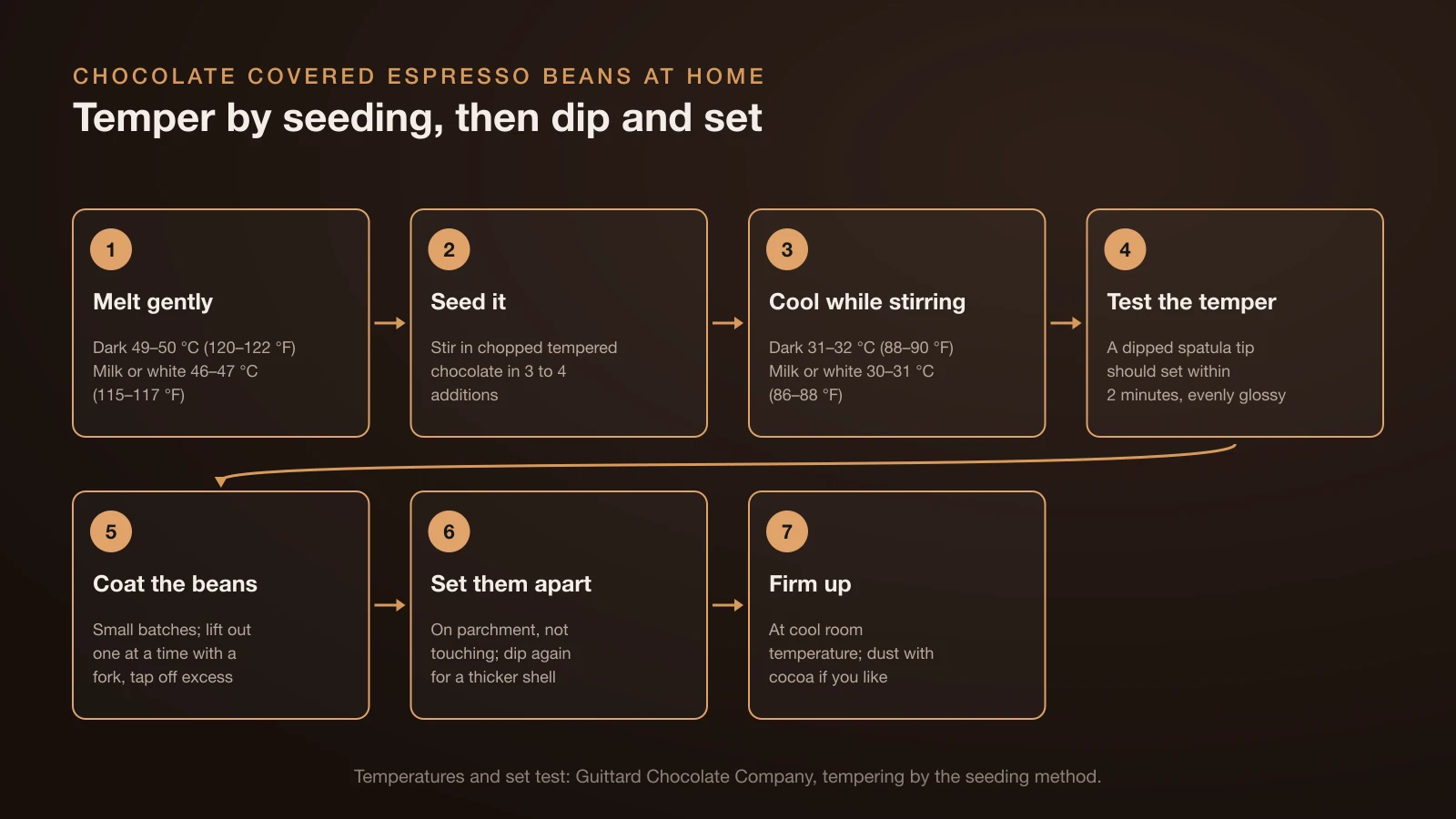
You make chocolate covered espresso beans by dipping roasted beans in melted, tempered chocolate and letting them set. Tempering is the step that makes the shell glossy and firm at room temperature. Guittard, a chocolate maker, describes it as controlled cooling with stirring so the cocoa butter forms stable crystals instead of unstable, random ones.
What you need
- Whole roasted espresso beans, fresh and dry
- Good chocolate (bars or wafers), plus a little extra, chopped, for “seeding”
- A heatproof bowl, a spatula and an instant-read thermometer
- A baking sheet lined with parchment, and a fork or dipping tool
Steps (seeding method)
- Melt the chocolate gently over barely simmering water or in short microwave bursts. Guittard’s melt temperatures are 49–50 °C (120–122 °F) for dark and 46–47 °C (115–117 °F) for milk or white.
- Seed it. Stir in the chopped tempered chocolate in 3 to 4 additions. The solid pieces add stable crystals while the mix cools.
- Cool to working temperature while stirring: 31–32 °C (88–90 °F) for dark, or 30–31 °C (86–88 °F) for milk and white, per Guittard.
- Test the temper. Dip the tip of a spatula or knife. Guittard says tempered chocolate should begin to set within 2 minutes with an even sheen.
- Coat the beans. Drop a small batch of beans into the chocolate, lift them out one at a time with a fork and tap off the excess.
- Set them apart on the parchment so they do not touch. For a thicker shell, let the first coat set, then dip again.
- Let them firm up at cool room temperature, then dust with cocoa powder if you like.
A shortcut without tempering
You can skip tempering by melting chocolate, coating the beans and chilling them until firm. The shell will be softer, can melt on your fingers and may turn dull or streaky, because the cocoa butter sets in unstable crystals. Keep this version cool and eat it within a short time. Chopped beans also make a good mix-in with espresso powder in brownies and cookies.
How to store chocolate covered espresso beans
Store chocolate covered espresso beans in an airtight container in a cool, dry, dark place. Clemson Cooperative Extension recommends keeping chocolate at 18–21 °C (65–70 °F) with relative humidity below 50–55%, and an airtight container keeps out air and odors.
- Avoid the fridge for daily storage. Clemson notes that chocolate can absorb odors and moisture there, and moisture is a cause of bloom.
- Freeze carefully if you must. University of Florida Extension advises cooling chocolate in the refrigerator for a day first, wrapping it well in an airtight freezer bag, and thawing it in the fridge for 24 hours before bringing it to room temperature. It keeps frozen for up to a year.
- Watch for bloom. A gray, dusty film makes the chocolate look dull and feel gritty.
For shelf life, Clemson gives best quality for about 2 years for dark chocolate, 1 year for milk chocolate and up to 6 months for white chocolate. The coffee inside also loses aroma over time, so commercial products often list shorter dates: Dandelion Chocolate gives its beans a shelf life of 6 months. Follow the date on your bag.
Ways to use chocolate covered espresso beans
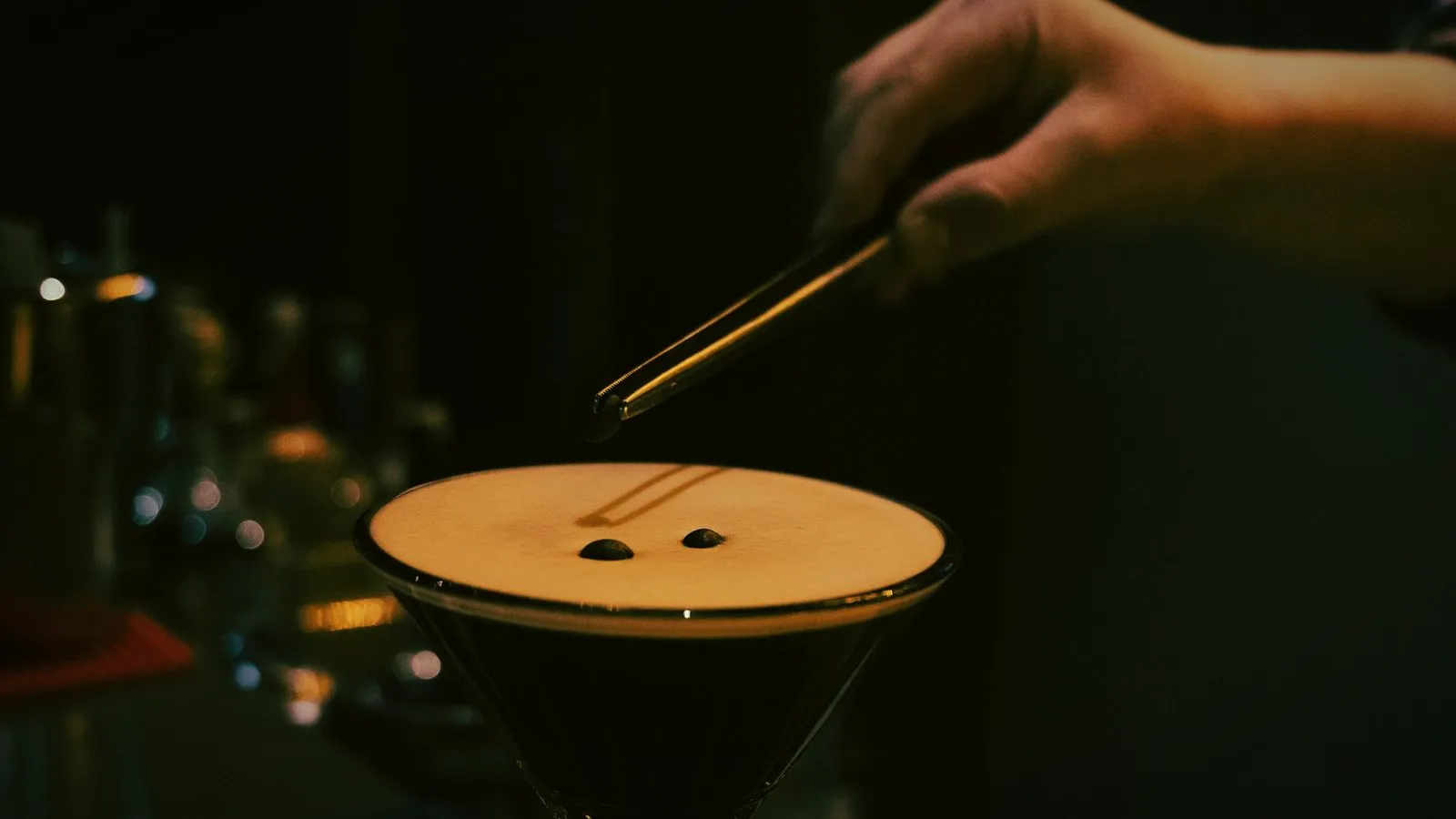
Beyond snacking, chocolate covered espresso beans work as a garnish and a baking ingredient:
- Drink garnish: three beans on a shaken espresso shakerato or an espresso martini.
- Dessert topping: chopped over ice cream, tiramisu, cheesecake or a chocolate tart.
- Baking: folded into cookies, brownies or muffins for crunchy coffee bites.
The bottom line
Chocolate covered espresso beans are roasted coffee beans in a chocolate shell, with about 12 mg of caffeine and roughly 8 kcal in a dark chocolate piece, according to USDA data. Dark coatings carry a little less sugar, while milk and white are sweeter. At home, tempered chocolate gives the best shell, and cool, dry, airtight storage keeps them glossy.
Sources
- USDA FoodData Central: Candies, dark chocolate coated coffee beans (caffeine, theobromine and nutrients per 100 g; 28 pieces = 40 g), Candies, milk chocolate coated coffee beans (per 100 g; 1 oz = 28.35 g), branded labels Milk chocolate covered espresso beans and Chocolate espresso beans (14 and 30 pieces per 40 g; 525 and 475 kcal per 100 g) and Coffee, brewed, espresso
- U.S. Food and Drug Administration: Spilling the Beans: How Much Caffeine Is Too Much? (400 mg a day) and Added Sugars on the Nutrition Facts Label (50 g Daily Value); eCFR 21 CFR Part 163, Cacao Products (chocolate standards)
- Guittard Chocolate Company: Tempering, seeding method and Chocolate fundamentals (temperatures, seeding, set test, stable crystals)
- University extension: Clemson Home & Garden Information Center, Tips for storing various forms of chocolate (temperature, humidity, fridge, shelf life); University of Florida IFAS Extension, Storing chocolate (bloom, freezing)
- Dandelion Chocolate: Chocolate-covered espresso beans (hand panning, more than 20 layers of 70% chocolate, 6-month shelf life)