
The caffeine in cappuccino comes entirely from its espresso, so it depends on the number of shots, not the cup. A single-shot cappuccino has about 63 mg of caffeine and a double about 126 mg, based on USDA espresso data. Milk and foam add none. Starbucks lists 75 mg in a Tall and 150 mg in a Grande.
Calories work the other way around: they come almost entirely from the milk. For per-shot detail, see our guide to caffeine in a shot of espresso.
The short answer
| Cappuccino | Caffeine | Calories |
|---|---|---|
| Single shot, traditional cup (100 ml milk) | about 63 mg | about 65 kcal with whole milk |
| Double shot, 12 oz café-style | about 126 mg | about 115 kcal with whole milk |
| Starbucks Tall, 12 fl oz (1 shot, 2% milk) | 75 mg | 100 kcal |
| Starbucks Grande, 16 fl oz (2 shots, 2% milk) | 150 mg | 140 kcal |
| Decaf cappuccino | usually a few mg per shot | same as regular |
| 8 oz brewed coffee, for comparison | about 95 mg | about 2 kcal |
Home figures are estimates built from USDA data, rounded; the method is shown below. Starbucks figures are its published values for standard recipes as of October 2026.
Does a cappuccino have caffeine?
Yes, every regular cappuccino has caffeine, because it is built on espresso, which is simply coffee brewed under pressure. The Istituto Espresso Italiano (IEI) certifies an Italian cappuccino as 25 ml of espresso topped with 100 ml of steamed milk. Starbucks lists only two ingredients for its version: milk and brewed espresso.
The steamed milk and foam soften the taste, which can make a cappuccino feel weaker than it is. A two-shot cappuccino carries exactly the caffeine of a straight double espresso.
How much caffeine is in a cappuccino?
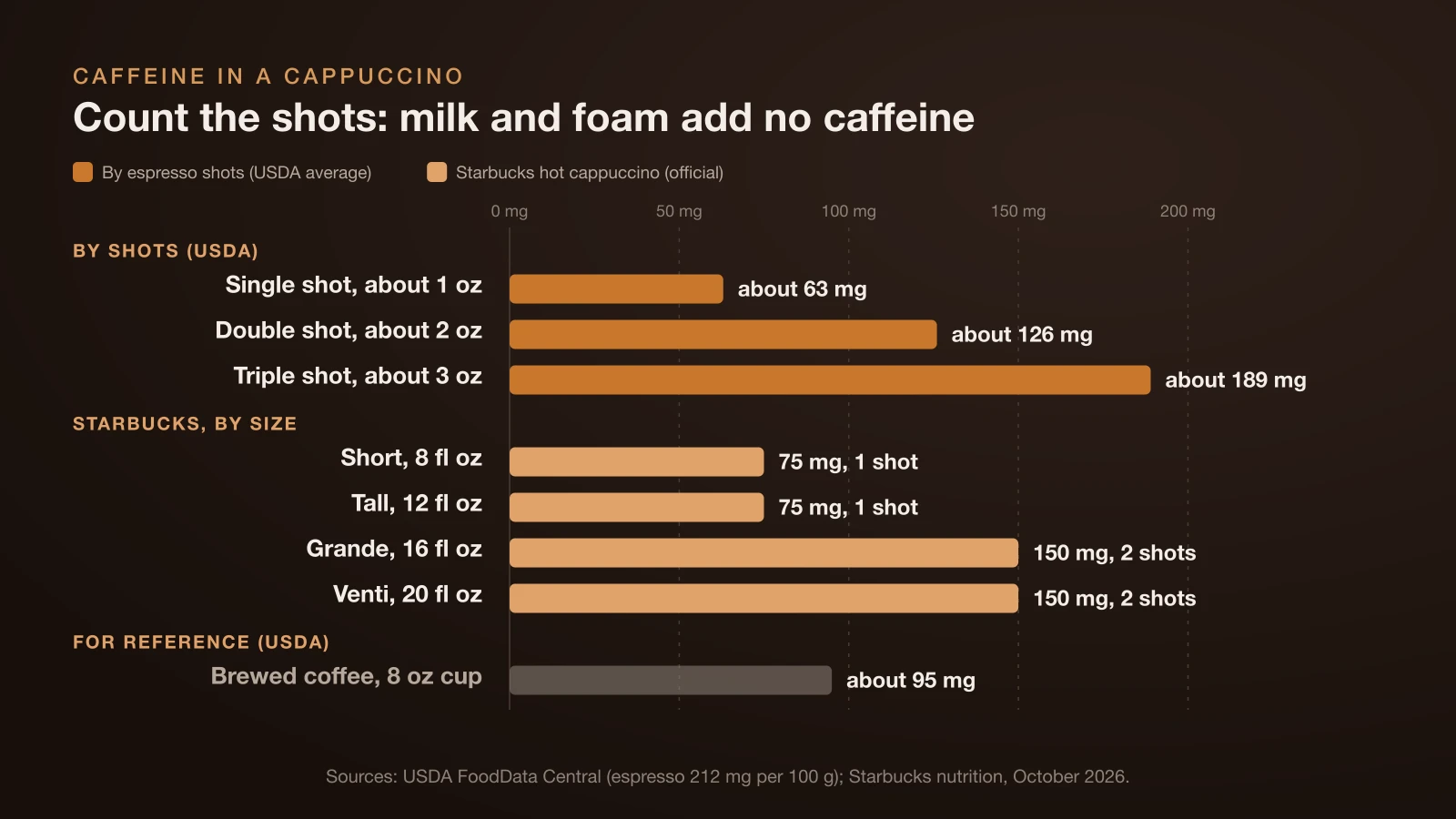
A cappuccino has about 63 mg of caffeine per average shot of espresso, so the total is the shot count times 63. USDA FoodData Central puts espresso at 212 mg of caffeine per 100 g, and a 1 oz (30 ml) shot weighs about 29.6 g.
| Espresso in the cup | Caffeine (USDA average) |
|---|---|
| Single shot (about 1 oz) | about 63 mg |
| Double shot (about 2 oz) | about 126 mg |
| Triple shot (about 3 oz) | about 189 mg |
Cup size only matters when a bigger size brings more shots. A small traditional cup and a 12 oz café cappuccino made with the same double shot both carry about 126 mg.
USDA’s reference cappuccino
USDA also lists a standard cappuccino at 36 mg of caffeine per 100 g. Its recipe uses 62 g of espresso, about a double shot, with 183 g (6 fl oz) of 2% milk and 118.5 g (4 fl oz) of water. Scaled to USDA’s own portions, that gives about 86 mg for an 8 fl oz cup (240 g) and about 130 mg for a 12 oz small (360 g).
That model keeps the espresso share fixed as the cup grows, while cafés usually keep the shot count, so count shots when you can.
Starbucks cappuccino caffeine by size
Starbucks publishes caffeine for each size of its hot cappuccino, made with its Signature Espresso and 2% milk:
| Starbucks size | Shots | Caffeine |
|---|---|---|
| Short (8 fl oz) | 1 | 75 mg |
| Tall (12 fl oz) | 1 | 75 mg |
| Grande (16 fl oz) | 2 | 150 mg |
| Venti (20 fl oz) | 2 | 150 mg |
A Venti has no more caffeine than a Grande, because both use two shots. Starbucks lists 75 mg for each one-shot size, a little above USDA’s 63 mg average. These are the same figures Starbucks lists for its Caffè Latte, as our guide to caffeine in a latte shows.
Does a cappuccino have more caffeine than coffee?
A cappuccino usually has less caffeine than the same size of brewed coffee, though a double shot beats a small cup. USDA puts brewed coffee at 40 mg per 100 g, about 95 mg in an 8 oz cup, against about 63 mg per espresso shot.
| Drink | Caffeine |
|---|---|
| Single-shot cappuccino | about 63 mg |
| 8 oz brewed coffee (USDA) | about 95 mg |
| Double-shot cappuccino | about 126 mg |
| Starbucks Grande cappuccino | 150 mg |
| Starbucks Grande Pike Place Roast (brewed) | 315 mg |
At the chain, a Grande brewed coffee has roughly twice the caffeine of a Grande cappuccino. Our full cappuccino vs coffee comparison covers taste, strength and how each is made.
Decaf cappuccino caffeine
A decaf cappuccino is low in caffeine but not caffeine-free. USDA lists its decaf cappuccino at 0 mg per 100 g, a rounded figure. In a 2006 study in the Journal of Analytical Toxicology, decaf espresso shots bought from one Starbucks outlet measured 3.0 to 15.8 mg each.
So a two-shot decaf cappuccino could hold roughly 6 to 32 mg, far below the 126 mg of a regular double. Our guide to caffeine in decaf espresso explains why decaf varies. Calories do not change, since the milk is the same.
How many calories are in a cappuccino?
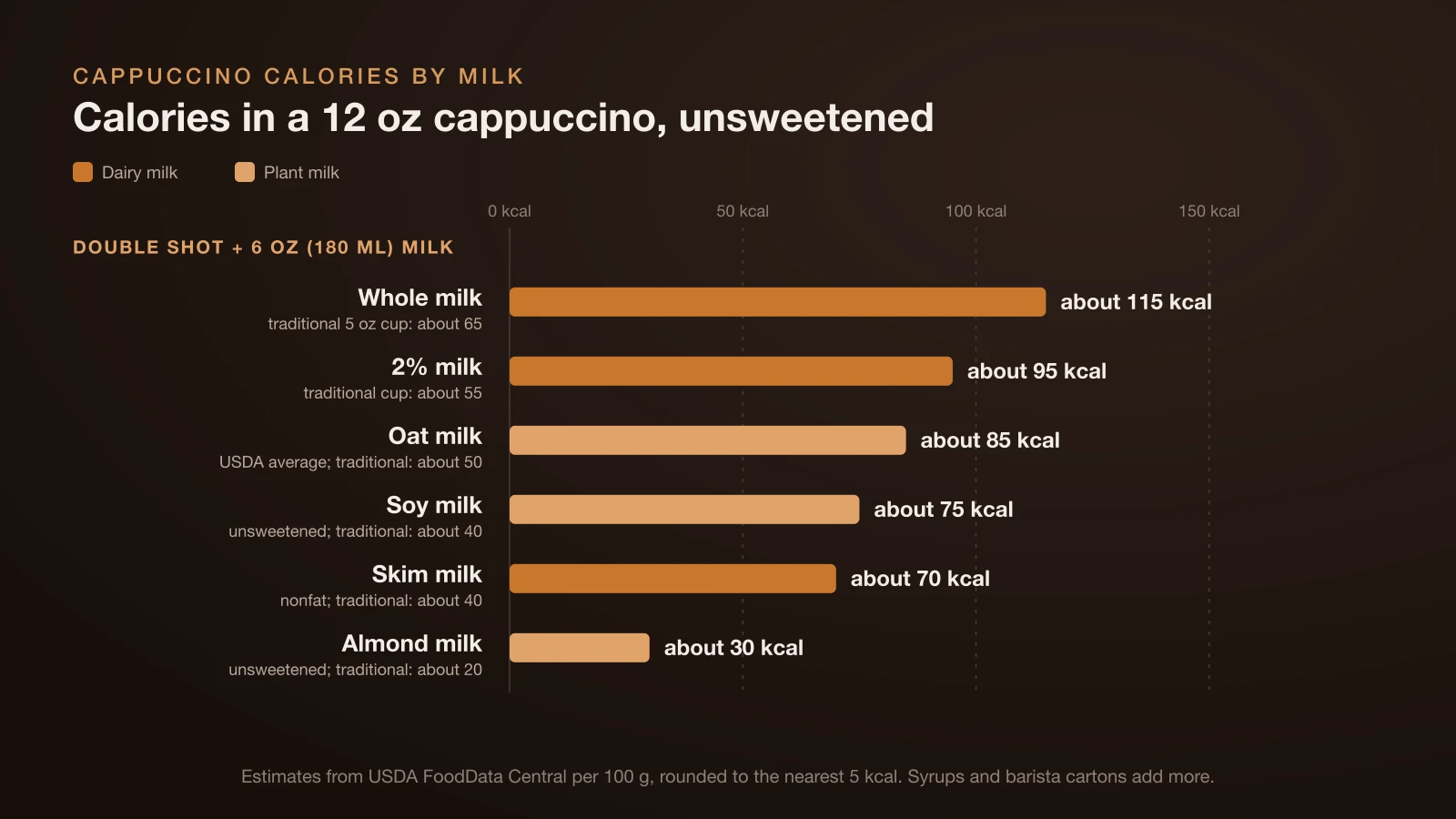
A plain cappuccino has roughly 20 to 115 kcal, depending mostly on the milk and how much of it goes into the cup. Espresso itself barely counts: USDA lists it at 9 kcal per 100 g, about 3 kcal per single shot and 5 kcal per double.
We built the estimates below from USDA values per 100 g, multiplied by two milk amounts:
- Traditional cappuccino: a single shot and 100 ml (3.4 oz) of milk, the IEI recipe.
- 12 oz café-style cappuccino: a double shot and 6 fl oz (180 ml) of milk, the milk amount in USDA’s reference cappuccino.
Dairy milk uses USDA’s weight per fluid ounce (about 30.5 g). Plant milks are assumed to weigh about 1 g per ml, the same method as our calories in a latte guide.
Cappuccino calories by milk type
Whole milk gives the highest calorie cappuccino of the common milks, and unsweetened almond milk the lowest. These are unsweetened estimates, rounded to the nearest 5 kcal:
| Milk (USDA, per 100 g) | Traditional, 100 ml milk + 1 shot | 12 oz café-style, 6 oz milk + 2 shots |
|---|---|---|
| Whole milk (61 kcal) | about 65 kcal | about 115 kcal |
| 2% milk (50 kcal) | about 55 kcal | about 95 kcal |
| Oat milk, USDA average (45 kcal) | about 50 kcal | about 85 kcal |
| Soy milk, unsweetened (38 kcal) | about 40 kcal | about 75 kcal |
| Skim (nonfat) milk (34 kcal) | about 40 kcal | about 70 kcal |
| Almond milk, unsweetened (15 kcal) | about 20 kcal | about 30 kcal |
As a cross-check, USDA’s own 2% cappuccino lists 27 kcal per 100 g, about 97 kcal for a 12 oz small, close to the 95 kcal estimate above.
Almond milk cappuccino calories
An almond milk cappuccino is the lightest option: about 20 kcal for a traditional cup and about 30 kcal for a 12 oz one, with unsweetened almond milk. The catch is the carton. Sweetened and barista almond milks often contain added sugar or oil, so check the calories per cup on your label and swap that number into the math.
Does a dry cappuccino have fewer calories?
A dry cappuccino has slightly fewer calories than a wet one of the same size, because foam is mostly air and the cup holds less liquid milk. Each ounce of whole milk left out saves roughly 19 kcal (30.5 g at 61 kcal per 100 g). Caffeine stays the same. Our guide to wet vs dry cappuccino explains how baristas change the foam.
Starbucks cappuccino calories by size
Starbucks lists its hot cappuccino, made with 2% milk and no syrup, at 70 to 200 kcal depending on size. All of the sugar is the lactose naturally present in the milk:
| Starbucks size | Calories | Sugar | Caffeine |
|---|---|---|---|
| Short (8 fl oz) | 70 kcal | 6 g | 75 mg |
| Tall (12 fl oz) | 100 kcal | 9 g | 75 mg |
| Grande (16 fl oz) | 140 kcal | 12 g | 150 mg |
| Venti (20 fl oz) | 200 kcal | 19 g | 150 mg |
Starbucks publishes values only for its standard 2% recipe, so use the milk table above for other milks.
The cappuccino is one of the lighter milk drinks on the menu. A Grande Caffè Latte, which holds more liquid milk, lists 190 kcal. A layered latte macchiato is milkier still, so expect its calories to run closer to a latte’s.
How much do syrups and sugar add?
Syrups and sugar are the biggest calorie add-on after the milk itself. Starbucks does not publish a per-pump calorie figure, but its recipes allow a fair estimate. The Grande Blonde Vanilla Latte, made with four pumps of vanilla syrup, lists 250 kcal and 35 g of sugar, against 190 kcal and 18 g for the plain Grande Caffè Latte.
That difference works out to roughly 15 kcal and 4 g of sugar per pump, our estimate rather than a Starbucks number. Starbucks adds syrup to its cappuccino at 2, 3, 4 and 5 pumps from Short to Venti, so a flavored Grande cappuccino would gain about 60 kcal.
At home, the same arithmetic applies:
- Sugar: one teaspoon (4.2 g) of granulated sugar adds about 16 kcal, per USDA.
- Bigger cup: each extra ounce of whole milk adds about 19 kcal.
How much caffeine is too much?
The FDA cites 400 mg of caffeine a day as an amount not generally associated with negative effects for most healthy adults. At average strength, that is about six single-shot cappuccinos or three double-shot cappuccinos, with no other caffeine that day.
Café shots can run stronger than the USDA average, as Starbucks’ 75 mg per shot shows. The FDA recommends that people who are pregnant, trying to become pregnant or breastfeeding talk with a health care provider about caffeine. This is general information, not medical advice.
The bottom line
The caffeine in a cappuccino is the caffeine of its espresso: about 63 mg per average shot, so most cappuccinos land between 63 and 150 mg, with Starbucks listing 75 mg for a Tall and 150 mg for a Grande. Calories follow the milk, from about 20 kcal for a small almond milk cup to about 115 kcal for a 12 oz whole milk one. Syrup is the fastest way to raise the total, and decaf the only way to cut the caffeine.
Sources
- USDA FoodData Central: Espresso, restaurant-prepared (212 mg caffeine and 9 kcal per 100 g; 1 fl oz = 29.6 g), Coffee, brewed (40 mg caffeine and 1 kcal per 100 g; 8 fl oz = 237 g), Coffee, Cappuccino and Coffee, Cappuccino, decaffeinated (36 mg and 0 mg caffeine, 27 kcal per 100 g; 62 g espresso + 183 g 2% milk + 118.5 g water; portions 240 g and 360 g), Milk, whole (61 kcal; 1 fl oz = 30.5 g), Milk, 2% (50 kcal), Milk, nonfat (34 kcal), Oat milk (45 kcal), Soy milk, unsweetened (38 kcal), Almond milk, unsweetened (15 kcal) and Sugars, granulated (387 kcal per 100 g; 1 tsp = 4.2 g)
- Starbucks nutrition, as of October 2026 (sizes, shots, pumps, calories, sugar, caffeine; standard recipes): Cappuccino, Caffè Latte, Blonde Vanilla Latte and Pike Place Roast; Oatly: Oatmilk Barista Edition (140 kcal per cup)
- Istituto Espresso Italiano: Certified Italian Espresso and Cappuccino (25 ml espresso + 100 ml steamed milk)
- McCusker et al., Journal of Analytical Toxicology (2006): Caffeine content of decaffeinated coffee (3.0–15.8 mg per decaf espresso shot)
- U.S. Food and Drug Administration: Spilling the Beans: How Much Caffeine Is Too Much? (400 mg a day)