How much caffeine is in decaf espresso? A single shot usually has between about 0.3 mg and 16 mg of caffeine. Regular espresso has roughly 63 mg per one-ounce shot. Decaf espresso is therefore low in caffeine, but it is not caffeine-free, and the exact amount depends on the beans, the decaffeination process and how the shot is made.
This guide shows the real numbers from USDA data and lab tests, explains why decaf shots vary so much, and covers what “decaf” legally means.
The short answer
| Caffeine per serving | Source | |
|---|---|---|
| Regular espresso, single (1 oz) | about 63 mg | USDA FoodData Central |
| Regular espresso, double (2 oz) | about 126 mg | USDA FoodData Central |
| Decaf espresso, single (1 oz) | about 0.3 mg (lab average) | USDA FoodData Central |
| Decaf espresso, café shot | 3–15.8 mg | McCusker et al., 2006 |
| Decaf drip coffee, 8 oz | 2–15 mg | FDA |
How much caffeine is in a shot of decaf espresso?
There are two good sets of numbers, and they tell slightly different stories.
The USDA average. USDA FoodData Central lists restaurant-prepared decaf espresso at 1 mg of caffeine per 100 g. A one-ounce shot weighs about 29.6 g, so that is roughly 0.3 mg per shot. This is a laboratory average for one set of samples.
Real café shots. A 2006 study in the Journal of Analytical Toxicology bought decaf espresso from a large coffee chain and tested it. Six single shots from one store contained 3.0 to 15.8 mg of caffeine each. The same study found decaf brewed coffee from other shops ranging from 0 to 13.9 mg per 16-ounce cup.
For planning purposes, assume a decaf shot has a few milligrams, and occasionally up to about 16 mg. That is a large drop from regular espresso, but not zero.
Decaf vs regular espresso: caffeine compared
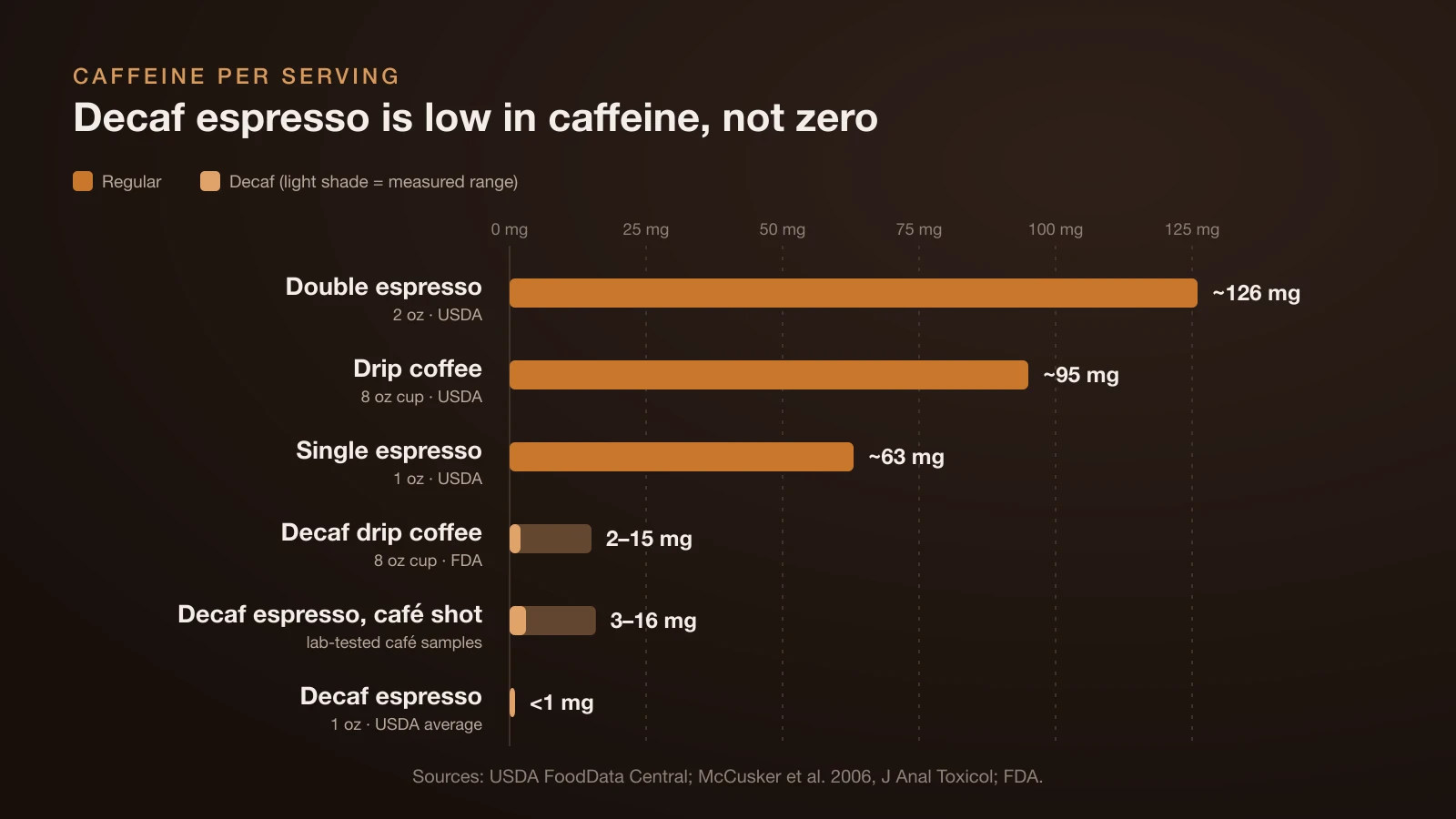
USDA data puts regular espresso at 212 mg of caffeine per 100 g, which is about 63 mg in a one-ounce shot and 126 mg in a double. Even the highest decaf shot in the 2006 study, 15.8 mg, has about a quarter of the caffeine of a regular single. A typical decaf shot has far less. For the full range in regular shots and why it varies, see how much caffeine is in a shot of espresso.
Compared with a cup of coffee, a regular single espresso actually has less caffeine than an 8-ounce mug of drip coffee (about 95 mg). Espresso is stronger per ounce, not per serving. We cover that difference in detail in espresso vs coffee.
Is decaf espresso completely caffeine-free?
No. The FDA says it plainly: “decaffeinated” does not mean caffeine-free. According to the FDA, decaf coffee typically has 2 to 15 mg of caffeine in an 8-ounce cup.
Decaffeination is done on green, unroasted beans. Whether the process uses water, carbon dioxide or a solvent, it removes most of the caffeine but leaves a small amount behind. How much of that remainder reaches your cup still varies with the beans, the batch and the way the shot is pulled.
If you need to avoid caffeine entirely, decaf espresso is not the right choice. For most people cutting back, it removes the great majority of it.
What “decaf” legally means
This is where many articles get it wrong.
In the United States, there is no FDA rule that sets a percentage of caffeine that must be removed. The often quoted “97% removed” figure is an industry description: the National Coffee Association says decaffeination “typically removes around 97%” of the caffeine. It is a useful rule of thumb, not a legal standard.
In Germany, the law is specific. Decaffeinated roasted coffee may contain at most 0.1% caffeine in dry matter. Bavaria’s food safety authority tested 326 decaf samples between 2022 and October 2025, and only three exceeded the limit.
For you as a buyer, this means the label “decaf” guarantees a large reduction, not a precise number.
Why decaf shots vary so much
Several things change the caffeine in a decaf shot:
- The bean species. Robusta naturally has about twice as much caffeine as arabica before decaffeination, so a robusta decaf can start with more to remove. See espresso beans vs coffee beans for how species and roast differ.
- The decaffeination process and batch. Each process and each batch leaves slightly different amounts behind. Read more in our guide to decaf espresso beans.
- The dose. A double shot often uses 18 g of coffee or more, twice a single. More coffee means more caffeine.
- Extraction. A longer shot, a finer grind or a longer contact time pulls out more of what caffeine is left.
- Mixed equipment in cafés. A grinder that just ground regular beans can leave a little regular coffee in the next decaf dose.
Differences like these are one reason café shots can test higher than a lab average.
How much caffeine is in 2 shots of decaf espresso?
Multiply by two. A decaf double contains roughly 0.6 mg at the USDA average and up to about 30 mg at the top of the café range from the 2006 study. Most doubles will land at the low end of that range.
For comparison, a regular double espresso has about 126 mg. Even a high-end decaf double removes roughly three-quarters of that caffeine.
Decaf espresso drinks: lattes, cappuccinos and Americanos
Milk and water add no caffeine. A decaf drink contains only the caffeine from its decaf shots:
- Decaf latte or cappuccino with two shots: the same as a decaf double.
- Decaf Americano: the same as the decaf shots in it, however much water is added.
- Mocha: decaf shots plus a little caffeine from the chocolate. Cocoa naturally contains some caffeine.
If you want to know what goes into each drink, see our types of espresso drinks chart.
How to keep caffeine as low as possible
If you drink decaf for the evening or for health reasons, a few habits keep the total down:
- Choose a 100% arabica decaf. It starts with less caffeine than a blend containing robusta.
- Buy from a roaster that names the process (for example Swiss Water or CO2) and ideally publishes a caffeine figure.
- Make singles instead of doubles when you want the least caffeine per drink.
- Grind decaf on a clean grinder, or purge a few grams first if the same grinder also handles regular beans.
- Count every shot in milk drinks. A large latte with three shots has three shots’ worth of decaf caffeine.
Who should pay attention to the leftover caffeine?
For healthy adults, the FDA cites 400 mg of caffeine a day as an amount not generally associated with negative effects, which is roughly two to three 12-ounce cups of regular coffee. A few decaf shots barely register against that.
People who have been told to limit caffeine closely, including during pregnancy or with certain medical conditions, should count decaf too and ask their doctor what total is right for them. This article is general information, not medical advice.
The bottom line
A decaf espresso shot usually contains a few milligrams of caffeine, with lab tests of café shots reaching about 16 mg, compared with about 63 mg in a regular shot. That is a large reduction, not zero. If you want a very low-caffeine espresso, choose a reputable decaf, keep to single or double shots and remember that the milk in a latte adds none.
Sources
- USDA FoodData Central: Coffee, brewed, espresso, restaurant-prepared, decaffeinated and Coffee, brewed, espresso, restaurant-prepared (caffeine per 100 g)
- McCusker, Goldberger and Cone, Journal of Analytical Toxicology (2006): Caffeine content of decaffeinated coffee
- U.S. Food and Drug Administration: Spilling the Beans: How Much Caffeine Is Too Much?
- National Coffee Association: Decaf coffee
- Bavarian State Office for Health and Food Safety (LGL): Decaffeinated coffee testing (German legal limit and test results)